The Complete Guide to Sweaters: History, Styles & How They're Made
May 06, 202629 min read
The sweater is one of the most familiar garments in any cold-weather wardrobe, yet few people ever stop to consider where it came from or how it's actually made. Behind its simple, comforting warmth lies a history that stretches back to fishermen battling icy winds on open boats, a design language of stitches and patterns passed down through generations and a manufacturing process that combines centuries-old craft with precise modern engineering.
Sweater
If you open almost any closet in a cold-weather country, you'll find a sweater tucked somewhere inside it — draped over a hanger, folded on a shelf or balled up in the back of a drawer waiting for the first chilly morning of autumn. It's one of those garments that feels so ordinary we rarely stop to think about it. Yet the sweater has a surprisingly rich backstory, a genuinely clever construction and a manufacturing process that blends old-world craftsmanship with some seriously precise modern engineering. This guide walks through all of it: what a sweater actually is, where it came from, the many forms it takes today and the behind-the-scenes work that turns a cone of yarn into the thing you pull over your head on a cold day.
What Exactly Is a Sweater?
At its core, a sweater is a knitted garment worn on the upper body — a simple definition that hides a lot of variety. Depending on where you live, you might not even call it a "sweater." Common regional names include:
Jumper — the standard term in the UK and much of the Commonwealth
Jersey — common in regions with strong Jewish or European knitwear traditions
Pullover / woolen — older terms still used by some generations
Cardigan — the name reserved for sweaters that open down the front
Whatever you call it, the appeal is the same: sweaters trap warm air in their loops of yarn, making them cozier than a woven shirt of similar thickness and they have a soft, stretchy feel that woven fabrics can't easily replicate.
Sweaters were originally made almost exclusively from wool, since wool fibers are elastic, trap air well and hold their shape and warmth even when damp. Today the fiber options have expanded enormously — cotton, acrylic, cashmere blends, recycled polyester and plant-based fibers like TENCEL™ lyocell are all common. "Sweater" has really become a category rather than a description of one specific fabric.
The History of the Sweater
To understand why sweaters look and feel the way they do, it helps to know where they came from — and the answer is decidedly unglamorous. Sweaters weren't invented as a fashion statement; they were invented because fishermen needed to survive freezing winds and icy spray on open boats.
Born on the Water
Long before knitwear appeared on runways, coastal communities across Northern Europe hand-knitted heavy wool garments for men who spent their days hauling nets in brutal weather. The wool was often left partially unwashed, retaining natural lanolin that gave the finished garment a degree of water resistance — something that mattered enormously when your job depended on staying warm in an open, unheated boat.
The Aran Islands and Their Legendary Patterns
Nowhere is this fishing heritage more famous than the Aran Islands, off Ireland's rugged west coast. Aran sweaters are known for their dense, raised cable-knit patterns that twist and braid across the chest and sleeves like rope. These patterns weren't purely decorative — each motif was believed to carry meaning:
Cable patterns — represented a fisherman's ropes and hopes for a safe, successful catch
Honeycomb stitches — tied to the industriousness of bees and a sweet, well-earned life
Diamond patterns — thought to symbolize wealth, small fields or good fortune
The patterns became a visual language passed down within knitting families and in some (probably exaggerated) folklore accounts, a drowned fisherman could be identified by his sweater's stitch pattern. Folklore aside, producing that level of dense, structured cable work by hand — stitch by stitch, with nothing but needles and wool — represents an extraordinary amount of skill, which is part of why Aran knitwear is still prized today.
From Workwear to Wardrobe Staple
For a long time sweaters stayed firmly in the "practical clothing" category, worn by fishermen, farmers and laborers rather than for show. That began to shift in the twentieth century as knitwear crept into leisurewear and then high fashion: preppy cable-knits became an Ivy League symbol mid-century, chunky oversized knits dominated the 1980s and in the early 1990s grunge culture flipped the sweater's image entirely. Musicians like Kurt Cobain wore huge, deliberately baggy, often thrifted cardigans as an anti-fashion statement — turning a garment invented for warmth on a fishing boat into a symbol of rebellious cool and later a red-carpet staple reinterpreted by luxury design houses.
Today sweaters occupy every point on the spectrum, from functional base layers worn under a ski jacket, to hand-finished cashmere pieces that cost more than a plane ticket, to fast-fashion basics priced like a sandwich. The thread connecting all of them is the knitting itself.
The Many Types of Sweaters
Crewneck Sweater
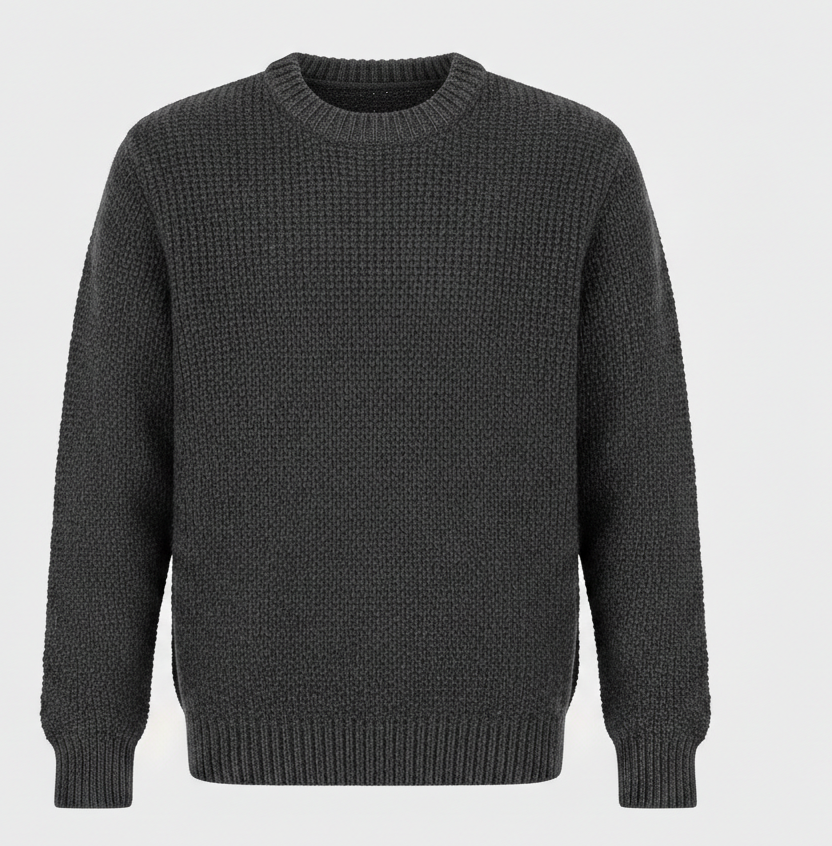
The crewneck is about as close to a "default" sweater as you can get. It has a simple, round neckline that sits close to the base of the neck without any collar or opening. Because it's so neutral, it works in almost any context — thrown over a t-shirt for a weekend errand, layered over a button-down for a business-casual office or worn on its own for something a little dressier. If you asked someone to picture "a sweater" without any other description, there's a good chance they'd picture a crewneck.
Crewneck Sweater
V-Neck Sweater
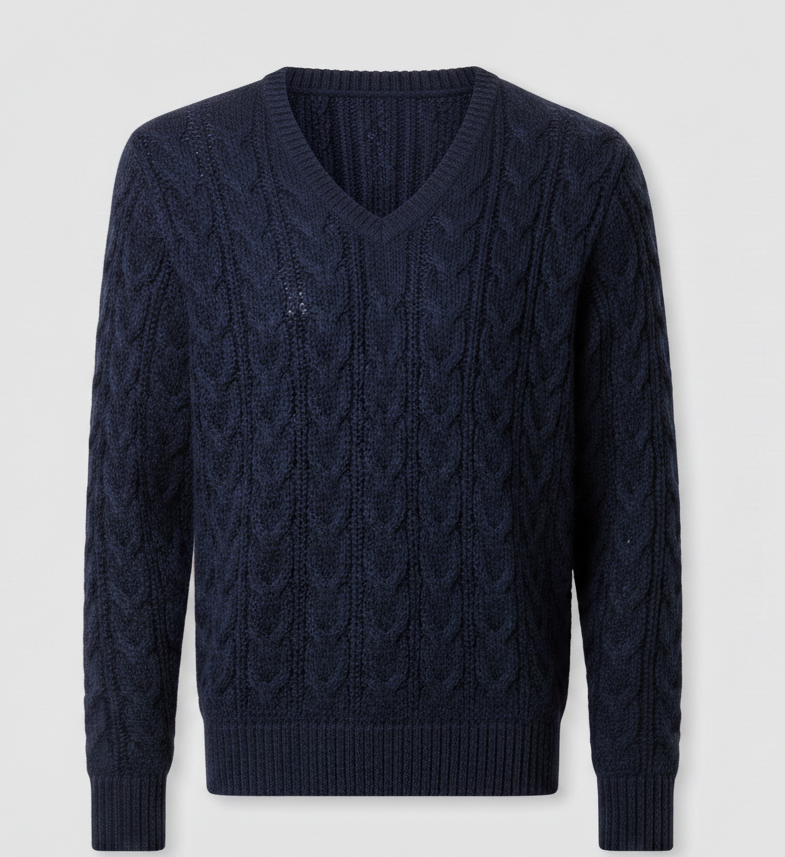
Swap that round collar for a V-shaped dip at the chest and you get a V-neck sweater. The V-neck exists largely to solve a layering problem: it lets you wear a collared shirt or a tie underneath without the sweater's neckline crowding it out. That's why V-necks are so common in office settings, school uniforms and golf apparel. The open V also has a slimming visual effect for some body types, which is part of why it remains a popular choice even outside of layering scenarios.
V-Neck Sweater
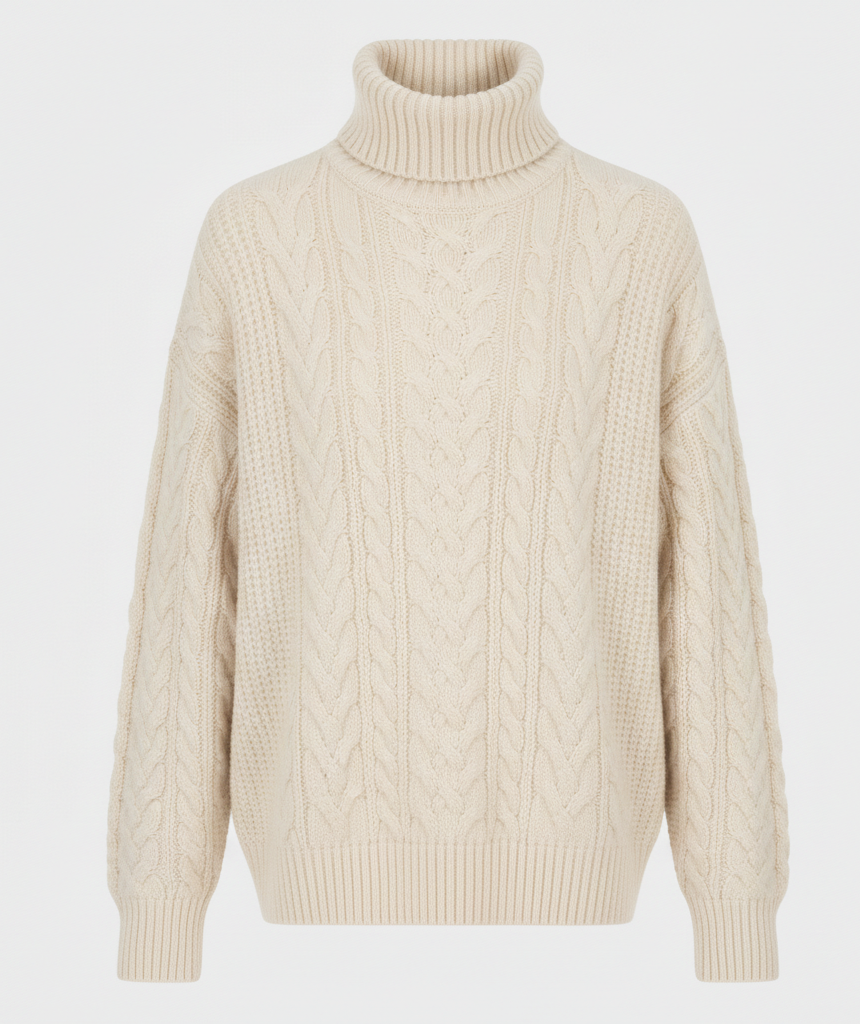
Turtleneck Sweater
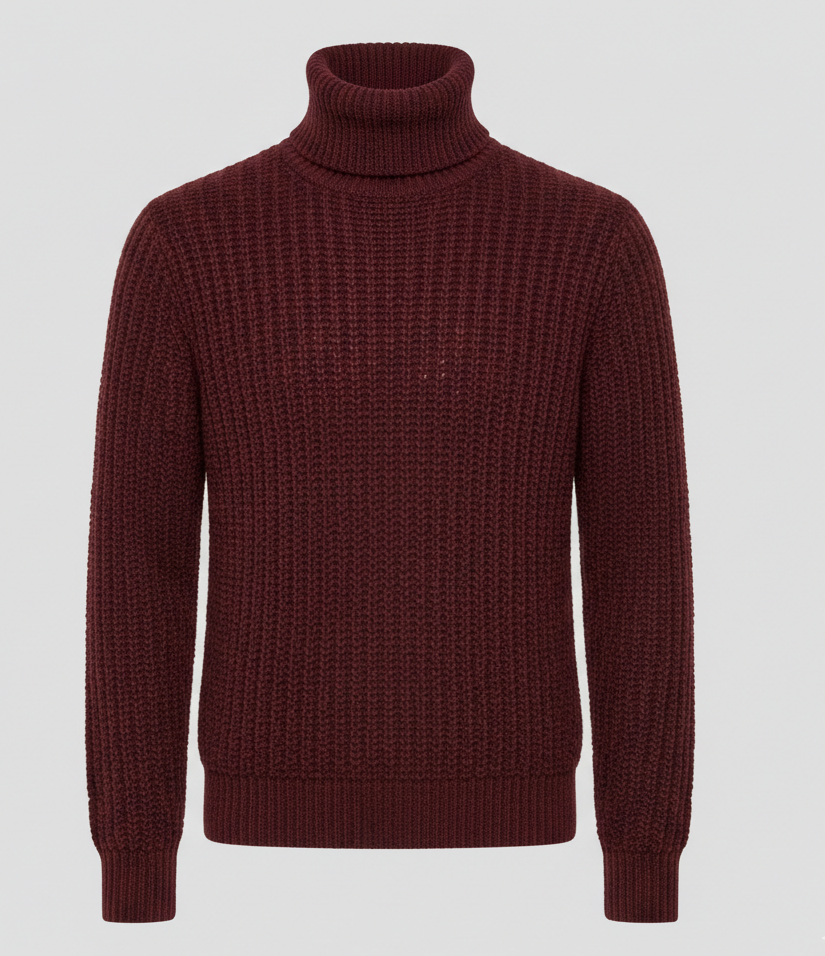
At the opposite end of the spectrum from the V-neck sits the turtleneck, which does the exact opposite job. Instead of opening the neckline up, it closes it off almost completely with a high, snug collar that folds over on itself. Turtlenecks trap heat around the neck and throat far more effectively than any other sweater style, which makes them a favorite for genuinely cold climates. They also carry a certain understated sophistication — think of the "minimalist intellectual" aesthetic often associated with turtlenecks in film and fashion photography. Functionally, they're also handy under a jacket, since the collar itself does double duty as a scarf.
Turtleneck Sweater
Cardigan
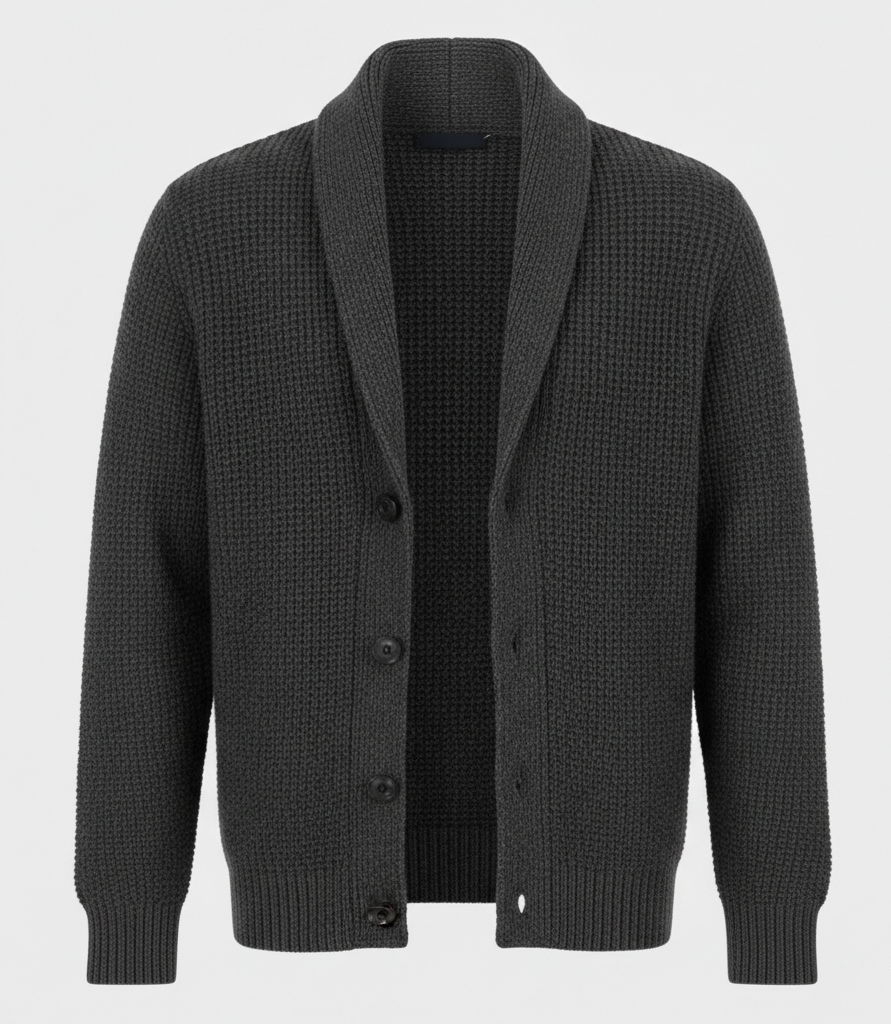
The cardigan breaks from the pullover format entirely. Instead of being a closed tube you pull over your head, it opens fully down the front, usually fastened with buttons, snaps or a zipper. That open-front design makes cardigans incredibly practical as a layering piece — you can put one on or take it off without disturbing your hair or whatever you're wearing underneath and you can adjust your warmth throughout the day just by doing up or undoing a button.
Cardigans have swung between "cozy grandparent" associations and genuine high fashion more than any other sweater style. As mentioned earlier, the oversized, often distressed cardigan became a defining piece of 1990s grunge fashion, largely thanks to musicians like Kurt Cobain, who wore them loose, unbuttoned and visibly worn-in. That single stylistic choice helped push the cardigan out of the "your grandfather's cozy sweater" category and into something edgier and more culturally loaded and its influence is still visible in fashion today.
Cardigan
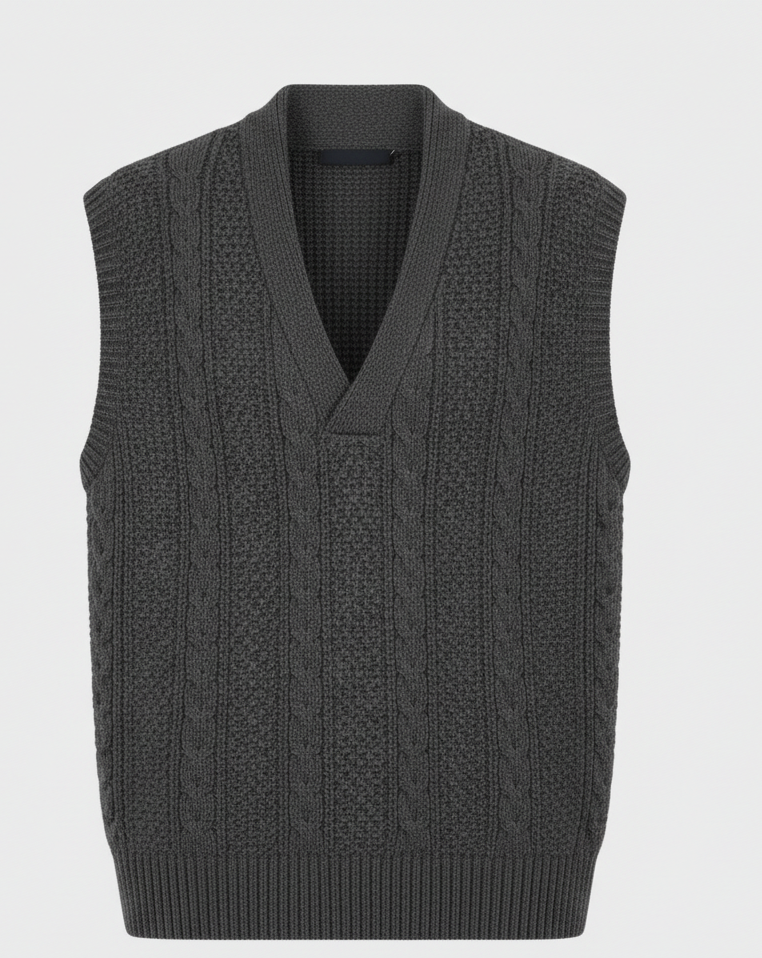
Vest Sweater
Take a sweater and remove the sleeves entirely and you've got a vest sweater, sometimes called a sweater vest. Because there are no sleeves to worry about, vest sweaters are ideal for layering over a long-sleeve shirt without adding excess bulk to the arms — a genuinely useful trick when you want extra warmth on your core without feeling like you're wearing three layers of sleeves at once. Vest sweaters are common in academic and preppy style circles and they've had a strong resurgence recently as a layering piece over button-downs, turtlenecks or even t-shirts.
Vest Sweater
Oversized Sweater
Rather than being defined by its neckline, the oversized sweater is defined by fit. It's cut deliberately larger and looser than the wearer's actual body size, prioritizing comfort and a relaxed, slouchy silhouette over a fitted shape. This style has become a mainstay of contemporary street style and cozy "off-duty" fashion, often paired with leggings or slim trousers to balance out the volume on top. Part of the appeal is purely sensory — an oversized knit just feels more like a blanket than a piece of clothing, which is exactly the point.
Oversized Sweater
How Sweater is manufactured
This is where things get genuinely technical and honestly, kind of fascinating if you've never thought about it before. Turning a cone of yarn into a finished sweater is a multi-stage process that blends mechanical engineering, textile chemistry and no small amount of hands-on skill. It ranges from painstaking hand knitting by individual artisans — the way Aran sweaters were traditionally made — all the way up to fully automated, computer-programmed flatbed knitting machines that can produce a finished, shaped garment panel with minimal human intervention.
Important Features of Sweater Manufacturing
Fully formed panels straight from machines
Elastic, loop-based builds
High dependence on the count, composition, twist and finishing of yarn
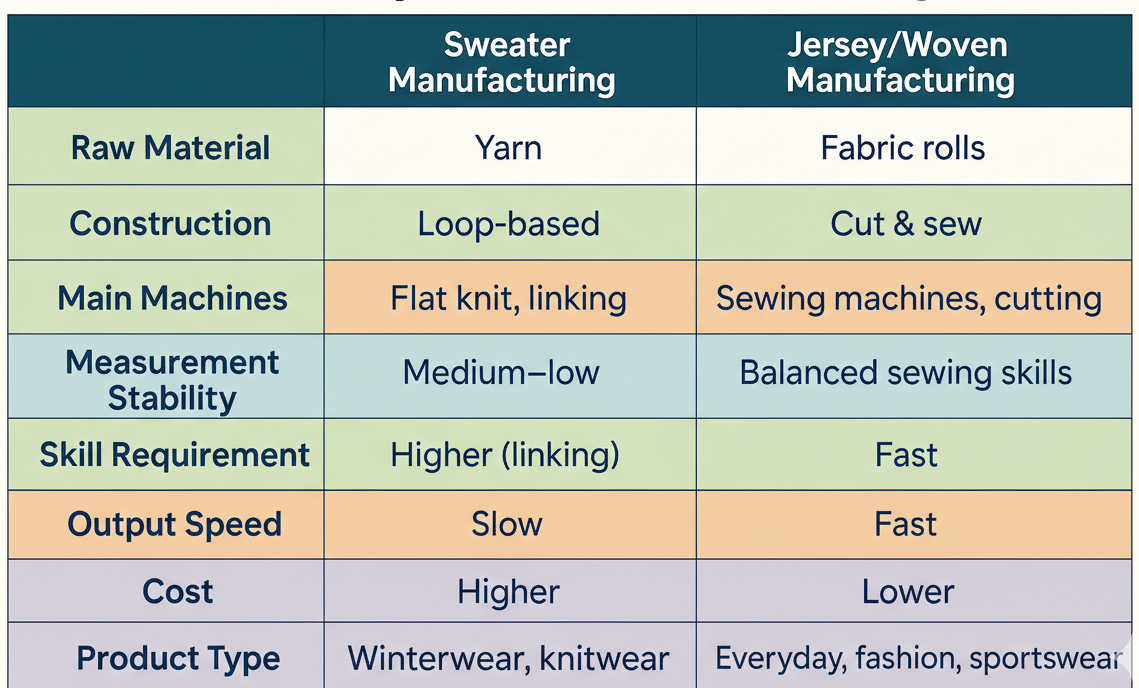
Before diving into the workflow, it's worth understanding what actually makes sweater knitting different from other kinds of fabric production. A woven fabric, like the denim in your jeans, is made by interlacing two sets of yarn at right angles — the warp and the weft — which creates a fairly rigid, non-stretchy structure. Jersey fabric, the kind used in t-shirts, is knitted too, but it's usually produced on circular knitting machines as continuous fabric that gets cut and sewn into shape afterward.
Sweater knitting takes a different approach entirely. On a flatbed knitting machine, panels are often knitted to their finished shape directly — meaning the machine increases and decreases stitches as it works to create the sleeve taper, the shoulder slope or the neckline curve, rather than knitting a flat rectangle that then gets cut. This is sometimes called "fully-fashioned" knitting and it's a big part of why a well-made sweater can fit so well without ever needing scissors to cut its main panels. It also explains why sweaters have that distinctive loop-based, elastic structure — every stitch is essentially a small interlocking loop, which is what gives knitwear its stretch and recovery, unlike the tighter, less forgiving grid of a woven fabric.
Sweater Vs Jersey/Woven manufacturing
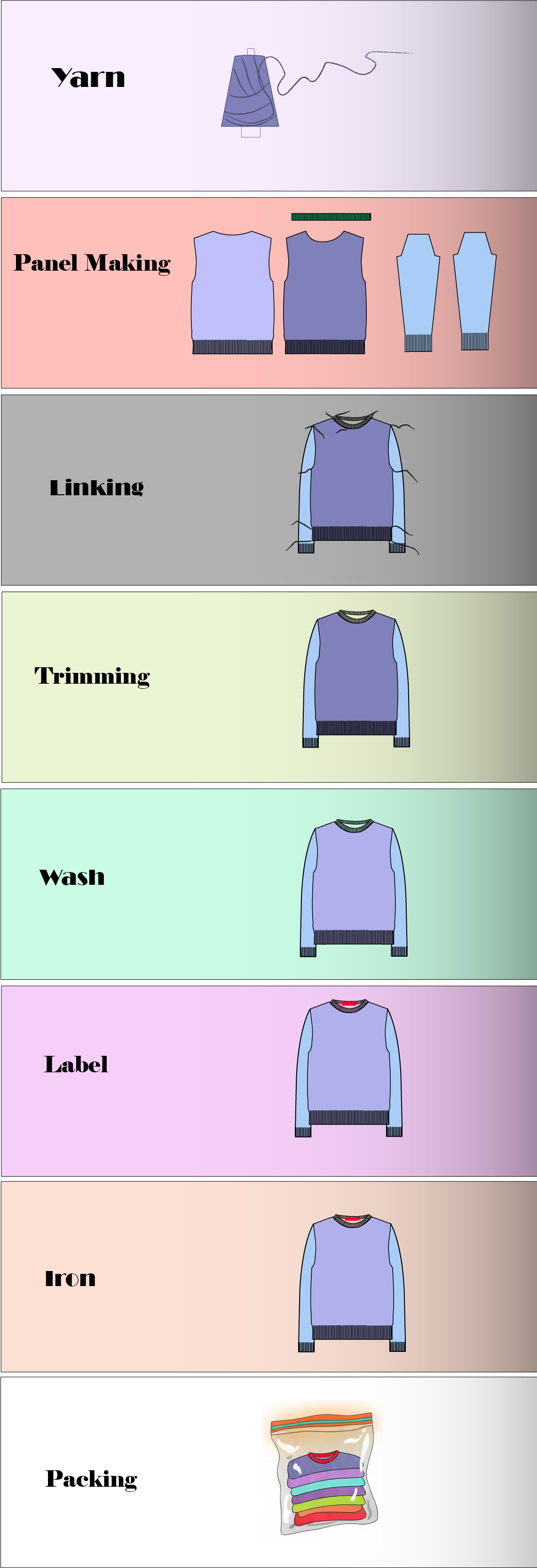
Sweater Manufacturing Workflow
A finished sweater passes through a surprising number of hands and machines before it ever reaches a store shelf. Here's roughly how that journey looks in a modern sweater factory.
Yarn receiving and testing. Before any knitting happens, incoming yarn is checked against its specification — fiber composition, count, twist and so on — to make sure what arrived actually matches what was ordered. Getting this wrong at the start can ruin an entire production run, so testing happens early.
Yarn preparation. Raw yarn cones often need conditioning (essentially letting the yarn relax and stabilize before use) and rewinding onto cones or bobbins that are compatible with the knitting machines. This step also helps even out tension irregularities that could otherwise cause defects later.
Knitting or panel production. This is where the actual garment shape starts to appear. Computerized flatbed machines follow a programmed stitch map to knit each panel — front, back, sleeves, collar — to its finished shape, increasing and decreasing stitches exactly where the design calls for it.
Panel checking. Freshly knitted panels are inspected for dropped stitches, tension inconsistencies or machine errors before they move any further down the line.
Panel mending and trimming. Small flaws get repaired by hand and any loose yarn ends or excess trim gets cleaned up.
Linking and overlocking. This is essentially the sewing stage of sweater production, except it's done with specialized machines suited to knitwear. Linking joins knitted panels together stitch-by-stitch for a nearly invisible, low-bulk seam, which is especially important on fine-gauge knitwear. Overlocking is used where a slightly more robust seam is acceptable.
Trimming and mending, round two. After assembly, garments get another pass to trim stray threads and fix any small issues introduced during linking.
Pre-wash quality control and light checking. Before the garment goes anywhere near water, it gets inspected under strong lighting to catch any visual defects — uneven color, holes, stitch irregularities — that would be much harder to fix after washing.
Washing and water extraction. Many sweaters, especially wool and wool-blend styles, are washed as finished garments rather than as raw yarn or fabric. This step also relaxes the knit structure and helps the garment settle into something closer to its final dimensions. Excess water is then extracted, usually through a spin cycle.
Drying. Depending on the fiber and the desired hand-feel, sweaters are either flat-dried on mesh racks (gentler, better for delicate fibers and shape retention) or tumble-dried (faster and sometimes used to intentionally add loft or softness).
Label sewing and embellishment. Brand labels, care labels and any decorative embellishments — embroidery, patches, appliqué — get added at this stage.
Button, zipper or badge attachment. For cardigans and other sweaters with hardware, this is when buttons, zippers, snaps or badges get sewn or attached.
A second light check. Another visual inspection, this time on the nearly finished garment, to catch anything that slipped through earlier.
Ironing and pressing. Steam pressing relaxes the knit, smooths out the fabric and gives the garment its final, presentable shape.
Measurement check. Finished garments are measured against the original spec sheet — chest width, body length, sleeve length and so on — to confirm they fall within acceptable tolerances.
Final quality check. A last, thorough inspection of the completed garment before it's cleared for packing.
Folding and polybag packing. Garments are folded to a standard presentation and sealed in individual polybags to protect them during transit and storage.
Carton packing and sealing. Polybagged garments are packed into shipping cartons in the quantities specified by the buyer.
Final audit. Before the cartons leave the factory, a final audit — often conducted by a third-party inspector on behalf of the buyer — verifies quantity, quality and packing accuracy.
Shipment loading. And finally, the finished sweaters are loaded for shipment, headed toward a warehouse, a distribution center and eventually, a store shelf or a doorstep.
It's a long road from cone of yarn to folded sweater and at almost every step there's an opportunity for a small error to become a big problem. That's why the technical documentation behind a sweater matters just as much as the knitting itself.
Technical Data Required for Sweater Production
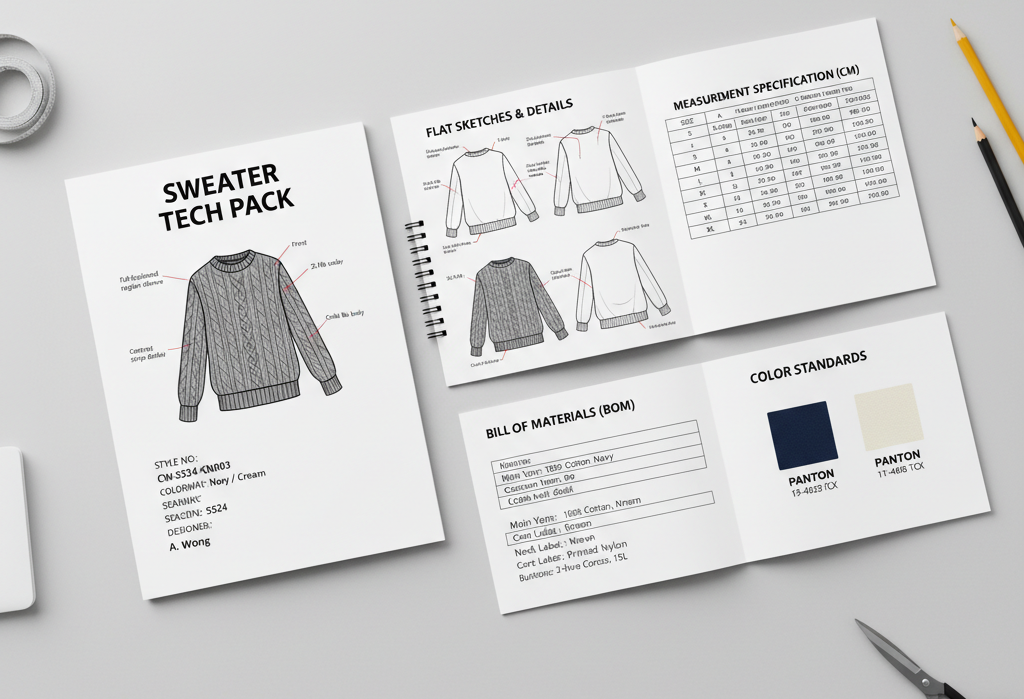
Tech packs & Measurement charts
Every detail of a sweater needs to be specified clearly enough that a factory anywhere in the world can reproduce exactly what a designer had in mind. The centerpiece of this documentation is the tech pack, which typically includes:
Measurement charts for every size in the range
Yarn specifications (fiber composition, count, twist and more)
Count or denier — yarn thickness; thinner yarns give finer fabric, thicker yarns give chunkier fabric
Twist — how tightly fibers are spun, affecting strength, texture and sheen
Ply — how many strands are twisted together, changing behavior under tension
Shrinkage percentage — expected shrinkage during washing, factored into panel sizing
Washing behavior and care requirements — shapes the care label sewn into the finished garment
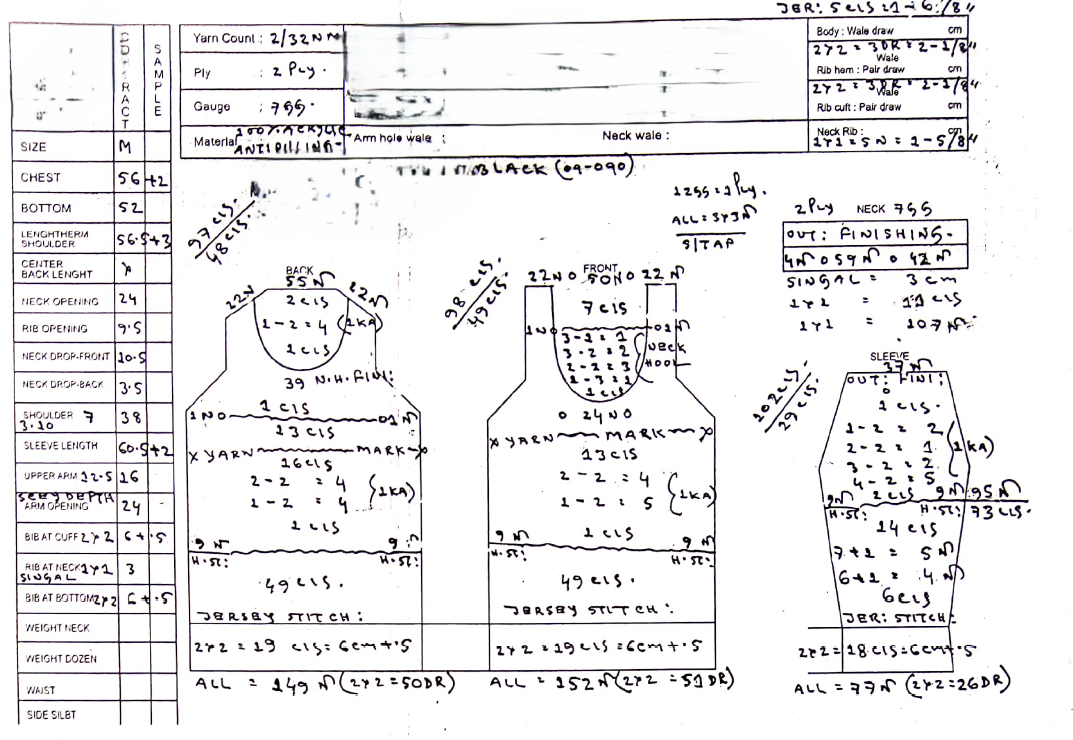
Stitch & Panel Data
Beyond the yarn itself, factories need precise instructions for how the knitting machine should actually build each panel. This includes stitch density (sometimes tracked as a value linked directly to the design chart), the course and wale count (essentially the vertical and horizontal stitch counts per unit of fabric), detailed panel shaping instructions for how increases and decreases should be placed to create the garment's silhouette and specific construction notes for details like the collar. Detailed technical input for knitting and shaping:
Stitch density (DS) (linked with design chart)
Course and wale count
Panel shaping details (via design chart)
Increase/decrease rules (design-based shaping)
Collar construction details
Sweater Design chart
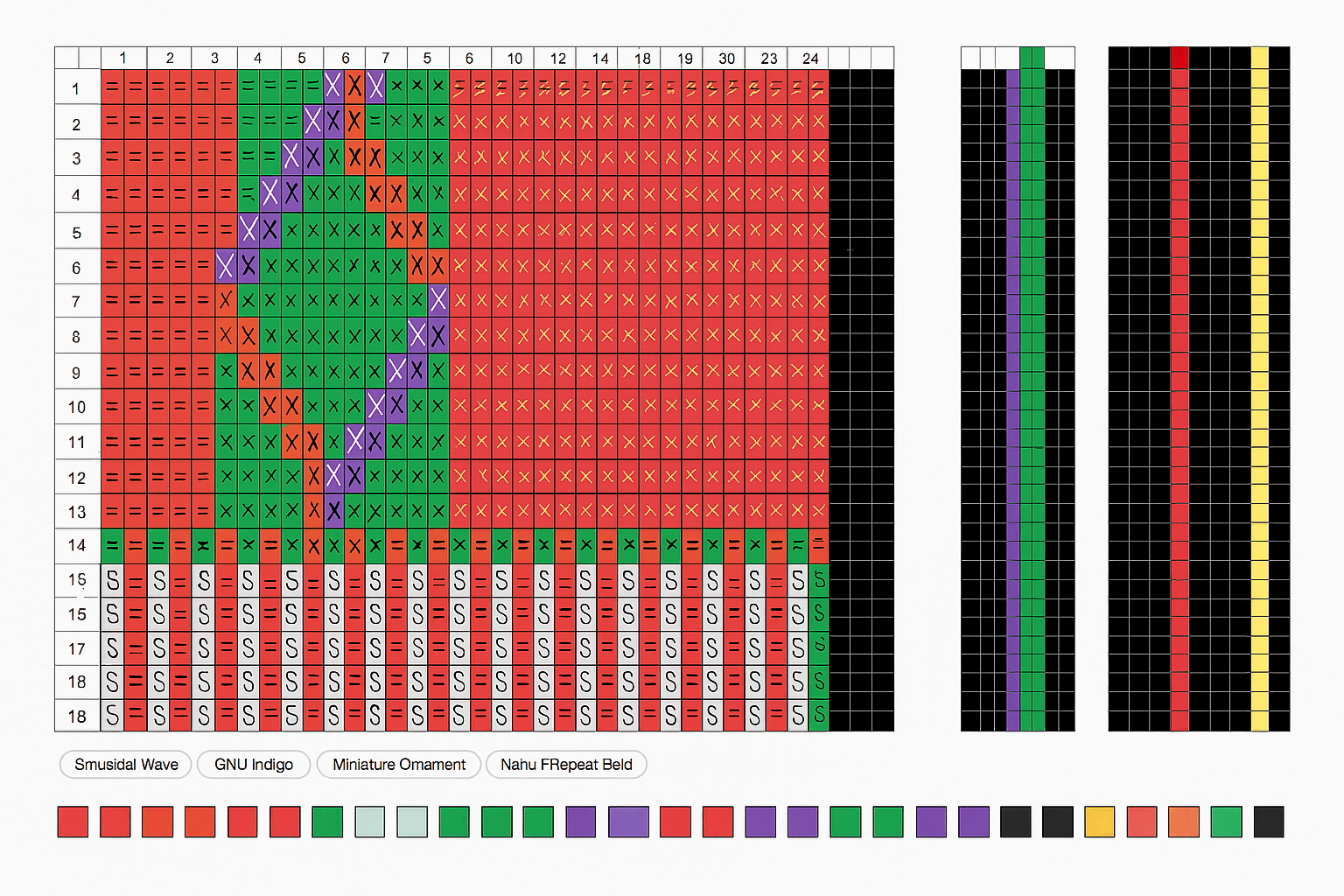
Notation Diagram & Charts
Because sweater production often spans multiple countries, languages and knitting traditions, the industry relies on standardized notation diagrams to communicate instructions clearly regardless of what language the knitter or machine programmer speaks. These diagrams use consistent symbols to represent different stitch types, including:
Knit stitches
Purl stitches
Tuck stitches
Miss or float, stitches
Cable transfers, where stitches cross over one another to create that braided look
Jacquard color coding, used for multi-color patterned knits
A knitter or a machine programmer trained on this notation system can pick up a diagram from virtually anywhere in the world and understand exactly what's being asked, which is enormously useful in a globalized supply chain.
Notation Diagram
Programming Files
Modern flatbed knitting machines don't knit intuitively — they follow precise digital instructions. This means a whole additional layer of technical files needs to be prepared before a single stitch gets knitted by the machine, including stitch maps that define the pattern row by row, shape data files that control the increases and decreases responsible for the garment's silhouette, color separation files for multi-color designs, racking instructions that tell the machine how to shift needle beds for certain stitch effects and cast-on and bind-off programs that control how the panel starts and finishes.
For automated knitting systems, technical files are essential:
Stitch maps
Shape data files
Color separation files
Racking instructions
Cast-on and bind-off programs
Yarn Selection and Gauge: The Engineering Side of Softness
If tech packs are the blueprint, yarn selection and machine gauge are where the physics comes into play — the combination that determines whether a sweater ends up light and drapey or thick and structured.
Spins, Ply and Twist
Ring-spun — strong and relatively smooth
Open-end spun — a more economical method for budget-conscious knitwear
Air-jet and MVS (vortex) — sit in between, chosen for specific performance or aesthetic qualities
Ply and twist — single or multi-plied (two or three strands), with twist direction described as Z-twist or S-twist
Specialty yarns — slub, mouliné, nep or space-dyed yarns add texture or color variation
Machine gauge (needles per inch) has an enormous effect on what kind of sweater can be produced — coarser gauges pair with thicker yarns for bulkier structures, finer gauges pair with thinner yarns for finer structures:
Gauge (GG)
Typical Yarn Count (metric Nm / cotton Ne)
Suitable Structures
3–5 GG
Bulky yarns (Nm 1.5–3; Ne 1/1–2/1)
Full/Half Cardigan, Fisherman, Heavy Cables, Brioche
7 GG
Medium (Nm 3–6; Ne 2/1–4/1)
Ribs, Waffles, Honeycomb, Basket
10–12 GG
Fine (Nm 6–12; Ne 4/1–8/1)
Single Jersey, Lace/Pointelle, Link Link, Moss
14–16 GG
Finer (Nm 12–20; Ne 8/1–12/1)
Pointelle Jacquard, Light Cables, Twill
18–21 GG
Very fine (Nm 20–36; Ne 12/1–20/1)
Lightweight lace, high needle densities
Mismatching yarn thickness and gauge is one of the fastest ways to end up with a garment that doesn't hang, drape or wear the way it's supposed to.
Stitch Engineering: Loop Length, Tension & GSM
Loop Length, Stitch Density and GSM
Two more variables heavily influence a sweater's weight and feel. Loop length (how much yarn forms each stitch, in mm per needle) — a longer loop produces a softer, lighter fabric, while a shorter loop produces a denser, firmer one. Stitch density (wales per inch × courses per inch) interacts with loop length to determine final fabric weight, expressed as GSM (grams per square meter). GSM can be estimated from loop length, yarn thickness, stitch density and a structural constant — roughly 1.0 for simple single jersey, 1.1–1.2 for rib structures and 1.3–1.6 for bulkier structures like brioche or cardigan stitch. These estimates are always confirmed with lab testing.
Loop Length (LL): mm/needle (flat) or mm/course (circular).
Stitch Density: Wales per inch (WPI) × Courses per inch (CPI)
GSM Estimation (simplified):
GSM≈Loop Length xYarn tex×Stitch Density×K
where K depends on structure (~1.0 Jersey, ~1.1–1.2 Rib, ~1.3–1.6 Brioche/Cardigan). Use lab verification.
Indicative Loop Length Ranges (pre‑wash)
Structure
Loop Length (mm)
Notes
Single Jersey (10–12GG)
2.6–3.2
Longer LL ⇒ softer drape, lower GSM
1×1 Rib (7–10GG)
2.8–3.6
Balance recovery vs handfeel
Half Cardigan
3.2–4.2
Higher K value; bulk increases GSM
Full Cardigan
3.8–4.8
Lofty; watch for spirality
Moss / Rice
2.8–3.4
Alternating knit/purl increases thickness
Waffle / Honeycomb
3.0–4.0
3D pockets trap air (warmth)
Lace / Pointelle (12–16GG)
2.4–3.0
Open area reduces GSM—watch seam burst
Brioche / Fisherman
3.6–4.6
Very elastic; control take‑down carefully
Cable (7–12GG)
Base LL + 0.2–0.5
Add LL to prevent yarn breakage at crossings
Multi‑Gauge Panels
Per zone
Align stitch growth across joins
Fiber Choices
Natural fibers — carded/combed cotton organic cotton, BCI cotton, wool (merino, lambswool) and luxury fibers like alpaca and cashmere (often blended for cost and durability)
Regenerated cellulosics — viscose/rayon, modal, TENCEL™ lyocell, prized for soft hand-feel and lower environmental footprint
Bast fibers — linen and hemp, less common in sweaters but used in breathable warm-weather knitwear
The Rule of Thumb
A finer gauge machine produces a higher stitch density, which in turn requires a shorter loop length to hit any given target fabric weight. Everything else — yarn selection, structure, GSM targets — is built around that basic relationship.
What Actually Determines a Sweater's Weight
The final weight and feel comes down to yarn count and fiber type, machine gauge, stitch density, loop length, knit structure and the finishing process. Change any one variable and the character of the sweater changes, sometimes subtly and sometimes dramatically.
One detail that trips up newer brands is the difference between pre-wash and post-wash measurements. Natural fibers like wool and cotton shrink during washing and finishing, so a responsible manufacturer builds wash-shrinkage curves for each yarn and structure, then works backward from the desired finished GSM and dimensions to set the loop length and panel size used during knitting. Skip this step and a sweater that fits perfectly on the machine can shrink into something smaller and stiffer after its first wash.
Caring for a Sweater So It Lasts
All the engineering that goes into a sweater — the matched gauge, calculated loop length, targeted GSM — can be undone fairly quickly by careless washing and storage. A little care knowledge protects that investment, whether the sweater cost ten dollars or ten times that.
Reading the Care Label
The care label reflects real testing done on that specific fiber and knit structure. Wool fibers have microscopic scales that can interlock and felt under heat, agitation and moisture, which is why many wool sweaters are labeled "hand wash only" or "dry clean." Acrylic and other synthetics are generally more forgiving and can often tolerate a gentle machine cycle. Cotton sits in between — reasonably durable, but still prone to shrinkage if washed too hot or dried too aggressively.
Washing Without Ruining the Fit
For most wool and wool-blend sweaters, hand washing in cool water with a mild delicates detergent is safest. Gently press the knit rather than wringing or twisting it, since twisting can permanently distort the stitch structure. Press out excess water with a towel, then lay flat to dry — hanging a wet sweater is one of the most common ways people accidentally ruin them, since the weight of the water pulls the knit downward and can permanently stretch wool out of shape.
Machine-washable sweaters should still generally go on a cold, gentle cycle, ideally turned inside out to reduce friction with other garments. A mesh laundry bag adds extra protection, particularly for sweaters with decorative trim, sequins or delicate cable work.
Storage Between Seasons
Sweaters should be folded for storage rather than hung, since hanging puts sustained strain on the shoulders and can leave permanent stretch marks or hanger bumps — especially in heavier, bulkier knits. For long-term storage, natural fibers like wool and cashmere need protection from moths, whose larvae feed specifically on animal fibers (they generally leave synthetics alone). Cedar blocks, lavender sachets and airtight containers all help and a sweater should be completely clean before storage, since food residue, body oils and sweat can attract pests even when the fabric looks fine.
Dealing With Pilling
Pilling — the small, fuzzy fiber balls that build up under the arms and along friction points like a bag strap — happens when shorter, weaker fibers work their way to the surface and tangle together under repeated friction. Lower-quality or heavily blended yarns tend to pill more readily than long-staple, higher-quality fibers, though pilling can happen to some degree on almost any sweater with enough wear. A dedicated fabric shaver or pilling comb removes pills without damaging the underlying knit, keeping a sweater looking newer for much longer.
Choosing the Right Sweater
A few practical questions are worth working through before buying or commissioning a sweater, whether for personal wear or a full production run:
What's the primary use case? A mid-layer worn under a winter coat calls for a finer gauge and slimmer silhouette; a standalone piece for mild weather can lean into a heavier, bolder knit.
What climate will it actually be worn in? A dense fisherman-style knit suits genuinely cold, damp conditions but feels stifling in a moderate climate, where a lighter cotton or linen-blend knit makes more sense.
How much structure versus drape is desired? Wool holds its shape well; fibers like viscose or modal drape more fluidly, closer to a woven fabric. Neither is objectively better — it depends on the silhouette being aimed for.
What's the maintenance tolerance? Anyone who wants to machine-wash without a second thought is better served by acrylic, cotton or an engineered washable wool blend than a delicate hand-wash-only cashmere piece.
Is budget a major constraint? Cashmere and merino sit at the premium end; acrylic and standard cotton sit at the accessible end. Blends often strike a balance, borrowing some softness or warmth from a premium fiber while keeping cost reasonable.
None of these questions has a single "correct" answer — they're about matching the garment's construction to how and where it will actually be worn. A sweater built for a fisherman on the Aran coast a century ago and one built for a commuter through a mild urban winter today are solving genuinely different problems, even though both fall under the same simple word: sweater.
Sustainability Considerations in Sweater Production
Sweater production has come under increasing scrutiny over its environmental footprint and the industry has responded with a growing set of more sustainable options.
On the fiber side:
Organic and BCI cotton reduce the pesticide and water usage of conventional cotton farming
Recycled polyester (from plastic bottles) and recycled wool (from post-consumer or post-industrial waste) reduce demand for virgin raw materials
TENCEL™ lyocell and similar regenerated cellulosics use a closed-loop process that recovers most chemical solvents, reducing waste
On the process side, whole-garment knitting technology knits an entire sweater — body and sleeves together — as a single seamless piece, eliminating linking and overlocking almost entirely and reducing labor and fabric waste. Digital, fully-fashioned knitting in general also generates far less scrap than cut-and-sew methods, since panels are knitted to their finished shape rather than trimmed down from larger rectangles.
None of this makes sweater production entirely free of environmental impact — no manufacturing process is — but it represents a meaningful shift toward reducing waste, water and chemical use at multiple points in the production chain.
Bringing It All Together
It's easy to take a sweater for granted: you pull it over your head, it keeps you warm and that's usually as far as the thought goes. But behind that simple experience sits centuries of history — fishermen on the Aran Islands developing intricate cable patterns meant to protect and bring luck, a slow migration from functional workwear into high fashion and cultural moments like grunge's embrace of the oversized cardigan that reshaped how a generation thought about knitwear.
And behind the finished garment sits an engineering discipline most people never see: gauge matched to yarn count, loop length tuned to hit a precise GSM target, notation diagrams that let instructions travel across language barriers and a manufacturing workflow with dozens of distinct steps, each designed to catch errors before they reach a customer's closet.
The next time you put on a sweater, it might be worth pausing for a second to appreciate everything packed into that one, simple, comforting garment.
References & Sources
Spencer, D.J. – Knitting Technology.
David J. Spencer – Technical foundations of weft knitting and flatbed knitting.
W. E. Morton & J. W. S. Hearle – Physical Properties of Textile Fibres.
M. L. Gulrajani – Textile material science and yarn engineering.
A. R. Horrocks & S. C. Anand – Textile technology and performance engineering.
Textile Institute (UK) – Knitwear engineering and knitted fabric structures.
The Textile Institute Manual of Knitting Technology.
Disclaimer: This content is intended for educational and training purposes only. Historical references, manufacturing workflows, machine gauges, loop length ranges, yarn specifications, GSM calculations, stitch structures, quality-control practices, and production examples represent commonly accepted apparel and knitwear industry practices. Actual manufacturing parameters, production methods, performance outcomes, and garment specifications may vary depending on machinery, yarn characteristics, factory capabilities, customer requirements, product design, and quality standards.
Written by
Alam Mohammad Shafiqul
Lead Editor, Senior Contributor & Founder
Textile Technology
Textile engineering professional with over 15 years of experience in Sweater Manufacturing, Industrial Engineering and Technical Development. Holds a degree in Textile Engineering and an MBA in Apparel Merchandising. Passionate about bridging the gap between factory-floor operations and technical expertise to drive efficiency, innovation, and continuous improvement.
Textile EngineeringSweaterIndustrial EngineeringLean Six SigmaPythonJS