Packing is the final stage of sweater manufacturing before the product is shipped to customers, warehouses, retail stores or e-commerce fulfillment centers. Although packing is often considered a simple operation, it is actually a highly controlled process that directly influences product protection, presentation, inventory management, logistics efficiency and customer satisfaction. A perfectly manufactured sweater can lose its value if it is incorrectly folded, poorly packed, contaminated during handling or damaged during transportation.
In the global apparel industry, buyers place significant emphasis on garment packing standards because packaging represents the final opportunity to ensure product quality before the garment reaches the consumer. International brands such as H&M, Zara, Uniqlo, Walmart, Target and Marks & Spencer maintain detailed packaging manuals specifying requirements for folding methods, polybag dimensions, barcode placement, carton markings, sustainability guidelines and shipment preparation procedures.
Sweaters require special attention during packing because knitted garments are bulkier, more flexible and more prone to stretching and shape distortion than woven garments. Improper handling can create wrinkles, damage embellishments, distort measurements and negatively affect the appearance of the finished product. Consequently, manufacturers must adopt standardized folding techniques and packaging methods that protect the garment while maximizing storage and transportation efficiency.
A properly packed sweater maintains its shape, appearance, cleanliness and brand value throughout the supply chain, ensuring that the product arrives in perfect condition at retail stores or directly to consumers. This chapter provides a comprehensive explanation of sweater packing objectives, pre-packing activities, folding techniques, industrial packing workflow, packing materials, buyer requirements, quality standards, common packing defects and best practices used in modern sweater manufacturing.
Purpose of Sweater Packing
| Category | Purpose / Details |
|---|---|
| Protection | ✓ Protects sweaters from dust, moisture, dirt, insects ✓ Prevents damage during transport ✓ Maintains garment shape and texture |
| Presentation | ✓ Provides a neat, retail-ready appearance ✓ Ensures barcodes and hangtags are visible |
| Compliance | ✓ Meets buyer packaging guidelines ✓ Follows export labeling rules ✓ Supports warehouse scanning and sorting |
| Logistics | ✓ Ensures correct size & color assortment ✓ Supports PO-based identification ✓ Enables efficient carton stacking & loading |
Pre‑Packing Activities
| Activity | Key Requirements / Details |
|---|---|
| Final Quality Check (FQC) | Sweater must: ✓ Pass measurement check ✓ Be defect‑free ✓ Have correct care labels ✓ Have correct trims |
| De‑linting / Cleaning | Tools used: ✓ Lint remover ✓ Air blower ✓ Fabric shaver Removes: hair, dust, loose fibers |
| Metal Detection (Required) | Mandatory for: ✓ Kidswear ✓ Buyers: H&M, C&A, Walmart Ensures no broken needles / metal fragments |
| Ironing & Final Shaping | Garment must be: ✓ Smooth ✓ Properly shaped ✓ Ready for folding |
Sweater Folding Techniques in Packing
Proper sweater folding is essential in apparel production and logistics to maintain garment quality, optimize packing efficiency and ensure a neat presentation for customers and buyers. Since sweaters are bulkier and more sensitive to stretching than lightweight knitwear, specific folding techniques help maintain shape, minimize creasing and save carton space.
Standard Flat Fold (Factory‑Preferred Method)
Standard Flat Fold is a folding technique where the garment is folded neatly into a rectangular flat shape so it can be placed inside:
-
Poly bags
-
Retail display packaging
-
Cartons for shipping
This is the most common method used in bulk packing.
Steps
- Lay the sweater face down on a flat surface.
- Smooth out wrinkles gently, avoiding stretching.
- Fold both sleeves inward horizontally so they overlap slightly.
- Fold the sides inward to create a clean rectangle shape.
- Fold the bottom hem up toward the shoulder seam.
- Insert size or polybag board if required.
- Slide into the polybag with the front side visible.

Advantages
- Uniform size consistency in bulk production
- Fits well in standard polybags
- Minimizes wrinkles
- Ideal for automated packing lines
Half Fold or "Book Fold" (For Gift Packs or Multi‑Pack)
The garment is folded in half from left to right (or right to left) so the front of the garment stays visible, similar to how a book closes.
Steps:
- Lay the garment flat with the front side facing down.
- Fold one side (with sleeve) toward the center.
- Fold the other side over it, like closing a book.
- Fold the bottom upward if needed to fit the packaging size.
- Place back board or tissue if required and insert into polybag.

Advantages:
- Compact shape for gift packaging
- Reduces movement inside the box
Tri Fold
Usually, the two sides are folded toward the center and then the bottom is folded upward, creating a neat flat package.
Steps
- Lay the garment face down on a flat surface.
- Fold the left side with sleeve toward the center.
- Fold the right side with sleeve toward the center.
- Fold the bottom part upward toward the neckline.
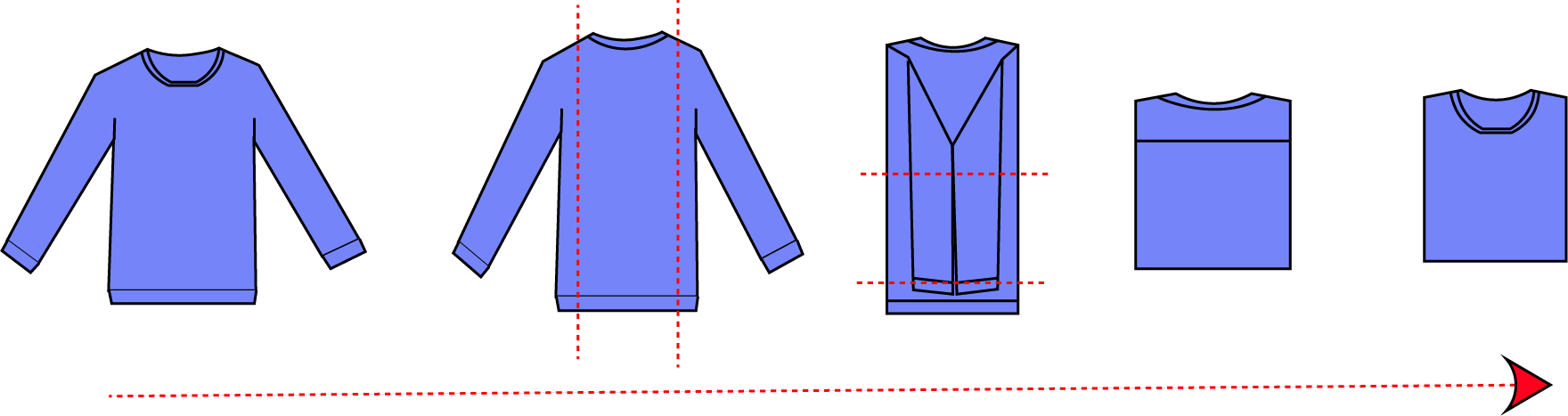
Advantages:
- Saves space in cartons
- Makes garments look neat in retail packaging
- Easy for automatic or manual folding
Hanger Fold
The garment is packed on a hanger but folded slightly so it fits neatly inside a polybag or shipping carton without removing the hanger.
Steps
- Place the garment properly on a hanger.
- Button or zip the garment if required.
- Fold the sleeves inward toward the center of the garment.
- Sometimes the bottom part is folded upward to reduce length.
- Cover with tissue paper if required.
- Insert the whole hanger garment into a polybag with hanger hook exposed or covered.
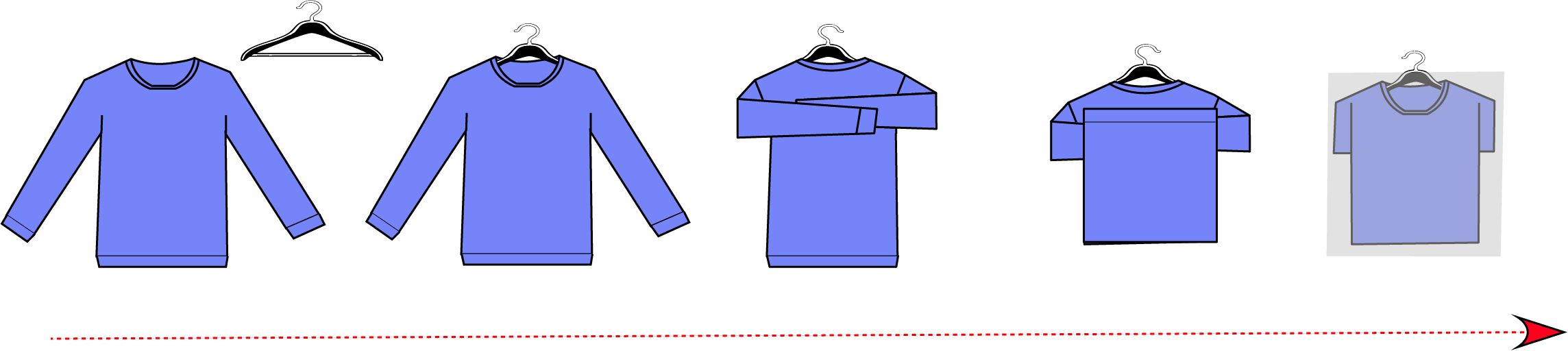
Advantages
- Reduces wrinkles
- Saves store preparation time
- Maintains garment shape
- Good for premium retail brands
Rolling Fold (Common for E‑commerce & Space Saving)
Used when small parcel size is key (e.g., online orders).
Steps
- Lay the sweater flat, face up.
- Fold sleeves inward in a straight line.
- Fold sides toward the center.
- Roll tightly from hem to neck.
- Place in a polybag with air removed.
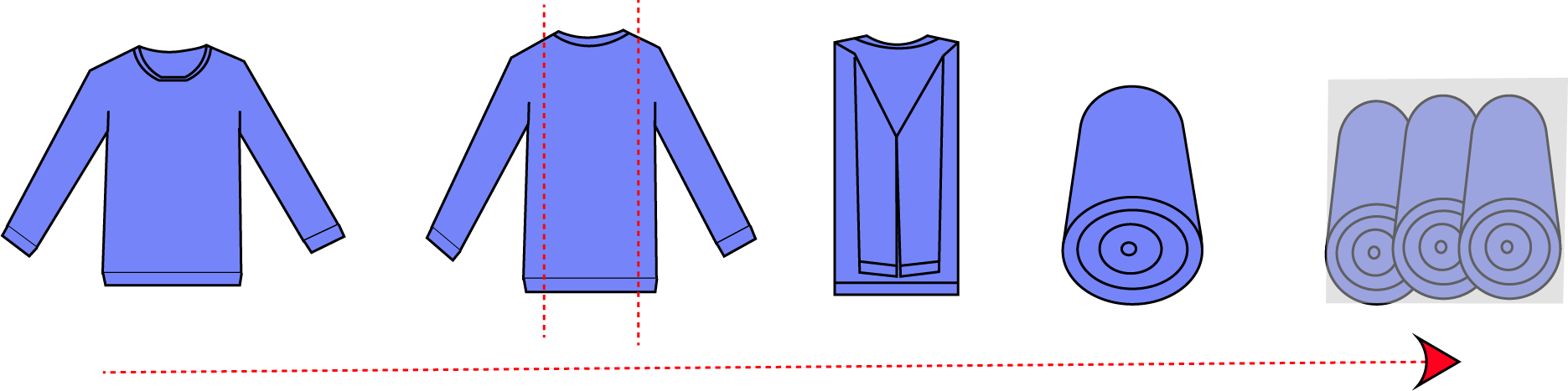
- Saves significant space
- Prevents harsh creases
- Suitable for vacuum‑sealed packaging
Best for
- E‑commerce shipments
- Lightweight or chunky knit sweaters
Board Folding
Board folding is a method where a folding board (usually cardboard or plastic) is placed inside the garment to guide the folds and maintain a uniform shape. It is commonly used for shirts and T-shirts in retail packaging.
Steps
- Lay the garment face down on a flat surface.
- Place the folding board at the center of the garment near the neckline.
- Fold the left side of the garment over the board.
- Fold the right side of the garment over the board.
- Fold the bottom part upward over the board.
- Carefully remove the board, leaving the garment neatly folded.
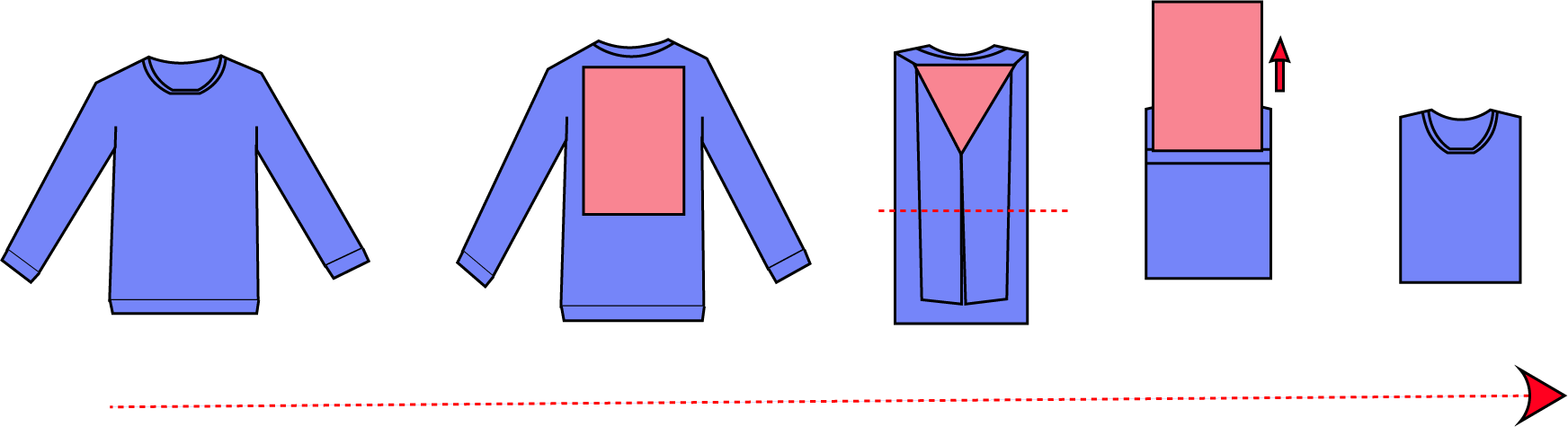
Advantages
- Ensures uniform size and shape of folded garments
- Improves appearance for retail display and packaging
- Speeds up the folding process in bulk production
- Helps maintain a professional and neat presentation
Packing Process Flow
A step-by-step industrial packing workflow:
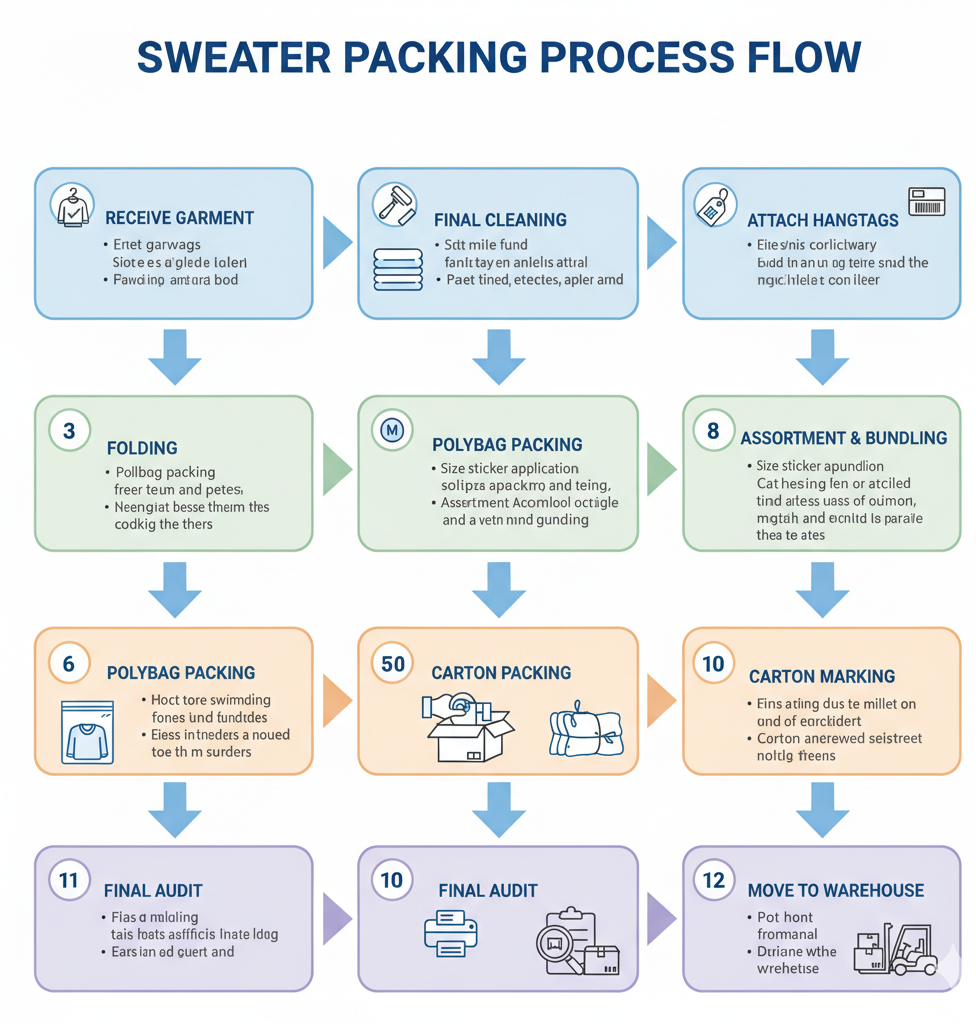
| Step No. | Process | Details / Checklist |
|---|---|---|
| 1 | Receive Garment from Finishing | ✓ Correct PO ✓ Correct Size ✓ QC stamp present |
| 2 | Final Cleaning | Remove: ✓ Lint ✓ Loose fibers ✓ Extra thread ends |
| 3 | Attach Hangtags & Stickers | Includes: ✓ Price tag ✓ Brand tag ✓ Barcode sticker ✓ Size sticker ✓ Care card (optional) |
| 4 | Folding | Fold as per: ✓ Buyer requirements ✓ Garment type ✓ Packaging method Add cardboard/tissue if required |
| 5 | Polybag Packing | ✓ Insert garment ✓ Seal (adhesive/heat) ✓ Insert silica gel (if required) ✓ Ensure barcode visibility |
| 6 | Size Sticker Application | Sticker placed on: ✓ Outside polybag ✓ Or garment (if required) Sticker must match: ✓ Size ✓ PO ✓ Color code (if required) |
| 7 | Assortment & Bundling | Group by: ✓ Size ✓ Color ✓ Style ✓ PO Bundle into dozens or buyer requirement |
| 8 | Carton Packing | Insert garments: ✓ Layer by layer ✓ Without compression ✓ Follow size runs ✓ Use poly separators (if required) |
| 9 | Carton Sealing | Use: ✓ Nylon tape ✓ Buyer-branded tape ✓ Tamper-proof seals |
| 10 | Carton Marking | Print: ✓ Buyer name ✓ PO number ✓ Style number ✓ Size assortment ✓ Quantity ✓ Country of origin ✓ Carton weight ✓ Barcode (if required) |
| 11 | Final Audit of Packing | Quality checks: ✓ Assortment correctness ✓ Label accuracy ✓ Carton weight ✓ Barcode scannability ✓ Folding quality ✓ Polybag compliance |
| 12 | Move to Finished Goods Warehouse | Store cartons: ✓ Per PO ✓ Per shipment plan ✓ Awaiting container loading |
Buyer-Specific Packing Requirements
Many brands have strict packaging guidelines:
✓ H&M
- ✓ Recycled polybags
- ✓ Printed warning statements
- ✓ Carton compliance standards
✓ Zara
- ✓ Minimal packaging
- ✓ Eco-friendly materials
✓ Walmart / Target
- ✓ Warning labels
- ✓ Prefolded templates
- ✓ Strict barcode placement
✓ Uniqlo
- ✓ Premium folding
- ✓ Clean polybag finish
✓ Marks & Spencer
- ✓ Moisture protection
- ✓ Garment shape preservation
Factories must follow each brand’s manual precisely to avoid rejections.
A properly packed sweater maintains its shape, quality and brand value until it reaches the end consumer.
Final Thoughts
Packing is the final and one of the most critical operations in sweater manufacturing. It represents the last opportunity to protect product quality, verify order accuracy and ensure compliance with buyer requirements before shipment. An effective packing system safeguards sweaters from dust, moisture, damage, contamination and handling risks while preserving their appearance, dimensions, texture and overall quality.
From final quality inspection and metal detection to folding, polybagging, carton packing and warehouse storage, every step must be executed with precision and consistency. Proper folding techniques such as Standard Flat Fold, Book Fold, Tri Fold, Hanger Fold, Rolling Fold and Board Folding help maintain garment shape while maximizing packaging efficiency. Additionally, adherence to buyer-specific packaging guidelines ensures smooth distribution, retail readiness and customer satisfaction.
Ultimately, packaging is far more than simply placing a sweater into a bag or carton. It is a strategic process that combines quality assurance, branding, logistics management, product protection and customer experience. A properly packed sweater preserves its shape, quality and brand value throughout the entire supply chain, ensuring that it reaches the end consumer in perfect condition and reflects the high standards of the manufacturer and brand it represents.