Yarn count is one of the most important parameters in textile engineering. It enables manufacturers, designers and engineers to:
- Select the right yarn for any fabric
- Control the fabric GSM
- Maintain consistency, strength and quality
- Compare yarn fineness across different count systems
Types of Yarn Count Systems
Yarn count systems are divided into two categories: direct and indirect systems, each using a different method of measurement.
Direct Yarn Count System
In the direct system, the yarn count is determined by measuring the weight of a fixed length of yarn. This means that the heavier the yarn for a given length, the thicker or coarser it is.
In simple terms, when the count number increases in this system, the yarn becomes coarser (thicker).
Rule: Higher count = Coarser yarn
Common direct count systems include:
- Tex: Weight in grams per 1,000 meters
- Decitex (dtex): Weight in grams per 10,000 meters
- Denier: Weight in grams per 9,000 meters
Examples:
- If 1,000 meters of yarn weighs 20 grams → 20 tex
- If 9,000 meters weighs 150 grams → 150 denier
- If 10,000 meters weighs 30 grams → 30 dtex
Indirect Yarn Count System
In the indirect system, the yarn count is measured by the length of yarn per fixed weight. This means that finer yarns will have a longer length for the same weight.
In this case, when the count number increases, the yarn becomes finer (thinner).
Rule: Higher count = Finer yarn
Common indirect count systems include:
- Cotton Count (Ne): Number of 840-yard hanks per pound
- Worsted Count: Number of 560-yard hanks per pound
- Woollen Run: Number of 1,600-yard hanks per pound
- Metric Count (Nm): Number of kilometers per kilogram
Examples:
- 20 hanks of 840 yards per pound → 20 Ne (Cotton count)
- 30 hanks of 560 yards per pound → 30 Worsted count
- 40 kilometers per kilogram → Nm 40
Direct vs Indirect Yarn Count System
| Feature | Direct System | Indirect System |
|---|---|---|
| Basis | Weight per fixed length | Length per fixed weight |
| Higher count means | Coarser yarn | Finer yarn |
| Mostly used for | Synthetic & filament yarns | Cotton, wool, silk, blends |
Popular Yarn Count Notations
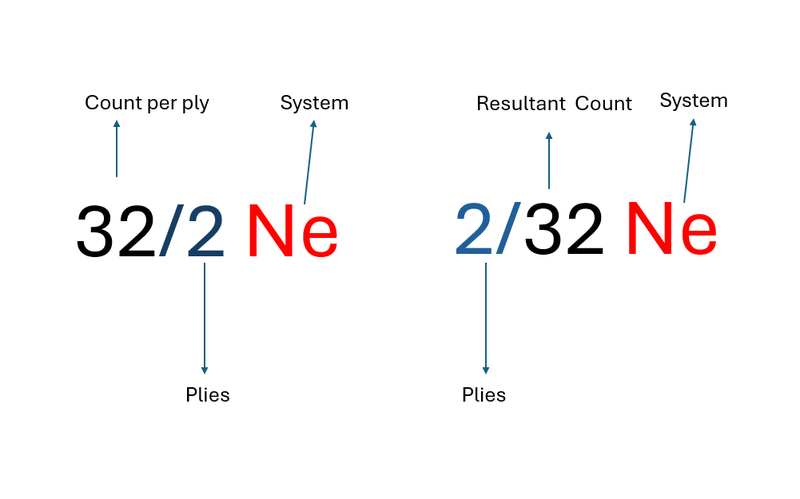
Yarn count is often written in a specific format that shows both the thickness of the yarn and its structure, especially when the yarn is made of multiple plies. These notations are widely used in the textile industry to quickly understand yarn properties such as fineness, strength and number of strands twisted together.
In most cases, the notation includes two parts:
- The first number indicates the yarn count (fineness or thickness)
- The second number shows the number of plies (how many yarns are twisted together)
Understanding these notations helps in selecting the right yarn for different fabric types and applications.
Note: If there is no second number then it is counted as single ply
Common Yarn Count Notations
Tex System (Direct)
In the tex system, yarn count is based on the weight of a fixed length. The notation often includes ply information.
Example:
20/2 tex
- 20 = yarn count per ply
- 2 = number of plies
20 = yarn count per ply
2 = number of plies
This means two yarns of 20 tex are twisted together.
Decitex (dtex) System
Decitex is another direct system commonly used for fine synthetic yarns.
Example:
150/1 dtex
- 150 = yarn count
- 1 = single ply yarn
150 = yarn count
1 = single ply yarn
Denier System
Denier is widely used for filament yarns like polyester and nylon, especially in technical and apparel applications.
Example:
75 den
- 75 = denier per filament
75 = denier per filament
Metric Count (Nm)
In the metric system, yarn count is expressed as length per unit weight, so it follows the indirect system.
Example:
40/2 Nm
- 40 = yarn fineness (higher = finer yarn)
- 2 = number of plies
40 = yarn fineness (higher = finer yarn)
2 = number of plies
Worsted Count System
Used mainly for wool yarns, especially in worsted spinning systems.
Example:
36/2 Worsted
- 36 = number of hanks per pound
- 2 = plies
36 = number of hanks per pound
2 = plies
Woollen Run System
This system is used for woollen yarns and follows a similar concept to other indirect systems.
Example:
10/3 Run
- 10 = yarn count
- 3 = number of plies
10 = yarn count
3 = number of plies
Quick Comparison by Type of count
| System | Type | Higher Number Means |
|---|---|---|
| Tex, dtex, Denier | Direct | Coarser yarn |
| Ne, Nm, Worsted, Run | Indirect | Finer yarn |
Yarn Count Conversion
Due to different regions and applications use different count systems. Convert between these systems helps manufacturers, merchandisers and technicians compare yarns, calculate fabric specifications and ensure accurate communication across global markets.
Conversion formulas help to bridge the gap between the two systems and make it easier to understand the fineness of yarn and its suitability for different applications.
Conversion Within Direct Systems
Direct count systems such as tex, denier and decitex (dtex) measure yarn thickness based on weight per fixed length. Since they follow the same principle, conversion between them is straightforward.
Key relationships include:
Denier = Tex × 9
Tex = Denier ÷ 9
dtex = Tex × 10
Tex = dtex ÷ 10
These conversions are commonly used for synthetic yarns, where denier and dtex are widely applied.
Conversion Within Indirect Systems
Indirect systems like cotton count (Ne) and metric count (Nm) measure yarn based on length per unit weight. In these systems, higher values indicate finer yarns.
Key relationships include:
Nm = 590.5 ÷ Ne
Ne = 590.5 ÷ Nm
These conversions are useful when working with cotton and wool yarns across different measurement standards.
Conversion Between Direct and Indirect Systems
Converting between direct and indirect systems is slightly different because the two systems follow opposite principles (weight vs length). However, simple formulas make this conversion easy.
Key relationships include:
Ne = 590.5 ÷ Tex
Tex = 590.5 ÷ Ne
This type of conversion is commonly required when comparing natural fiber yarns (like cotton) with synthetic yarns.
Example Conversions
20 Tex → Denier : 20 × 9 = 180 den
40 Ne → Tex : 590.5 ÷ 40 = 14.76 tex
25 dtex → Tex: 25 ÷ 10 = 2.5 tex
Effect of Yarn Count on Fabric

The count of yarn is very important in determining the overall characteristics of a fabric. It affects the look, feel and performance of the fabric in many applications. Yarn count is a measurement of the fineness or coarseness of a yarn . It can affect weight , strength , softness and the final use of a fabric .
The finer yarns produce light, soft fabrics, while the coarser yarns produce heavier, stronger and more durable fabrics. Hence, the correct choice of yarn count is very important in fabric design and product development.
Key Effects of Yarn Count
Fabric GSM (Weight)
Yarn count has a direct impact on fabric weight.
Finer yarns → lower GSM (lightweight fabrics)
Coarser yarns → higher GSM (heavier fabrics)
This is why lightweight garments like T-shirts use finer yarns, while jackets or denim use thicker yarns.
Fabric Strength & Durability
The thickness and structure of the yarn influence how strong the fabric will be.
Coarser yarns generally create stronger and more durable fabrics
Finer yarns produce softer fabrics but may have lower durability
Drape, Softness & Flexibility
Yarn count also affects how the fabric feels and behaves when worn.
Fine yarns → soft, smooth and better drape
Coarse yarns → stiffer feel with less flexibility
This is why fine yarns are preferred for comfort wear, while coarser yarns are used for structured garments.
Fabric Appearance & Cover Factor
Yarn count determines how dense and smooth the fabric surface appears.
Fine yarns → smoother surface and better finish
Coarse yarns → rougher texture and higher cover (more compact look)
Application & End Use
The choice of yarn count depends on the intended use of the fabric.
Fine yarns:
- Used in shirts, innerwear, lightweight knits
- Focus on comfort and softness
Used in shirts, innerwear, lightweight knits
Focus on comfort and softness
Coarse yarns:
- Used in denim, upholstery, workwear
- Focus on strength and durability
Used in denim, upholstery, workwear
Focus on strength and durability
✅ In simple terms, the yarn count determines the balance between comfort and strength of the fabric. Getting the right count will ensure the fabric performs well for its purpose, whether it’s soft and lightweight or strong and heavy-duty.