Trimming
Trimming is the process of removing unwanted yarns, loose threads, fabric tails and excess materials from the sweater after linking, overlocking or assembly.
Trimming ensures the garment looks neat, professionally finished and ready for subsequent processes.
Purpose of Trimming
- Improve appearance
- Prevent snagging
- Ensure clean, professional finishing
- Prepare panels for linking and washing
- Remove yarn tails from jacquard, intarsia & cable patterns
Types of Trimming Activities
Thread-end cutting
– Removal of yarn tails after cast-on, cast-off, transfers, feeder change.
Removing loose fibers (fuzz)
– Combing, brushing or trimming using scissors or mini clippers.
Trimming after linking
– Removing thread ends left from loop-to-loop joining.
Trimming inside jacquard/intarsia areas
– Intarsia has many yarn changes; trimming ensures smooth inside surface.
Trimming on ribs & edges
– Neck, cuff, bottom hems often have small yarn knots that must be clipped.
Trimming must be precise to avoid cutting loops—any mistake may cause holes or laddering.
Mending
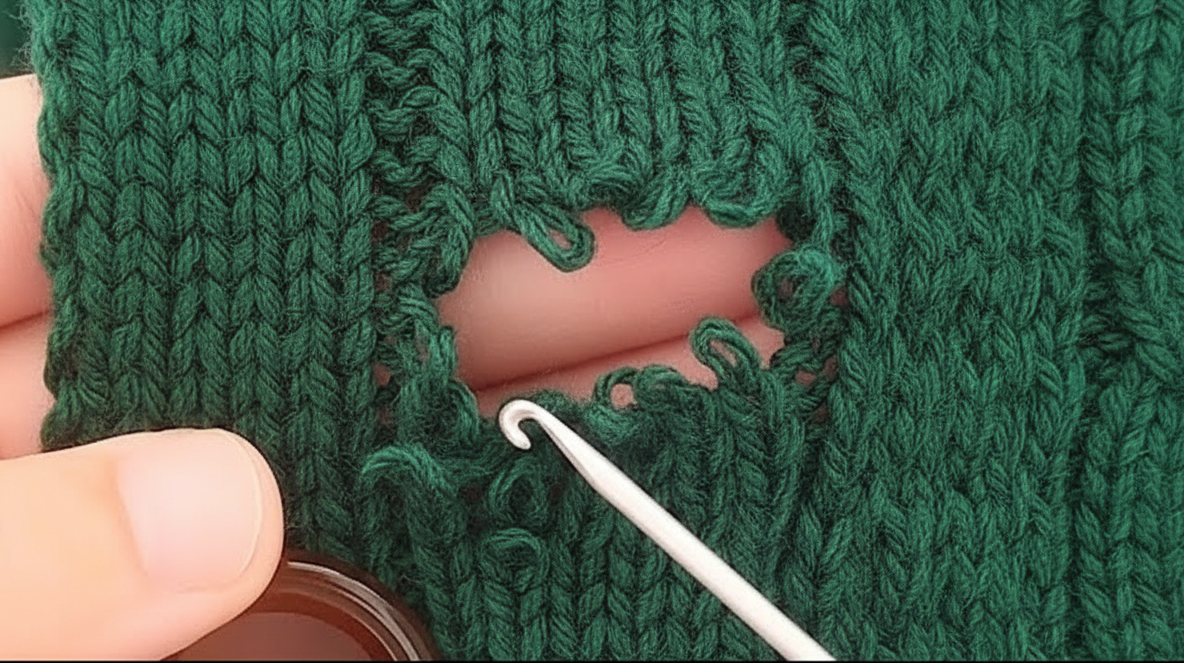
Mending is where defects are fixed — by hand.
Since knit fabrics are loop-based, even a single broken loop can turn into a visible hole pretty quickly. That’s why mending is done before washing — once washed, defects become harder to correct.
This work is usually handled by skilled operators (menders). It’s not something you can easily automate.
Why Mending Is Important
- Restores fabric strength and structure
- Fixes visible defects
- Improves durability
- Maintains brand quality
- Reduces rejection and wastage
Types of Mending in Sweaters
Loop Mending
When a loop is broken or pulled out.
The mender uses a hook or needle to bring the loop back into the structure, stitch by stitch.
Dropped Stitch Repair
A very common issue in sweaters.
The missing stitch is rebuilt using nearby loops — carefully, so it blends in.
Hole Mending
Holes can happen due to:
- Yarn breakage
- Needle damage
- Snagging
The mender manually rebuilds the area, matching the original gauge and pattern as closely as possible.
Tension Correction
Sometimes the fabric isn’t even.
- Some stitches too loose
- Others too tight
The mender adjusts tension by pulling or relaxing yarns. Small adjustments, but noticeable difference.
Pattern Correction
This is more technical.
Needed in cases like:
- Wrong jacquard color
- Cable crossing mistakes
- Missed stitches or tuck effects
Here, the mender has to fix both structure and appearance — not easy.
Final Thought
Trimming and mending don’t get much attention compared to knitting or finishing, but they quietly decide the final quality.
A sweater might be knitted perfectly… but if trimming is rough or defects aren’t mended properly, the product won’t pass inspection — simple as that.
It’s one of those stages where detail matters more than speed.
Not always easy in production, but skipping it (or rushing it) usually shows in the final garment.