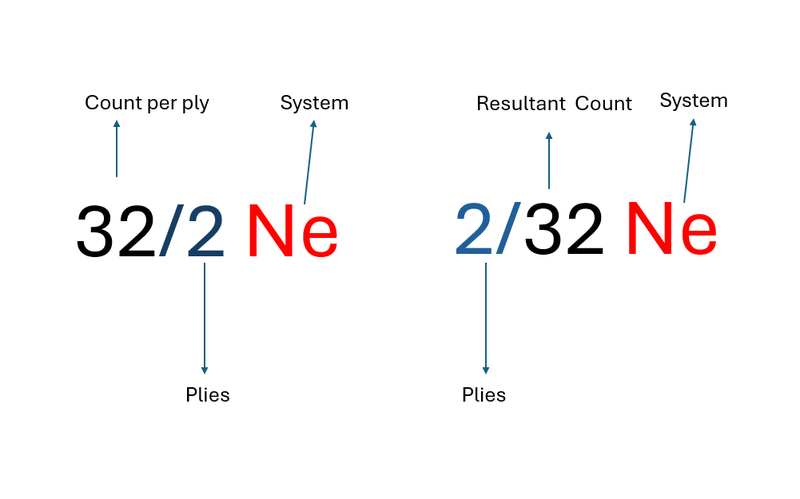
Today, regenerated filament yarn is a remarkable combination of nature and technology in the textile industry. It bridges the gap between natural fibers and synthetics—providing the comfort and sustainability of botanical materials with the accuracy and performance of engineered filaments. Knowing how these yarns are made and why they matter is essential for textile engineers, manufacturers and sourcing pros to navigate the changing landscape of sustainable textiles.
Regenerated filament yarns are made from natural cellulose sources, such as wood pulp, bamboo pulp and cotton linters. These raw materials are transformed into fine, continuous filaments through sophisticated chemical and mechanical processes producing a look and performance similar to silk. The major types are viscose, modal, lyocell, acetate and triacetate and each has its own unique properties and manufacturing processes.
These fibers come from nature. But they are anything but simple. Behind each and every strand lies a complex story of chemistry, engineering and design innovation that transforms simple plant cellulose into high performance textile materials for fashion, home and industrial applications.
Types of Regenerated Filament Fibers
| Fiber Type | Key Characteristics | Strength & Performance | Comfort Properties | Common End Uses |
|---|---|---|---|---|
| Viscose Filament Yarn (VFY) | Bright appearance, silky feel, excellent drape | Moderate strength (weaker when wet) | Soft, smooth, good moisture absorption | Sarees, scarves, linings, dress materials |
| Modal Filament | Finer, smoother than viscose; improved durability | Higher strength than viscose (better wet strength) | Very soft, breathable, excellent comfort | Innerwear, sleepwear, luxury apparel |
| Lyocell Filament | Smooth surface, natural sheen, eco‑friendly production | High tensile strength, excellent wet strength | Excellent moisture absorption, skin‑friendly | High-end apparel, sustainable fashion, premium textiles |
| Acetate Filament | Glossy, luxurious look, thermoplastic nature | Lower strength compared to other regenerated filaments | Soft feel, moderate breathability | Linings, fashion fabrics, evening wear |
Advantages of Regenerated Filament
Regenerated filament yarns are made from renewable plant resources and not from petroleum-based synthetics such as polyester or nylon. These fibers are far more sustainable as the cellulose that’s extracted from wood or bamboo is biodegradable. With the textile industry under scrutiny for its environmental impact, regenerated filaments are a responsible alternative. Their production supports principles of circular economy – returning to nature with no harmful residues.
Elegant Silky Appearance
Regenerated filament yarn is often praised for its luxurious sheen and smooth surface. The filaments have a natural luster and drape that closely resemble silk, but are less expensive and easier to maintain. This is why designers often choose them to bring elegance to their designs without the hefty price tag of natural silk. Fabrics such as viscose and acetate are often used for evening wear and high quality linings, due to the graceful drape and refined look they have.
Unparalleled Comfort and Breathability
Where regenerated filaments really shine is in comfort. Their air-permeability and moisture-absorbing properties make them perfect for warm-weather apparel. They are not like synthetics that trap heat; they allow the skin to breathe, keeping the wearer cool and comfortable. The reason why modal and lyocell fabrics are so popular for casual wear, lingerie and bedding is that they combine softness with excellent moisture management.
Improved Dyeability
Dyeing – Regenerated cellulose fibers have a natural affinity for dyes, resulting in a rich, vibrant coloration with excellent shade depth. The improved dyeability helps fashion brands to achieve targeted color shades and to maintain consistency throughout their collections. Home textile makers also profit. Curtains, upholstery and decorative fabrics composed of viscose or acetate have brilliant hues that hold up.
Very Versatile
Regenerated filaments are perhaps most impressive in their adaptability. Depending on the manufacturing method, they can be made to resemble silk, cotton or even some synthetics. This versatility means that they are used in a wide range of industries from delicate apparel to technical textiles.
Regenerated filament spinning process
So how does regenerated filament actually come to life?
While the final filament may look simple, its creation involves intricate chemical and mechanical engineering. Each fiber type—viscose, acetate, lyocell—uses slightly different technologies, but the underlying principle remains the same: transforming solid cellulose into a spinnable liquid and then regenerating it into continuous filaments.
The exact method changes a bit depending on the type—viscose, modal, lyocell, acetate—but the core idea stays the same. Three main steps.
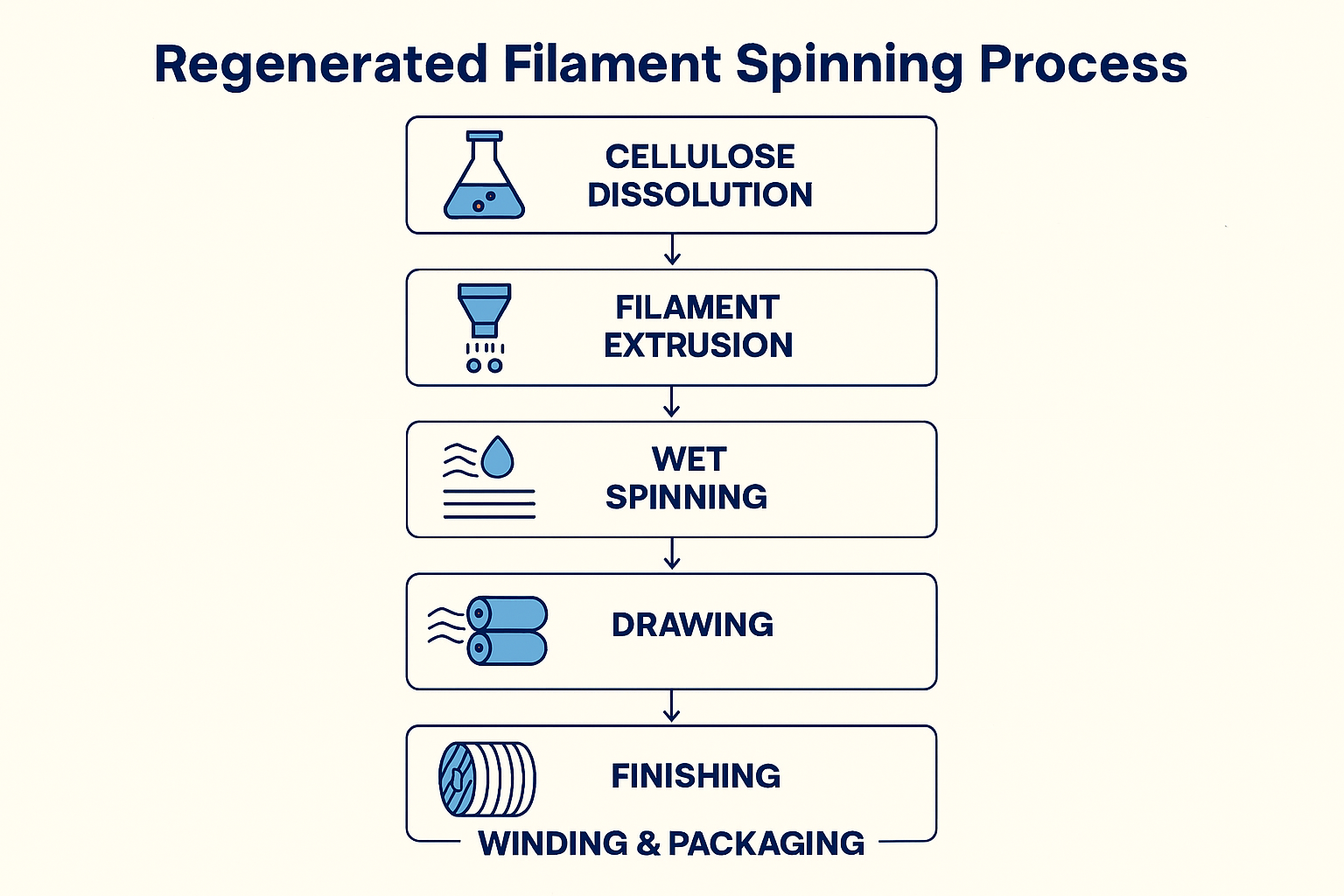
Step 1: Cellulose Preparation and Dissolution
The journey begins with purified cellulose, which is converted into a viscous solution known as spinning dope.
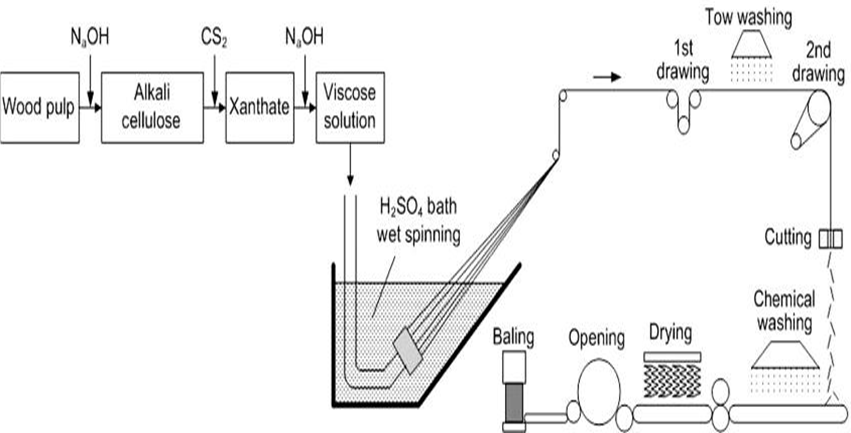
Viscose Process: Cellulose reacts with caustic soda and carbon disulfide to form cellulose xanthate, which is dissolved to create viscose solution.
Acetate Process: Cellulose undergoes acetylation, forming cellulose acetate that dissolves in organic solvents.
Lyocell Process: Cellulose is directly dissolved in N-methylmorpholine N-oxide (NMMO), a solvent that allows near-complete recovery and reuse—making it the most eco-friendly method.
Viscose Process: Cellulose reacts with caustic soda and carbon disulfide to form cellulose xanthate, which is dissolved to create viscose solution.
Acetate Process: Cellulose undergoes acetylation, forming cellulose acetate that dissolves in organic solvents.
Lyocell Process: Cellulose is directly dissolved in N-methylmorpholine N-oxide (NMMO), a solvent that allows near-complete recovery and reuse—making it the most eco-friendly method.
Despite their differences, all processes aim to achieve the same goal: converting natural cellulose into a homogeneous liquid suitable for spinning.
Step 2: Filament Formation Through Spinnerets
The spinning dope is extruded through a spinneret, a precision device resembling a showerhead with hundreds of microscopic holes. As the solution passes through these holes, it forms continuous streams that solidify into filaments. Engineers carefully control flow rate, pressure and temperature to ensure uniformity. The resulting filaments are gathered into bundles, forming the basis of regenerated yarn.
Step 3: Regeneration and Solidification
Once extruded, the liquid filaments must be converted back into solid fibers—a process known as regeneration. Depending on the fiber type, this may involve chemical coagulation or solvent evaporation. In viscose production, for example, the filaments pass through a coagulation bath containing sulfuric acid and sodium sulfate, which reconverts the cellulose into solid form. This stage gives regenerated fibers their name—they are literally “reborn” cellulose.
Spinning Methods in Regenerated Filament Production
Regenerated cellulose filaments are produced using three major spinning methods. Each method differs based on how the polymer solution solidifies into filaments.
Wet Spinning (Viscose, Cuprammonium Rayon)
Wet spinning is the most traditional and widely used method, particularly for viscose and cuprammonium rayon. The spinning dope is extruded into a coagulation bath, where chemical reactions regenerate cellulose. Subsequent washing, stretching and purification steps refine the fiber’s texture and strength. The result is a filament with high luster, smooth texture and excellent drape, commonly used in sarees, linings and decorative fabrics.
Process in short:
- The viscose solution is extruded
- Filaments enter a chemical bath (often sulfuric acid + sodium sulfate)
- Cellulose regenerates
- Fibers are washed, stretched and strengthened
What you get:
- Bright, smooth, silky filaments
- Great for high-luster fabrics
- Used in sarees, dress materials, linings, drapery… lots of flowy stuff
Dry Spinning (Acetate, Triacetate)
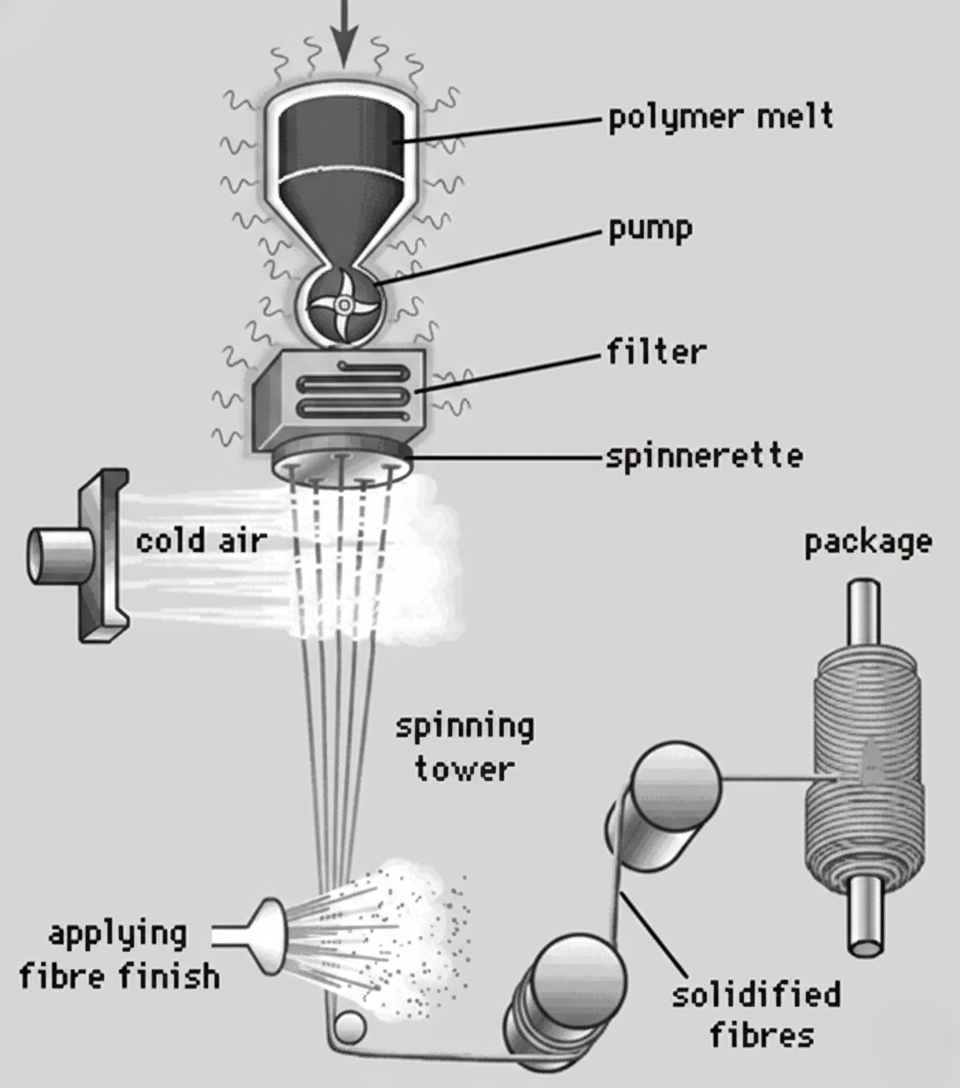
Used primarily for acetate and triacetate fibers, dry spinning involves extruding the solution into heated air. The solvent evaporates rapidly, leaving behind solid filaments. These fibers are known for their soft hand feel, luxurious drape and wrinkle resistance, making them ideal for premium fashion fabrics and elegant evening wear.
Process:
- Solution is extruded into warm air
- Solvent evaporates quickly
- Solid filaments remain
End result:
- Soft, drapey filaments
- Widely used in acetate fabrics with that luxurious feel
Lyocell Solvent Spinning (Eco-Friendly Option)
Lyocell represents the modern face of regenerated fiber production. It uses direct cellulose dissolution in NMMO solvent within a closed-loop system, where over 99% of the solvent is recovered and reused. This process minimizes environmental impact while producing filaments with high tensile strength, excellent moisture management and silky smoothness. Lyocell’s eco-friendly credentials have made it a favorite among sustainable brands worldwide.
What’s different:
- Cellulose dissolves directly in NMMO—no heavy chemical conversion
- Up to 99% of solvent is recovered and reused
Output:
- Strong, breathable, smooth filaments
- Lower environmental impact compared to traditional viscose
Drawing and Orientation
After spinning, the filaments aren’t quite ready yet.
Freshly spun filaments initially have limited strength. Through drawing, the fibers are stretched to several times their original length, aligning cellulose molecules along the fiber axis. This molecular orientation enhances tensile strength, elasticity, dimensional stability and luster. In practical terms, drawn filaments resist shrinkage and maintain uniformity—qualities essential for weaving and knitting operations.
Benefits:
- Higher strength
- Better elasticity
- More uniform yarn
- Improved luster
- Less shrinkage
Finishing Treatments
After drawing, fibers undergo finishing treatments to improve handling and performance. Lubricants and softeners reduce friction during weaving, while anti-static finishes prevent electrostatic buildup. Dye-affinity enhancers ensure consistent coloration. These treatments transform raw filaments into materials that perform reliably in high-speed textile machinery, ensuring smooth production and superior fabric quality.
Common finishes include:
- Lubricants
- Anti-static agents
- Softeners
- Dye-affinity enhancers
These help during downstream processes like weaving and knitting. Also makes handling easier. Less friction, more consistency.
Winding and Packaging
Finally, The finished filaments are wound onto cones, bobbins or industrial spools. Each package must meet strict quality standards—consistent denier, tensile strength, filament continuity and surface smoothness. Advanced inspection systems detect even microscopic irregularities. This meticulous quality control ensures that regenerated filament yarns integrate seamlessly into downstream processes like weaving, knitting and dyeing.
the filaments are wound into usable formats:
- Cones
- Bobbins
- Cheese packages
- Industrial spools
Before shipping out, they go through quality checks:
- Denier uniformity
- Strength consistency
- Filament continuity
- Surface smoothness
Only then are they ready for fabric production or industrial use.
Applications of Regenerated Filament Yarn
Apparel and Fashion
Regenerated filaments are prized in fashion for their silk-like elegance and comfort. They appear in sarees, dresses, scarves, blouses and lingerie. Designers appreciate their drape and sheen, while consumers enjoy their softness and breathability.
Home Textiles
In home décor, viscose and acetate filaments bring sophistication to curtains, upholstery and bedding. Their ability to hold vibrant colors and resist pilling makes them ideal for decorative fabrics that combine beauty with durability.
Industrial Applications
Beyond fashion, regenerated filaments serve in technical textiles—tire cords, medical products and composite reinforcements. Their controlled strength and uniformity make them suitable for demanding industrial environments.
Future Trends and Sustainability
The future of regenerated filament yarn lies in eco-innovation. Closed-loop solvent systems, biodegradable fibers and circular manufacturing models are reshaping the industry. Lyocell technology continues to lead sustainability efforts, while research into bio-based solvents and nanocellulose promises even greener alternatives. As consumers demand transparency and responsibility, regenerated filaments are poised to become the cornerstone of sustainable textile production.
Final Thought
Regenerated filament yarn is the ideal mix between nature and engineering. Made from renewable cellulose and sophisticated technology, these fibres offer a unique combination of silken appearance, comfort, dyeability and versatility. They are silently running many products that we use each day, from fancy clothes to technical fabrics.
Regenerated filaments are at the forefront of the textile industry’s shift to sustainability, proving that innovation and environmental stewardship can co-exist beautifully. These are not just fibers, they are a testament to how science can reinvent nature for a better, more sustainable future.