Filament yarns are produced from long, continuous fibres of synthetic or regenerated fibres. Filament yarn is a popular choice for apparel, home textiles and industrial applications due to its strength, smoothness and uniformity.
Filament yarn Common polymer sources include:
-
Polyester (PET): –[O–CH₂–CH₂–O–CO–C₆H₄–CO]–n
-
Nylon (Polyamide – e.g., Nylon 6 / Nylon 66) : –[NH–(CH₂)₅–CO]–n
Polypropylene (PP) : –[CH₂–CH(CH₃)]–n
-
Viscose/Rayon: –[C₆H₁₀O₅]–n
-
Acrylic (Polyacrylonitrile – PAN) : –[CH₂–CH(CN)]–n
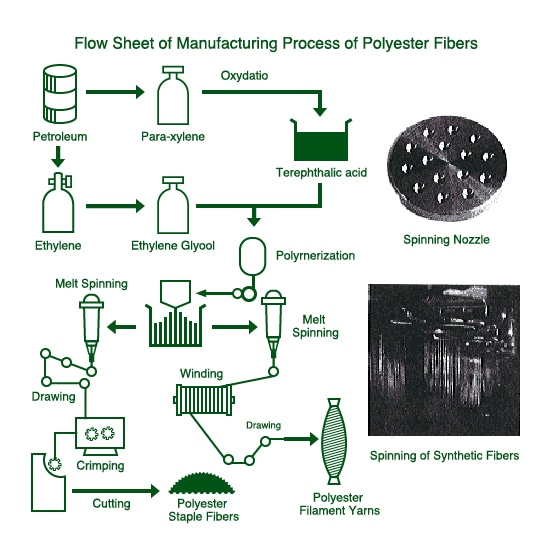
Manufacturing Process of Polyester Fibres
Polyester is one of the most widely used man-made fibres in the textile industry globally, accounting for more than half of the total fibre consumption in the world. Its popularity is due to a combination of low cost, high strength, durability, versatility and ease of processing.
Polyester fibres are long-chain polymers obtained from the condensation polymerization of diols and dicarboxylic acids, which most commonly yields Polyethylene Terephthalate (PET). Polyester fibres can be made in the form of:
- Filament fibres (POY, FDY)
- Staple fibres (PSF)
- Industrial fibres (tire cords, technical textiles)
Understanding the manufacturing process is critical for controlling fiber quality, cost, sustainability and downstream textile performance.
Raw Materials Used in Polyester Fibre Production
The basic raw materials for polyester fibre manufacturing are derived from petrochemical sources.
Primary Raw Materials
- Purified Terephthalic Acid (PTA) or Dimethyl Terephthalate (DMT)
- Monoethylene Glycol (MEG)
Auxiliary Materials
- Catalysts (Antimony, Titanium-based)
- Stabilizers
- Delusterants (Titanium Dioxide – TiO₂)
- Additives for UV resistance, flame retardancy or dyeability
The purity of raw materials directly affects:
- Polymer molecular weight
- Fiber strength
- Color clarity
- Spinnability
Polyester Fibre Manufacturing major Stages
The polyester fibre production process can be broadly divided into four major stages:
- Polymerization
- Melt Spinning
- Drawing (Orientation)
- Post‑Spinning Treatments & Cutting (for staple fibres)
Each stage determines final fibre performance characteristics.
Filament Yarn Manufacturing Process
Below is a complete, easy‑to‑read explanation of how filament yarn is produced, including preparation, spinning, drawing, finishing and final applications.
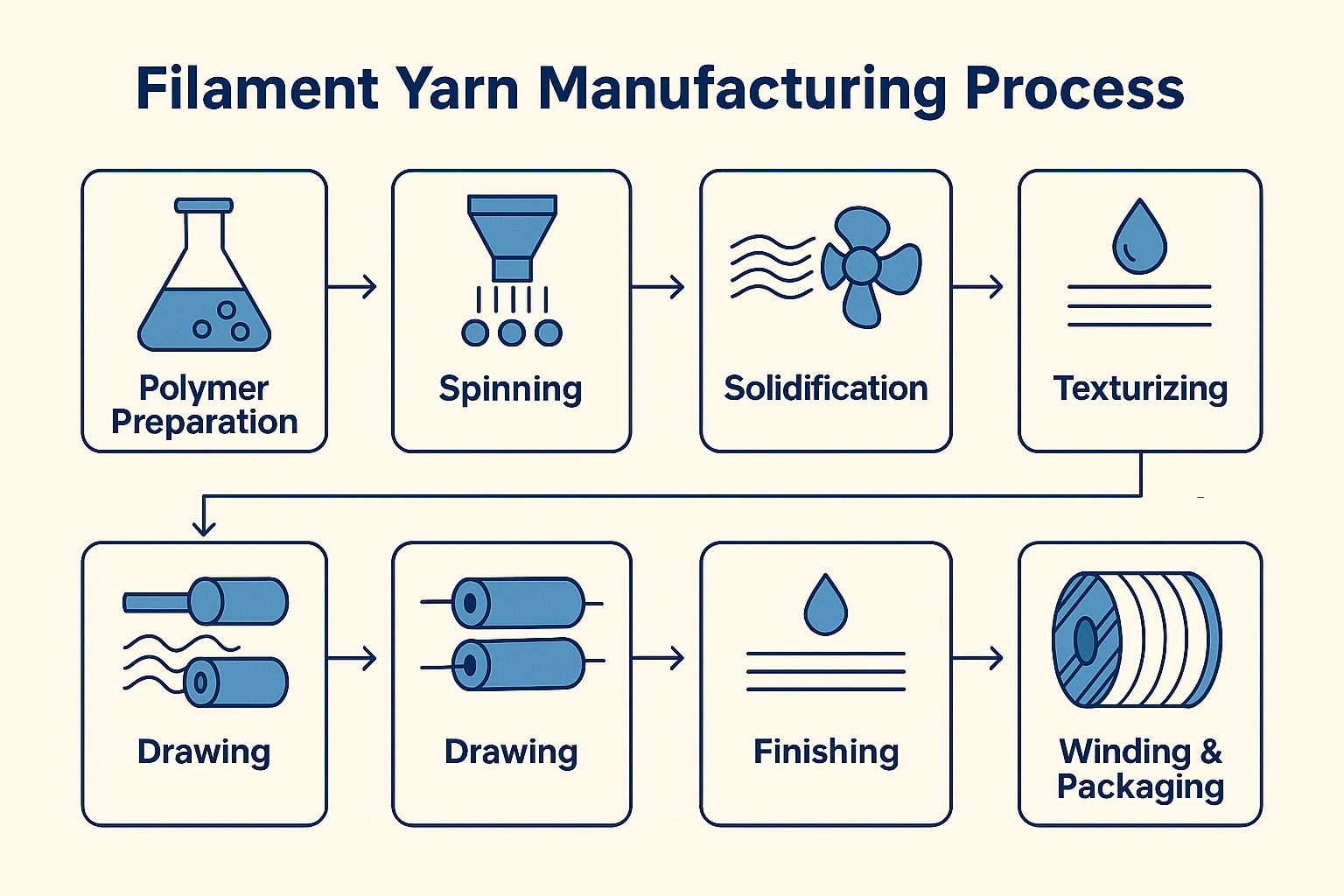
1. Polymer Preparation
Filament yarn production begins with preparing the base polymer, which can be done in two ways:
a) Melt Polymer (e.g., Polyester, Nylon, Polypropylene)
Polymer chips are:
- dried
- melted
- filtered to remove impurities
b) Solution Polymer (e.g., Viscose, Acrylic)
Polymer is dissolved in specific chemicals to create a thick, spinnable solution known as dope.
Goal: Produce a clean, impurity‑free polymer mixture for smooth and consistent spinning.
2. Spinning (Extrusion Process)
Spinning is the central step of filament yarn manufacturing.
The molten polymer or polymer solution is pumped through a spinneret — a metal plate with many micro‑holes.
- Each hole forms one continuous filament.
Types of Spinning
- Melt Spinning – polyester, nylon, polypropylene
- Wet Spinning – viscose, acrylic
- Dry Spinning – acetate, spandex
Outcome: Continuous filaments emerging in a liquid or softened condition, ready for solidification.
3. Solidification
After extrusion, filaments must be solidified to gain structure.
- Melt‑spun yarns: cooled with cold air
- Wet‑spun yarns: solidified in a coagulation bath
- Dry‑spun yarns: formed as solvent evaporates
This step produces stable, continuous filaments suitable for drawing.
4. Drawing (Orientation Process)
Freshly spun filaments are weak and have disordered molecular alignment.
Drawing stretches them several times their original length.
Benefits of Drawing
- Increases tensile strength
- Improves elasticity
- Enhances uniformity
- Reduces shrinkage
Depending on stretching level, the yarn becomes:
- FOY (Fully Oriented Yarn)
- POY (Partially Oriented Yarn)
5. Texturizing (Optional)
Texturizing gives smooth filaments a natural‑fiber feel, adding bulk and stretch.
Common Texturizing Methods
- False‑twist texturizing
- Air‑jet texturizing
- Stuffer‑box texturizing
This converts flat filaments into DTY (Draw Textured Yarn) — widely used in knitted apparel.
6. Finishing
Before winding, yarns are treated with:
- anti‑static agents
- lubricants
- spin finishes
Purpose: Improve weaving performance, knitting smoothness, handling quality and dye absorption.
7. Winding & Packaging
Finally, the finished yarn is wound onto:
- cones
- bobbins
- cheese packages
- industrial spools
After inspection, the yarn is packed and sent to mills for weaving, knitting or industrial processing.
Types of Filament Yarns Produced
POY (Partially Oriented Yarn)
POY is a semi-finished yarn that has not been fully drawn. It is mainly used as a base for further processing.
- Low to medium orientation
- High elongation
- Used as input for DTY production
FDY (Fully Drawn Yarn)
FDY is fully stretched and ready for direct use in fabric production without further processing.
- High strength and stability
- Smooth and uniform surface
- Used in weaving, knitting, and direct fabric manufacturing
DTY (Draw Textured Yarn)
DTY is produced from POY through a process of drawing and texturing, giving it a crimped structure.
- Soft and bulky texture
- High elasticity and comfort
- Widely used in apparel and knitwear
MOY (Medium Oriented Yarn)
MOY has a moderate level of orientation and lies between POY and FDY in terms of properties.
- Medium strength and elongation
- Used for specific technical and industrial applications
HOY (High Oriented Yarn)
HOY has higher molecular orientation than POY, providing better strength and performance.
- Improved strength and dimensional stability
- Suitable for industrial and performance fabrics
Monofilament Yarn
Monofilament yarn consists of a single continuous filament.
- Smooth and stiff structure
- High strength and durability
- Used in fishing lines, nets, and technical applications
Multifilament Yarn
Multifilament yarn is made up of multiple fine filaments twisted or combined together.
- Flexible and soft
- Better drape compared to monofilament
- Widely used in apparel and home textiles
Applications of Filament Yarn
Filament yarns are highly versatile and are used across different industries due to their strength, uniformity, and adaptability. Their applications range from fashion garments to heavy industrial products.
Apparel Applications
Filament yarns are widely used in clothing due to their smooth texture and strength.
- Sarees and traditional wear
- Sportswear and activewear
- Lingerie and innerwear
- Shirts, dresses, and fashion garments
Home Textile Applications
In home furnishings, filament yarns provide durability and aesthetic appeal.
- Curtains and drapes
- Carpets and rugs
- Upholstery fabrics
Industrial Applications
Filament yarns are also essential in technical and heavy-duty applications due to their high strength and performance.
- Ropes and fishing nets
- Airbags and safety materials
- Seatbelts
- Tire cords
- Geotextiles for construction and infrastructure