Mercerization is basically a chemical finishing process used on cotton. The fabric (or yarn) is treated with caustic soda (sodium hydroxide, NaOH) under controlled conditions.
What this does is change the fiber structure — not just on the surface, but internally too. And once it’s done, the changes are permanent.
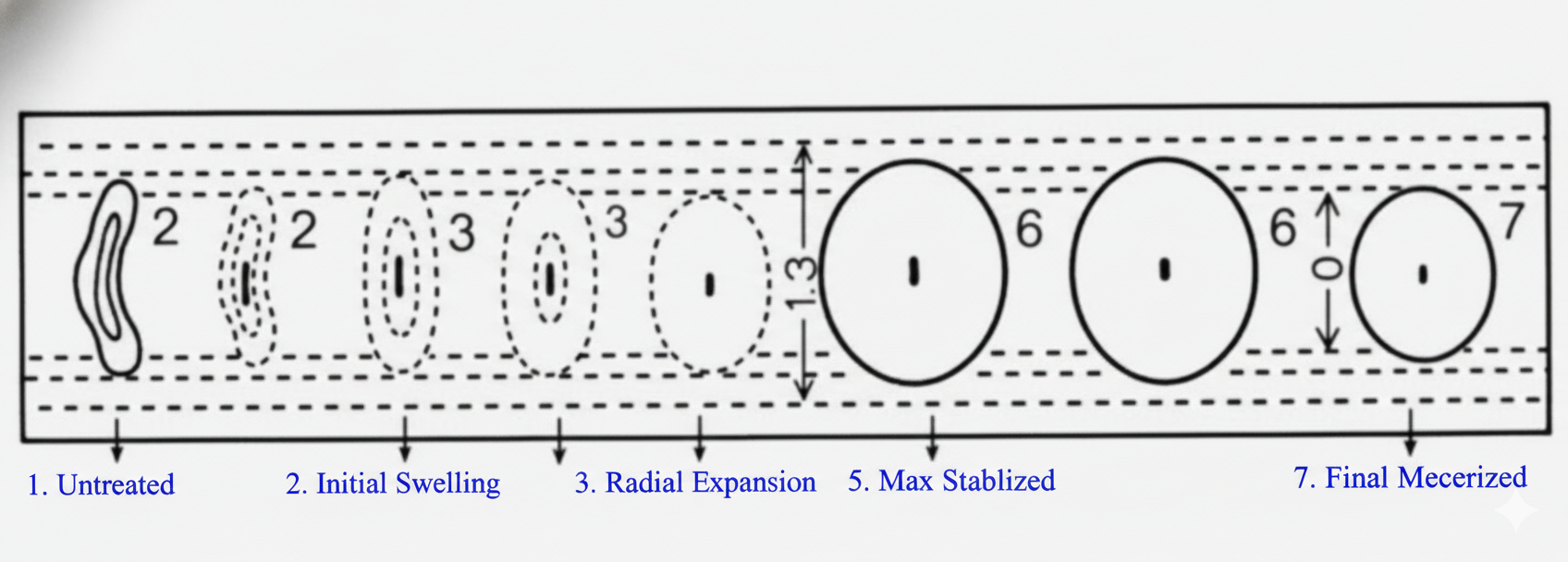
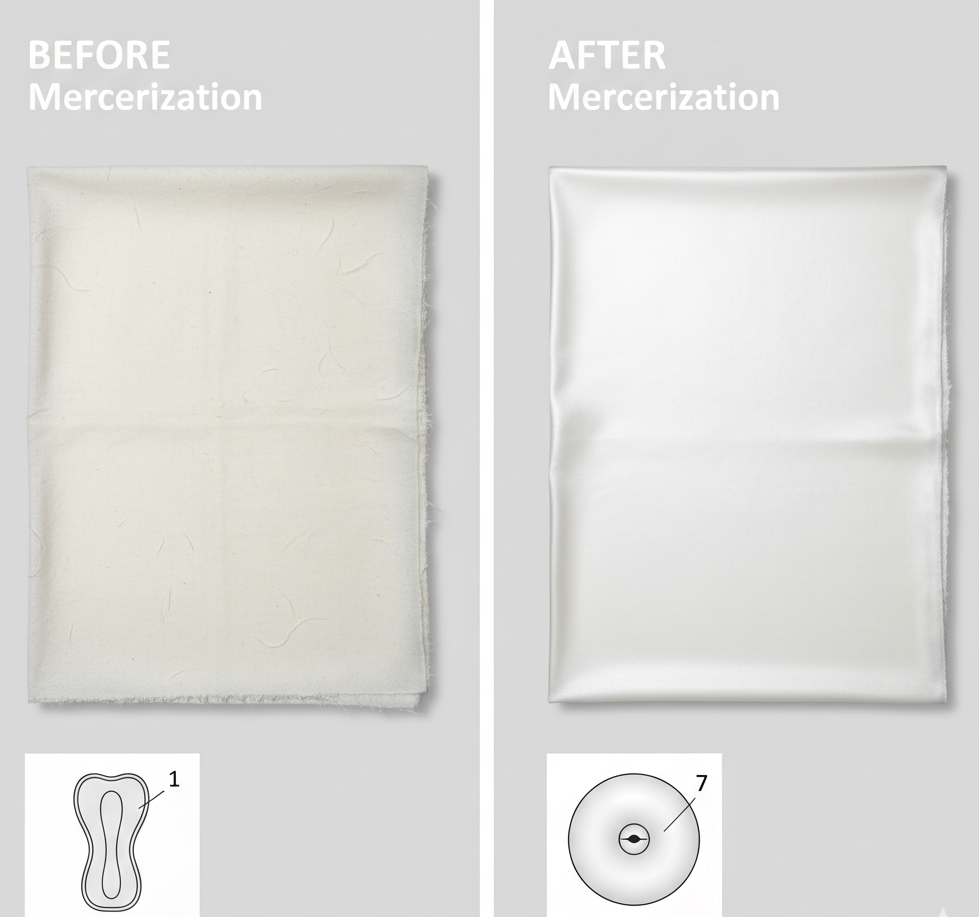
You can actually see the difference if you compare before and after: the fiber cross-section goes from a sort of flattened, twisted shape to something more rounded and smooth.
Where It’s Used
Mostly on:
Process of Mercerization
Chemistry Behind Mercerization
Chemical Reaction
Cotton (cellulose) reacts with NaOH to form alkali-cellulose:
Cellulose + NaOH → Alkali Cellulose
When the alkali is washed out, it regenerates cellulose but with:
- More uniform molecular orientation
- Reduced internal voids
- Increased fibril alignment
Why Mercerization Is Done
Not complicated, really. The goal is to improve both look and performance:
- Increase fabric strength
- Improve luster (that slight shine)
- Make dye colors richer
- Improve dimensional stability
- Reduce fuzziness
- Make the fabric feel smoother
Working Principle
When cotton is dipped into strong NaOH, the fibers start swelling — sideways, not lengthwise.
During this:
- The natural twisted shape straightens out
- The fiber becomes more cylindrical
- Internal structure rearranges
This opens up more space for dyes and chemicals.
Then the alkali is washed out and that new structure stays.
Mercerization Process Flow
A. Material Stage Options
Mercerization can be done at:
- Fiber stage (less common)
- Yarn stage (common in high-quality yarns)
- Fabric stage (woven/knitted)
B. Typical Process Steps
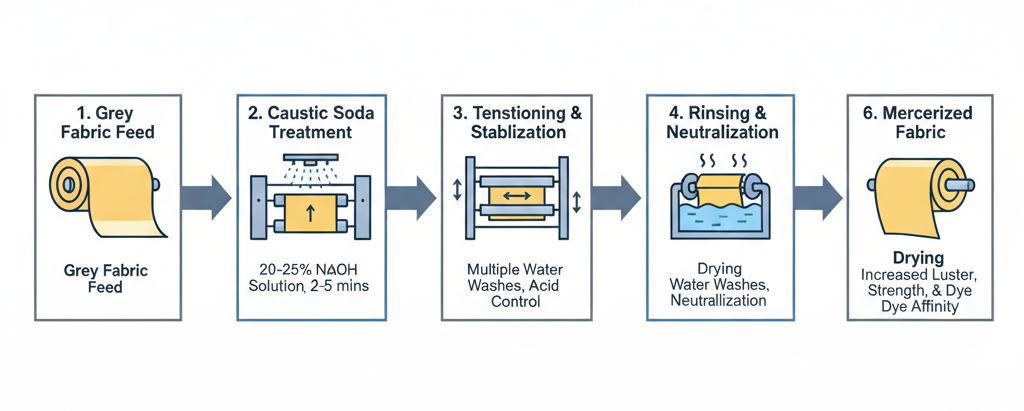
Step 1: Caustic Application
- NaOH concentration: 20–30%
- Temperature: Room temperature (20–25°C)
- Time: 10–60 seconds, depending on fabric type
Step 2: Tensioning
- Fabric is held tight to prevent shrinkage
- Creates smooth, lustrous surface
- Very important for knit fabrics
Step 3: Washing Off
- Multiple hot and cold washes
- Neutralization with acetic acid
Step 4: Final Drying
- Fabric is stabilised through stenter or dryer.
Types of Mercerization
Caustic Soda Mercerization
The most common industrial mercerization method. Cotton fabric or yarn is treated with concentrated caustic soda under controlled tension.
Main Chemicals
| Material | Chemical Formula |
|---|---|
| Caustic Soda (Sodium Hydroxide) | NaOH |
| Cellulose (Cotton) | (C₆H₁₀O₅)ₙ |
| Water | H₂O |
| Acetic Acid (Neutralization) | CH₃COOH |
Characteristics
- Maximum luster improvement
- Increased dye absorption
- Improved fabric strength
- Better dimensional stability
- Enhanced smoothness
Uses
- Cotton apparel
- Knit fabrics
- Woven fabrics
- High-quality textile products
Liquid Ammonia Mercerization
A premium finishing process where fabric is treated with liquid ammonia instead of, or sometimes in combination with, caustic soda.
Main Chemicals
| Material | Chemical Formula |
|---|---|
| Liquid Ammonia | NH₃ |
| Cellulose (Cotton) | (C₆H₁₀O₅)ₙ |
| Water | H₂O |
Characteristics
- Superior softness
- Excellent crease recovery
- Smooth surface appearance
- Improved dimensional stability
- Better fabric handle
Uses
- Premium shirting fabrics
- Luxury cotton garments
- High-end denim
- Fine woven textiles
Cold Mercerization
Mercerization carried out at relatively low temperatures, typically 20–25°C.
Main Chemicals
| Material | Chemical Formula |
|---|---|
| Sodium Hydroxide | NaOH |
| Water | H₂O |
| Cellulose | (C₆H₁₀O₅)ₙ |
Characteristics
- Most widely used process
- Better control of fiber swelling
- High luster development
- Consistent dyeability
Uses
- Standard cotton processing
- Knits and woven fabrics
- Large-scale textile production
Hot Mercerization
Mercerization performed at elevated temperatures, typically 35–50°C.
Main Chemicals
| Material | Chemical Formula |
|---|---|
| Sodium Hydroxide | NaOH |
| Cellulose | (C₆H₁₀O₅)ₙ |
| Water | H₂O |
Characteristics
- Faster processing
- Reduced treatment time
- Suitable for heavy fabrics
- Often used in denim finishing
Uses
- Denim fabrics
- Heavy cotton fabrics
- Industrial textile processing
Mercerization Chemical Reaction
During mercerization, cellulose reacts with sodium hydroxide:
Cellulose + NaOH → Alkali Cellulose2(C₆H₁₀O₅)ₙ + NaOH → Swollen Cellulose StructureShow more linesThis structural change improves:
- Dye uptake
- Fabric luster
- Tensile strength
- Dimensional stability
Key Chemical Symbols Used in Mercerization
| Chemical | Formula |
|---|---|
| Sodium Hydroxide (Caustic Soda) | NaOH |
| Liquid Ammonia | NH₃ |
| Cellulose (Cotton) | (C₆H₁₀O₅)ₙ |
| Water | H₂O |
| Acetic Acid | CH₃COOH |
Most Important Chemical Components
- Caustic Soda Mercerization: NaOH + Cellulose (C₆H₁₀O₅)ₙ
- Liquid Ammonia Mercerization: NH₃ + Cellulose (C₆H₁₀O₅)ₙ
These chemical treatments alter the cellulose structure, giving mercerized fabrics their characteristic luster, strength, softness, and enhanced dyeability.
Key Effects on Fabric Properties
Strength Improvement
Mercerized cotton exhibits higher tensile strength due to better molecular alignment.
Enhanced Luster
The smoother, rounder fiber surface reflects light more evenly, giving the fabric a silk‑like shine.
Improved Dye Affinity
Dyes penetrate deeper and more uniformly, resulting in:
- Deeper shades
- Better color fastness
- Reduced dye consumption
Deeper shades
Better color fastness
Reduced dye consumption
Better Dimensional Stability
Shrinkage during subsequent washing is reduced.
Benefits of Mercerization
Aesthetic Enhancements
- Silk-like luster
- Brighter and deeper colors
- Improved fabric hand feel
Mechanical/Physical Improvements
- +15–25% tensile strength
- +20–30% dye uptake
- +5–10% shrinkage control
- Improved dimensional stability
Dyeing & Finishing Advantages
- Enhanced reactivity with reactive dyes
- Uniform color penetration
- Less patchiness in dark shades
Mercerization in Knits vs. Wovens
Property Knitted Fabric Woven Fabric Shrinkage risk Higher Lower Tension control Critical Moderate Typical use Premium T-shirts, polo Shirting, sateen Challenges Loop distortion Luster uniformity
| Property | Knitted Fabric | Woven Fabric |
|---|---|---|
| Shrinkage risk | Higher | Lower |
| Tension control | Critical | Moderate |
| Typical use | Premium T-shirts, polo | Shirting, sateen |
| Challenges | Loop distortion | Luster uniformity |
Mercerization Machine Types
Common types:
- Chain mercerizer (woven fabrics, high speed)
- Pad-chain mercerizer (both knit & woven)
- Relax mercerizer (for knits, allows controlled shrinkage)
Main components usually include:
- Caustic bath
- Tension rollers
- Squeeze rollers
- Washing unit
- Neutralizing section
- Dryer or stenter
Quality Parameters to Monitor
Parameter Ideal Range NaOH concentration 22–30% Caustic temperature 20–25°C Mercerization time 20–60 sec Tension High (to prevent shrinkage) PH after wash 7 (neutral) Degree of mercerization >85% (reflectance test)
| Parameter | Ideal Range |
|---|---|
| NaOH concentration | 22–30% |
| Caustic temperature | 20–25°C |
| Mercerization time | 20–60 sec |
| Tension | High (to prevent shrinkage) |
| PH after wash | 7 (neutral) |
| Degree of mercerization | >85% (reflectance test) |
Common Defects & Causes
| Defect | Cause |
|---|---|
| Uneven dyeing | Poor squeezing, uneven NaOH pickup |
| Creases | Low tension, improper guiding |
| Low luster | Low NaOH concentration, insufficient tension |
| Strength loss | Excess time in alkali, high temperature |
Applications of Mercerized Fabrics
- High‑quality T-shirts
- Polo shirts
- Sateen bed sheets
- High‑end shirting
- Knitted undergarments
- Embroidery threads
You’ll often see it marketed as:
“Mercerized Cotton,” “Pearl Cotton,” “Royal Cotton,” or “Gassed & Mercerized Cotton.”
- High‑quality T-shirts
- Polo shirts
- Sateen bed sheets
- High‑end shirting
- Knitted undergarments
- Embroidery threads
You’ll often see it marketed as: “Mercerized Cotton,” “Pearl Cotton,” “Royal Cotton,” or “Gassed & Mercerized Cotton.”
Final Thought: Mercerization
Mercerization might look like just another finishing step, but it actually does a lot more than people expect. It quietly upgrades cotton — makes it stronger, smoother, and more responsive to dye — without changing the basic character of the fabric.
The difference shows up later. Better color, cleaner surface, less shrinkage… things that really matter in final garments, especially in quality-focused products.
Of course, it’s not something you can rush. Small variations in tension, chemical strength, or timing can easily affect the result. That’s why consistency on the production floor matters just as much as the process itself.
In the end, mercerization is less about adding something new, and more about bringing out the best in cotton — making a good fabric feel just a bit more refined, a bit more premium.
Mercerization might look like just another finishing step, but it actually does a lot more than people expect. It quietly upgrades cotton — makes it stronger, smoother, and more responsive to dye — without changing the basic character of the fabric.
The difference shows up later. Better color, cleaner surface, less shrinkage… things that really matter in final garments, especially in quality-focused products.
Of course, it’s not something you can rush. Small variations in tension, chemical strength, or timing can easily affect the result. That’s why consistency on the production floor matters just as much as the process itself.
In the end, mercerization is less about adding something new, and more about bringing out the best in cotton — making a good fabric feel just a bit more refined, a bit more premium.