/article/dye-classes-fibre-compatibility/
Yarn Mix & Blend – Engineered for Performance, Cost and Comfort
When people talk about yarn quality, they often jump straight to fibre type. Cotton. Polyester. Viscose.
But that’s only half the picture.
How those fibres are combined—that’s where things start to get interesting.
Sometimes you’re not changing the fibre at all. Just how it’s put together. Other times, you’re mixing completely different fibres to get a very specific outcome. Comfort, strength, cost… you name it.
Mix:
A mix is pretty straightforward. Same fibre, combined together.
Think of taking two cotton yarns and twisting them. Nothing fancy in terms of material—but the behavior changes a bit.
What you get:
- More uniform yarn
- Slightly better strength
- A bit of visual texture (especially in something like twisted black yarn)
It’s subtle. But useful in the right context.
Blend:
Now blends—that’s where the real engineering comes in.
A blend combines different fibre types to balance properties. One fibre fills the gap of another.
Classic example: 80% cotton / 20% polyester
- Cotton → breathable, soft
- Polyester → strong, less wrinkling
Put them together… you get something more balanced. Not perfect, but practical.
Key benefits of blends:
- Better durability and strength
- More stable fabric behavior (less shrinkage surprises)
- Improved performance overall
And yes—usually better cost control too.
Common Yarn Blends & What They’re Best For
CVC (Chief Value Cotton) – Cotton/Polyester ≈ 60/40
- Why it’s used: Cost-effective, soft hand feel with better pilling resistance and reduced shrinkage than 100% cotton.
- Applications: T‑shirts, polos, uniforms, casual wear.
PC (Polyester/Cotton ≈ 50/50)
- Why it’s used: Balanced performance—durable, fast-drying and stable after repeated laundering.
- Applications: Sportswear, workwear, blended shirting.
PV (Polyester/Viscose ≈ 80/20)
- Why it’s used: Smooth hand, elegant drape, good dimensional stability and rich color.
- Applications: Corporate wear, trousers, suiting blends, fashion knits.
CV (Cotton/Viscose ≈ 60/40)
- Why it’s used: Breathability of cotton with viscose’s silk-like feel and dye brilliance.
- Applications: Premium tees, dresses, soft-touch knitwear.
Quick note: These ratios aren’t fixed.
Factories tweak them all the time—depending on GSM targets, cost limits, or just the “feel” they’re chasing.
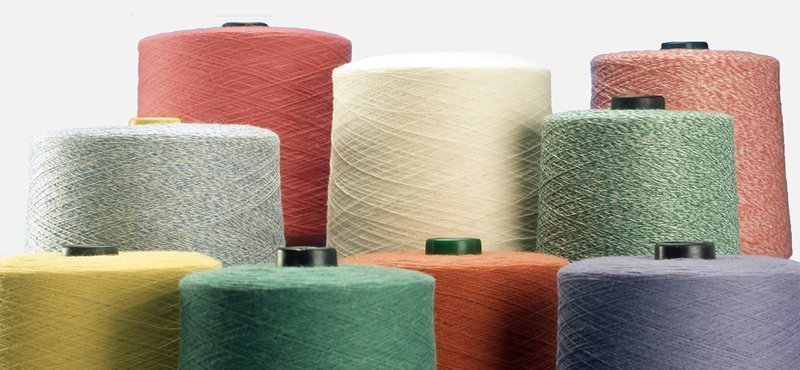
Melange Color Lines (Typical Recipes & Look)
Dark Grey Melange – 85% Cotton / 15% Viscose
- Look & feel: Deep heather, strong shade contrast, soft handle.
- Use cases: Athleisure, hoodies, heavier jerseys where visual texture matters.
Grey Melange – 90% Cotton / 10% Viscose
- Look & feel: Classic mid-grey heather, everyday comfort.
- Use cases: Core tees, sweatshirts, kidswear.
Light Grey Melange – 95% Cotton / 5% Viscose
- Look & feel: Fine, subtle heather with a clean surface.
- Use cases: Fashion basics, performance tees, layering pieces.
Ecru Melange – 98% Cotton / 2% Viscose
- Look & feel: Natural tone with a gentle, almost solid heather.
- Use cases: Eco-led capsules, undyed/natural collections, premium basics.
Why Choose Blends?
There’s no single reason. It’s more like a mix of small advantages.
Hand feel & drape
Viscose softens things. Polyester stabilizes. Cotton keeps it breathable.
Durability & care
Polyester quietly does its job—adds strength, speeds up drying, reduces wrinkles.
Color & appearance
Viscose takes dye beautifully. Mélange spinning adds depth you can’t fake later.
Cost side of things
Blending helps control price without killing performance. That balance matters. A lot.
A few Practical note on Quality & Manufacturing
This part doesn’t always make it into summaries—but it matters.
fibre prep
If bale selection or humidity isn’t right, blending goes uneven. You’ll see it later as neps or shade variation.
Spinning method
Ring, open-end, compact—each one changes the final look and pilling behavior.
Dyeing approach
For mélange, fibres are often pre-dyed before spinning. That’s how you lock in those heather shades.
Testing (non-negotiable)
- Pilling
- Shrinkage
- Colorfastness (wash and rub)
- Dimensional stability
- Spirality
Miss testing… problems show up later. Always.
Recommended End Uses by Blend
| Blend | Comfort | Durability | Drape | Typical Products |
|---|---|---|---|---|
| CVC 60/40 | High | High | Medium | Tees, polos, uniforms |
| PC 50/50 | Medium | Very High | Medium | Workwear, sportswear |
| PV 80/20 | Medium | High | High | Corporate wear, suiting knits |
| CV 60/40 | Very High | Medium | High | Premium knits, dresses |
| Mélange (various) | High | Medium–High | Medium–High | Fashion basics, athleisure |
These aren’t fixed rules, by the way.
Yarn count, knitting structure, finishing—all of that can shift the final result.
Final thought
Mixes are simple. Blends are strategy.
One keeps things consistent. The other tries to get the “best of both.”
And sometimes, it works really well. Other times… it’s all about compromises.
That’s textile engineering in a nutshell. Not perfect—but always intentional.