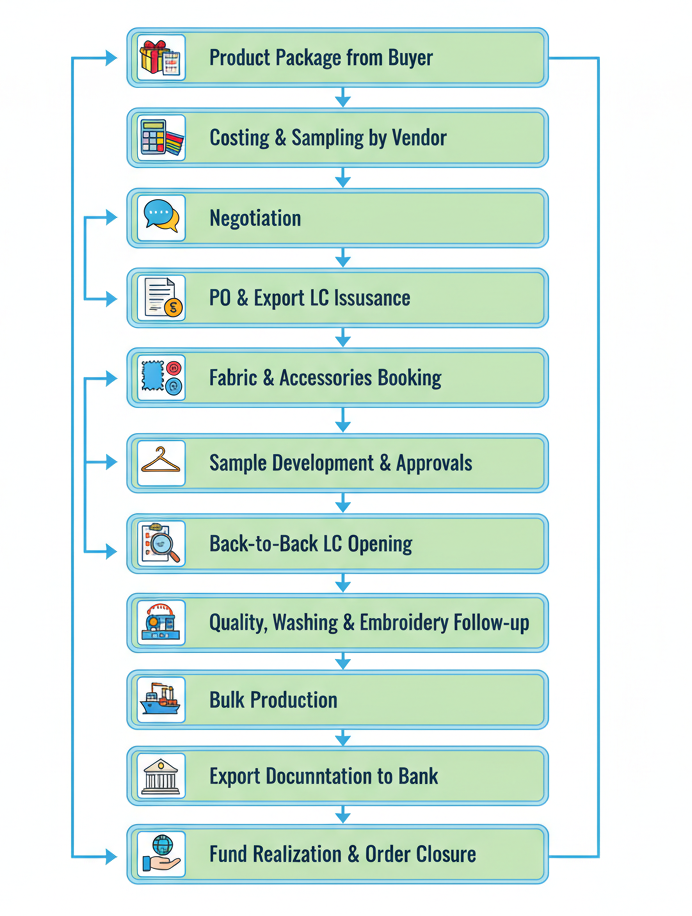
Process steps of Merchandising
- Product Package from Buyer
- Costing & Sampling by Vendor
- Negotiation
- Buyer Confirmation
- PO & Export LC Issuance
- Fabric & Accessories Booking
- Sample Development & Approvals
- Back‑to‑Back LC Opening
- Pre‑Production Review
- Bulk Production
- Quality, Washing & Embroidery Follow‑up
- Shipment Booking
- Export Documentation
- Document Submission to Bank
- Fund Realization & Order Closure
Buyer Product Package and Initial Development
Product Package from Buyer
The merchandising cycle starts when the buyer provides a product package, containing:
- Technical specification (tech pack)
- Measurement chart
- Fabric and trim details
- Artwork or embellishment requirements
- Target price and delivery timeline
This package becomes the foundation for all downstream merchandising activities.
Costing and Sampling by Vendor
- Detailed garment costing
- Fabric and trim consumption
- Initial sample development
Costing accuracy at this stage is critical for profitability and buyer acceptance.
Negotiation and Buyer Confirmation
- Costing
- Sample estimations
- Lead‑time proposals
Negotiation takes place between buyer and vendor regarding price, delivery and quality expectations. Once agreed, the buyer provides order confirmation.
Sampling and Material Booking Process
Sample Development Stages
In the process different types of samples are developed, each with a specific purpose. These include proto samples, pre-line samples, size set samples, pre-production approval samples (PAS), seal samples and salesman samples. Each sample has to pass the standards of the buyer before it can be moved on to the next level.
here multiple samples are developed and submitted for approval, including:
- Proto sample
- Preline sample
- Size set sample
- PAS (Pre‑production Approval Sample)
- Seal sample
- Salesman sample
Each sample serves a specific approval purpose and must meet buyer standards.
Samples Approval (Local & International)
Samples are inspected and approved either locally at the buying office or abroad at the buyer’s HQ. Official approval is required and production cannot start until all required samples are officially approved.
Fabric and Accessories Booking
Once the order is confirmed, the fabric is booked with nominated or vendor selected suppliers. Also laid out are accessories such as trimmings, labels, buttons and zippers. In addition, approved vendors are responsible for initiating processes such as embroidery, applique, and printing. Prompt booking is important to avoid shortages and production delays.
Commercial and Banking Formalities
Issuance and Verification of Purchase Order and Export LC
The Purchase Order (PO) and Export Letter of Credit (LC) will be issued by the Buyer. Merchandisers check these documents carefully for accuracy of price, quantity, shipment date and payment terms. All inconsistencies need to be addressed before moving on.
Merchandisers collect proforma invoices from suppliers to finalize LC values, to keep cost control and to declare material utilization accurately. This step is important to ensure transparency and financial discipline.
Merchandisers verify PO and LC for:
- Price
- Quantity
- Shipment date
- Payment terms
Discrepancies must be resolved before proceeding.
Back‑to‑Back LC Opening and Lien Arrangement
On confirmation of the export LC, a back-to-back LC is opened in favour of the fabric and accessory suppliers. At the same time, export LC is liened with bank. This mechanism allows to pay suppliers, but with financial control and security.
- Back‑to‑Back LC is opened in favor of fabric and accessory suppliers
- Export LC lien is placed to local bank
Collection of Proforma Invoices
Merchandisers collect proforma invoices from suppliers to finalize LC values, to keep cost control and to declare material utilization accurately. This step is important to ensure transparency and financial discipline.
- Finalize back‑to‑back LC values
- Maintain cost control
- Declare material utilization
Pre‑Production Planning and Review
Fund Distribution and Utilization Declaration
- Fabric and trim consumption
- Fund distribution
- Utilization declarations for banks
Proper tracking ensures compliance and audit readiness.
Pre‑Production Review (PPR)
- Confirm sample approvals
- Validate fabric and trims
- Align production planning
- Identify risks before bulk production
Production Execution and Follow‑Up
Production Readiness
With all approvals in hand, the factory is ready to begin production. Sewing lines are selected, washing plants & embroidery units are finalized to support production plan.
- Factory is declared ready for production
- Sewing lines are selected
- Washing plant and embroidery units are finalized
Continuous Production Follow‑Up
Merchandisers are closely following the processes of sewing, embroidery and washing. The follow-ups are done on a daily basis to ensure that the production is on schedule and it meets the required quality standards and the time schedules for delivery.
Inventory and Cargo Follow‑Up
Outside of production merchandisers track inventory levels, work-in-progress (WIP) and cargo readiness. Good follow-up avoids bottlenecks and smooth shipment preparation is guaranteed.
- Inventory status
- WIP tracking
- Cargo readiness
Effective follow‑up avoids shipment bottlenecks.
Shipment Planning and Export Logistics
Booking for Shipment
Shipment bookings are done with shipping lines, freight-forwarders and CNF agents. The shipment mode and schedule should be chosen according to the delivery requirements of the buyer.
Shipment mode and schedule must align with buyer delivery windows.
Export Documentation Preparation
All export documents are submitted for negotiation to the bank of the exporter, as well as to CNF agents, representatives of buyers and destination brokers, if necessary. Proper submission means every step goes smoothly.
- Commercial Invoice
- Packing List
- Bill of Lading
- Certificate of Origin
- Inspection Certificates
Accuracy in documentation is essential for smooth negotiation.
Submission of Documents
All export documents are submitted for negotiation to the bank of the exporter, as well as to CNF agents, representatives of buyers and destination brokers, if necessary. Proper submission means every step goes smoothly.
Documents are submitted to:
- Exporter’s bank for negotiation
- CNF agent
- Buyer’s agent
- Broker at destination (if applicable)
Fund Realization and Post‑Shipment Activities
Fund Realization Process
Once the documents are submitted, the export bank negotiates the documents and the buyer’s bank releases payment. This concludes the fund realization process and brings in export revenue.
- Export bank negotiates documents
- Buyers’ bank releases funds
- Export proceeds are realized
Financial Settlement and Adjustments
Upon receipt of funds, a back-to-back LC liability is adjusted, retention accounts are updated and payments made to local suppliers. Any remaining costs are also paid up, completing the order cycle successfully.
- Back‑to‑Back LC liabilities are adjusted
- Retention account is updated
- Local supplier bills are paid
- Miscellaneous expenses are settled
Role of Merchandising in the Entire Process
Garment merchandising is the key player in smooth coordination of all stakeholders. It controls costs, monitors delivery schedules, assures customer satisfaction and financial security. Good merchandising management turns buyer orders into profitable on-time shipments and contributes to overall operating success. Garment merchandising ensures:
- Smooth coordination among all stakeholders
- Cost and delivery control
- Buyer satisfaction
- Financial security for factory
A well‑managed merchandising flow transforms buyer orders into profitable and timely shipments.
Conclusion
The garment merchandising process flow is a multi-stage, highly coordinated system encompassing product development, sourcing, banking, production, quality, logistics and financial settlement. Merchandisers play the pivotal role in aligning buyer expectations with factory capabilities while ensuring commercial and operational compliance. Strong merchandising execution is the backbone of successful garment export operations. Merchandisers are crucial in aligning buyer expectations with factory capabilities, while also ensuring commercial and operational compliance.