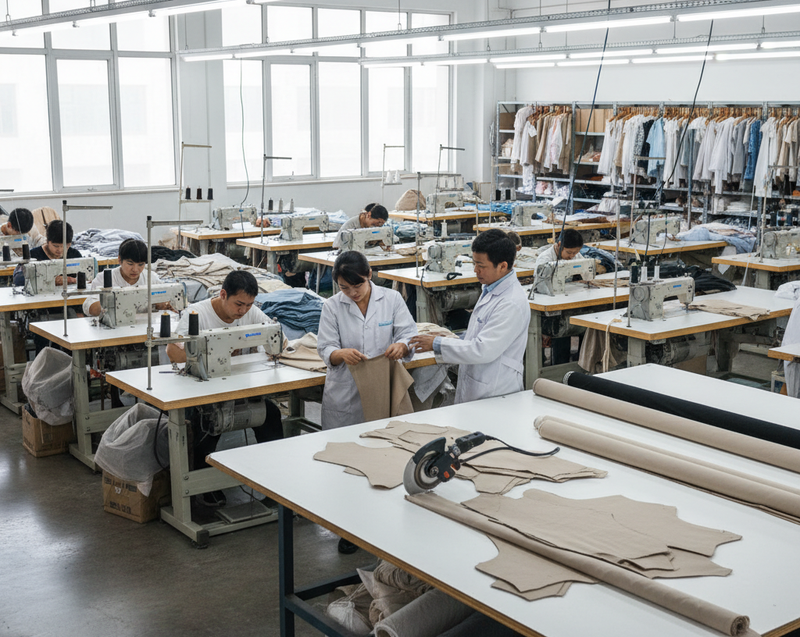
A garment sample is a physical prototype of a apparel item, created before mass production. It is design, fit, fabric, trims, workmanship, construction and quality standards that has to be adhered to during mass production.
Purpose of Garment Samples
- To interpret and confirm buyer requirements
- To test pattern, fit, measurements and construction
- To validate fabric, color, wash and trims
- To estimate cost and consumption
- To evaluate production feasibility
- To obtain buyer approval before bulk manufacturing
Sampling is the communication bridge between buyer and manufacturer.
Types of Garment Samples
Garment samples differ based on production stages and approval requirements.
Pre‑Order Samples (Before Order Confirmation)
Proto Sample / Development Sample
Purpose: To create the first physical garment from the buyer’s tech pack or sketch and confirm the initial design interpretation.
Key Features:
• First trial version
• May use substitute fabric or trims
• Focus on validating style and concept
Used By:
• Designers
• Buyers / Development teams
This sample helps ensure that the garment direction is correct before further development.
Fit Sample
Purpose: To evaluate garment pattern accuracy, measurements and overall fit.
Key Features:
• Usually made in base size (M / 38)
• Multiple rounds (Fit 1, Fit 2, Fit 3)
• Focus on shape, balance and measurement correction
Used By:
• Technical teams
• Pattern makers
• Buyers’ fit technicians
This sample confirms that the garment fits properly on the human body.
Design Sample / SMS Sample (Salesman Sample)
Purpose: To present the garment for marketing, sales and catalog purposes.
Key Features:
• Made in production fabric
• Prepared in full size set or selected key sizes
• High visual accuracy required
Used By:
• Buyer’s sales team
• Marketing and photoshoot teams
This sample helps showcase the style to retail teams and customers.
Counter Sample
Purpose: To replicate the buyer’s reference garment for understanding styling and construction details.
Key Features:
• Copied directly from provided reference sample
• Helps analyze sewing techniques and construction
• Not always in final fabric
Used By:
• Merchandisers
• Technical and development teams
This sample ensures the factory understands the expected look and build.
Costing Sample
Purpose: To support accurate costing, fabric consumption and SMV evaluation.
Key Features:
• Follows production‑feasible construction methods
• Allows estimation of real production cost
• Used to validate fabric and trim usage
Used By:
• Costing departments
• Industrial engineering teams
This sample helps determine whether the style is cost‑effective for bulk production.
Post‑Order Samples (After PO Confirmation)
Pre‑Production (PP) Sample
Purpose: To provide the final approved reference before starting bulk production.
Key Features:
• Made with actual fabric, trims, wash and accessories
• Must match buyer‑approved tech pack exactly
• Submitted before bulk cutting
Used By:
• Production team
• Buyer QA
• Factory management
This sample ensures all parties agree on final quality and specifications.
Size Set Sample
Purpose: To verify grading accuracy across all sizes.
Key Features:
• Made in full size range (e.g., XS–XL)
• Ensures uniform fit and proportion
• Helps detect grading errors
Used By:
• Technical team
• Buyer’s QA / fit teams
This sample validates that all sizes fit correctly, not just the base size.
TOP Sample (Top of Production)
Purpose: To confirm that bulk production quality matches the approved PP sample.
Key Features:
• Taken from initial bulk production pieces
• Shows actual sewing, finishing and consistency
• Must align with PP sample
Used By:
• Buyer QA
• Factory quality team
This sample ensures production is running correctly from the start.
Shipment Sample
Purpose: To represent the final finished production shipped to the buyer.
Key Features:
• Collected from actual bulk goods
• Reflects final wash, finishing and packing
Used By:
• Buyer QA
• Marketing and documentation teams
This sample is used for record‑keeping and quality verification.
Special Category Samples
Wash Sample
Purpose: To show the outcome of the selected wash process for denim and wash‑dependent garments.
Key Features:
• Demonstrates effects like stone wash, acid wash, enzyme wash, etc.
• Helps finalize wash recipe
Used By:
• Wash development team
• Buyers (for wash approval)
This sample confirms the final wash look before bulk washing.
Photo Sample
Purpose: To provide visually perfect garments for e‑commerce shoots, catalogs and campaigns.
Key Features:
• High-quality, flawless appearance
• Accurate color and finishing
Used By:
• Photography teams
• Marketing teams
This sample is used purely for visual and promotional purposes.
Sealing Sample / Gold Seal Sample
Purpose: To serve as the final approved reference sample for all bulk production.
Key Features:
• Buyer‑tagged and sealed
• No deviation allowed
• Represents 100% approved version
Used By:
• Production and QA teams
• Buyer quality assurance
This sample ensures that the factory follows an approved standard during mass production.
Sample Submission Process (Industry Standard Workflow)
The flow varies slightly by brand (H&M, Zara, PVH, M&S, etc.), but usually follows this pattern:
Step‑by‑Step Sample Submission Flow
Sample submission is a structured and iterative process that ensures the product meets the buyer’s expectations before bulk production begins. It involves multiple steps—from initial design understanding to final approval—where each stage requires careful coordination between teams. The process may go through several cycles of correction and improvement until the buyer is fully satisfied.
1. Buyer Sends Tech Pack / Reference
The process begins when the buyer shares detailed information about the product. This forms the base for all further development and must be clearly understood by the factory team.
Typically includes:
- Measurement charts
- Construction and stitching details
- Artwork and placement instructions
- Trims and accessories specifications
- Fabric type and quality details
2. Sampling Department Reviews Feasibility
Once the tech pack is received, the sampling and merchandising teams analyze it to check whether the design can be executed practically within the given timeline and cost.
Key checks include:
- Availability of fabrics and trims
- Pattern complexity and development needs
- Requirement of special stitches or machines
- Costing and production implications
3. Pattern Making
After feasibility is confirmed, the pattern master develops the garment pattern. This can be done manually or with advanced CAD systems.
Common tools used:
- Gerber
- Lectra
- Optitex
The pattern forms the foundation for fit and construction accuracy.
4. Sample Cutting
The fabric is cut based on the prepared patterns. During early stages like proto samples, substitute fabrics may be used if the original material is not available.
Key points:
- Cutting is often done manually for precision
- Marker planning ensures correct panel usage
- Accuracy is critical for proper garment shape
5. Sample Sewing
The cut panels are stitched in the sample room by highly skilled operators. This stage focuses on correct construction, detailing, and finishing according to the tech pack.
Key focus areas:
- Stitch quality and method
- Design accuracy
- Handling of trims and accessories
6. Sample Quality Check
After sewing, the garment undergoes a detailed inspection to verify that it meets all requirements.
Quality checks include:
- Measurement verification
- Overall appearance
- Workmanship and stitching quality
- Trim accuracy
- Fit checking on dummy or live model
7. Sample Submission to Buyer
The completed sample is sent to the buyer or buying house along with all necessary documentation. Proper submission ensures clarity and smooth feedback.
Documents included:
- Sample Submission Form (SSF)
- Measurement chart
- Fabric and trim details
8. Buyer Review & Feedback
The buyer evaluates the sample and provides feedback based on quality, fit, and design expectations. This feedback determines the next step in the process.
Possible outcomes:
- Approved → Ready to proceed
- Approved with comments → Minor corrections required
- Rejected → Sample must be corrected and resubmitted
Continuous Improvement Cycle
Sampling is not always a one-time process. It often involves multiple iterations until all requirements are fully met.
- Corrections are implemented based on feedback
- New samples are developed and resubmitted
- Process continues until final approval
Stage‑Wise Timeline- What & when sample needed to be submitted
| Sample Type | Typical Submission Time |
|---|---|
| Proto | Initial development stage |
| Fit | After proto acceptance |
| SMS | Pre‑order sales period |
| PP Sample | Before bulk cutting |
| Size Set | Before cutting or early production |
| TOP | During bulk production |
| Shipment Sample | After finishing/packing |
Departments Involved in Sampling
Sampling is a cross-functional operation:
- Merchandising → Coordinates with buyer
- Sampling Room → Sewing & sample making
- Pattern Department → Pattern & grading
- CAD / Marker Department → Consumption & cost efficiency
- Fabric & Trims Section → Material availability
- Industrial Engineering (IE) → SMV, operations breakdown, feasibility
- Quality Department → Sample approval QA
Sample Production
1. Tech Pack Review
The process begins with a detailed review of the buyer’s tech pack. This involves the merchandiser, pattern maker, and sample room team working together to understand design specifications and assess feasibility.
- Review style details, measurements, and construction
- Identify any missing or unclear information
- Evaluate production feasibility before development
2. Pattern Making & Adjustment
Based on the tech pack, patterns are developed either manually or using CAD systems. Adjustments are made as per design requirements or feedback from earlier samples.
- Pattern drafting using CAD or manual methods
- Fit corrections based on buyer comments
- Continuous refinement for accuracy
3. Fabric & Trim Arrangement
At this stage, required fabrics and trims are sourced. If original materials are not available, the closest substitutes are used for development.
- Sourcing of fabrics and trims
- BOM (Bill of Materials) verification
- Ensuring compatibility with lead time
4. Sample Cutting
Fabric is cut according to the marker plan with high precision. Since samples are critical for evaluation, cutting is often done manually for better control.
- Accurate marker planning
- Careful manual cutting
- Ensuring correct panel shapes and sizes
5. Sample Sewing
Sewing is handled by skilled operators in the sample room. The focus is on achieving correct construction, finishing, and design detailing.
- Use of appropriate sewing methods
- Attention to stitching quality and detailing
- Following design specifications closely
6. Finishing & Quality Check
After sewing, the sample undergoes finishing and inspection to ensure it meets required standards.
- Thread trimming and ironing
- Measurement verification
- Quality checking as per specifications
7. Submission to Buyer
The final sample is submitted to the buyer along with all required documentation. Follow-up is done until approval is received.
- Submission with measurement sheet and comments
- Documentation and sample tracking
- Continuous communication with the buyer
Common Challenges in Sampling
Despite its importance, sampling can face several challenges that affect timelines and accuracy.
- Unavailability of correct fabrics or trims
- Misinterpretation of tech pack details
- Delays in buyer approvals
- Wash variation issues (especially in denim)
- Fit inconsistencies
- High development cost for factories
Best Practices for Efficient Sampling
To improve sampling efficiency and quality, factories follow certain best practices that help streamline the process.
- Carefully analyze buyer feedback and comments
- Maintain the PP (pre-production) sample as a master reference
- Use sample tracking systems to monitor progress
- Apply CAD pattern making for better accuracy
- Ensure all trims and materials are correct before PP stage
- Improve operator skills in the sample room
- Conduct internal fit checks before submission