Production of Intimate Garments: Workflow, Fabric Selection and Quality Control
February 10, 202616 min read
Intimates – such as bras, panties, shapewear and lounge wear – is one of the most technically challenging areas of the apparel manufacturing industry. Unlike outerwear, intimate garments require precise engineering, high-comfort materials, advanced machinery and strict quality standards to ensure functionality, fit and long-term durability.
Intimate Garments Production
Market Landscape and Industry Importance
The global intimate apparel market has come a long way from basic functionality. Today it is an innovation-led dynamic sector, driven by changing consumer demand, lifestyle trends and technological advancement. Today’s consumers expect more than fit – they want a combination of comfort, performance, aesthetics and sustainability.
Brands globally continue to pour money into new product development to remain competitive. This includes the emergence of seamless garments, 3D knitted structures and moisture management fabrics that improve the comfort for the wearer. But at the same time sustainability is a big focus and we are seeing more recycled nylon, organic cotton and biodegradable elastics. Another significant trend is the move towards size-inclusive and adaptive designs, making sure products fit different body types and needs.
In this changing environment manufacturers are not just suppliers anymore - they are technical partners. Their role includes engineering support, innovation input and scalable production capabilities. A strong manufacturer adds value by converting design ideas into commercially viable, high-quality products and increasing efficiency and consistency at scale.
Manufacturers play a crucial role by providing engineering support, technical expertise and scalable production capacity to meet these evolving demands.
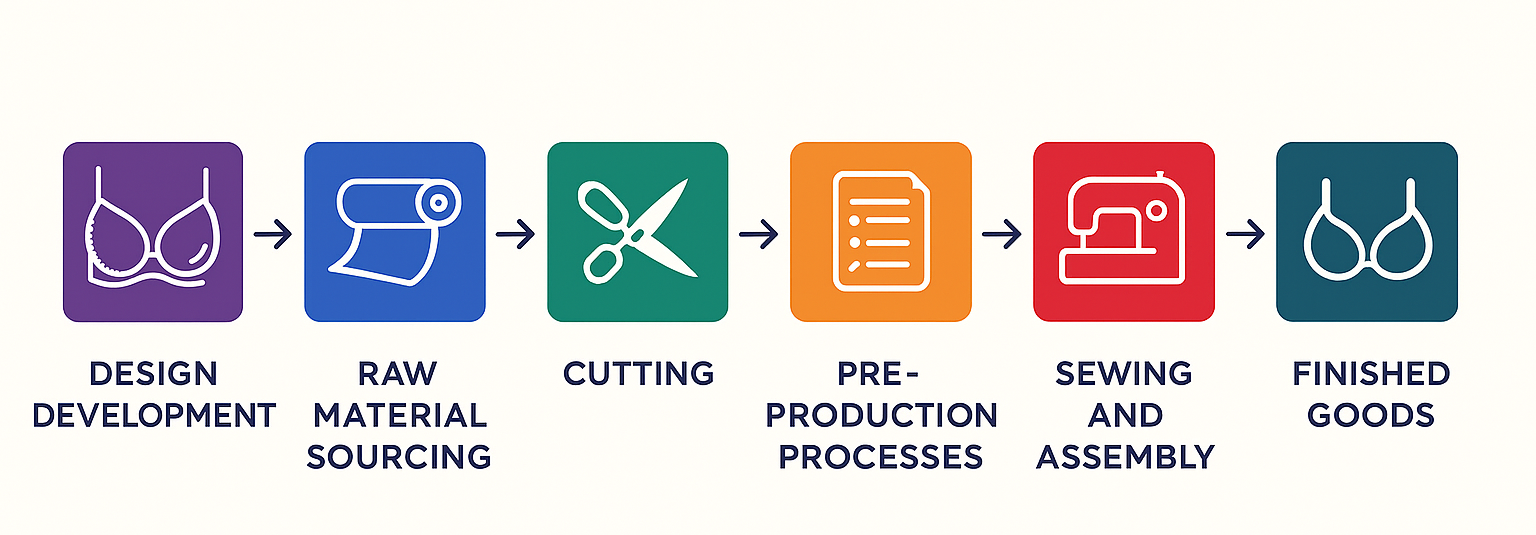
Intimate manufacturing process flow
Product Development & Design Engineering
Stages in Product Development
Concept & Sketching Design is the starting point in the journey of an intimate garment, but unlike many other types of apparel, it requires heavy technical collaboration at this stage. Designers collaborate closely with technical teams to make sure the product looks good and performs well in terms of support, comfort and durability.
The process begins with concept development and sketching in which the silhouette, support structure and design aesthetics are visualised. But that’s just the beginning. The design needs to be translated into something that works with the human body and that means careful selection of materials.
Material Selection
Lingerie is made up of fabrics one of the main components. The types of fabrics used are selected based on the function of the garment such as lightweight microfibre, high stretch elastane, lace, mesh and moulded foam. The underwires, soft elastics and trims are all functional and comfort features. Every material must be chosen carefully because even the slightest change can impact fit and the person wearing it.
Pattern Making
Another highly specialised stage is pattern making. Intimate apparel patterns are different from normal garments because they have to cope with complex body curves, stress zones and dynamic stretch behaviour. For example, the shape of a bra cup has to be very specific to get support but also be comfortable.
Patterns must consider:
Body curves
Varying stress zones
Cup geometries
Mobility and stretch behavior
Sample Making & Fit Trials
Sample making and fit trials start once patterns are made. To make sure the garment meets all the performance requirements, multiple fittings are done. Meticulous evaluation is given to support level, breathability, seam smoothness and comfort of movement. Then there are a few tweaks before the product goes forward.
Technical Pack Creation
Information is then collated into a technical pack (tech pack) consisting of the Bill of Materials (BOM), stitching details, measurement charts, grading rules and quality checkpoints. This document is the guiding reference for production.
Raw Material Sourcing & Testing
Since intimate garments are worn directly against the skin, there’s little room for compromise on the quality of the material. Fabrics and trimmings have to satisfy rigid requirements as to softness, elasticity, durability and safety.
Materials should have soft hand feel, high stretch and moisture management properties. They need to be colourfast, sweat- and wash-resistant and free of harmful chemicals. More and more brands require certifications such as OEKO‑TEX and compliance with REACH and RSL standards.
A lot of lab testing is done before production actually begins. This includes testing the fabric weight (GSM), seam strength, stretch recovery, shrinkage behavior and colorfastness. Additional testing, such as underwire durability and chemical safety compliance, ensures the product meets international standards and customer expectations.
Colorfastness and chemical compliance (OEKO‑TEX, REACH, RSL/ MRSL)
Cutting and Pre‑Production Processes
Fabric Relaxation
Elastic fabrics are first relaxed under controlled conditions. This is a necessary step because these fabrics tend to shrink or stretch, and failure to relax them results in inaccurate sizes.
Cutting Techniques
Cutting is done with advanced techniques according to the material type. Automatic spreading systems are used to lay even layers. Laser cutting is used for delicate lace and ultrasonic cutting for fabrics with no seeming cut. These technologies increase accuracy and cut down on material waste.
While the different parts are being prepared. These include foam cup moulding, wire setting, strap production and elastic cutting. Each part is thoroughly inspected for dimensions and quality to ensure that it will go together smoothly later.
Automatic fabric spreading
Laser cutting for lace
Ultrasonic cutting for seamless garments
Component Preparation
Foam cup molding
Wire setting
Strap making
Elastic cutting
Hook & eye attachment preparation
Sewing and Assembly Line Engineering
Sewing is one of the most complex and time-consuming processes in the manufacture of intimate apparel. These garments are made from small parts, curved seams, elastic material and delicate fabrics, all of which require a high level of precision, unlike outerwear.
Prior to production, Industrial Engineers create an Operation Bulletin (OB) that is very detailed. This document breaks the garment down into individual operations and states the most efficient way to do each step. Considerations include material behaviour, machine compatibility, operator skill level, thread selection.
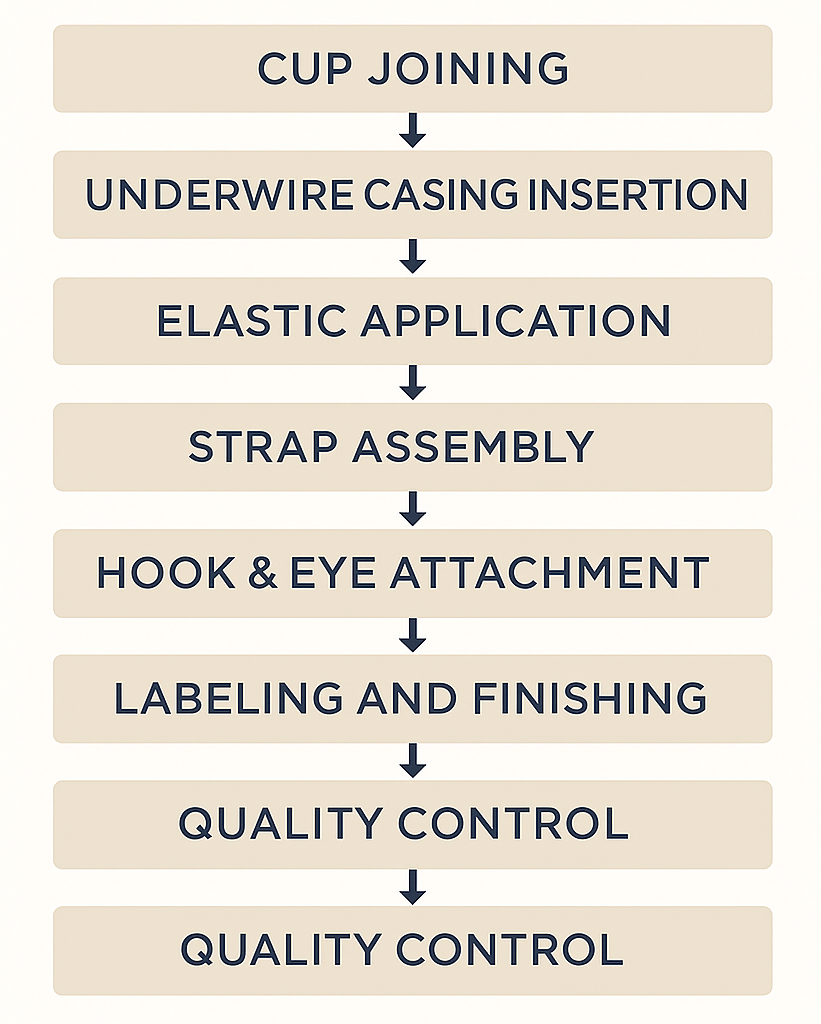
This stage is characterised by specialised operations. This covers bra cup construction, underwire channel attachment and frame assembly. Another important process is the elastic application which directly influences fit and comfort. Depending on the design, techniques such as three-step zigzag stitching, flatlock seams, and bonding are used.
These processes are supported by a wide range of machines, from lockstitch and overlock machines to ultrasonic bonding and moulding equipment. Quality and efficiency are ensured by the right mix of equipment.
Production lines are designed carefully using systems such as progressive bundle systems, modular layouts and multi-skill mini lines. Industrial Engineers are key players in line balancing, bottleneck reduction and efficiency tracking.
Intimate sewing process flow
Specialized Sewing Operations
Intimate garments involve several precise and technique‑sensitive operations:
A. Cup and Frame Construction (for Bras)Cup and Frame Construction
Cup joining (foam / fabric)
Binding cup edges
Underwire channel attachment
Wing attachment and cup–frame joining
Bridge reinforcement
B. Elastic Application
Elastic application is a core skill area as it determines fit and comfort.
Underband elastic insertion
Leg opening elastic (for panties)
Tunnel elastic application
Fold‑over elastic (FOE) application
Variable elastic tensioning depending on size and design
C. Seam Construction Techniques
3‑step zigzag: for elastic attachment
Flatlock: for seamless comfort
Coverstitch: for hemming and elastic cover-ups
Overlock: high‑stretch seam joining
Bonded/heat‑seal seams: invisible finish for premium lingerie
D. Components & Accessory Attachment
Strap production and attachment
Ring and slider fixing
Hook‑and‑eye stitching
Label and care tag application
Each operation demands accuracy to maintain symmetry and wearer comfort.
Machinery Matrix for Intimate Apparel
Intimate garments use a diverse set of machines for specialized operations:
Common Machines Used
Machine Type
Applications
Single needle lockstitch
General joining, topstitching
3‑step zigzag
Elastic application, cup edges
Overlock
High‑stretch seams
Flatlock
Seamless panty joints
Coverstitch
Hems, decorative stitching
Bartack
Reinforcement at stress points
Picot machines
Decorative elastic stitching
Ultrasonic machines
Seamless bonding
Molding machines
Foam cup shaping
The right machine combination determines operational quality and production speed.
Line Layout & Production Engineering
Intimate garment production can adopt several types of layouts based on product complexity.
Elastic tension is one of the most critical factors in intimate garments.
Parameters Monitored
Tension ratio (length applied vs. relaxed length)
Stitch density
Feed mechanism adjustment
Differential feed settings (for stretch fabrics)
Impact of Improper Tension
Garment riding up
Tightness/looseness
Poor durability
Asymmetry between left and right sides
Quality engineers use template checks, tension testers and in‑line inspections to ensure uniformity.
Handling Techniques for Sensitive Materials
Intimate apparel often uses ultra‑fine materials like mesh, lace and microfiber.
Best Practices
Minimize fabric stretching while feeding
Use soft‑edge folders and guides
Maintain needle sharpness to avoid snagging
Use silicone or Teflon presser feet for smooth fabric flow
Train operators in delicate material handling
Inline Monitoring & Performance Indicators
Continuous monitoring ensures consistent output and maintains product quality.
Key Performance Indicators (KPIs)
Line efficiency (%)
Operator efficiency (%)
DHU (Defects per Hundred Units)
WIP levels
Throughput time
Right‑first‑time (RFT) stitching
SMV vs. actual performance
Production supervisors and IEs regularly analyze KPIs to drive improvements.
Integration of Automation and Advanced Technologies
The industry is slowly adopting advanced technologies to increase efficiency and reduce reliance on manual skills. Innovations such as automatic elastic feeders, laser cutting systems, bonding machines and real-time production monitoring tools are becoming increasingly common.
Today’s digital tools allow line balancing, tracking of operator skills and analysis of performance. These technologies help manufacturers achieve better consistency and faster turnaround time.
These technologies deliver minimal seam visibility, perfect for modern innerwear trends.
Quality Control & In‑Line Inspection
Quality control is especially important in intimate apparel because of the garment’s close proximity to the skin and functional need to support and provide comfort.
Elastic tension control is one of the most important parameters. Wrong tension can cause discomfort, poor fit or reduced durability. Engineers manipulate things like stitch density, machine settings and tension ratio to ensure consistency.
Handling techniques matter as well. Lace, microfibre and like materials must be handled with care to avoid damage. Operators are trained to minimise stretching. Special guides and presser feet are used to ensure smooth operation.
Production is continuously monitored using key performance indicators (KPIs) such as line efficiency, defect rate (DHU), work-in-progress (WIP) and right-first-time quality. This helps keep productivity up but also makes sure of high quality output.
QC Focus Areas
Elastic tension and recovery
Cup symmetry
Underwire stability
Seam smoothness
Label placement
Color uniformity
Fit and support tests
Inline, End‑line and Final AQL inspections ensure product integrity.
Packaging, Branding & Logistics
The garments are then assembled and go through a detailed finishing process. Threads are cut, garments are heat-set to hold their shape, and each piece is inspected for symmetry, fit and function.
Final checks could include stress tests, visual inspections and even metal detection for safety. The product is only packaged after these checks have been passed.
Packaging is as per brand requirements like polybags, branded boxes or hanger displays. Proper labelling, barcoding and carton standardisation allow for smooth logistics and retail handling.
Sustainability in Intimate Apparel Manufacturing
Sustainability is no longer a choice. It is becoming a core requirement. Manufacturers are working with recycled materials, biodegradable components, water-efficient dyeing processes and zero waste cutting techniques.
There is also a growing emphasis on traceability and transparency, with brands requiring complete visibility throughout the supply chain. Factories are reacting with digital tracking systems and environmentally friendly production practices.
The Future of Intimate Garment Production
Technology and sustainability are shaping the future of intimate apparel manufacturing. Disruptive innovations, including 3D body scanning, AI-based fit prediction, intelligent fabrics, and automated sewing systems, are likely to reshape the industry.
Those manufacturers who invest in technical know-how, process efficiency and sustainability will be best placed to lead this transformation.
References & Sources
Carr, H. & Latham, B. The Technology of Clothing Manufacture.
Glock, R. E. & Kunz, G. I. Apparel Manufacturing: Sewn Product Analysis.
Kadolph, S. J. Textiles.
Chuter, A. J. Introduction to Clothing Production Management.
Textile Institute Publications on Apparel Manufacturing and Product Development.
ASTM International Textile and Apparel Standards.
AATCC Technical Manuals and Textile Testing Standards.
OEKO-TEX®, REACH, and RSL/MRSL compliance guidelines.
Industry best practices for intimate apparel product development, fit engineering, sewing technology, quality control, and sustainable manufacturing.
Disclaimer: This article is intended for educational and informational purposes only. Manufacturing processes, material specifications, testing requirements, quality standards, and production methods may vary depending on product type, brand requirements, customer specifications, and manufacturing facilities. Readers should verify technical and compliance requirements with relevant industry professionals, buyers, and applicable standards before implementation.
Written by
Alam Mohammad Shafiqul
Lead Editor, Senior Contributor & Founder
Textile Technology
Textile engineering professional with over 15 years of experience in Sweater Manufacturing, Industrial Engineering and Technical Development. Holds a degree in Textile Engineering and an MBA in Apparel Merchandising. Passionate about bridging the gap between factory-floor operations and technical expertise to drive efficiency, innovation, and continuous improvement.
Textile EngineeringSweaterIndustrial EngineeringLean Six SigmaPythonJS