CMYK and Digital Printing in Textiles: Advanced Techniques for Color Accuracy and Fabric Design
December 01, 202510 min read
CMYK and Digital printing process are two very advanced techniques that are used today in the textile and garment industry to produce detailed, vibrant and multi-colour designs. Both have broad applications in fashion apparel, sportswear, home textiles, accessories and custom merchandise, providing flexibility, high resolution and quick production cycles.
CMYK & Digital Printing
CMYK printing
CMYK printing — often called 4‑color process printing — is one of those techniques you’ll see almost everywhere in the textile and garment world. It’s especially useful when designs get detailed, colorful, or even photo-like.
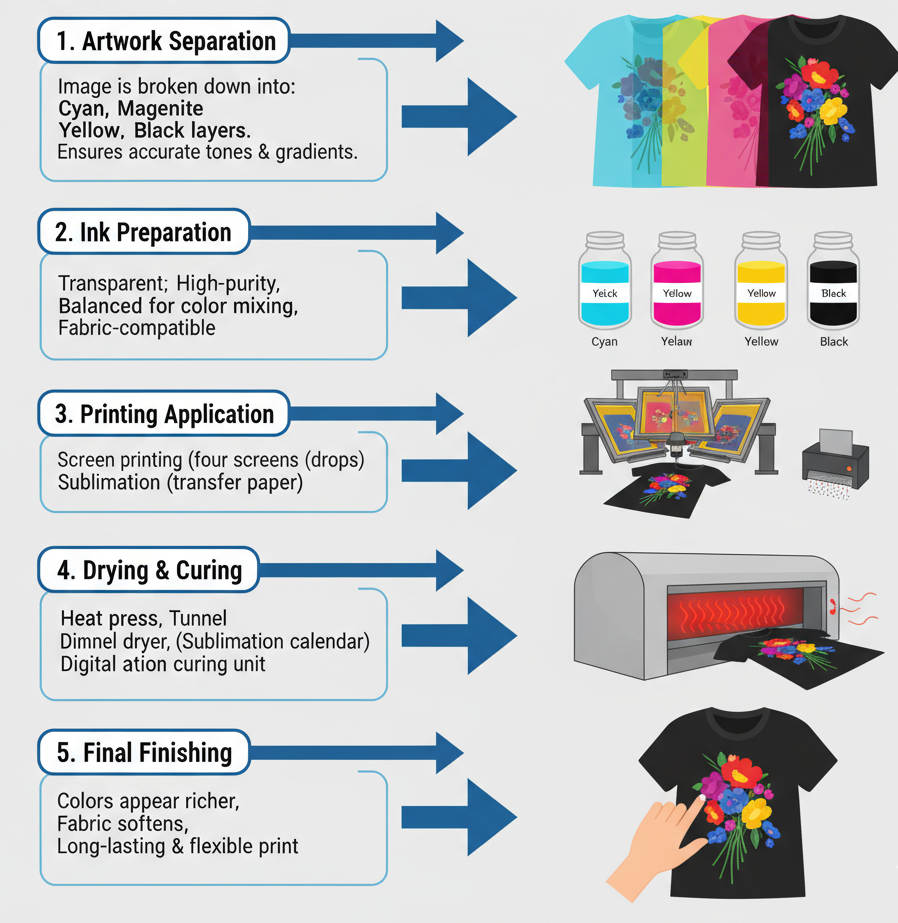
At its core, it uses four ink colors: Cyan, Magenta, Yellow, and Black (Key). These inks are layered in different combinations to create a wide range of colors — kind of like how digital images are built, but in print form.
You’ll find CMYK printing across fashion apparel, promotional T‑shirts, sportswear, sublimation garments, and a lot of digital textile applications.
In simple terms, CMYK printing separates artwork into four color channels — C, M, Y, and K — and then reproduces the image layer by layer onto fabric.
CMYK Printing
Key Features
Produces near photographic-quality prints
Smooth gradients and realistic color depth
Works well for complex, multi-color graphics
Widely used in screen printing, sublimation, and digital printing
Types of CMYK Printing in Textiles
When people say “CMYK printing,” they often think it’s just one method. In reality, it shows up in a few different ways depending on production setup, fabric type, and volume.
Each type has its own workflow, limitations… and honestly, its own headaches too.
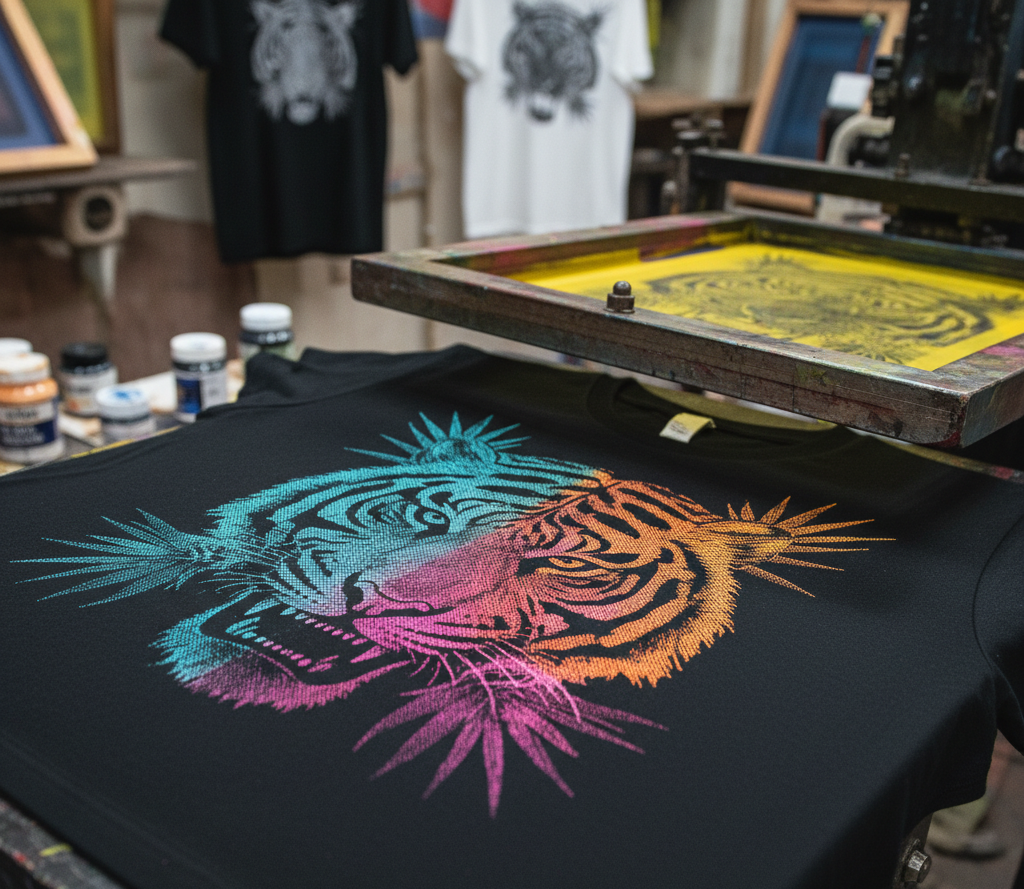
1. Screen Process CMYK Printing
Traditional method using halftone dots and fine mesh screens.
Best for: Cotton T‑shirts, bulk orders
Challenges: Registration issues, dot gain, less precise color matching
Note: Cost-effective for large volumes once set up
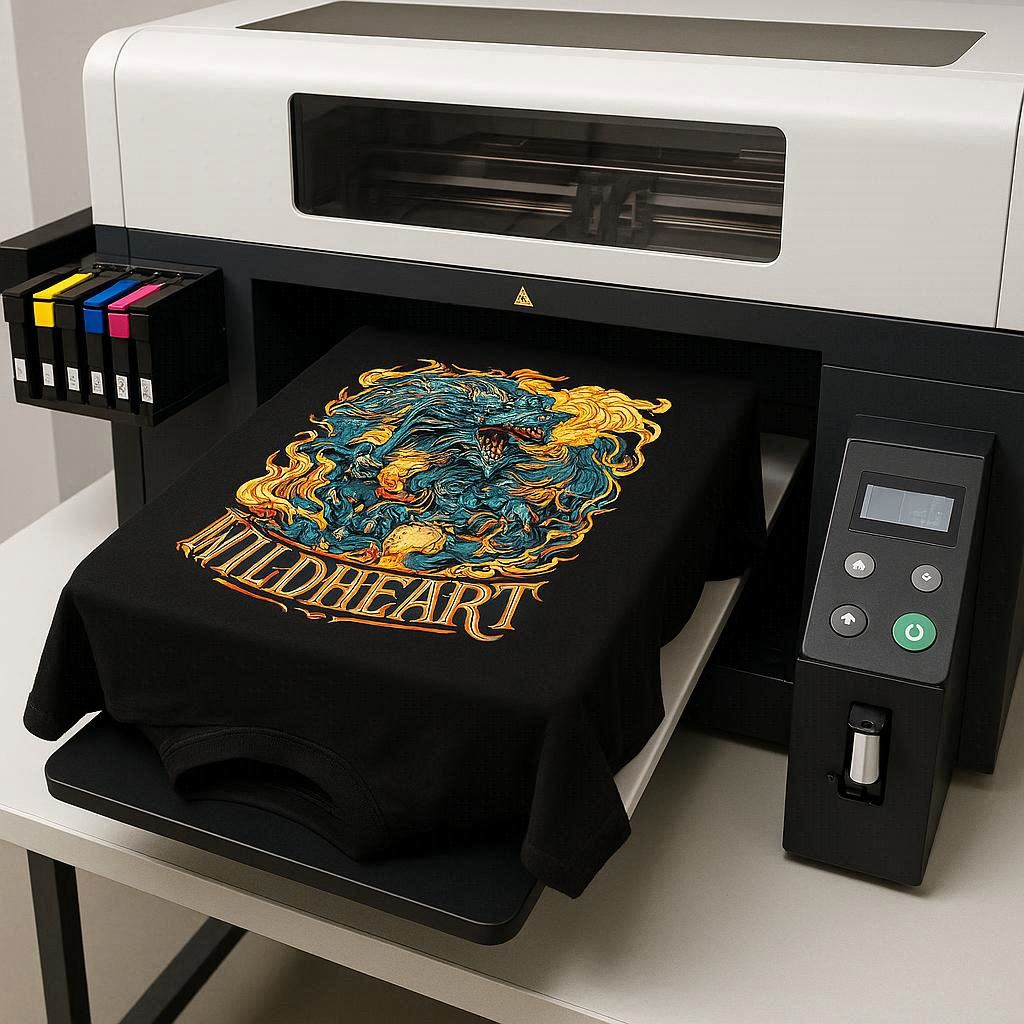
2. Digital CMYK Printing (DTG)
Inkjet printing directly onto garments, no screens needed.
Best for: Cotton, small to medium runs
Pros: High detail, easy setup, flexible Cons: Slower in bulk, higher ink cost, needs white underbase on dark fabrics
3. Sublimation CMYK Printing
Printed on paper, then heat-transferred into polyester fibers.
Best for: Polyester sportswear
Pros: Bright colors, no cracking, soft feel Cons: Not for cotton or dark fabrics
4. CMYK Heat Transfer Printing
Printed on transfer paper and heat-pressed onto fabric.
Best for: Small batches, custom items
Pros: Low setup, quick
Cons: Heavier feel, lower durability
5. Hybrid CMYK Printing (CMYK + Spot Colors)
Combines CMYK with solid inks for better color control.
Best for: Fashion and branded designs
Pros: More vibrant, accurate colors
Cons: Higher cost, more complex setup
Sportswear
Dye-sublimated jerseys and vibrant polyester garments.
Kidswear
Colorful illustrations and cartoon designs.
Merchandise & Promotions
Event T-shirts, branding, tour merchandise.
Custom & On-Demand
Personalized apparel, print shops, e-commerce POD.
Why Brands Choose CMYK Printing
High-quality image reproduction
Cost-effective for multi-color designs
Versatile across many fabric types
Suitable for both small and large volumes
Perfect for digital transformation & fast fashion cycles
CMYK printing provides the ability to deliver vibrant, detailed and modern garment designs without the limitations of traditional flat-color screen prints.
Digital Printing
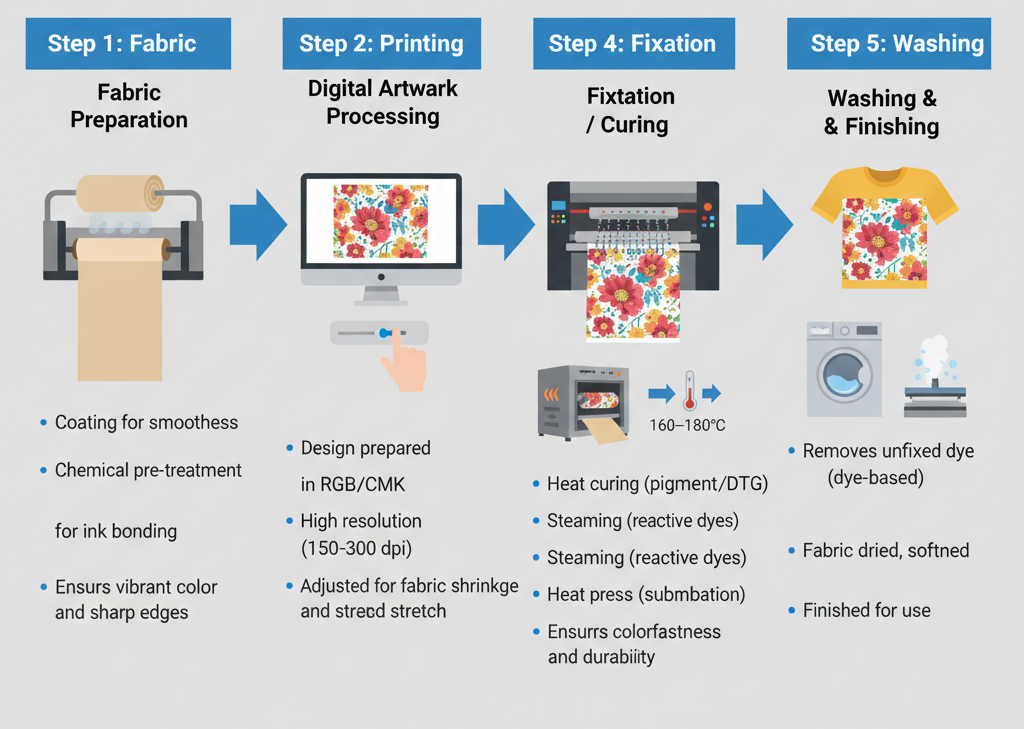
Digital printing has transformed the textile and apparel industry by enabling high-resolution, full-color and customizable prints directly on fabrics. Digital textile printing eliminates much of the set up that is traditionally required with screen printing, reduces waste and can support short to long-run production with outstanding detail.
Fashion, sportswear, home textiles, accessories and custom merchandise widely employ digital printing.
it is a process in which fabric is printed directly using inkjet technology, where micro-droplets of ink are sprayed onto the textile surface based on a digital design file.
Digital printing empowers brands to innovate freely while reducing production time, waste and complexity.
Differences Between Digital Printing & CMYK Printing
Feature
Digital Printing
CMYK Printing
Definition
Method of applying digital design directly to fabric via inkjet
4-color process using Cyan, Magenta, Yellow & Black
Used In
DTG, sublimation, reactive, pigment printing
Screen CMYK, digital printers, sublimation
Best For
Photographic designs, small runs, customization
Full-color artwork, gradients, detailed images
Setup Cost
Low
Medium
Fabric Types
Cotton, polyester, silk, blends
Mostly light-colored fabrics unless white base used
Output
High-resolution
Full-color mixed through 4 color channels
Final Thought
At the end of the day, CMYK printing and digital printing aren’t really competing — they actually work together more than people think.
CMYK is the color system that makes full-color reproduction possible. Digital printing is the technology that delivers that color onto fabric with speed and flexibility.
If the goal is high-detail, photo-quality designs, CMYK is essential. And when you combine it with digital printing, you get something even more powerful — fast production, unlimited design freedom, and the ability to print almost anything without complicated setup.
That said, it’s not always one-size-fits-all. For bulk production, traditional methods like screen CMYK still make sense. For short runs, customization, and fast fashion cycles, digital printing becomes the obvious choice.
In real factory conditions, the best results usually come from choosing the right method based on fabric, volume, and design complexity, not just following trends.
So it’s less about “which is better” — and more about how well you use both together to get the result you actually need.
References & Sources
The Textile Institute – Textile printing technologies, process color printing, CMYK printing, digital textile printing, inkjet technologies, and textile coloration systems.
AATCC (American Association of Textile Chemists and Colorists) – Digital printing, print quality evaluation, color measurement, colorfastness, and textile performance standards.
Society of Dyers and Colourists (SDC) – Textile coloration, CMYK color management, digital ink chemistry, and textile printing technology.
Broadbent, A.D. – Basic Principles of Textile Coloration.
Miles, L.W.C. – Textile Printing.
Epson, Kornit Digital, MS Printing Solutions, Mimaki, Roland DG, EFI Reggiani, Archroma, Huntsman, and DyStar technical resources covering DTG, DTF, sublimation, reactive, pigment, acid digital printing, and industrial textile printing systems.
Disclaimer: This information is intended for educational and industry reference purposes only. CMYK printing parameters, digital printing workflows, ink formulations, pre-treatment methods, curing conditions, color management settings, printer configurations, transfer temperatures, and fabric compatibility may vary depending on equipment type, substrate composition, ink technology, supplier recommendations, buyer specifications, and factory operating standards. All CMYK and digital textile printing processes should be validated through laboratory trials, strike-offs, color calibration, wash fastness testing, rubbing fastness testing, and approved production standards before bulk manufacturing. Compliance with applicable safety, environmental, ZDHC, OEKO-TEX®, REACH, and buyer-specific requirements should be verified prior to commercial implementation. Color reproduction may vary based on fabric characteristics, printer settings, ICC profiles, and production conditions.
Written by
Alam Mohammad Shafiqul
Lead Editor, Senior Contributor & Founder
Textile Technology
Textile engineering professional with over 15 years of experience in Sweater Manufacturing, Industrial Engineering and Technical Development. Holds a degree in Textile Engineering and an MBA in Apparel Merchandising. Passionate about bridging the gap between factory-floor operations and technical expertise to drive efficiency, innovation, and continuous improvement.
Textile EngineeringSweaterIndustrial EngineeringLean Six SigmaPythonJS