Work Study in Textile and Apparel Industry: Techniques for Productivity and Efficiency
May 04, 20267 min read
Work Study is one of the basic disciplines of Industrial Engineering. Work Study is concerned with the study, analysis, improvement and optimization of work processes. It is used extensively in manufacturing, services, logistics and any environment where productivity, efficiency and worker well-being matter.
Work Study is a systematic examination of the activities of the workplace, with the purpose of designing the most efficient methods of performing tasks while ensuring safety, comfort and acceptable work conditions.
It is based on work simplification - the elimination of waste, the reduction of needless motions and the organization of work so as to secure the greatest effectiveness. The Work Study’s primary aim is to achieve two main objectives:
Improvement in Productivity
Human Safety & Comfort
Formal Definition of Work Study
The Work Study is the systematic study of work systems to:
Developing the Preferred System and Method
This is done by considering alternative methods of performing a task and choosing the most appropriate method that guarantees:
lowest cost
highest productivity
required quality
Standardizing the System and Method
When the preferred method is created, it is documented and established as the standard method for all to follow.
Determining Standard Time
This consists of determining the Standard Minute Value (SMV) or standard time needed for a trained worker to perform a task using:
given methods
correct tools and equipment
proper workplace conditions
Assisting in Worker Training
Work Study trains workers in the standard method that is preferred for consistency and efficiency.
Two Fundamental Pillars of Work Study
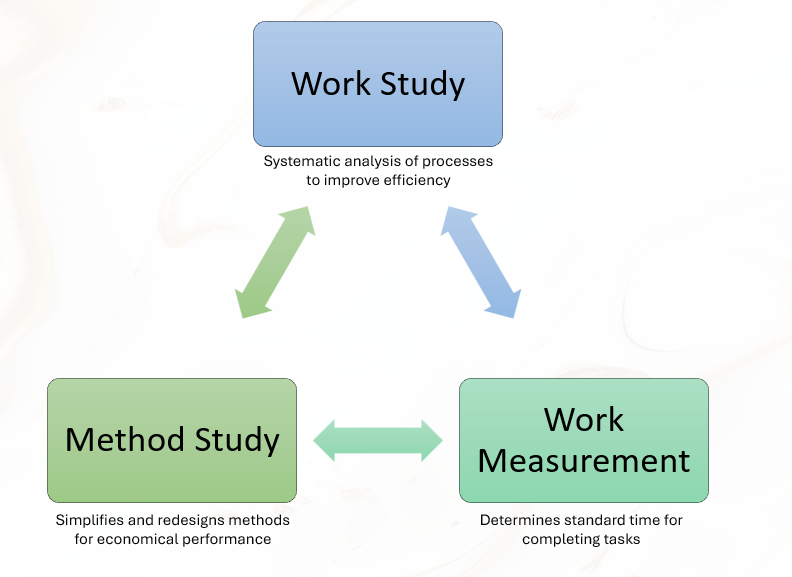
Work Study is based on a systematic methodology for the analysis and improvement of work systems. While the complete definition has a number of elements, two pillars are most important toward realizing meaningful productivity improvements and operational excellence: Motion Study and Time Study. Together, the pillars allow organizations to design efficient processes and to set trustworthy performance standards.
Work Study
Method Study (Motion Study / Work Methods Design)
Method Study studies the way work is done and how it can be improved. In many factories processes evolve over time without proper planning. That's why operators develop habits that aren't necessarily efficient. Study Method challenges these existing practices and re-structures them in a more structured way.
Instead of accepting a process the way it is, Method Study uses simple but powerful questions:
Is this the best way to go about it? Can it get any easier? Can we cut down effort? Yes, it is.
It analyses every element of a job – from the movements of the operator's hands to the location of tools and machines – in detail. Small changes to the work environment, such as having materials close at hand or not having to bend over, can make a big difference to productivity and worker comfort.
What Method Study Examines
The exact sequence of steps followed in a task
Operator motions and body movements
Placement of tools, materials, and machines
Workplace layout and ergonomic design
Overall process flow between operations
Core Objective
To develop the simplest, safest, and most efficient method of performing a task with minimum effort and maximum output.
What Happens After Implementation
When Method Study is applied effectively, the improvements are visible not only in productivity but also in the working environment.
Unnecessary motions are eliminated
Work becomes smoother and less tiring
Workflow becomes faster and more logical
Operators feel more comfortable and less stressed
Overall output increases without increasing manpower
Method Study is about working smart, not just working hard.
Work Measurement (Time Study)
After deciding on the best method , the next question is how long it should take to perform the task . This is the function of Work Measurement.
Work Measurement is a scientific method of establishing the standard time i.e. the time taken by a trained worker to perform a task under normal working conditions. Without proper time standards, planning is not reliable, targets are not realistic and performance evaluation is subjective.
Work Measurement is not an estimate or guess but applies systematic techniques to set accurate time values. This allows the managers to plan the production scientifically and to determine the fairness in the performance assessment.
Core Objective
To estimate right and achievable time to do work by defined method.
Why It Matters in Real Operations
Prevents overloading or underutilizing workers
Enables proper production planning
Supports realistic delivery commitments
Helps calculate product cost accurately
Builds a fair and transparent incentive system
In industries such as garments, Work Measurement is directly associated with SMV (Standard Minute Value) that forms the backbone of efficiency measurement and costing.
Techniques Used in Work Study
Work Study uses structured tools and techniques to achieve meaningful improvements. These methods simplify complex processes by breaking them into understandable and manageable parts.
Method Study Techniques (Improving the Way Work is Done)
Method Study applies analytical tools to visualize and redesign work flows. These techniques help you to detect waste, delays and inefficiencies
Key
Techniques:
Process
Charting:
Mapping the work flow by operation charts, flow charts, man – machine charts to
understand each step.
Motion
Study:
Breaking down human movements into basic elements (therbligs) and use of motion
economy principles.
Workplace
Layout Analysis: Planning workstation layouts for minimum movement and maximum efficiency.
Process
Mapping:
Studying the end-to-end flow to identify bottlenecks and delays.
Work
Redesign:
Simplify things, combine steps, or eliminate unnecessary steps.
Work Measurement Techniques (Setting Time Standards)
These techniques allow us to estimate the time a task should take under standardized conditions.
Time Study (Direct Measurement)
It is the most popular method in the factory. The time it takes to complete each element of a task is measured using a stopwatch or digital tool. Standard time is determined after allowances and performance rating are applied.
Historical Data
Time values are derived from historical production records. This is faster, but less accurate and relies heavily on the reliability of the data.
PMTS (Predetermined Motion Time Systems)
These systems provide standard time values for basic motions without the need for on-floor measurements.
Examples include:
MTM (Methods-Time Measurement)
MOST (Maynard Operation Sequence Technique)
PMTS is particularly advantageous in today’s industrial engineering environments, where precision and uniformity are key.
Why Work Study is Critical for Organizations
The impact of Work Study is on operational performance and profitability of the business. It guarantees the best utilisation of each resource, time, labour and machine.
Productivity Improvement
This reduces waste and makes for better methods of boosting output without additional investment.
Cost Reduction
Better utilization of labor and resources reduces the overall cost of production and increases profitability.
Better Planning and Scheduling
Accurate time standards allow accurate planning of
Daily production targets
Capacity requirements
Machine and manpower utilization
Improved Worker Comfort and Safety
Well-designed methods reduce physical strain, improve posture and create a safer working environment.
Fair and Motivational Incentive Systems
Standard times help to develop transparent payment systems based on performance and increase worker motivation.
Consistency and Quality Control
Standardized methods mean that each operator will do the task in the same way and this will lead to consistent quality.
Applications of Work Study Across Industries
Work Study is not only for manufacturing - it is used in many industries where efficiency is a factor.
Main application fields:
Garment Industry: SMV, line balancing, method improvement
Automotive: Lean production, waste elimination
Electronics: Precision assembly and cycle time control
Logistics: Warehouse flow and time optimization
Healthcare: Patient movement and process efficiency
Food Industry: Line efficiency and waste reduction
Importance in Apparel Manufacturing
Work Study is very important in apparel production as it is a labour intensive and highly competitive industry. Even small inefficiencies can translate to huge cost increases and delivery delays.
A strong Work Study system allows factories to operate with predictability, stability, and control, which is critical for meeting buyer expectations.
Final Thought
Work Study is not only about saving seconds – it is about creating a smart, balanced and sustainable work environment. It aligns efficiency with human capacity, so that productivity gains need not be at the expense of worker well-being.
Organizations using Work Study well become proactive in control, not reactive problem solvers. They enjoy increased productivity, improved quality, reduced costs, and more satisfied employees. All at once.
References & Sources
International Labour Organization (ILO) – Introduction to Work Study, including method study, work measurement, productivity improvement, work simplification, and standard time development.
Institute of Industrial and Systems Engineers (IISE) – Industrial engineering principles, work systems design, productivity analysis, work measurement, and operational improvement.
Niebel, B.W. & Freivalds, A. Methods, Standards, and Work Design – Time study, motion study, work measurement, PMTS systems, ergonomics, and productivity engineering.
Ralph M. Barnes – Motion and Time Study: Design and Measurement of Work – Work simplification, method improvement, motion economy, and labor productivity.
Maynard, H.B. – Industrial Engineering Handbook – Work study techniques, performance measurement, standardization, and operations improvement.
International Ergonomics Association (IEA) – Ergonomics, human factors engineering, workplace design, safety, and worker well-being.
APICS / ASCM (Association for Supply Chain Management) – Capacity planning, production control, labor standards, resource utilization, and operational efficiency.
Lean Enterprise Institute (LEI) – Lean manufacturing, waste elimination, Kaizen, value stream improvement, and standardized work.
Toyota Production System (TPS) resources – Continuous improvement, waste reduction, workflow optimization, and operational excellence.
MTM Association (Methods-Time Measurement) – Predetermined Motion Time Systems (PMTS), work measurement standards, and motion analysis.
MOST Association (Maynard Operation Sequence Technique) – Motion-based work measurement, labor standard development, and productivity improvement methodologies.
American Society for Quality (ASQ) – Process improvement, quality management, Six Sigma, root cause analysis, and performance measurement.
Industry resources covering apparel work study, SMV calculation, line balancing, GSD implementation, capacity planning, production engineering, and factory performance optimization.
Disclaimer: This article is intended for educational and professional reference purposes only. Work study methods, standard times, productivity improvements, labor performance standards, and efficiency gains may vary depending on industry, product complexity, workforce skill level, production technology, working conditions, and organizational practices.
Written by
Hasan Mohammad Ashraful
Senior Contributor
Industrial Engineering
Industrial Engineering professional with 17 years of experience in manufacturing excellence and productivity improvement. Graduated in Industrial & Production Engineering and specialized in Lean Six Sigma, SMV calculation, line balancing and efficiency enhancement. Passionate about applying and sharing IE tools and methodologies that deliver measurable operational results and sustainable performance improvements.