
According to the American Institute of Industrial and Systems Engineers (IISE), industrial engineering is the field that combines people, materials, equipment and information to design and improve efficient, productive systems.
Industrial engineering differs from other engineering disciplines in that it is not focused on the design of products or machines, but rather takes a holistic, systems perspective. It looks at the interrelationship of all aspects of an operation with the aim of reducing waste while improving quality, safety, cost and efficiency-in both manufacturing and service industries.
Core Objectives of Industrial Engineering
🔹 Productivity Enhancement
Increasing output while optimizing resource utilization, reducing operational costs and improving throughput.
🔹 Waste Elimination
Identifying and removing non‑value‑added activities through lean principles, process mapping and standardization.
🔹 Quality Focus
Improving consistency, accuracy and reliability across operations to meet customer and compliance requirements.
Industrial Engineering’s Influence: Practical Success Stories
IE has generated billions of dollars of value globally through systematic optimization, data-driven decision making and continuous improvement methodologies. The following real-world success stories show how industrial engineering principles—ranging from lean systems to analytics—are redefining productivity, quality and operational excellence.
$2B – Tesla Production
Through industrial engineering methods, Tesla has re-engineered workflows and introduced robotics to dramatically increase the capacity to manufacture electric vehicles (EV).
Key Impacts
- Optimized assembly line sequencing
- Automated complex, repetitive operations
- Reduced production cost per unit by 30%
- Improved consistency and throughput
These changes created an estimated $2 billion in value through efficiency gains, lower costs and faster delivery cycles.
$42B – Global Six Sigma Savings
The world-wide adoption of Six Sigma methodologies has helped organizations in defect elimination, variation reduction and improvement in customer satisfactions.
Key Impacts
- Billions saved by minimizing process errors
- Improved reliability in manufacturing and service operations
- Enhanced decision‑making through statistical analysis
- Increased customer confidence in consistent quality
Successful Six Sigma initiatives have accounted for over $42 billion in savings across industries.
40% – Productivity Gains through Lean Systems
The global manufacturing arena has seen remarkable improvements due to lean manufacturing approaches, especially those derived from the Toyota Production System (TPS).
Key Impacts
- Productivity increases of 40% without major capital investment
- Reduced defects and rework
- Lower inventory levels due to Just‑In‑Time (JIT) principles
- Higher workforce efficiency through standardized work
TPS principles still impact industries all over the world . Showing the long term power of continuous improvement .
Additional Success Stories
Toyota Production System
The Toyota Production System revolutionized manufacturing with a framework built on:
- Waste elimination
- Respect for people
- Continuous improvement (Kaizen)
- Smooth process flow
TPS has become the core of modern Lean Manufacturing and has led almost all the major global manufacturers to operational excellence.
Operational Analytics
Leading organizations leverage advanced industrial engineering analytics to transform real‑time data into actionable insights.
Key Impacts
- Enhanced decision‑making through predictive analytics
- Enterprise‑wide productivity improvements of 25% or more
- Better alignment between engineering operations and business strategy
- Real‑time visibility into performance and resource utilization
Operational analytics enables companies to move from reactive problem‑solving to proactive optimization.
The Future of Industrial Engineering
Industrial Engineering is rapidly changing as industries are undergoing digital transformation. The field is moving beyond its traditional roles of productivity and optimization, incorporating advanced technologies that boost efficiency, sustainability and decision-making. As global markets move towards automation, AI and smarter operations, Industrial Engineering will be more important than ever in shaping the future of work and industry.
These are the new directions that will define the future of this dynamic field.
Data‑Driven Decision Making
Industrial Engineers are increasingly using big data, predictive analytics and artificial intelligence to optimize complex operational systems in real time.
What This Means
- Leveraging machine learning models to forecast demand and resource needs
- Using digital twins to simulate processes before making changes
- Applying advanced analytics to identify patterns, inefficiencies and risks
- Making faster, evidence‑based decisions with integrated data platforms
The transition allows organizations to shift from problem management to proactive, strategic decision making.
Smart Factories
Industry 4.0 is on the rise, creating hyper-connected, intelligent production environments that are changing manufacturing.
Key Innovations
- IoT‑enabled equipment that collects and shares performance data
- Autonomous systems and robots that handle repetitive tasks
- Self‑optimizing machines capable of predictive maintenance
- Integrated production lines communicating in real time
Smart factories increase productivity, reduce downtime and facilitate high-precision manufacturing at scale.
Enhanced Collaboration
The future workplace is a combination of human capabilities and intelligent machines to provide more efficient, safer and ergonomic operations.
What’s different
- Improved interaction with advanced robotics
- Collaborative robots (cobots) working safely alongside workers
- Augmented reality interfaces for training, maintenance and complex tasks
- Systems designed to enhance—not replace—human performance
Such collaboration increases output, reduces physical strain and operational error.
New Industries
Industrial Engineering is moving beyond traditional manufacturing into new areas where optimisation plays a key role.
Growth Areas
- Healthcare: improving patient flow, reducing wait times, optimizing resource allocation
- Logistics: enhancing delivery networks, warehouse automation and routing efficiency
- Service Sector: standardizing operations, improving customer experience, reducing service lead times
- Sustainability: designing energy‑efficient systems and minimizing environmental impact
These industries depend on the analytical power and system design knowledge that Industrial Engineers bring to the table.
Call to Action
Apply industrial engineering principles to design smarter, safer and more sustainable systems of the future.
Whether you are optimising manufacturing operations, improving supply chains or enhancing service delivery, Industrial Engineering provides you with the tools and methodologies you need to achieve meaningful, measurable results.
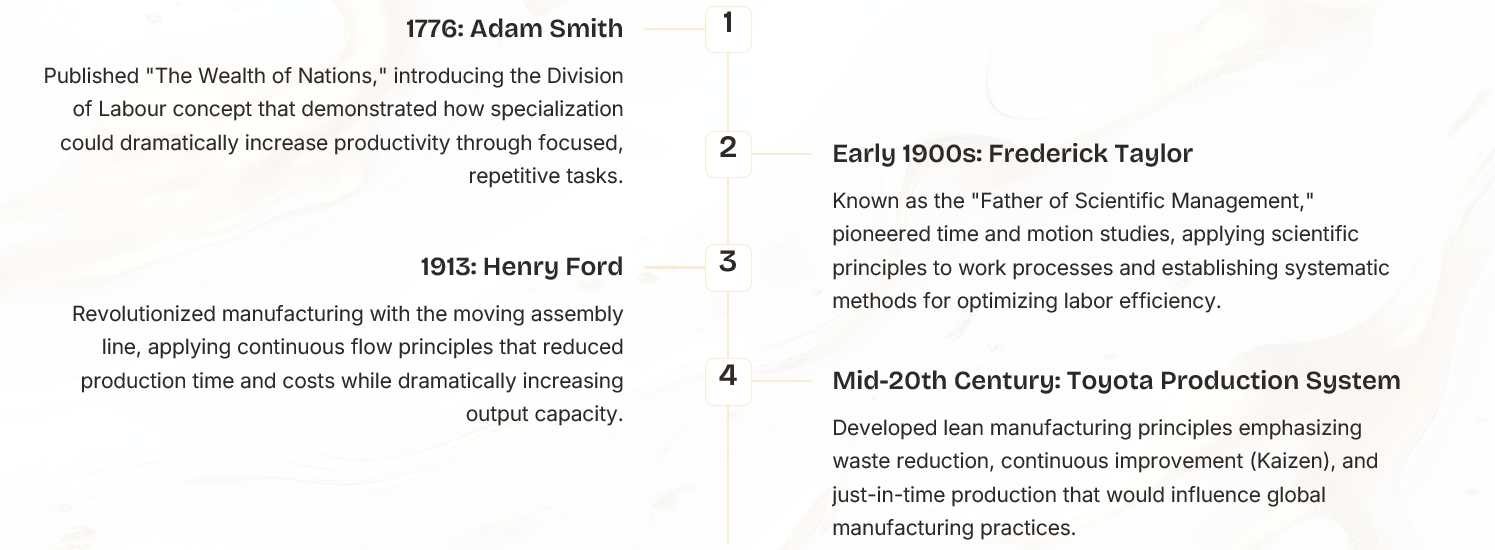
Industrial engineering Roots: History & Evolution
Core Objectives of Industrial Engineering
Industrial Engineering (IE) deals with the systematic and measurable improvement of organisational performance. The discipline is intended to optimise the way people, process, technology and materials work together to deliver maximum value. Industrial Engineering is fundamentally about achieving three basic goals: increasing productivity, removing waste, and enhancing quality and safety.
These objectives guide all improvement initiatives, be it in manufacturing, services, logistics or any operation-driven industry.
1. Maximize Productivity
Industrial Engineers are about producing more output with the same or fewer resources. IE analyses workflows, breaks down tasks and identifies inefficiencies to design lean, high-performing systems.
How IE Improves Productivity
- Optimizes process flow to reduce delays
- Analyzes machine and manpower utilization
- Removes redundant motions and unnecessary activities
- Improves workstation layout for better ergonomics
- Balances workloads to prevent bottlenecks
The net result is better throughput, better resource utilisation and quicker cycle times – and no compromise to quality.
Real‑World Example: Tailoring & Apparel Industry
Better cutting techniques are often used by garment manufacturers to increase productivity.
Strategic nesting of pattern pieces can improve fabric usage by 15–20%, thereby reducing material waste while keeping the fit and quality of the garment. This has a tangible effect on cost effectiveness and output.
The elimination of waste is at the core of Industrial Engineering and Lean Manufacturing. Waste is anything that consumes time, resources, or energy, but does not add value.
Types of Waste IE Targets
- Overproduction
- Waiting time
- Excess motion
- Defects and rework
- Over‑processing
- Poor layout and unnecessary movement
- Inefficient use of materials or energy
IE looks at every step in a process to identify non‑value‑added tasks. Once identified, these activities are either redesigned or eliminated, so that only meaningful work remains.
Real‑World Impact
Organisations benefit from: shifting resources from wasteful tasks to value-adding activities
- Reduced operational cost
- Shorter lead times
- Increased agility
- Better customer satisfaction
3. Improve Quality & Safety
Industrial Engineers design systems that ensure reliable output while protecting the workforce. Quality and safety are part of productivity. Poor quality leads to rework and loss, and unsafe workflows lead to risk and downtime.
How IE improve Quality
- Establishes standardized methods and procedures
- Implements quality control tools like SPC and root‑cause analysis
- Ensures consistent product specifications
- Designs error‑proofing mechanisms (Poka‑Yoke)
How IE Enhances Safety
- Studies ergonomic principles to minimize strain
- Designs workstations that prevent fatigue and injuries
- Implements safe work sequences and tool configurations
- Ensures compliance with workplace safety standards
Real‑World Example: Machining Operations
Industrial Engineers frequently work in machining environments, assisting workers in running multiple machines safely and efficiently.
Smart scheduling, optimised machine setup and partial automation can increase output per worker by 40% or more without additional machines. This will help not only in productivity but also provide a safer & well organized environment.
Key Fields in Industrial Engineering
Industrial Engineering (IE) deals with the optimization of complex systems through integration of people, materials, information, equipment and energy. This covers a wide range of specialist areas which all contribute to making operations more efficient, cheaper, of better quality and safer. These domains support continuous improvement and strategic decision-making in modern industries.
Here are the four main domains from your image, fleshed out into richer, web ready content.
1. Productivity & Work Study
The basic of Industrial Engineering is mostly related to Productivity and Work Study. This domain is concerned with the measurement, analysis and improvement of the relationship between inputs (labour, materials, machines) and outputs (products or services). IE professionals analyze workflows and human motions to develop standardized, efficient methods that enable organizations to achieve maximum productivity with minimum resource use.
Key Activities
- Conducting time studies, work sampling and motion analysis
- Identifying process bottlenecks and inefficiencies
- Developing and implementing standard operating procedures (SOPs)
- Establishing standard time (SMV) for tasks
- Benchmarking performance against industry standards
- Supporting continuous improvement projects (Lean, Kaizen, 5S)
This domain ensures every task is performed in the most efficient, safe and repeatable manner possible.
2. Facility Layout & Material Handling
This domain is about designing physical work spaces to enable smooth, efficient and safe operations. A good facility layout helps to ensure that materials, people and information flow with minimum delays and waste.
Key Activities
- Designing layouts that reduce travel time and handling distance
- Planning location of equipment, workstations, storage areas and pathways
- Implementing material-handling solutions such as:
- Conveyors
- Automated guided vehicles (AGVs)
- Robotics
- Forklifts and pallet systems
- Introducing warehouse management systems (WMS)
- Minimizing non‑value‑added movement and transportation waste
A thoughtfully designed facility can significantly reduce operational costs, improve throughput and enhance safety.
3. Quality Control
Quality Control is a significant IE domain that deals with ensuring that products and processes meet the desired standards. Industrial Engineers use scientific and statistical methods to design systems that prevent defects, monitor performance and continuously improve quality.
Key Activities
- Utilizing Six Sigma methodologies for defect reduction
- Implementing Statistical Process Control (SPC) tools
- Conducting comprehensive quality audits
- Performing process capability analysis (Cp, Cpk)
- Using control charts to detect variation
- Applying root cause analysis techniques (Fishbone, 5 Whys)
- Redesigning processes to eliminate failure points
Through strong quality controlorganizations reduce rework, improve customer satisfaction and maintain consistency across production lines.
4. Project & Program Management
Industrial Engineers are often responsible for managing complex engineering projects that require careful planning, scheduling and resource allocation. This domain ensures that projects are delivered on time, within budget and to specification.
Key Activities
- Developing project schedules and timelines
- Conducting risk analysis and mitigation planning
- Allocating manpower, machines and materials
- Using industry‑standard project management tools such as:
- Critical Path Method (CPM)
- Program Evaluation and Review Technique (PERT)
- Earned Value Management (EVM)
- Monitoring project progress and implementing corrective actions
IEs combine analytical thinking with leadership skills to guide teams through complex initiatives successfully.
Tools & Techniques Driving Efficiency
Industrial engineers employ a wide range of methodologies and advanced technologies to analyze, improve and control complex systems. These tools assist organizations to make informed decisions, reduce waste and improve overall operational performance. Here are the key techniques that show how Industrial Engineering can provide measurable efficiency in industries.
Simulation & Process Optimization
Simulation models allow engineers to visualise, test and refine processes before making changes in the real world.
Engineers can use digital twins, predictive simulations and workflow modelling to:
- Evaluate system behavior under different operating conditions
- Visualize bottlenecks and cycle‑time variations
- Test “what‑if” scenarios without disrupting production
- Optimize capacity planning and equipment utilization
- Improve layout design and resource allocation
Simulation empowers teams to reduce costs, increase throughput and make strategic improvements with confidence.
Ergonomics & Human Factors
Ergonomics is the design of workplaces to improve safety, comfort and performance. Industrial engineers use human-factors analysis to create environments in which work is performed efficiently and sustainably.
Key Applications
- Designing workstations that reduce physical strain
- Improving tool placement and reach distance
- Minimizing repetitive motion and fatigue
- Optimizing shift schedules and rest cycles
- Enhancing overall worker well‑being and productivity
Strong ergonomic systems lead to fewer injuries, improved morale and higher output.
Root Cause Analysis
Root Cause Analysis (RCA) serves as a core element in continuous improvement efforts. It helps organizations identify underlying causes of process failures instead of only addressing symptoms.
Common Methods
- 5 Whys
- Fishbone (Ishikawa) diagrams
- Failure Mode and Effects Analysis (FMEA)
- Pareto analysis
By identifying the true root causes, engineers can take corrective actions that prevent recurrence and provide long term performance improvements.
Operational Analytics
Operational analytics is the combination of real-time data tools and engineering techniques that enables faster, smarter decisions.
Capabilities Include:
- Performance tracking across machines, processes and systems
- Advanced dashboards for instant visibility into KPIs
- Integration with IoT networks, automation systems and SCADA platforms
- Predictive analytics to anticipate issues before they occur
- Data‑driven optimization of workflows and resource usage
This modern analytics ecosystem enables continuous improvement, proactive maintenance and consistent operational excellence.