Sonali Bag (Jute Plastic Bag): Sustainable Alternative to Polythene in Textiles and Packaging
November 13, 202414 min read
Sonali Bag, also known as jute polymer bag or jute biopolymer bag, is an innovative, biodegradable and eco-friendly alternative to conventional polyethylene plastic bags. These bags are made from jute cellulose and are as strong, flexible and durable as plastic but fully compostable and non-toxic.
Sonali Bag
A Sonali Bag is basically a smarter version of plastic—made from jute cellulose, not petroleum. It looks like a regular polythene bag, feels pretty similar too… but the big difference shows up later. It doesn’t sit in landfills for decades. It actually breaks down on its own.
That’s the whole idea. Same utility, way less damage.
Key Features
100% biodegradable – it decomposes naturally
Non-toxic – no harmful leftovers
Durable and water-resistant (within practical limits)
Looks and behaves like plastic – so no learning curve
Made from renewable jute resources
For countries with strong jute production, this is kind of a big deal. It’s not just eco-friendly—it’s practical at scale.
Composition and Material Properties
Jute Polymer Base
Everything starts with jute cellulose. That’s extracted from raw jute fibre and then turned into a biopolymer.
Think of it as reshaping a natural material so it behaves like plastic—but without losing its biodegradability.
Additives for Strength
On its own, cellulose isn’t enough. So a few eco-safe additives are mixed in:
Natural plasticizers
Softeners
Binders
These help:
Improve flexibility
Increase tear strength
Add some water resistance
Not heavy chemicals—just enough to make the material workable.
Biodegradation Behavior
Here’s where Sonali Bags really stand apart.
Under proper conditions, they break down within a few months. Compare that to conventional plastic… which sticks around for centuries.
That’s not a small difference.
Manufacturing Process of Sonali Bags
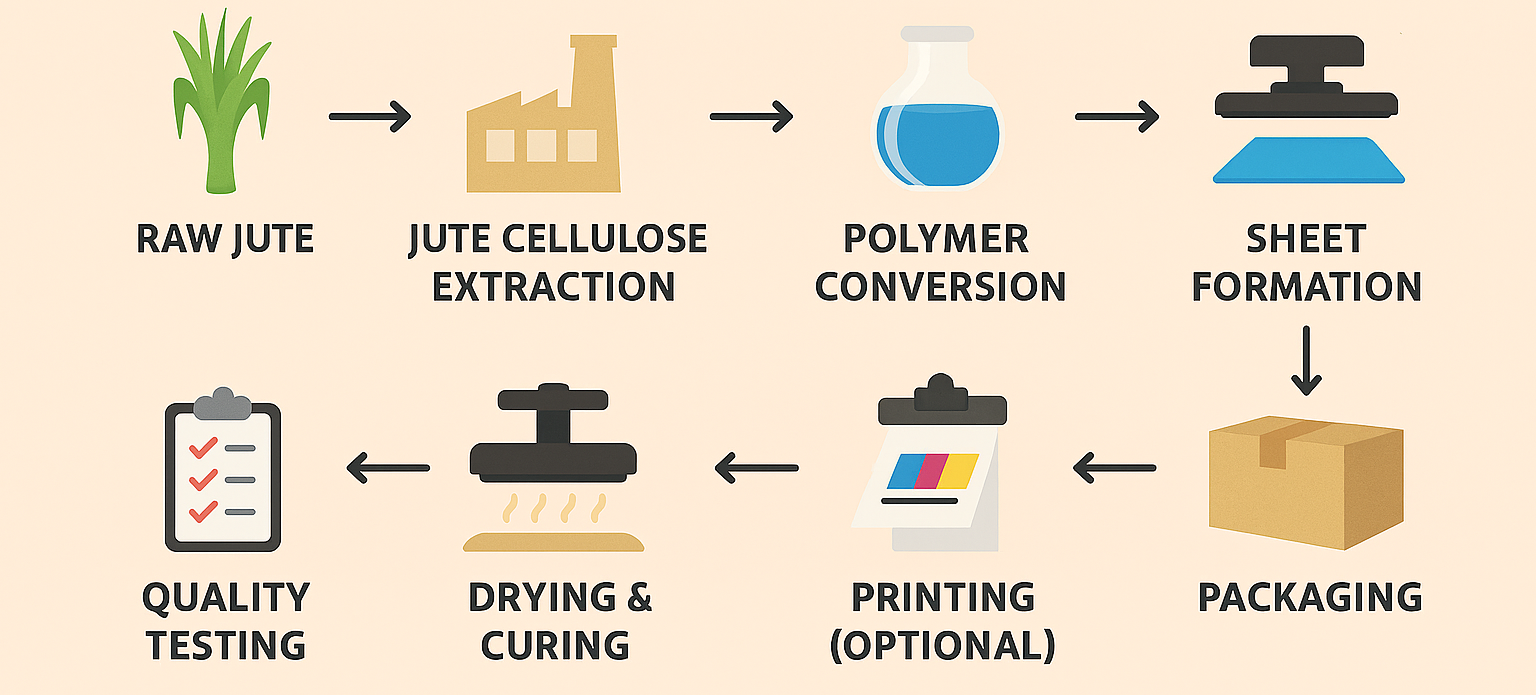
Manufacturing Process of Sonali Bags
industrial manufacturing process for Sonali Bags.
1. Raw Jute Collection and Preparation
Jute stalks are harvested from jute-growing regions.
Fibers are extracted, cleaned and dried.
High‑quality long jute fibers are selected for cellulose extraction.
2. Jute Cellulose Extraction
The jute fibers are processed to extract α‑cellulose, using mechanical and chemical steps:
Fibers undergo alkaline treatment to remove lignin, pectin and waxes.
Pulping produces a cellulose-rich slurry.
Cellulose is washed and filtered to achieve purity.
This purified cellulose is the foundation of the biopolymer.
3. Polymer Conversion (Biopolymer Production)
Cellulose is converted into a biodegradable polymer:
Cellulose slurry is mixed with natural plasticizers and additives.
The mixture is heated and processed until it forms a gel-like polymer mass.
This cellulose-based biopolymer now mimics properties of traditional plastics.
Polymer conversion is the core scientific step that transforms raw jute cellulose into a thermoplastic, film‑forming biopolymer suitable for making Sonali Bags. This stage involves cellulose extraction, chemical modification, plasticization and polymer structuring, resulting in a biodegradable material with properties similar to synthetic plastics.
Below is an expanded breakdown of the full chemistry behind the process.
Raw cellulose is not thermoplastic; it does not melt, so it cannot be turned into film directly.
To make cellulose suitable for bag manufacturing, its chemistry must be altered.
This occurs through partial esterification, etherification and plasticization, depending on the desired grade of the Sonali Bag.
Common Chemical Pathways
A. Cellulose Ester Formation (Similar to Cellulose Acetate)
Cellulose is reacted with organic acids (or derivatives):
Acetic acid / acetic anhydride
Citric acid
Maleic acid
This creates cellulose esters, which:
Reduce crystallinity
Increase solubility
Improve thermoplastic behavior
General reaction:
Cell–OH + R–COOH → Cell–O–CO–R + H2O
This esterification improves flexibility and film formation.
B. Cellulose Ether Formation (Similar to CMC, HEC)
Cellulose reacts with alkylating agents (e.g., chloroacetic acid) to form cellulose ethers.
Example reaction for Carboxymethyl Cellulose (CMC):
Curing stabilizes the polymer, improving strength and durability.
Properly dried sheets are flexible, glossy and tear-resistant.
6. Cutting & Bag Formation
The bioplastic sheets are converted into bags:
Cutting machines shape bags to required dimensions.
Edges are sealed using:
Heat sealing
Ultrasonic sealing
Press sealing
These sealing methods bond the biopolymer without harmful chemicals.
7. Printing & Branding (Optional)
Eco-friendly inks are used to print:
Logos
Product information
Retail branding
Custom artwork
Flexographic or screen printing machines are most commonly used.
Types of Sonali Bags
Sonali Bags aren’t just one standard type. They’ve slowly branched out, depending on how and where they’re used. Some are light and simple. Others… a bit tougher, built for repeated use.
Grocery & Retail Bags
The everyday kind. Lightweight, easy to carry—used in supermarkets, convenience stores, small retail shops. Nothing fancy, just practical.
Shopping & Carry Bags
Slightly thicker. More durable. These are what clothing stores or lifestyle brands usually go for—something that can handle weight without tearing halfway home.
Packaging Bags
Used behind the scenes more than you notice. For packing garments, accessories, dry goods… even promotional kits sometimes.
Garbage Bags
A cleaner alternative to traditional plastic waste bags. Same purpose, just less environmental guilt attached to it.
Custom Printed Sonali Bags
This is where branding comes in. Logos, messages, event names—these bags double as marketing tools. You see them a lot in corporate events or retail branding campaigns.
Advantages of Sonali Bags (Jute Plastic Bags)
Sonali Bags (Jute Plastic Bags)
There’s a reason these bags are getting attention. Actually, a few reasons.
Environmentally Friendly
Fully biodegradable
Compostable under natural conditions
Helps reduce plastic waste buildup
It’s not just “eco-friendly” as a label—it actually breaks down, which is what matters.
Supports the Agricultural Sector
Since it’s made from jute, demand for Sonali Bags directly supports:
Jute farming
Rural employment
Local economies in jute-producing regions
So there’s a bigger ripple effect beyond just packaging.
Strong and Durable
People assume biodegradable means weak. Not really the case here.
Strength is comparable to conventional plastic bags
Can handle regular usage without falling apart instantly
Safe for Food Packaging
Non-toxic
No harmful chemical residues
That makes it usable for food items—fruits, grains, dry goods without concern.
Water Resistant
Not waterproof, but better than paper.
Handles light moisture
Doesn’t collapse quickly like paper bags
Good enough for day-to-day use.
Cost-Effective (Longer Term)
Yes, upfront cost can be higher. But zoom out a bit:
Lower environmental impact
Easier compliance with regulations
Better brand perception
So over time, it starts making more sense.
Limitations of Sonali Bags
Still not perfect. There are a few practical challenges.
Higher production cost
Compared to polyethylene, manufacturing is still expensive
Limited water exposure tolerance
Prolonged contact with water can weaken certain types
Scaling issues
Not every region has the infrastructure to produce these at massive volumes
Temperature sensitivity
Excess heat can affect shape or performance
Nothing deal-breaking—but worth keeping in mind.
End use of Sonali Bags
You’ll find these bags popping up in more places now.
Government & NGOs – awareness drives, plastic-ban initiatives
They’re flexible in use—just like plastic, but with less long-term impact.
Future Potential of Sonali Bags
There’s still room to grow—but the direction is clear.
Sonali Bags could play a real role in:
Cutting down global plastic waste
Supporting sustainable industries
Expanding biodegradable packaging markets
And with ongoing improvements, we’ll likely see:
Better strength and improved water resistance
Lower production costs over time
Wider adoption across different countries
It’s not a perfect replacement yet. But it’s getting there—step by step.
History of the Sonali Bag (Jute Plastic Bag)
The origin of the Sonali Bag is deeply connected to Bangladesh’s long struggle against plastic pollution and its global leadership in jute‑based innovation. The journey began after Bangladesh became the first country in the world to ban polythene bags in 2002, a move that triggered national research efforts to find a biodegradable alternative to conventional plastic bags. [en.wikipedia.org]
During this time, scientist Dr. Mubarak Ahmad Khan, a polymer and radiation chemistry expert at the Bangladesh Atomic Energy Commission, began researching natural fiber composite (NFC) materials. Over nearly two decades, he experimented with jute cellulose to develop a biopolymer capable of mimicking the physical properties of polythene. [en.wikipedia.org]
By 2015–2017, Dr. Khan successfully transformed jute cellulose into a biodegradable polymer film at Latif Bawany Jute Mills, Demra, where the prototype Sonali Bag was first produced. This early development marked a major leap in sustainable material science, as jute can be harvested in 100–110 days, making it far more renewable than wood‑based cellulose sources. [pojf.org][mubarakahmadkhan.org]
The breakthrough gained national attention when the Government of Bangladesh, through the Bangladesh Jute Mills Corporation (BJMC), started supporting the project. In 2018, BJMC launched the first commercial‑scale production of the jute biopolymer bags using Dr. Khan’s technology. [en.wikipedia.org]
The name “Sonali Bag”, meaning “Golden Bag,” was given by Prime Minister Sheikh Hasina, symbolizing jute’s nickname in Bangladesh—“The Golden Fiber.” The name reflects both the cultural significance of jute and the promising future of this eco-friendly innovation. [en.wikipedia.org]
Since then, Sonali Bags have gained wide global interest due to their ability to biodegrade within 3–6 months, addressing the global crisis of plastic waste. International media, sustainability organizations and foreign governments have highlighted the invention as a game-changing alternative to plastic bags. [saudibusin...xpress.com]
Today, the Sonali Bag continues to expand in production, research and export potential, reaffirming Bangladesh’s role as a leader in biopolymer innovation and sustainable packaging solutions. [textileapex.com]
References & Sources
Bangladesh Atomic Energy Commission (BAEC) – Research and Development of Jute-Based Biopolymers and Sonali Bag Technology.
Bangladesh Jute Mills Corporation (BJMC) – Sonali Bag Commercialization and Jute Diversification Initiatives.
Dr. Mubarak Ahmad Khan – Research on Jute Cellulose-Based Biopolymer and Sonali Bag Development. Available at: https://www.mubarakahmadkhan.org
Wikipedia – Sonali Bag (History, Development and Commercialization Overview). Available at: https://en.wikipedia.org/wiki/Sonali_Bag
Plastic Oceans International – Resources on Plastic Pollution and Sustainable Alternatives. Available at: https://plasticoceans.org
United Nations Environment Programme (UNEP) – Plastic Pollution and Biodegradable Material Resources. Available at: https://www.unep.org
International Jute Study Group (IJSG) – Jute Industry and Sustainable Fiber Resources. Available at: https://www.jute.org
Palli Karma-Sahayak Foundation / Jute Innovation and Sustainable Packaging Resources. Available at: https://pojf.org
Disclaimer: This article is intended for educational and informational purposes only. Information regarding Sonali Bag technology, biodegradability, manufacturing processes, chemical modifications, performance characteristics, and commercialization is based on publicly available research, industry publications, and reported developments available at the time of writing. Actual material properties, degradation rates, production methods, and commercial performance may vary depending on formulation, manufacturing conditions, usage environment, and technological advancements. Readers should consult original research publications, technical specifications, and qualified experts for scientific, engineering, or commercial applications.
Written by
Alam Mohammad Shafiqul
Lead Editor, Senior Contributor & Founder
Textile Technology
Textile engineering professional with over 15 years of experience in Sweater Manufacturing, Industrial Engineering and Technical Development. Holds a degree in Textile Engineering and an MBA in Apparel Merchandising. Passionate about bridging the gap between factory-floor operations and technical expertise to drive efficiency, innovation, and continuous improvement.
Textile EngineeringSweaterIndustrial EngineeringLean Six SigmaPythonJS