The textile and garment industry depends heavily on water. From growing cotton to dyeing, washing, printing and finishing fabric, water is involved in a surprising number of steps before a garment reaches a customer.
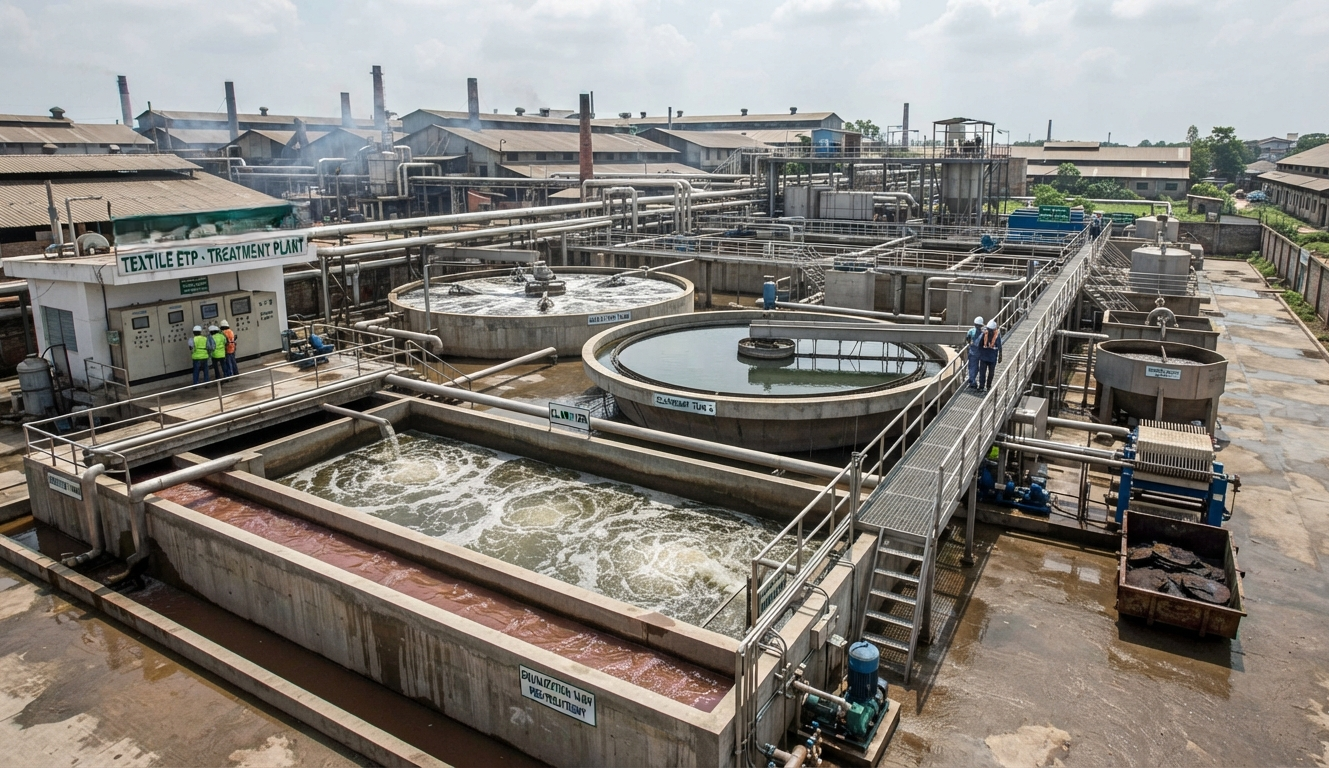
The problem is that water is not an unlimited resource. Many textile-producing regions are already dealing with groundwater depletion, drought, pollution and increasing competition for freshwater. At the same time, textile factories generate large quantities of wastewater that must be treated before it can be discharged.
For manufacturers, water management is therefore no longer only an environmental issue. It has become a matter of cost, production efficiency, compliance, customer requirements and long-term business security.
Large apparel brands are also putting more pressure on their supply chains to measure water consumption, improve wastewater treatment and reduce freshwater use. As a result, factories that invest in efficient processes and water-reuse systems can gain both environmental and commercial advantages.
Why Water Is So Important in Textile Manufacturing
Water is particularly important during wet processing, which includes activities such as:
Bleaching
Dyeing
Washing and rinsing
Printing
Finishing
Garment washing
Among these processes, dyeing and washing are usually major sources of water consumption.
A dyeing process may involve several separate baths for preparation, dyeing, washing, neutralization and rinsing. If each bath uses fresh water and is discharged after one use, the total consumption can become very high.
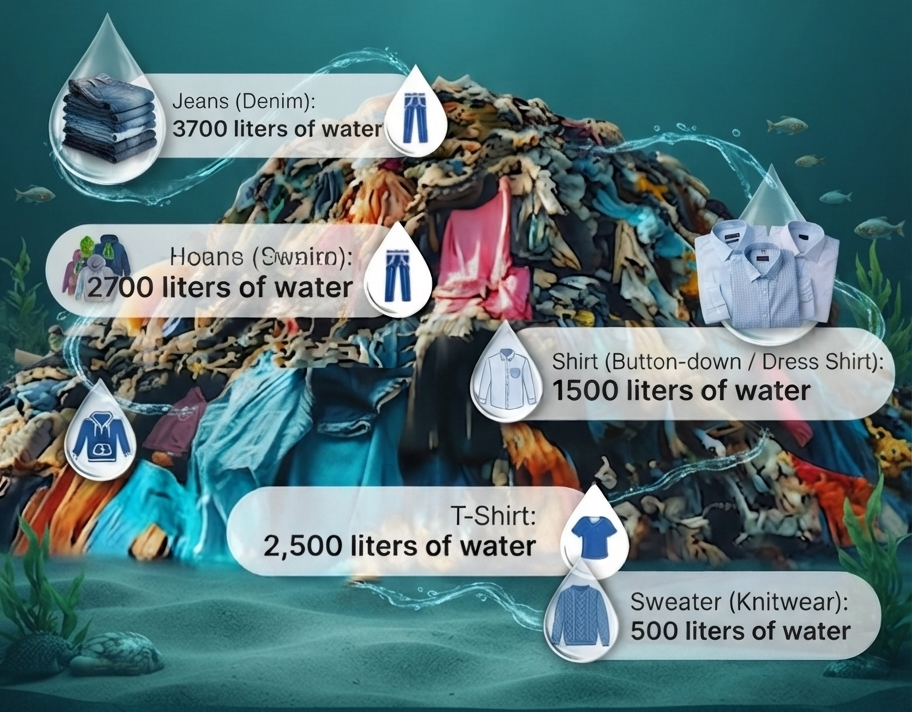
Garment washing can also be water-intensive, especially for denim products. Stone washing, enzyme washing, bleaching and other finishing techniques may require several washing cycles.
This is why reducing water consumption at the process level can have a significant effect on the overall water footprint of a factory.
Where Textile Water Consumption Happens
| Production Stage | Main Activities | Water Intensity | Overall Impact | Approx. Share of Total Water Use (%) |
|---|---|---|---|---|
| Cotton Growing | Watering fields | Very High | Very High | 30-40%* |
| Fiber Processing | Cleaning, preparation | Medium | Medium | 1-3% |
| Spinning | Making yarn | Low | Low | <1% |
| Weaving & Knitting | Forming fabric | Low | Low | 1-2% |
| Dyeing | Adding color | Very High | Very High | 25-35%** |
| Bleaching | Preparing fabric | Very High | Very High | 10-15%** |
| Washing | Cleaning and rinsing | Very High | Very High | 15-25%** |
| Printing | Adding patterns | Medium-High | High | 3-8% |
| Garment Washing | Denim and apparel finishing | Very High | Very High | 5-15% |
| Utility Operations | Boilers, cooling systems | Medium | Medium | 3-8% |
* Includes agricultural water used for cotton cultivation across the entire value chain.
** Percentage of factory-level water consumption, not including cotton cultivation.
The exact percentage varies considerably from factory to factory. Machine type, fabric construction, dye class, liquor ratio, batch size and production method all affect water consumption.

Why Water Scarcity Is Becoming a Business Problem
Freshwater availability is under increasing pressure in many textile-producing countries. Population growth, agriculture, industrial development, climate change and groundwater extraction all contribute to the problem.
Countries such as Bangladesh, India, Pakistan, China, Vietnam and Turkey have textile manufacturing areas where water availability or water quality is becoming an increasingly important concern.
For a factory, this creates several risks.
Water may become:
More expensive to purchase
More difficult to obtain
More expensive to pump and treat
Subject to stricter regulations
A potential limitation on future production
This means water efficiency is becoming part of normal business planning rather than something handled only by the environmental department.
Water Saving Can Reduce Production Costs
Reducing water consumption does not simply reduce the water bill.
Every cubic meter of water entering a factory may require pumping, heating, chemical treatment, wastewater treatment and disposal.
For example:
Less water → less heating → less steam → less fuel → lower energy cost
The same principle applies to wastewater.
If a factory uses less process water, it normally produces less wastewater. That can reduce the load on the ETP, chemical consumption, sludge generation and treatment costs.
So a properly designed water-reduction project can produce savings in several areas at the same time.
Understanding the Water Footprint
A water footprint looks at the amount of water associated with producing a product or operating a business.
It is commonly divided into three categories:
| Type | Meaning |
|---|---|
| Blue Water | Surface water and groundwater withdrawn for use |
| Green Water | Rainwater stored in soil and used by plants |
| Grey Water | Water theoretically required to dilute pollution to an acceptable level |

For a textile factory, blue water is particularly important because it represents water physically withdrawn from sources such as rivers, reservoirs or groundwater.
For example, suppose a factory consumes:
| Operation | Annual Consumption |
|---|---|
| Dyeing | 500,000 m³ |
| Washing | 250,000 m³ |
| Boilers | 100,000 m³ |
| Cleaning and utilities | 50,000 m³ |
| Total | 900,000 m³ |
A 20% reduction would save approximately 180,000 m³ of water per year.
That is a substantial reduction before considering the associated energy and wastewater savings.
Where Factories Can Save Water
1. Dyeing
Dyeing can consume a large amount of water because several baths may be required during preparation, dyeing and rinsing.
One of the most effective approaches is reducing the liquor ratio.
Traditional machines may operate around:
1:10–1:15
Modern low-liquor-ratio machines can operate at approximately:
1:4–1:6
The actual saving depends on the machine, fabric, dyeing recipe and process conditions, but lower liquor ratios can significantly reduce water, chemical and energy consumption.
2. Counter-Current Washing
In conventional washing, fresh water is often introduced and discharged after use.
Counter-current washing works differently. Relatively clean water is introduced at the final washing stage and moves in the opposite direction to the fabric.
This allows water to be used more efficiently and can substantially reduce freshwater demand.
3. Automatic Chemical Dosing
Incorrect chemical dosing can create another hidden source of water consumption.
If too much or too little dye, salt, alkali or finishing chemical is used, the batch may require additional washing or even reprocessing.
Automatic dosing systems can improve accuracy and repeatability.
The result can be:
Less chemical waste
Fewer process corrections
Fewer additional washes
More consistent quality
Lower water consumption
4. Digital Printing
Digital textile printing can reduce some of the water associated with conventional screen printing.
Traditional printing requires screens, preparation and cleaning, all of which can generate wastewater.
Digital printing eliminates many of these steps and can therefore reduce water and chemical consumption, particularly for suitable production types.
The actual saving depends on the product and printing process.
5. Garment Washing
Denim and other washed garments can consume considerable amounts of water.
Factories are increasingly using alternatives such as:
Ozone treatment
Laser finishing
Enzyme processes
More efficient washing systems
Optimized washing recipes
These technologies can reduce the number of conventional washing steps and therefore lower water consumption.
Wastewater Recycling and Reuse
Reducing water consumption is only one part of the solution.
Factories can also treat wastewater and reuse it for suitable applications.
Depending on the quality required, treated water may be reused for:
Floor and equipment cleaning
Cooling
Toilet flushing
Gardening
Some washing operations
Selected textile processes
Treatment technologies can include:
Biological treatment
Ultrafiltration (UF)
Nanofiltration (NF)
Reverse osmosis (RO)
Activated carbon
Other membrane systems
Not every application requires the same water quality. This is important because producing extremely high-quality recycled water for a low-quality application can increase costs unnecessarily.
A good water-reuse strategy matches water quality with the actual process requirement.
Zero Liquid Discharge
Zero Liquid Discharge (ZLD) takes water recycling a step further.
The objective is to recover and reuse wastewater so that little or no liquid wastewater leaves the facility.
A typical ZLD system may combine wastewater treatment, membrane systems, evaporation and crystallization.
The main advantages are:
High water recovery
Reduced wastewater discharge
Lower freshwater demand
Better control of wastewater
However, ZLD is not a simple solution for every factory.
It can require:
High capital investment
Significant energy
Skilled operation
Regular maintenance
Careful management of concentrated salts and solids
Therefore, the decision to install ZLD should be based on local water conditions, discharge requirements, production needs and financial feasibility.
Rainwater Harvesting
Large textile factories often have extensive roof areas, making rainwater harvesting another possible source of water.
Collected rainwater can potentially be used for applications such as:
Gardening
Cleaning
Cooling
Utility purposes
After suitable treatment, it may also be suitable for other applications depending on local requirements.
Rainwater harvesting will not replace all industrial water demand, but it can reduce dependence on groundwater and municipal supplies.
The Water-Energy Connection
Water and energy are closely connected in textile manufacturing.
Water has to be pumped, heated, transported and treated. Therefore, reducing water consumption can also reduce energy consumption.
This is particularly important for hot processes.
For example:
This relationship is often referred to as the Water-Energy Nexus.
For this reason, water-saving projects should not be evaluated only by the amount of water saved. The associated energy savings should also be considered.
Digital Technology for Water Management
Factories are increasingly using digital systems to understand where their water is going.
Common technologies include:
IoT Monitoring
Flow meters and sensors can monitor water consumption in real time.
This makes it easier to identify:
Leaks
Abnormal consumption
Equipment problems
High-consumption processes
Digital Dashboards
Instead of collecting readings manually, factories can use dashboards to monitor water consumption by department, machine or production area.
Data Analytics and AI
Historical production and water-consumption data can be analyzed to identify unusual patterns and predict future demand.
For example, if a dyeing machine suddenly begins consuming significantly more water than its normal operating range, the system can flag the issue for investigation.
The technology itself is not the main objective. The real value comes from using the data to make better operational decisions.
From Water Efficiency to Water Stewardship
There is an important difference between water efficiency and water stewardship.
Water efficiency mainly asks:
How can the factory use less water?
Water stewardship asks a broader question:
How can the factory use water responsibly while considering the surrounding community, ecosystem and local water resources?
This approach considers:
Water availability
Water quality
Wastewater discharge
Groundwater extraction
Community needs
Local environmental risks
Long-term water security
This broader approach is becoming increasingly relevant to global textile supply chains.
Major Industry Trends
Several changes are shaping textile water management.
1. More Attention to Water-Stressed Locations
Brands and manufacturers are paying greater attention to factories operating in areas where water availability is already under pressure.
2. Greater Wastewater Reuse
Factories are increasingly looking at treated wastewater as a resource rather than something that simply needs to be discharged.
3. Low-Water Technologies
Technologies such as low-liquor-ratio dyeing, ozone processing, laser finishing and digital printing are receiving greater attention.
4. Better Water Measurement
Factories are installing more meters and monitoring systems to understand consumption at process level.
5. Water and Carbon Management Together
Reducing water use can also reduce energy consumption, so water and carbon-reduction programs are increasingly being connected.
6. Greater Supply-Chain Transparency
International buyers increasingly want suppliers to provide reliable information about:
Water consumption
Water intensity
Wastewater quality
Recycling
Reduction targets
Improvement projects
Measuring Water Performance
A factory cannot effectively manage water without reliable measurements.
Some useful KPIs include:
| KPI | What It Measures |
|---|---|
| Total Water Consumption | Total water used by the factory |
| Water Intensity | Liters of water per kg of production |
| Recycled Water Rate | Percentage of water reused |
| Wastewater Volume | Wastewater generated per day |
| Water Cost | Financial impact of water consumption |
| Process Water Consumption | Water used by individual processes |
For example, if a factory produces 8 million garments per year and consumes 400,000 m³ of water:
400,000 m³ × 1,000 liters = 400 million liters
400 million ÷ 8 million garments = 50 liters per garment
This figure can then be tracked over time to determine whether water-efficiency projects are actually working.
What Global Brands Expect From Suppliers
Water management has become part of the broader sustainability requirements used by many international apparel brands.
Companies such as Levi Strauss & Co., H&M Group, Nike, Adidas, Patagonia, Inditex, Fast Retailing and PVH have all developed environmental programs that address resource efficiency, water, wastewater, materials or supply-chain sustainability.
The exact requirements differ from one company to another, but the general direction is similar.
Suppliers are increasingly expected to:
Measure water consumption
Improve wastewater treatment
Set reduction targets
Monitor environmental performance
Improve chemical management
Increase water reuse where practical
Provide reliable sustainability data
Demonstrate continuous improvement
The important point for manufacturers is that sustainability performance is increasingly becoming part of supplier evaluation, rather than something separate from production.
Circular Economy and Water
The traditional production model can be summarized as:
Take → Make → Dispose
A circular approach aims for:
Reduce → Reuse → Recycle → Recover
Circular manufacturing can reduce the need for virgin raw materials and, in some cases, reduce the associated water demand.
Examples include:
Recycled polyester
Recycled cotton
Textile-to-textile recycling
Fabric scrap recovery
Garment repair
Longer product life
Material selection also matters.
| Material | General Water Consideration |
|---|---|
| Conventional Cotton | High agricultural water demand |
| Recycled Cotton | Can reduce demand for virgin cotton |
| Polyester | Lower direct water demand but fossil-resource impacts |
| Recycled Polyester | Reduces virgin polyester demand |
| Lyocell | Uses a closed-loop solvent system |
No material is automatically sustainable in every situation. Water, energy, chemicals, land use, carbon emissions and end-of-life impacts all need to be considered together.
Challenges Factories Face
Water-saving projects can deliver strong results, but implementation is not always easy.
The biggest challenges often include:
Initial investment:
Efficient machines, recycling plants, meters and treatment systems require capital.
Technical knowledge:
Operators need to understand new equipment and process conditions.
Existing infrastructure:
Older factories may have piping and drainage systems that were never designed for water reuse.
Product quality:
Reducing water or changing a recipe without proper trials can affect shade, hand feel, shrinkage or other quality parameters.
Supply-chain complexity:
A brand may work with hundreds of factories and suppliers, making consistent water management difficult.
For these reasons, water reduction should normally be introduced through measurement, trials and controlled implementation rather than simply setting an aggressive target.
The Business Benefits
A well-designed water strategy can create benefits in several areas.
| Area | Potential Benefit |
|---|---|
| Environmental | Lower freshwater withdrawal and pollution |
| Financial | Lower water, energy and treatment costs |
| Operational | More efficient processes |
| Compliance | Easier management of environmental requirements |
| Customer | Stronger performance against buyer expectations |
| Strategic | Better resilience against future water shortages |
The strongest projects usually create value in more than one of these areas.
What Textile Manufacturers Should Do Now
Factories do not necessarily need to begin with expensive technology.
A practical starting point is:
- Measure current water consumption.
- Identify the highest-consuming processes.
- Check for leaks and unnecessary water use.
- Establish a water-intensity baseline.
- Optimize dyeing and washing recipes.
- Consider low-liquor-ratio equipment during machine replacement.
- Improve chemical dosing accuracy.
- Install sub-meters where useful.
- Investigate wastewater reuse opportunities.
- Train operators and production teams.
- Set realistic annual reduction targets.
- Track performance using reliable data.
The key is to start with the areas that offer the largest practical savings rather than trying to change everything at once.
What Comes Next?
The next phase of textile water management is likely to combine process efficiency, recycling and digital monitoring.
Technologies such as waterless dyeing using supercritical CO₂, foam-based processes, laser finishing, advanced membrane systems and AI-assisted process optimization could reduce water consumption further.
However, technology alone will not solve the problem.
A factory can install sophisticated equipment and still waste water if processes are poorly controlled, leaks are ignored or operators are not trained properly.
The most effective approach is usually a combination of good production practices, accurate measurement, efficient machinery, wastewater treatment, recycling and continuous improvement.
Final Thoughts
Water management is becoming one of the most important sustainability challenges facing the textile and garment industry.
The opportunity is not limited to simply using less water. Factories can reduce water consumption, lower energy use, reduce wastewater generation, control operating costs and become more resilient to future water shortages at the same time.
The first step is surprisingly simple: know where the water is going.
Once a factory understands which processes consume the most water, it can begin making targeted improvements. Sometimes the solution is a new dyeing machine or recycling plant. In other cases, the biggest savings may come from a better recipe, a leaking valve, improved rinsing practices or more accurate chemical dosing.
The future of textile water management will therefore not depend on one single technology. It will depend on how well manufacturers combine process knowledge, technology, data and responsible water stewardship.
For an industry that depends so heavily on water, using that resource wisely is no longer optional. It is becoming part of running a competitive and resilient textile business.