The whole process is built around surface abrasion and partial pigment removal during washing.
Garments are first treated with a mix of pigment and binder, then loaded into an industrial washing machine. After that, things start to shift.
Inside the machine:
- Water is combined with enzymes or mild chemicals
- Mechanical action keeps the garments moving, rubbing against each other
- Slowly, the binder system begins to weaken
As the binder breaks down, pigment particles loosen and start coming off the surface.
That’s what creates:
- Uneven color loss
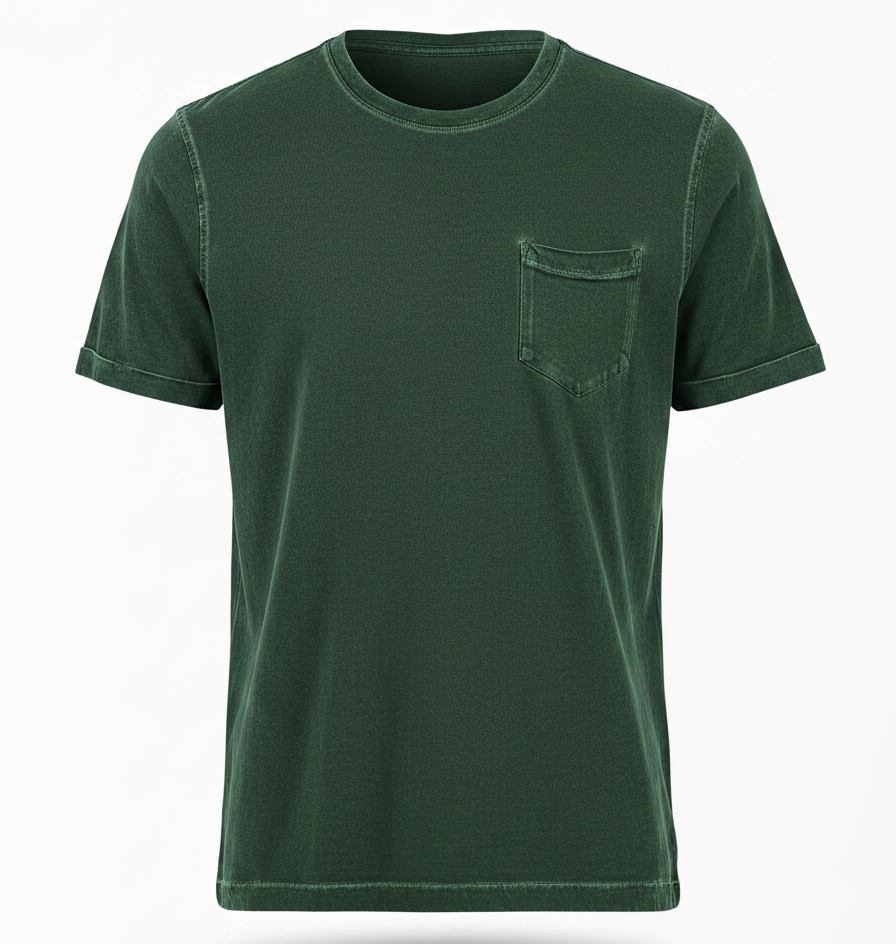
- A soft, faded, slightly chalky look
Once the wash cycle is done, garments are rinsed, softened and dried. The end result usually feels much softer than before.
Working Principle
The whole process is built around surface pigmentation and controlled pigment removal during washing.
Pigments do not chemically bond with fibers like reactive dyes. Instead, they are fixed to the fabric surface using binders.
Process Mechanism
- Garments are treated with pigment and binder.
- Pigment particles adhere to the fabric surface.
- Garments are loaded into a washing machine.
- Water, enzymes, or mild chemicals are introduced.
- Mechanical action weakens part of the binder film.
- Some pigment particles detach from the surface.
- Controlled pigment loss creates fading and shade variation.
- Garments are rinsed, softened, and dried.
What Happens During Washing:
Pigment + Binder Film
↓
Mechanical Abrasion
↓
Partial Binder Breakdown
↓
Pigment Release
↓
Vintage Pigment Wash Effect
Key Effects You Get
- Washed-out, almost vintage appearance
- Matte, slightly powdery surface
- Softer hand feel
- Natural shade variation (not perfectly uniform — which is actually the point)
Characteristics
- Looks like it’s already been worn and laundered
- Slight unevenness gives a more natural feel
- Color stays mostly on the surface
- Shade intensity is easy to control — lighter or deeper depending on process
Objectives of Pigment Wash
Most of the time, pigment wash is used for visual and aesthetic reasons rather than performance.
Main purposes:
- Create tone-on-tone, aged effects
- Add subtle tints or adjust fabric shade
- Improve appearance after enzyme or bleach processes
- Introduce fashion colors like khaki, olive, charcoal, rust
- Give garments that soft “washed-down” look
Chemicals Used in Pigment wash
A. Pigments:
Pigments are insoluble color particles that remain on the fabric surface.
Characteristics
- Available in virtually all shades
- Insoluble in water
- Excellent color versatility
- Color intensity controlled by dosage
| Pigment Type | Chemical Composition |
|---|---|
| Titanium Dioxide White | TiO₂ |
| Carbon Black | C |
| Iron Oxide Red | Fe₂O₃ |
| Iron Oxide Yellow | FeO(OH) |
| Phthalocyanine Blue | C₃₂H₁₆CuN₈ |
| Phthalocyanine Green | C₃₂H₃Cl₁₅CuN₈ |
Function
- Provides desired color effect
- Creates surface coloration
- Produces fashion shades
B. Binder
Chemical Type
- Acrylic Binder (C3H4O2)n
- Polyurethane (PU) Binder [-NH-CO-O-]n
Function
- Fixes pigment onto the fabric
- Improves wash durability
- Enhances rubbing fastness
C. Fixer / Crosslinker (Optional)
Chemical:
Melamine Formaldehyde Resin
(C3H6N6)n
Polyaziridine Crosslinker (C2H3N)n
Function
- Improves pigment fixation
- Enhances wash fastness
- Improves rubbing fastness
D. Additives
- Wetting agent : Nonionic Surfactant( R–O–(CH₂CH₂O)nH)
- Softener: Polydimethylsiloxane (PDMS) (C₂H₆OSi)n, Cationic Softener R₄N⁺
- Salt (optional)
E. Acetic Acid ( CH₃COOH)
- Adjusts bath pH to 4.5–5.5 for binder performance
Pigment Wash – Standard Recipe
A. Typical Recipe
| Stage | Chemical | Dosage | Time | Temp |
|---|---|---|---|---|
| Pigment Bath | Pigment | 0.1–1.0% owg | 20–30 min | 30–40°C |
| Binder | 1–3% owg | |||
| Fixer | 0.5–1% owg | |||
| Wetting Agent | 0.2–0.5 g/L | |||
| Acetic Acid | pH 4.5–5.5 | |||
| Rinse | Water | – | 2–5 min | Room temp |
| Softener | Silicone/Cationic | 0.5–1.5% owg | 10–15 min | 30–35°C |
| Dry/Cure | – | – | as needed | 120–140°C (if required) |
Liquor Ratio: 1:10 – 1:15
Pigment Wash – Detailed Process Flow
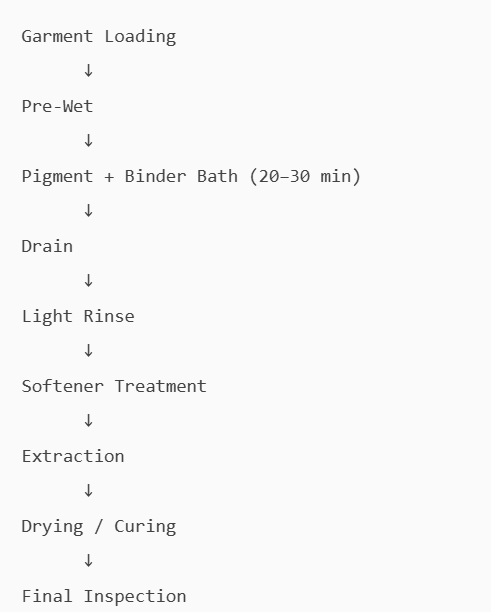
Step 1: Garment Loading
Load machine at around 50–60%. Also important — no chlorine residue on garments.
Step 2: Pre-Wet
Run briefly (2–3 minutes) in clean water.
Step 3: Prepare Bath
Add pigment, binder, fixer, wetting agent. Adjust pH.
Step 4: Pigment Application
Run for 20–30 minutes. Longer time or more pigment = deeper shade.
Step 5: Drain
Make sure pigment doesn’t stay unevenly.
Step 6: Rinse
Quick rinse to remove loose particles.
Step 7: Softener
10–15 minutes improves hand feel.
Step 8: Extraction
3–5 minutes.
Step 9: Drying / Curing
If needed, cure at 120–140°C for better fixation.
Advantages
- Fashionable tone-on-tone aesthetic
- Cast correction possible
- Low cost compared to garment dyeing
- Suitable for denim, knits, fleece, twill
- Easy to control shade intensity
Disadvantages
- Rub fastness can be low if binder is insufficient
- Slight stiffness due to binder film
- Shade variation if pH not controlled
- Lower durability vs reactive/vat dye
Final Thought
Pigment wash is less about precision… and more about controlled imperfection.
You’re not aiming for a perfectly even result — in fact, that slightly uneven, worn look is what makes it work. But at the same time, the process itself still needs control. pH, binder level, machine load — small changes can shift the final look quite a bit.
Done right, it gives garments that casual, lived-in feel people like. Done poorly, it just looks inconsistent.
So yeah, it’s a bit of a balance — part chemistry, part process control, part aesthetic judgment.