Washing with enzymes is one of the most important wet processing techniques in denim and garment industry . It employs cellulose enzymes (EC 3.2.1.4) to degrade selectively small cellulose fibers [(C₆H₁₀O₅)ₙ] on the fabric surface. The controlled bio-abrasion process offers a softer hand feel, reduces surface fuzz and delivers a natural faded look without the heavy mechanical action of traditional stone washing.
Working principle
Here’s what’s really happening during enzyme wash—it’s chemistry, but in a controlled, almost gentle way.
cellulose enzymes start breaking down the cellulose right on the surface of the fabric. Not deep inside. Just the outer layer. As those tiny surface fibers weaken and come off, the indigo dye attached to them goes along too.
Cellulose (C₆H₁₀O₅)ₙ + H₂O
↓ cellulose Enzyme
Cellobiose + Glucose (C₆H₁₂O₆)
That’s where the change starts to show:
- A smoother, cleaner surface
- Less fuzz, less pilling over time
- Fading that feels natural—not forced or patchy
The key thing? Control.
This process doesn’t just “run”—it’s carefully managed through temperature, processing time, liquor ratio and pH. Small shifts in these can change the outcome quite a bit.
Types of enzymes used in enzyme washing
Not all cellulose enzymes behave the same. Each type gives a slightly different result, depending on how aggressive—or how gentle—you want the finish to be.
Neutral cellulose
This one is the safe choice in many cases. Works under neutral pH and overall, it’s pretty mild.
It doesn’t attack the fabric aggressively. Instead, it softly cleans up the surface—just enough to improve feel and appearance without pushing too much fading.
Chemical Type: Cellulose Enzyme (Protein-Based Biocatalyst)
Enzyme Commission (EC) No.: EC 3.2.1.4
Main Active Components:
- Endoglucanase
- Exoglucanase
- β-Glucosidase
Substrate:
- Cellulose → (C₆H₁₀O₅)ₙ
Neutral cellulose operates under near-neutral pH conditions and gently hydrolyzes surface cellulose fibers without excessive fabric damage.
Typical conditions:
- pH: 6.0 – 7.0
- Temperature: 45–55°C
What you get:
- Light, controlled fading
- Noticeably softer hand feel
- Minimal strength loss
Where it fits best:
- Low-abrasion garments
- Premium or delicate denim
- Knit fabrics where strength matters
Acid cellulose
Now this one is stronger. More active. Works in acidic conditions and gives a more visible effect.
It removes surface fibers faster, which means more dye comes off too. That’s why the fading looks deeper, more pronounced—sometimes even a bit rugged.
But there’s a catch. If it’s not controlled properly, it can overdo it.
Chemical Type: Cellulose Enzyme (Protein-Based Biocatalyst)
Enzyme Commission (EC) No.: EC 3.2.1.4
Substrate:
- Cellulose → (C₆H₁₀O₅)ₙ
Acid cellulose is more aggressive and works faster under acidic conditions, producing stronger fading and vintage effects.
Typical conditions:
- pH: 4.5 – 5.5
- Temperature: 50–60°C
What you get:
- Stronger fading effect
- More defined worn look
- Faster processing (but higher risk)
Where it’s used:
- Denim that needs medium to heavy wash effects
- Vintage or “aged” finishes
- Large-scale industrial washing setups
Biopolishing enzymes
This one plays a slightly different role.
It’s not really about fading. It’s about cleaning up the fabric surface—especially for knits.
Think of it as refinement rather than transformation.
These enzymes remove tiny protruding fibers—the fuzz you can’t always see but definitely feel.
Chemical Type: Surface-Finishing cellulose
Enzyme Commission (EC) No.: EC 3.2.1.4
Substrate:
- Cellulose → (C₆H₁₀O₅)ₙ
Biopolishing focuses on removing protruding fibers from the fabric surface rather than creating fading effects.
What you get:
- Less pilling over time
- Smoother surface
- Softer, more premium feel
Best for:
- T-shirts, sweaters and other knitwear
- Fabrics where appearance matters as much as performance
- Higher-end garments with a clean finish
Laccase Enzyme (Bio-Fading Enzyme)
This one works very differently from cellulose enzymes.
Instead of attacking the cotton fibers, laccase targets the indigo dye itself. Think of it as fading the color rather than wearing down the fabric.
Laccase uses oxygen to oxidize indigo molecules, gradually breaking down the dye and creating a faded appearance. Because the cotton fibers are largely unaffected, fabric strength is better preserved compared to conventional abrasion-based washing methods.
The result is a cleaner, more controlled fade with less damage to the garment.
Chemical Type: Oxidoreductase Enzyme
Enzyme Commission (EC) No.: EC 1.10.3.2
Contains Copper Ion: Cu²⁺
Unlike cellulose, laccase acts primarily on indigo dye rather than cellulose fibers.
Indigo Dye Formula: C₁₆H₁₀N₂O₂
Typical Conditions
- pH: 4.0 – 6.0
- Temperature: 30–50°C
What You Get
- Indigo fading
- Lower fabric damage
- Improved sustainability
- Reduced chemical usage
Best Applications
- Eco-friendly denim processing
- Sustainable washing operations
- Premium denim collections
Advantages
✓ Lower strength loss
✓ Reduced environmental impact
✓ Better sustainability performance
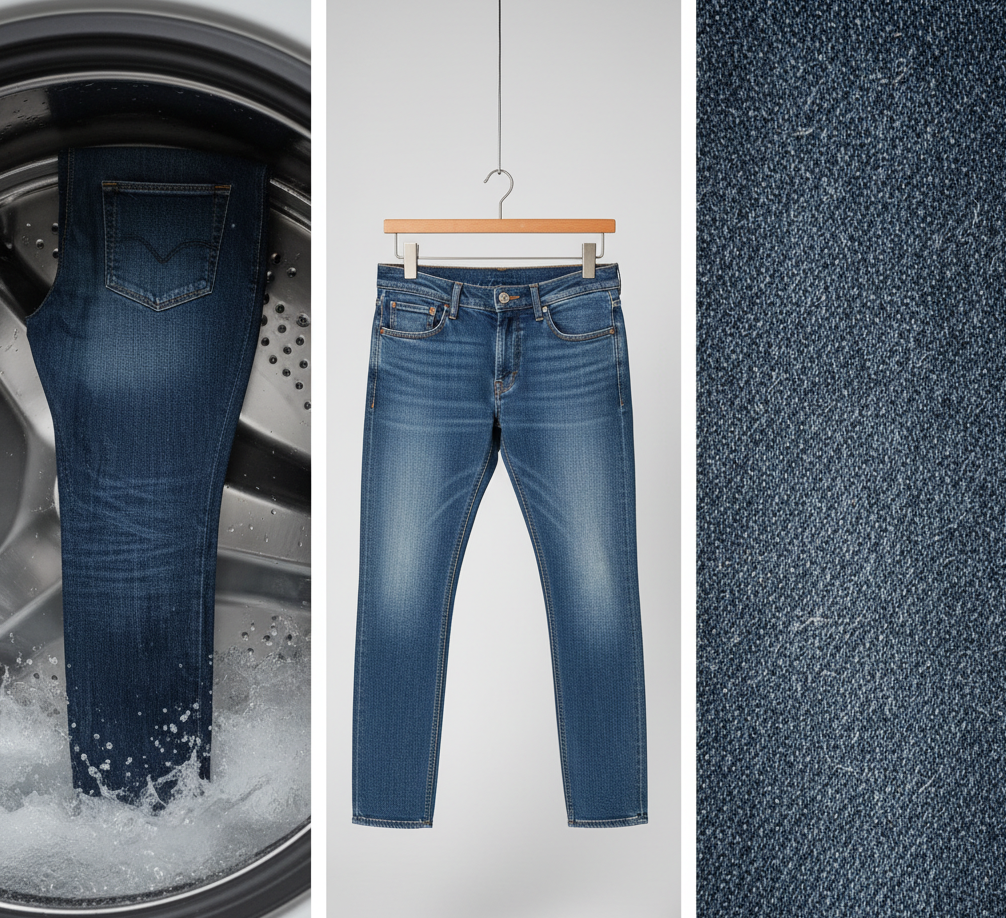
cellulose Action on Cotton Cellulose
Cellulose:
(C₆H₁₀O₅)ₙ + H₂O2
↓ Cellulose
Cellobiose + Glucose (C₆H₁₂O₆)
Result:
- Surface fiber removal
- Softening effect
- Mild fading
Laccase Action on Indigo Dye
Indigo Dye:
C₁₆H₁₀N₂O₂ + O₂2
↓ Laccase (Cu²⁺)
↓ Oxidized Indigo Products
Result:
- Color fading
- Reduced fiber damage
- Sustainable bleaching alternative
| Enzyme | EC Number | Target Material | Chemical Symbol/Formula | Purpose |
|---|---|---|---|---|
| Neutral cellulose | EC 3.2.1.4 | Cellulose | (C₆H₁₀O₅)ₙ | Mild fading & softening |
| Acid cellulose | EC 3.2.1.4 | Cellulose | (C₆H₁₀O₅)ₙ | Strong fading |
| Biopolishing Enzyme | EC 3.2.1.4 | Cellulose | (C₆H₁₀O₅)ₙ | Anti-pilling & smoothness |
| Laccase | EC 1.10.3.2 | Indigo Dye | Cu²⁺ (active center) | Bio-fading |
| Indigo Dye | — | Denim Colorant | C₁₆H₁₀N₂O₂ | Target dye for fading |
Enzyme Wash Recipe
Below is a practical factory‑level recipe used in denim and apparel laundries.
Basic Enzyme Wash (Bio wash) Recipe
| Process | Chemical | Dosage | Temperature | Time |
|---|---|---|---|---|
| Enzyme Treatment | Neutral/Acid cellulose | 0.5–2.0% owg | 45–60°C | 20–40 min |
| Detergent | 0.5–1.0 g/L | |||
| Anti‑back staining (for denim) | 0.5–1.0 g/L | |||
| Rinse 1–2 | Water | – | Cold | 5–10 min |
| Neutralization | Acetic Acid | To pH 5.0–6.0 | 25–30°C | 5–10 min |
| Softening | Softener | 0.5–2.0% | 30–35°C | 10–20 min |
| Drying | – | – | 60–75°C | As required |
Heavy Fade (Denim) Enzyme Wash Recipe
For more aggressive fading:
- cellulose: 1.5–3% owg
- Temperature: 55–60°C
- Time: 40–60 minutes
- Optional: Combine with light pumice stones (bio‑stone wash)
Enzyme Wash – Detailed Process Flow
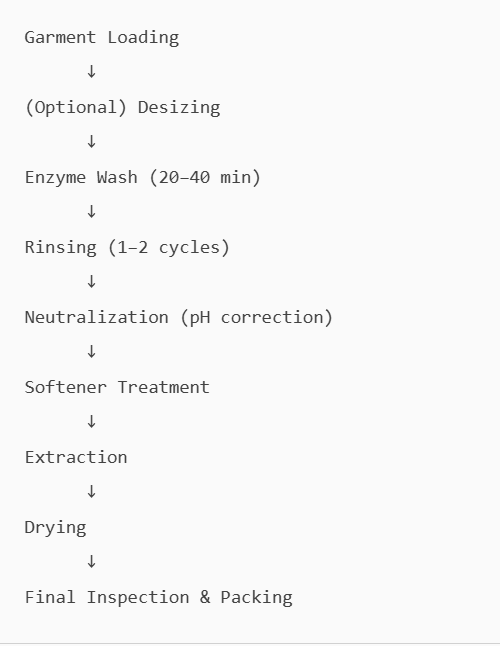
Alright, let’s walk through this step by step—but not in a rigid, textbook way. Think of enzyme wash as a sequence where each stage quietly sets up the next. Miss one detail and the final result can feel a bit off.
Step 1: Garment loading
First things first—loading.
You don’t just fill the machine and press start. Overloading kills movement and without movement, enzymes can’t do their job properly.
- Keep load around 50–60% capacity
- Make sure all trims are wash-safe (buttons, zippers, prints… everything matters)
Good agitation = better, more even results. Simple.
Step 2: Desizing (optional)
For denim, this step is hard to skip.
Before the enzyme even touches the fabric, sizing chemicals from weaving need to go. Otherwise, the enzyme can’t really penetrate properly.
- Use desizing agent or enzyme + detergent
- Temperature: 50–60°C
- Time: 10–15 minutes
- Then drain completely
Why it matters:
Removes sizing, opens up the fabric and basically prepares it to respond properly to enzyme action.
Step 3: Enzyme wash (main stage)
This is where the real transformation starts.
- Set liquor ratio: 1:8 to 1:10
- Adjust pH, temperature, time based on enzyme type
- Add cellulose enzyme + auxiliaries
- Run for 20–40 minutes
What’s happening inside?
The enzymes start breaking down surface cellulose. Slowly. Controlled. As those tiny fibers come off, indigo goes with them.
Result?
Less hairiness. Softer surface. Gradual fading.
Not dramatic—but clean and consistent.
Step 4: Rinsing
Once the enzyme has done its job, you don’t let it keep going.
- Rinse 1–2 times with cold water
That helps:
- Stop enzyme activity
- Flush out loosened fibers
Think of it as hitting pause before things go too far.
Step 5: Enzyme neutralization
This one’s critical. Skip it—or do it poorly—and you’ll regret it later.
- Add acetic acid to bring pH to 5–6
- Temperature: 25–30°C
- Time: 5–10 minutes
Especially with acid cellulose, this step is non-negotiable.
Why? Because enzymes don’t just stop on their own. If they keep working, they’ll keep eating into the fibers.
Too much → fabric damage.
Step 6: Softening
Now we refine the feel.
- Add silicone or cationic softener
- Temperature: 30–35°C
- Time: 10–20 minutes
This step brings that final touch:
- Better drape
- Smoother hand feel
- More comfort when worn
It’s subtle—but noticeable.
Step 7: Extraction
Quick but important.
- Hydro-extract for 3–5 minutes
Goal: remove excess water before drying.
If moisture stays uneven, drying gets tricky—and so does consistency.
Step 8: Drying
Final stage.
- Tumble dry at 60–75°C
or - Line dry (especially for knit garments to avoid shrinkage)
Drying locks in the result. Do it right and the garment holds its shape and feel.
Effects of enzyme wash on garments
Once everything’s done, the difference is pretty clear—not loud, but definite.
Enzyme washing works on the surface, so the fabric stays structurally strong while the outside gets refined.
What changes?
- Softness jumps up – smoother, more comfortable against skin
- Cleaner surface – less fuzz, less pilling over time
- More defined seams – stitching and panels stand out better
- Natural fading – not harsh, not artificial
- Improved drape – fabric just falls better
It’s the kind of improvement you feel immediately, even if you can’t always explain it.
Advantages of enzyme washing
Beyond the look and feel, there’s a practical side too.
- Lower strength loss compared to harsh methods like stone washing
- Less mechanical damage to garments and machines
- More consistent shades across production batches
- Better for the environment – fewer harsh chemicals, no stones
In other words—it’s cleaner, safer and easier to control.
✅ In simple terms:
Enzyme washing makes garments feel better, look better and last longer—without beating them up in the process.
That’s why it’s become the go-to finishing method in modern garment processing.