Burnout printing is a chemical technique of fabric reduction. A pattern is printed using a special paste containing acidic or fiber-dissolving agents.
- Cotton, viscose, rayon? They react.
- Polyester, nylon? They stay as they are.
Once the reaction is complete, the cellulose portions dissolve away. What’s left behind forms a pattern that feels almost etched into the fabric. Light, airy. Sometimes almost lace-like.
How Burnout Printing Works (Process Flow)
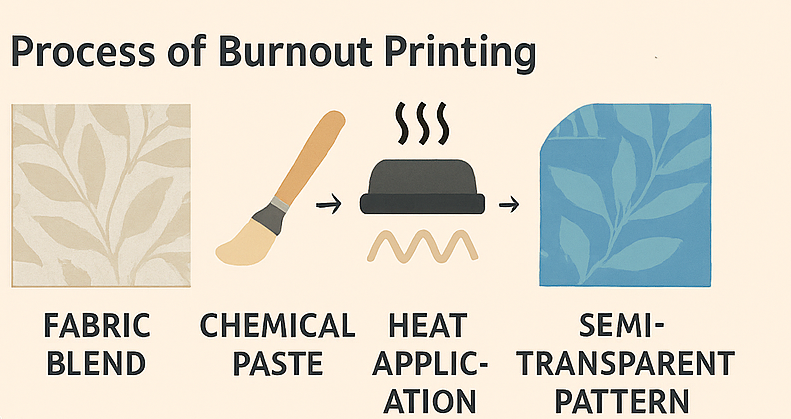
It’s a fairly controlled process. Has to be.
1. Fabric selection
This step matters more than people think.
Burnout printing only works on blends—specifically mixes of cellulose and synthetic fibers. Common ones include:
- Polyester–Cotton
- Polyester–Viscose / Rayon
- Polyester–Silk
| Fiber | Chemical Formula |
|---|---|
| Cotton (Cellulose) | (C₆H₁₀O₅)ₙ |
| Viscose/Rayon (Cellulose) | (C₆H₁₀O₅)ₙ |
| Polyester (PET) | (C₁₀H₈O₄)ₙ |
2. Applying the chemical paste
The burnout paste is applied onto the fabric in a pattern.
Usually through:
- screen printing
- block printing
- Rotary printing
The paste itself often includes sulfuric acid or sodium hydrogen sulfate. Strong stuff, but used carefully.
| Chemical | Formula |
|---|---|
| Sulfuric Acid | H₂SO₄ |
| Sodium Hydrogen Sulfate | NaHSO₄ |
| Water | H₂O |
| Printing Thickener | Various polymers |
3. Heat activation
Next comes heat.
The printed fabric goes through a heated chamber where:
- the chemical activates
- the cellulose fibers start to break down
This is where the transformation begins.
Chemical Reaction
Cellulose:
(C₆H₁₀O₅)ₙ
↓
Acid + Heat
↓
Degraded cellulose products + Water
The synthetic component remains intact and forms the transparent pattern.
4. Washing & neutralizing
After the reaction, the fabric is thoroughly washed.
This removes:
- dissolved fibers
- leftover chemicals
What remains are those sheer, translucent areas where the cellulose used to be.
Neutralizing Chemicals
| Chemical | Formula |
|---|---|
| Sodium Carbonate | Na₂CO₃ |
| Sodium Bicarbonate | NaHCO₃ |
| Water | H₂O |
5. Final finishing
Last step—cleaning it up.
The fabric is:
- dried
- softened
- sometimes over-dyed for added contrast
And that’s when the design really pops.
Most Important Burnout Chemistry
Cellulose (C₆H₁₀O₅)ₙ + H₂SO₄ + Heat → Cellulose degradation
This selective destruction of cellulose while leaving polyester intact is the fundamental principle behind burnout printing.
Suitable Fabrics for Burnout Print
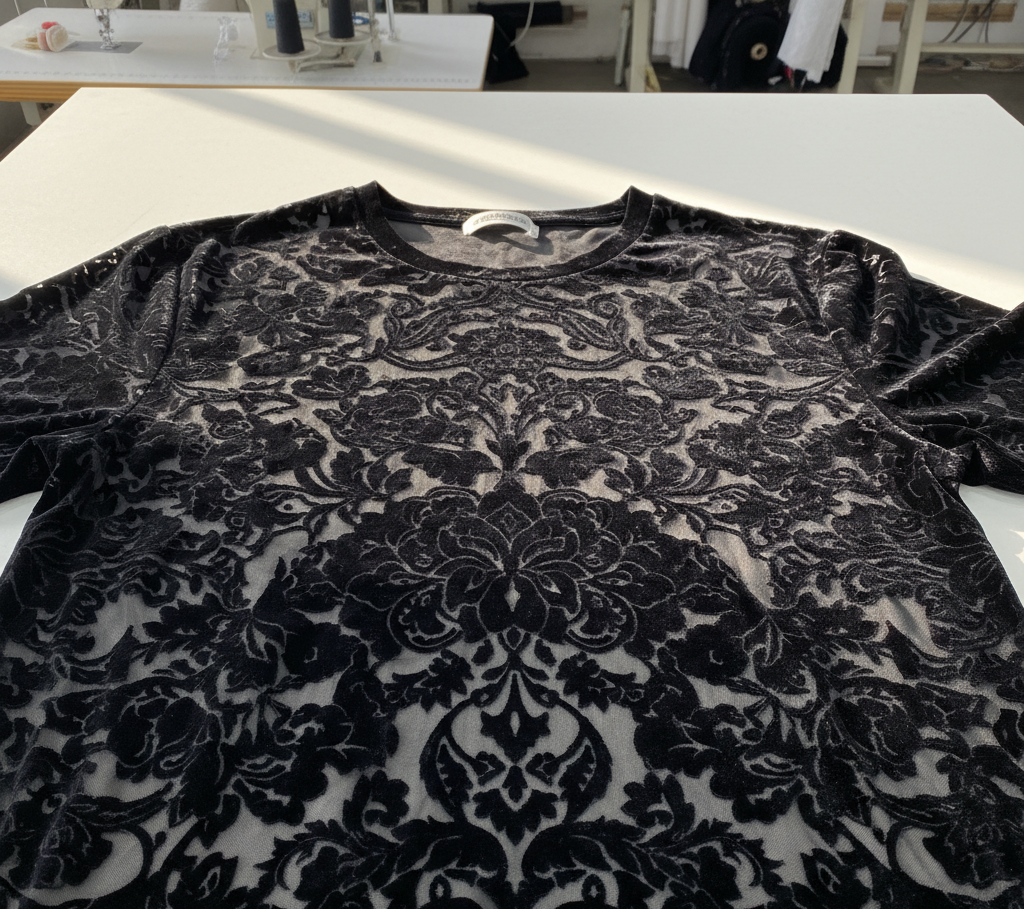
Not all fabrics can handle it. In fact, most can’t.
Ideal blends:
- Polyester / Cotton
- Polyester / Rayon or Viscose
- Polyester / Silk
- Any mix combining cellulose + synthetic fibers
The rule is simple:
Cellulose burns out. Synthetics hold the structure.
Why designers love burnout printing
It brings a certain texture you don’t get from regular prints.
That premium look
There’s a layered, almost dimensional feel to burnout fabrics.
- Sheer + opaque contrast
- Subtle depth
- A slightly worn-in elegance
It looks expensive. Often is.
Light and breathable
Because parts of the fabric are literally removed, you get built-in airflow.
Great for:
- summer wear
- resort fashion
- lightweight layering pieces
Design freedom
Burnout printing handles intricate patterns surprisingly well.
You can go:
- delicate florals
- bold graphics
- abstract textures
And it works with both traditional and modern printing methods.
Limitations of Burnout Printing
It’s not a perfect technique.
Fabric limitations
You must use blends.
- No pure cotton
- No 100% polyester
That alone narrows your options.
Chemical sensitivity
The process involves reactive chemicals.
So:
- timing matters
- neutralization matters even more
One mistake, and the fabric can weaken too much.
Durability concerns
Those sheer areas? They’re fragile.
Not ideal for:
- high-stress zones
- heavy-duty garments
Looks great, but needs some care.pplications of Burnout Printing
Where burnout printing shows up
You’ve probably seen it more than you realize.
Fashion garments
- Women’s tops
- Dresses and skirts
- Eveningwear with sheer panels
- High-end collections
It’s especially popular where softness and movement matter.
Knitwear & casualwear
- T-shirts with burnout overlays
- Light cardigans
- Trend-driven streetwear
Adds interest without making the garment heavy.
Home textiles
- Drapes and curtains
- Decorative cushions
- Table covers
Creates subtle light play—especially in interiors.
Final Thought
At the end of the day, burnout printing sits in that sweet spot between chemistry and design. It’s subtle, but it doesn’t go unnoticed. You’re not adding layers—you’re taking them away, and somehow ending up with something richer. That contrast, that lightness, that almost see-through texture… it gives fabrics a kind of quiet depth that’s hard to replicate. Not the most forgiving technique, sure. But when it’s done right, it speaks for itself.