The 8 Wastes of Lean: A Complete Guide to Spotting and Eliminating DOWNTIME in Your Organization
May 19, 202627 min read
Waste, whether in a factory, hospital or small business, silently consumes time, money and energy in any organization. Lean thinking, developed from the Toyota Production System by Taiichi Ohno, offers a powerful lens for identifying and eliminating these inefficiencies. At the heart of this approach is the notion of Muda, the Japanese word for waste. Once you see it, you start to see it everyplace: idle machines, reports nobody needs, talent passed over, or too much inventory.
Lean 8 wastages
Walk into almost any workplace and you will find waste.
It might be obvious, such as finished products sitting in a warehouse because nobody needs them yet. Sometimes it is much harder to see. A production operator may spend part of every hour looking for a tool. A purchase order may sit on someone's desk for two days waiting for approval. A quality problem may be discovered only after a garment has already moved through several production operations.
All of these situations have something in common: time, effort, material or human ability is being consumed without creating corresponding value.
In Lean terminology, this is Muda, the Japanese word for waste.
The concept is simple, but recognizing it consistently takes practice. Once people start looking at a process through a Lean lens ordinary activities can look very different. A pile of unfinished work is no longer just "work in progress." It may be a sign of excess inventory. A long approval chain may reveal waiting. Repeated movement between departments may point to transportation waste. A skilled employee spending most of the day on a task that does not require their skills may represent unused human potential.
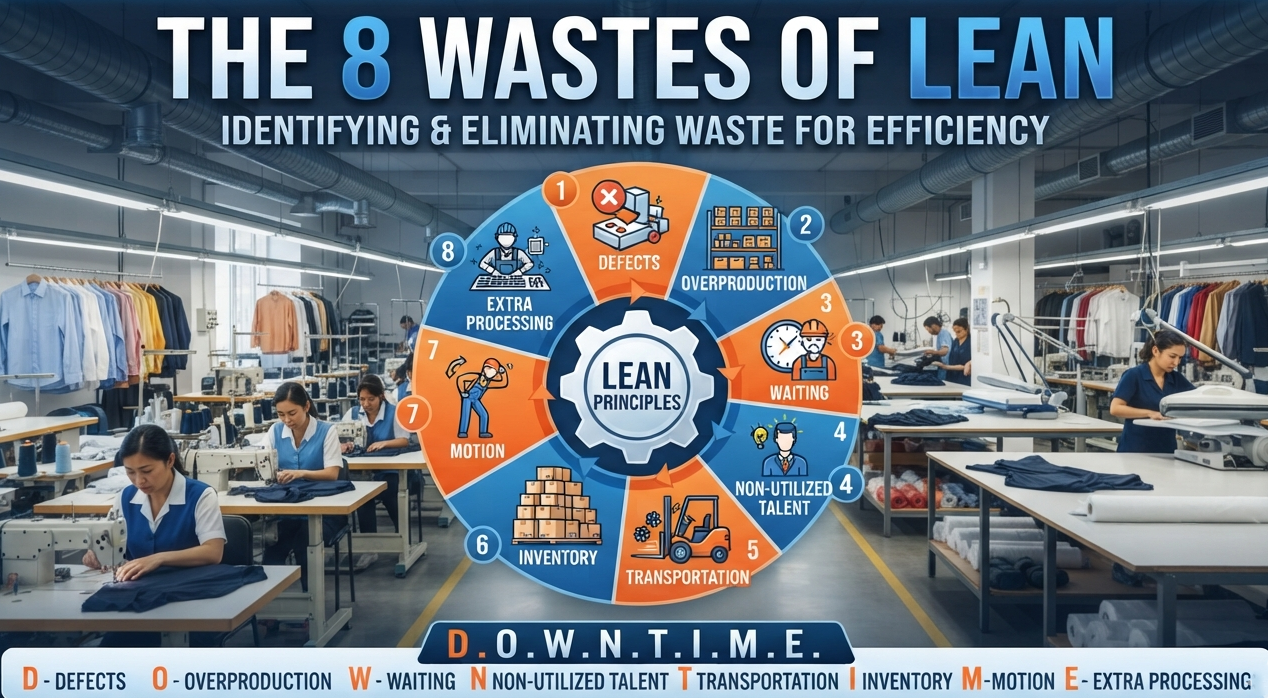
This article explains the 8 Wastes of Lean, commonly remembered by the acronym DOWNTIME:
D — Defects
O — Overproduction
W — Waiting
N — Non-Utilized Talent
T — Transportation
I — Inventory
M — Motion
E — Extra Processing
The examples focus heavily on practical workplace situations, including manufacturing, but the same ideas can be applied to offices, software teams, healthcare, logistics, retail and many other environments.
Where Did the 8 Wastes Come From?
The original Lean framework identified seven wastes.
Taiichi Ohno, one of the key figures behind the Toyota Production System, studied production systems from the perspective of how work actually moved through a factory. His concern was not simply whether workers were busy. He wanted to know whether the work being performed was actually contributing value.
The original seven wastes were:
Overproduction
Waiting
Transportation
Inappropriate processing
Unnecessary inventory
Unnecessary motion
Defects
As Lean ideas moved beyond traditional manufacturing, practitioners increasingly recognized another important problem: organizations were often failing to use the knowledge and abilities of their own employees.
That led to the addition of Non-Utilized Talent, creating the eight-waste version commonly represented by DOWNTIME.
The acronym is useful because it makes the categories easier to remember, but the real value is not memorizing the letters. The useful part is learning to recognize what each type of waste looks like inside an actual process.
Lean Starts With One Question: What Creates Value?
Before looking at the eight wastes individually, it helps to understand what Lean means by value.
Ask a straightforward question about each activity:
Does this activity create something the customer actually needs or values?
If a step changes the product or service in a way the customer wants, it may be value-added. Certain activities that do not directly add customer value may still be necessary, particularly when they are required for safety, legal compliance or other essential reasons.
Everything else deserves to be questioned.
For example, imagine a garment factory.
Cutting fabric according to the required pattern changes the material into something needed for the finished garment. Sewing the panels together also contributes directly to the product. But what about moving the same bundle between distant departments several times? What about waiting three hours for an approval? What about repairing a sewing defect that should never have occurred?
Those activities consume resources, but they do not increase the value of the garment in the same way.
This distinction is important because Lean is not simply about making employees work faster. It is about removing unnecessary friction so that valuable work can move through the process with fewer interruptions.
8 wastes of LEAN
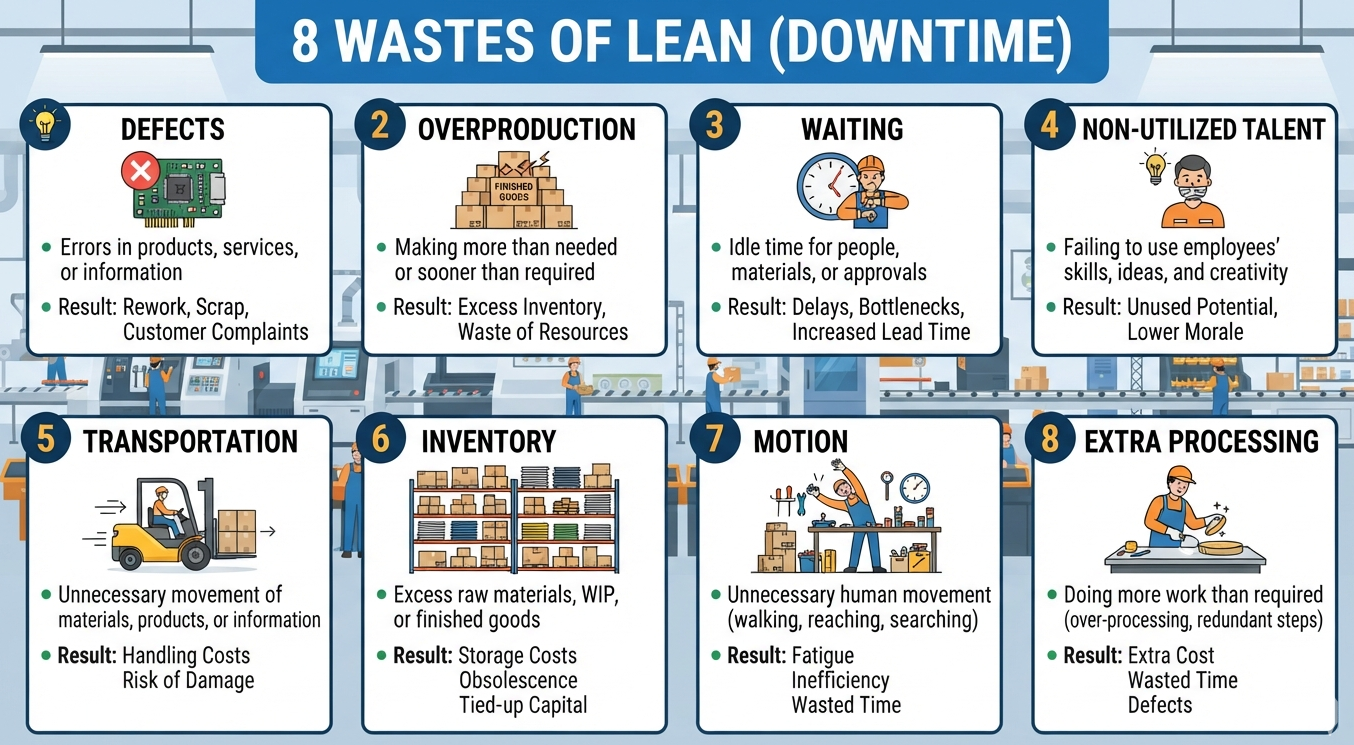
The 8 Wastes of Lean at a Glance
Waste
What It Means
Typical Impact
Common Countermeasures
Defects
Errors that require correction or result in rejected output
Rework, scrap, complaints, lost time
Poka-yoke, standard work, root cause analysis
Overproduction
Producing earlier or in greater quantity than required
Excess inventory and additional handling
Pull systems, Kanban, SMED
Waiting
People, materials, information or equipment sitting idle
Longer lead time and poor flow
Bottleneck analysis, smaller batches
Non-Utilized Talent
Failing to use employees' knowledge and abilities
Lost ideas, low engagement, missed improvement opportunities
Training, cross-functional teams, feedback systems
Transportation
Unnecessary movement of materials or information
Extra handling, delay, damage risk
Cellular layouts, process integration
Inventory
More stock or WIP than the process currently needs
Capital tied up and hidden problems
JIT, Kanban, WIP limits
Motion
Unnecessary movement by workers
Fatigue and lost productivity
5S, ergonomic design, better workstation layout
Extra Processing
Doing more work than the customer or process requires
Additional time and cost
Simplification, clear requirements, standard work
D is for Defects
What It Actually Looks Like
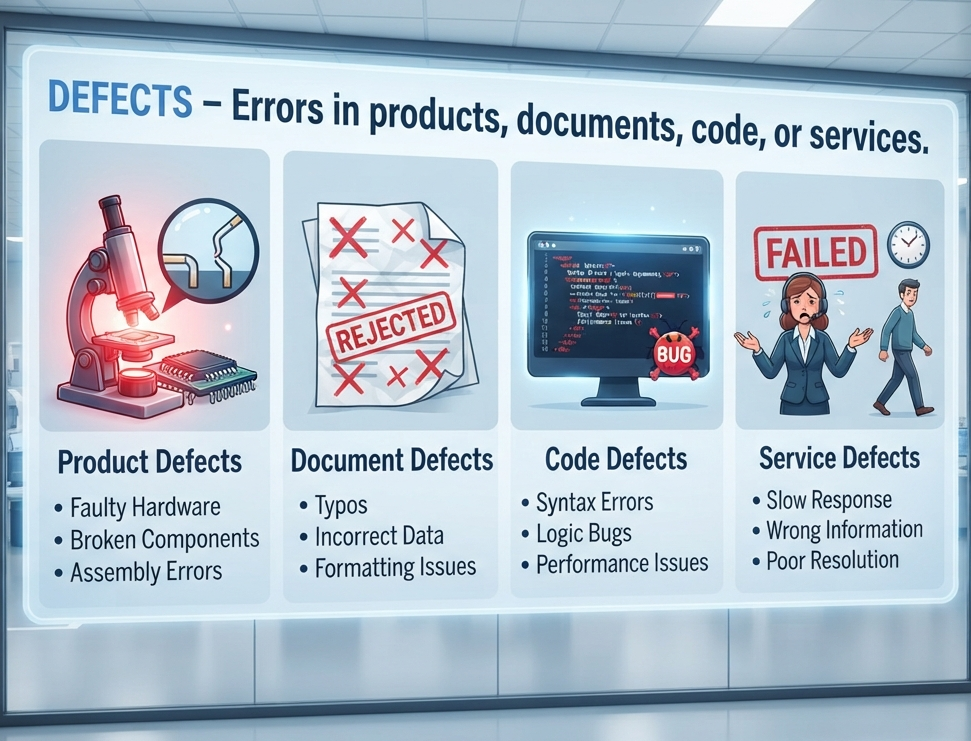
A defect is an output that does not meet the required specification, standard or expectation.
In manufacturing, the example is easy to understand. A garment may have a broken stitch, incorrect measurement, shade variation, oil stain, puckering or a misplaced label. The product may need repair or it may have to be rejected altogether.
But defects are not limited to physical products.
A wrong invoice is a defect.
Incorrect data entered into a system is a defect.
A software feature that does not work as intended is a defect.
A shipment containing the wrong item is a defect.
The common factor is that the output is not right the first time.
Defects
Wastage (LEAN)
Why Defects Create So Much Waste
The real cost of a defect is usually much larger than the cost of fixing the visible problem.
Consider a garment with a sewing defect.
The operator may need to stop working and separate the garment. Someone has to identify the problem. The garment then needs to be sent back for repair. The repaired garment may need another inspection before it can continue.
That single mistake has now created additional handling, labor, inspection and waiting.
If the defect is discovered later, the situation becomes even more expensive.
A problem caught at the sewing line may take a few minutes to correct. The same problem discovered during final inspection can disrupt packing and shipment. If it reaches the buyer, the consequences can include claims, discounts, returns, delayed deliveries or damage to the supplier relationship.
This is why Lean quality thinking emphasizes preventing defects rather than depending entirely on final inspection.
Common Causes of Defects
Defects usually have causes that can be investigated.
Some common examples include:
Unclear specifications: Workers cannot consistently meet a requirement that has not been clearly defined.
Poor handoffs: Important information can be lost when work moves between departments.
Insufficient training: An operator may make mistakes simply because the correct method was never properly demonstrated.
Poor-quality inputs: Problems with fabric, components, information or materials can create downstream defects.
Process variation: When the same task is performed differently by different people or under changing conditions, output can become inconsistent.
Repetitive manual work: Fatigue and repetitive tasks can increase the likelihood of human error.
A useful point here is that the person who discovers a defect is not necessarily the person who caused it.
A sewing operator may be blamed for a garment problem when the real cause is an incorrect pattern, unclear measurement specification, poor fabric quality or a problem created during an earlier operation.
How to Reduce Defects
Poka-Yoke
Poka-yoke or mistake-proofing, means designing a process so that an error is prevented or becomes immediately obvious.
The principle is straightforward: don't depend entirely on someone remembering the correct action if the process itself can make the wrong action difficult.
For example, a fixture can be designed so that a component fits only in the correct orientation.
Standard Work
Standard work establishes a consistent method for performing a task.
Instead of allowing each operator to develop a different way of doing the same job, the process defines the expected sequence, checks, tools and conditions.
Consistency makes abnormal results easier to identify.
Root Cause Analysis
Finding and repairing the immediate problem is not the same as eliminating its cause.
The 5 Whys method is one common approach. The team repeatedly asks why a problem occurred until it reaches a cause that can actually be addressed.
Quality at the Source
Quality should not be treated as something that belongs only to the final inspection department.
The person performing each operation should be able to recognize an abnormal condition and prevent the problem from moving forward.
Statistical Process Control
Statistical process control uses process data to identify changes and trends before they become major quality problems.
The goal is not simply to detect more defects. The better goal is to make the process stable enough that fewer defects are produced in the first place.
O is for Overproduction
What Is Overproduction?
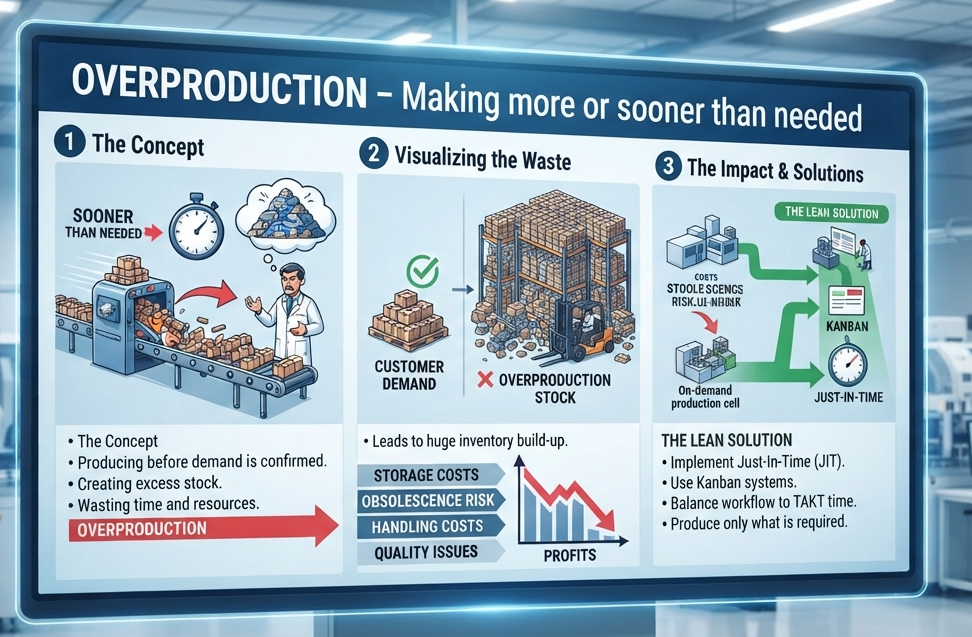
Overproduction happens when an organization produces something:
before it is needed,
in greater quantity than required or
without a confirmed demand.
This waste is particularly important in Lean because it can create several other wastes at the same time.
Imagine a factory producing 10,000 pieces when the next process currently needs only 6,000.
The additional 4,000 pieces have to go somewhere.
They may require storage.
They may need to be moved.
Someone has to count and manage them.
They may eventually become obsolete.
And if a quality problem is discovered later, a much larger quantity may be affected.
Overproduction
Wastage (LEAN)
A Garment Factory Example
Suppose a garment factory has a large order for several styles.
A cutting department produces far more panels than the sewing line can consume because running a large batch feels more efficient.
The extra cut panels now become WIP.
They occupy space.
They require bundling and identification.
Workers have to move them around the factory.
The sewing line may not need them for several days.
If the buyer changes a specification or the order quantity changes, some of those panels may become unusable.
What looked like high productivity at the cutting stage can therefore create problems somewhere else.
Why Lean Treats Overproduction Seriously
Overproduction tends to feed other forms of waste.
More production can mean:
More production → more inventory → more movement → more storage → more handling → more opportunities for defects and obsolescence.
This is one reason Lean systems prefer a pull approach.
In a push system, production continues because a plan or forecast says it should.
In a pull system, downstream demand signals what should be produced.
Kanban is one practical mechanism for creating that signal.
Overproduction Outside Manufacturing
The same problem appears in offices.
A team may create a 50-page report when the manager needs a two-page summary.
A software team may build features nobody requested.
A marketing department may create multiple versions of material before anyone has confirmed the requirement.
A meeting may involve ten people when only three actually need to make the decision.
In all of these cases, people are busy. The problem is that some of that effort is being spent on output that nobody actually needs.
How to Reduce Overproduction
The first step is to understand actual demand.
Useful approaches include:
Pull-based production
Kanban
Smaller batch sizes
Better demand planning
Clear production priorities
Reduced setup and changeover time
SMED (Single-Minute Exchange of Die) is particularly relevant when long changeovers encourage factories to produce huge batches simply to avoid changing equipment frequently.
If changeovers become quicker, producing smaller batches becomes more practical.
A useful question in office work is even simpler:
Who actually needs this and how much do they need?
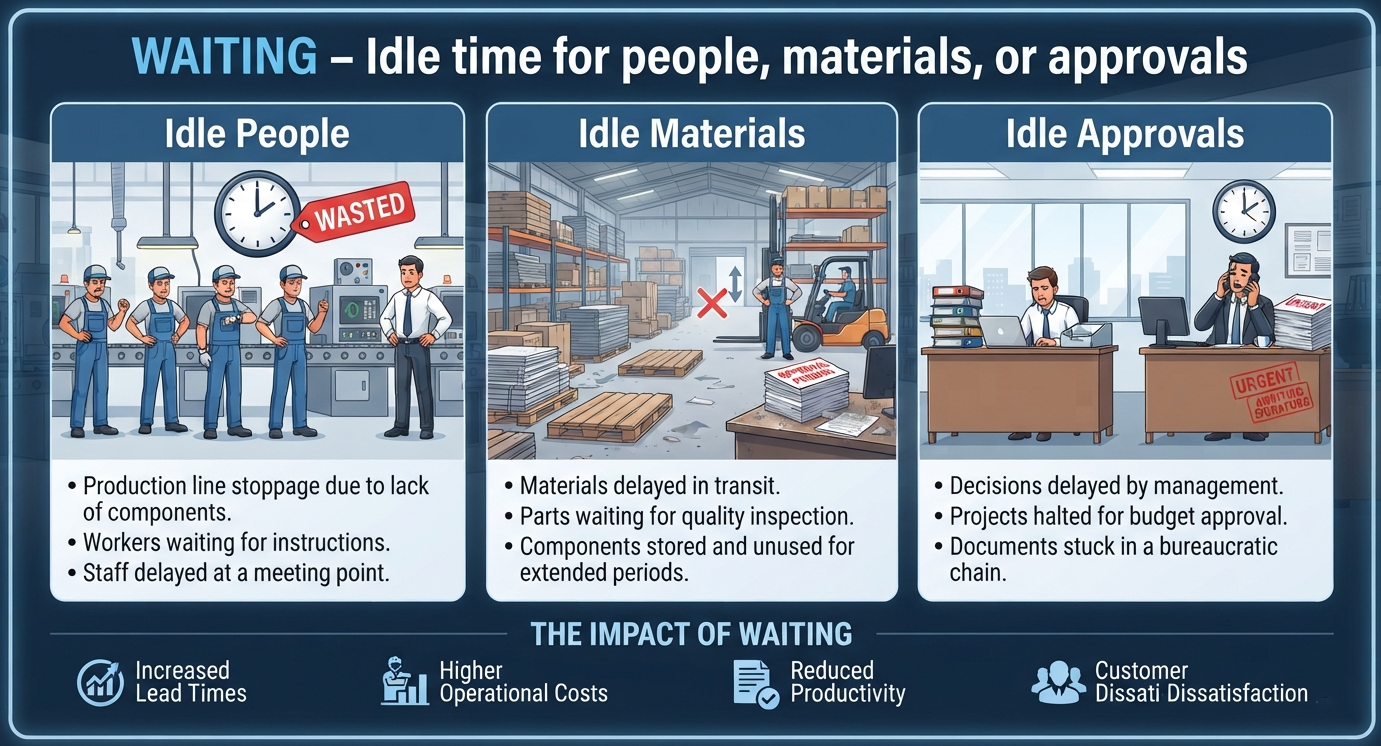
W is for Waiting
What Is Waiting Waste?
Waiting occurs whenever work cannot continue because something else has not happened yet.
A machine is waiting for material.
An operator is waiting for instructions.
A production line is waiting for approval.
A shipment is waiting for paperwork.
A buyer is waiting for a sample.
A developer is waiting for code review.
The common feature is that the process has stopped, even though there is still work that could eventually be completed.
Waiting
Wastage (LEAN)
Waiting Is Often Hidden in Lead Time
Consider a process that requires several approvals.
The actual review may take five minutes for each person. But if the document sits in each person's queue for two days, the total lead time can stretch to weeks.
The work itself may take less than an hour.
The process takes much longer because of waiting.
This is one reason value stream mapping can be so useful. It separates active processing time from the time spent sitting between activities.
The difference can be surprisingly large.
Waiting in Garment Production
Waiting can appear almost anywhere in a garment factory:
Sewing waiting for cut panels
Cutting waiting for fabric
Finishing waiting for washing
Washing waiting for test approval
Production waiting for a sample decision
Packing waiting for final inspection
Operators waiting because one bottleneck operation cannot keep up
A line waiting for a machine repair
A factory can have plenty of workers and machines and still have poor flow if work spends too much time waiting between operations.
Common Causes of Waiting
Bottlenecks
One operation may have significantly lower capacity than the others.
Everything behind that operation eventually forms a queue.
Large Batches
When work is processed in large batches, individual pieces can spend a long time waiting before the next stage begins.
Approval Delays
Too many approval levels can create long queues, especially when decision-makers are not continuously monitoring incoming requests.
Poor Coordination
Two dependent activities may simply be poorly synchronized.
One team finishes its work while the next team is not ready to receive it.
Equipment Breakdown
A machine failure can stop an entire downstream process.
Missing Information
Sometimes the equipment and people are available, but the job cannot proceed because a specification, material or decision is missing.
How to Reduce Waiting
Start by finding the bottleneck.
If one operation determines the pace of the whole process, improving unrelated operations may not improve total output.
Other useful approaches include:
Reducing batch sizes
Balancing workloads
Improving machine reliability
Simplifying approvals
Setting response-time expectations
Making queues visible
Improving material availability
Synchronizing dependent processes
The important thing is to measure where work is actually waiting rather than assuming the problem is where it first appears.
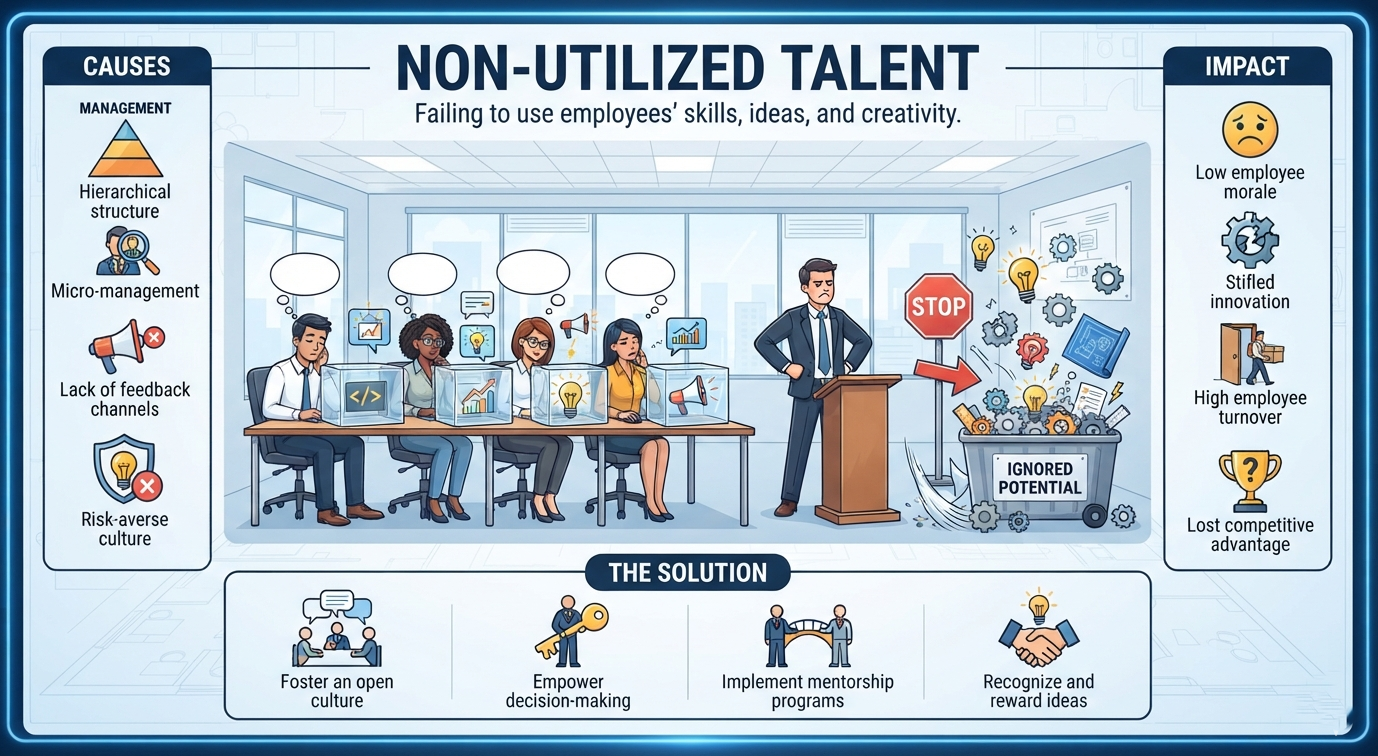
N is for Non-Utilized Talent
What Does Non-Utilized Talent Mean?
This waste is different from the others because it involves people rather than materials, machines or information.
Non-utilized talent means failing to make effective use of employees':
skills,
experience,
knowledge,
creativity,
problem-solving ability and
improvement ideas.
A company can lose enormous value this way without seeing anything physically accumulate.
Non-Utilized Talent (LEAN)
What It Looks Like in a Factory
Imagine an experienced sewing operator who has spent ten years working on the same type of garment.
They know which operation regularly causes problems.
They know which machine settings tend to create defects.
They know that a particular workstation layout forces unnecessary movement.
But nobody asks them.
Management may instead spend weeks trying to understand the problem through reports and meetings.
That is a missed opportunity.
The operator already has useful information because they experience the process every day.
Why This Waste Is Difficult to See
A pile of excess fabric is visible.
Unused employee knowledge is not.
There is no warehouse showing "2,000 hours of unused experience."
The loss may appear gradually:
An improvement idea is never suggested.
A recurring problem remains unsolved.
An employee stops offering suggestions because nothing happens when they speak.
A skilled person spends most of their time performing work that does not use their strongest abilities.
Eventually, capable employees may become disengaged.
Common Causes
Non-utilized talent can come from:
Highly centralized decision-making
Managers who rarely seek frontline input
Rigid job descriptions
Poor communication between management and workers
Limited training
Lack of career development
Excessive workload
Weak feedback systems
Poor alignment between employee skills and assigned roles
How to Make Better Use of People
Ask the People Doing the Work
Daily meetings, suggestion systems, improvement workshops and structured feedback sessions can create channels for employees to identify problems.
Cross-Training
Cross-training allows employees to understand more than one operation.
It also makes the organization less dependent on a single person who knows how to perform a particular task.
Kaizen
Kaizen activities can bring operators, supervisors, engineers, quality staff and other relevant people together to solve a specific problem.
Training and Development
Training does more than improve current performance. It can expand what employees are capable of contributing.
The larger lesson is simple:
Employees should not be viewed only as labor capacity. They are also a source of process knowledge.
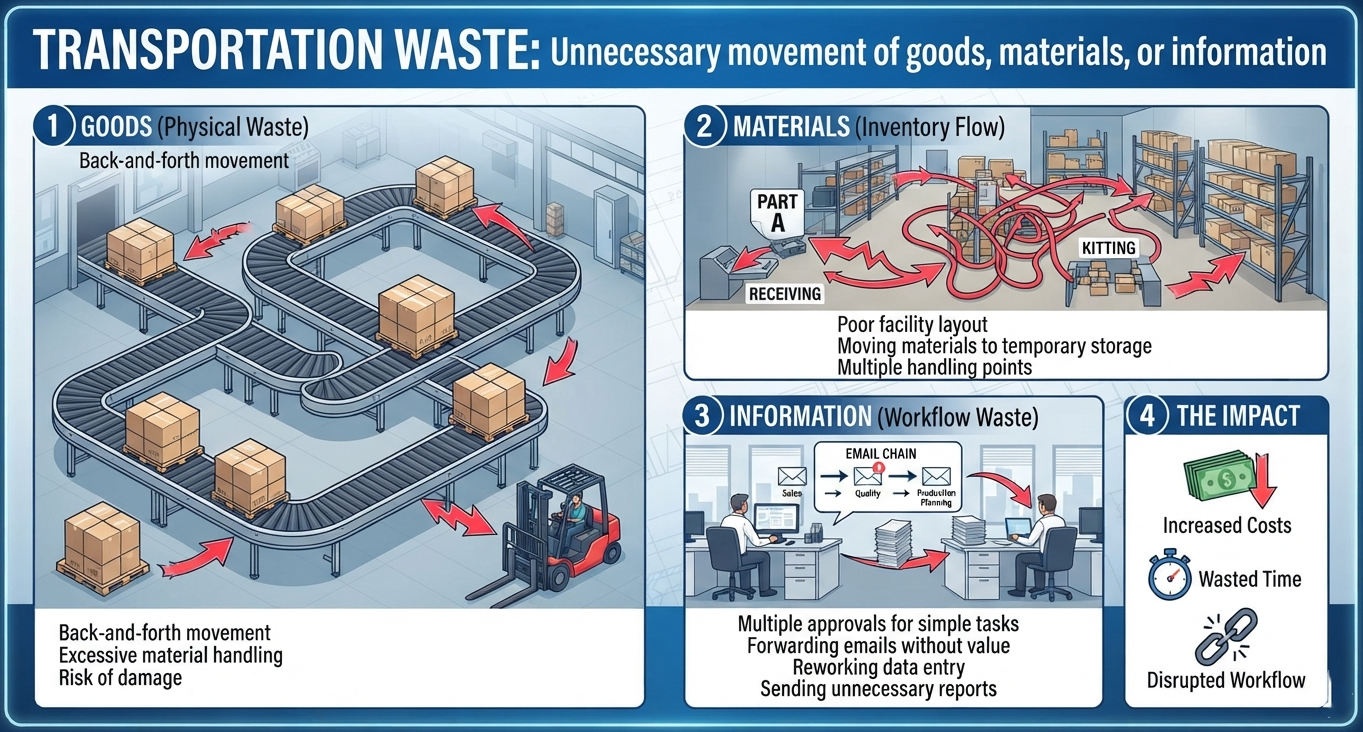
T is for Transportation
What Is Transportation Waste?
Transportation waste is unnecessary movement of materials, products, components or information.
Movement itself is not automatically waste.
A finished garment has to travel from a factory to a customer. Raw materials have to reach the factory.
The problem occurs when the movement is greater than necessary or happens because the process was poorly designed.
The repeated movement may be a sign that the factory layout or process arrangement is creating unnecessary transportation.
A better layout could potentially bring related operations closer together and reduce the distance traveled.
Transportation Does Not Always Look Like a Problem
This is what makes transportation waste tricky.
The product eventually arrives where it needs to go.
The document eventually gets signed.
The file eventually reaches the correct system.
Nothing appears to have failed.
But the extra movement still consumes time and creates risk.
Materials can be damaged.
Documents can be lost.
Versions can become confused.
Products can be misplaced.
Workers spend time moving items instead of processing them.
Common Causes
Typical causes include:
Poor factory layout
Departments located too far apart
Large batch movement
Centralized storage
Too many handoffs
Siloed departments
Unnecessary approval routes
Software systems that do not communicate with one another
How to Reduce Transportation
Cellular Layout
A cellular manufacturing layout places related operations close together and arranges them according to the sequence of work.
This can reduce unnecessary travel between departments.
Spaghetti Diagram
A spaghetti diagram traces the actual movement of people, materials or information.
Instead of relying on the planned process map, it shows what really happens.
When the lines on the diagram repeatedly cross the factory floor, the layout may deserve closer attention.
Digital Integration
For information-based processes, integration can play the same role as a better physical layout.
If employees repeatedly copy information between several systems, connecting those systems may eliminate a significant amount of unnecessary movement.
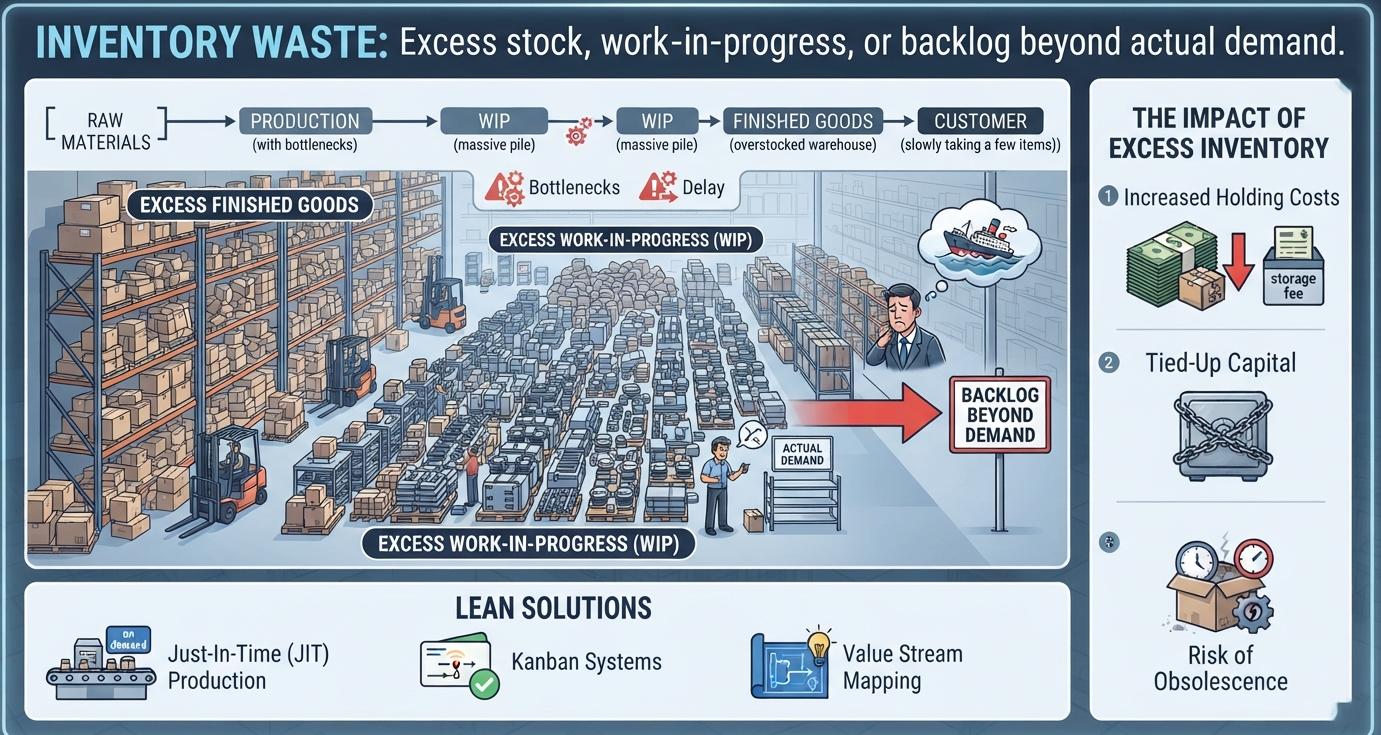
I is for Inventory
What Is Inventory Waste?
Inventory waste occurs when an organization holds more material, product or work-in-progress than it currently needs.
That might mean:
Excess raw materials
Too many finished goods
Large WIP quantities
Unused components
Backlogged work
Projects that have been started but not completed
Inventory is not automatically bad.
Some buffer stock may be necessary.
The Lean concern is excess inventory.
Inventory waste (LEAN)
Inventory in a Garment Factory
Consider a sewing line with hundreds of unfinished bundles waiting between operations.
At first, this might look like a sign of productivity.
After all, there is plenty of work available.
But large WIP can hide problems.
Perhaps one operation is slower than the others.
Perhaps a machine has insufficient capacity.
Perhaps the line is poorly balanced.
Perhaps quality problems are accumulating.
Because there is already a large pile of WIP, the underlying issue may not be obvious.
The Financial Cost of Excess Inventory
Inventory consumes money.
The business has already paid for the fabric, components, labor, storage, handling and other resources associated with that stock.
While the inventory sits unused, the money remains tied up.
There are also physical costs:
Storage space
Handling
Counting
Tracking
Insurance
Risk of damage
Risk of obsolescence
For fashion products, obsolescence can be especially important because demand can change quickly.
Inventory Can Hide Problems
One of the most important Lean ideas is that inventory can act like a cushion.
Suppose a supplier is unreliable.
If a factory holds a huge quantity of extra material, production may continue despite supplier problems.
The problem is still there, but the inventory hides it.
Reducing the buffer exposes the weakness.
This is sometimes illustrated as water hiding rocks in a river. High inventory is like high water: the problems underneath are difficult to see.
Common Causes
Excess inventory may come from:
Inaccurate demand forecasts
Large production batches
Long supplier lead times
Poor production planning
Fear of shortages
Weak communication between departments
Producing without checking downstream demand
Reducing Inventory Waste
Just-in-time (JIT) production aims to have materials available when they are needed rather than building unnecessarily large stocks.
Kanban provides a practical way to control replenishment using demand signals.
In project work, the same principle can be applied with WIP limits.
Instead of allowing employees to start ten tasks simultaneously, a team might limit the number of active tasks and finish existing work before starting more.
The objective is not to eliminate every buffer.
It is to understand why the buffer exists and keep it at a level that makes sense.
M is for Motion
Motion vs. Transportation
These two wastes are easy to confuse.
Transportation concerns unnecessary movement of materials, products or information.
Motion concerns unnecessary movement by people.
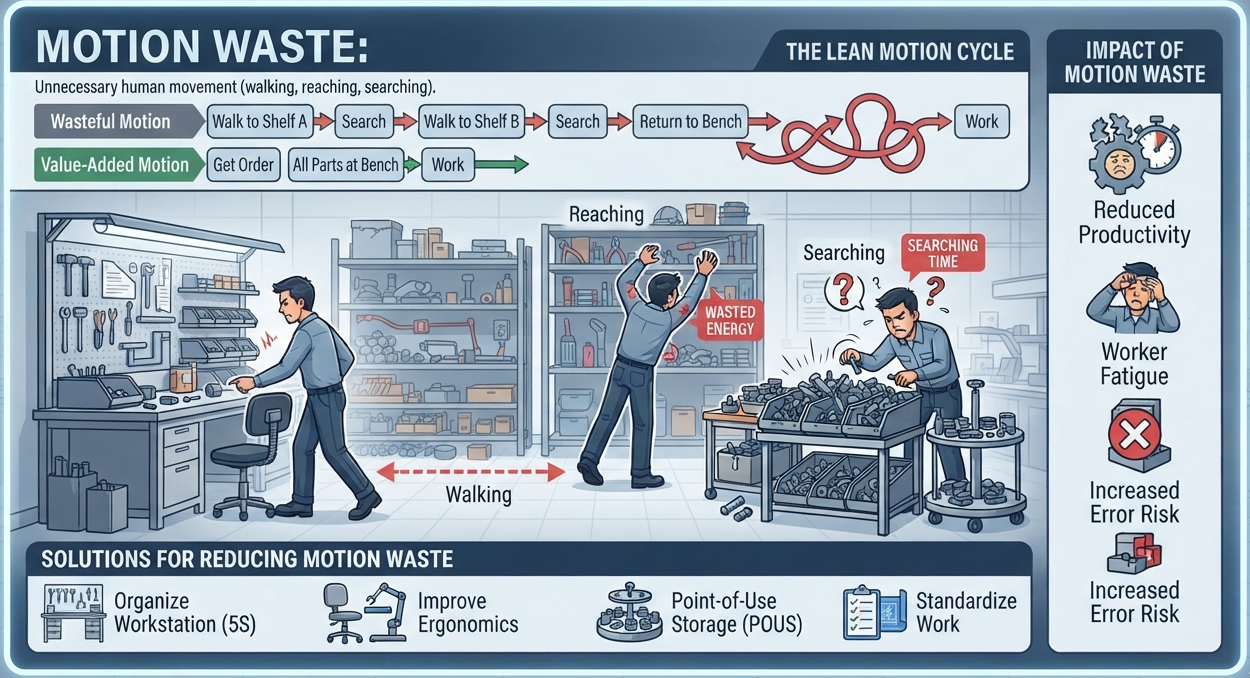
A worker walking repeatedly across a workstation to collect tools is motion waste.
A bundle of garments being moved unnecessarily between departments is transportation waste.
Motion Wastage (LEAN)
What Motion Waste Looks Like
A sewing operator may repeatedly reach behind the machine for thread.
A worker may walk several meters to collect frequently used components.
An inspector may repeatedly turn around because the workstation is poorly arranged.
An office employee may switch between several software applications just to complete one simple transaction.
None of these movements necessarily looks serious on its own.
The problem appears when the same movement happens hundreds or thousands of times.
The Cost Adds Up
Suppose an unnecessary movement takes only 20 seconds.
That does not sound important.
But imagine it happens 300 times in a day.
That's 100 minutes.
Over a week, month or year, the number becomes much larger.
Motion also has a human cost.
Repeated reaching, bending, twisting and awkward postures can increase physical fatigue and strain.
A better workstation can therefore improve both productivity and working conditions.
Common Causes
Motion waste often comes from:
Poor workstation layout
Poor tool placement
Disorganized storage
Inconsistent work methods
Excessive walking
Poor ergonomics
Complicated digital workflows
Poorly designed forms or interfaces
How to Reduce Motion
5S
The 5S methodology—Sort, Set in Order, Shine, Standardize and Sustain—is widely used to improve workplace organization.
Frequently used items should be easy to find and easy to reach.
Ergonomic Design
Observe how workers actually perform the task.
Do not design a workstation only from a drawing or theoretical layout.
Watch the operator.
Where do they reach?
Where do they turn?
Where do they walk?
Where do they search?
Those observations can reveal improvement opportunities.
Time-and-Motion Study
Time-and-motion analysis can help identify unnecessary movements and determine whether workstation design or work methods can be improved.
In digital processes, the same thinking can be applied to reduce unnecessary clicks, application switching, searching and manual data entry.
E is for Extra Processing
What Is Extra Processing?
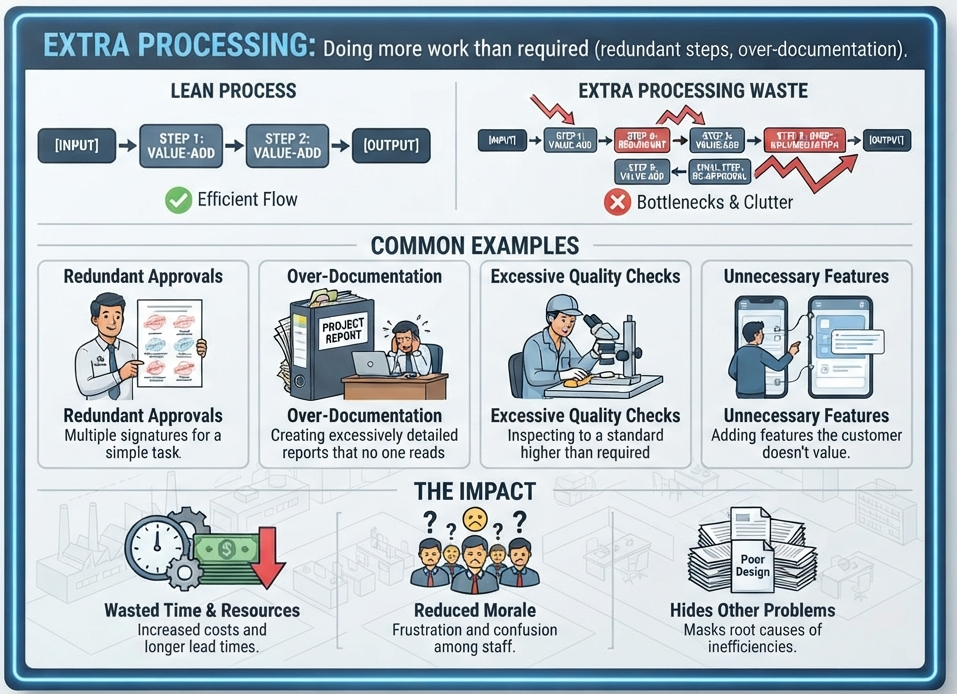
Extra processing means doing more work than the customer or process actually requires.
This is different from overproduction.
Overproduction: making more units than needed.
Extra processing: doing unnecessary work to each unit.
For example, a factory may perform an additional finishing operation that does not improve the garment according to the buyer's specification.
An office may require three approvals for a low-risk document that only needs one.
A team may spend hours formatting an internal report that will only be used as a temporary working document.
The common problem is effort that does not create enough additional value to justify its cost.
Extra Processing Wastages (LEAN)
Why More Work Is Not Always Better
People often associate quality with doing more.
More checking.
More polishing.
More documentation.
More approval.
More features.
But Lean asks a different question:
Does the additional effort provide value?
If a customer genuinely wants the extra quality, then the activity may be justified.
If nobody needs it, the additional effort may simply be waste.
How Extra Processing Develops
It often starts for a reasonable reason.
A company introduces an additional approval after a serious incident.
A quality department adds another inspection step.
A report gains several extra fields.
A team creates a more detailed template.
Years later, nobody remembers why some of those steps exist, but everyone continues doing them.
This is how processes become heavier over time.
Another common cause is gold-plating—adding features, polish or work beyond what was requested.
Common Causes
Outdated procedures
Excessive approval requirements
Unclear customer requirements
Gold-plating
Repeated checking
Legacy forms
Standards applied where they are unnecessary
Fear of making a mistake
How to Reduce Extra Processing
Start by clarifying the requirement.
What does the customer actually need?
What must be done for safety or compliance?
What is genuinely necessary?
Then question the existing process.
A useful question is:
If we removed this step tomorrow, what would actually go wrong?
If the answer is unclear or nothing meaningful would happen, the step deserves review.
Standard work can also help define what "complete" means so employees do not feel that they need to keep adding effort simply because the expected endpoint is unclear.
How the 8 Wastes Connect
The eight wastes should not be treated as eight completely separate problems.
In practice, they often form a chain.
Consider a garment factory where a machine has a long changeover time.
To avoid changing the machine frequently, production decides to make a large batch.
That creates Overproduction.
The extra garments become Inventory.
The inventory needs to be moved and stored, creating Transportation.
Workers spend additional time handling it, creating Motion.
Because the batch is large, a quality problem may not be discovered immediately, resulting in Defects.
Once the problem is discovered, production may stop while the issue is investigated, creating Waiting.
Meanwhile, an experienced operator may have noticed the problem earlier but never been asked for their opinion. That represents Non-Utilized Talent.
Management may then respond by adding several new inspection and approval steps, creating Extra Processing.
One decision has now contributed to all eight wastes.
This is why Lean improvement should focus on the whole process, not just one isolated activity.
Fixing one problem can sometimes push the problem somewhere else.
For example, increasing the output of one department may look like an improvement until the next department becomes overloaded and WIP begins to pile up.
How to Find Waste in a Real Workplace
Knowing the definitions is only the beginning.
The real skill is recognizing waste while watching an actual process.
Several practical methods can help.
1. Go to the Gemba
Gemba means the actual place where work happens.
Instead of trying to understand a factory entirely from spreadsheets and reports, go to the production floor.
Watch the process.
Observe the operators.
Follow the material.
Look at where work stops.
Notice where people walk.
Ask why a bundle is waiting.
Ask why a material has been moved three times.
Ask the people doing the job what regularly causes problems.
The purpose of a Gemba walk should not be to catch employees doing something wrong. It should be to understand how the process really works.
2. Use Value Stream Mapping
Value stream mapping provides a broader view.
Start with the customer requirement and follow the process all the way through to delivery.
Record:
Process steps
Processing time
Waiting time
WIP
Information flow
Material flow
Lead time
The comparison between processing time and total lead time can reveal where the largest opportunities are.
A process may contain only a small amount of actual value-adding work but still take days because of queues, approvals, transportation or batching.
3. Conduct a Waste Walk
A waste walk is a practical exercise where a team walks through the workplace specifically looking for evidence of the eight wastes.
Instead of asking generally, "Is this process efficient?", ask specific questions:
✓ Where are the defects?
✓ Where are we producing more than needed?
✓ Where are people waiting?
✓ Are employee skills being used?
✓ What is moving unnecessarily?
✓ Where is excess WIP?
✓ Where are workers making unnecessary movements?
✓ What work are we doing that nobody actually needs?
These questions help turn Lean from an abstract concept into something observable.
4. Ask the Frontline
The people closest to a process often know more about its daily problems than people looking at it from an office.
Ask operators:
✓ What slows you down?
✓ What do you have to wait for?
✓ What do you have to search for?
✓ What causes rework?
✓ What information is usually missing?
✓ Which step creates the biggest difficulty?
✓ If you could change one thing, what would it be?
Then take the answers seriously.
Asking for ideas without acting on them can create another problem: employees eventually stop believing that their feedback matters.
5. Use Data Alongside Observation
Observation tells you what is happening.
Data helps show how often and how severely it is happening.
Useful metrics can include:
Cycle time
Lead time
First-pass yield
Rework percentage
Scrap
WIP
On-time delivery
Machine downtime
Changeover time
Productivity
For example, a declining first-pass yield may indicate increasing defects.
Growing WIP may point toward a bottleneck or imbalance.
Long lead times combined with relatively short processing times often suggest waiting or excessive handoffs.
The strongest improvement decisions usually combine what people see with what the data shows.
Lean Tools That Help Reduce the 8 Wastes
Tool
Main Contribution
Kaizen
Continuous improvement with frontline participation
5S
Better organization and less unnecessary motion
Kanban
Controls WIP and helps prevent overproduction
Standard Work
Reduces variation and clarifies the expected process
TPM
Improves equipment reliability and reduces breakdown-related waiting
SMED
Reduces changeover time and supports smaller batches
Are the 8 Wastes Only for Manufacturing?
No.
The terminology came from manufacturing, but the underlying thinking is much broader.
A hospital can experience waiting when patients spend hours in a queue.
A software company can overproduce by building features customers never requested.
A university can create extra processing through unnecessary administrative approvals.
A logistics company can create transportation waste through poor routing.
An office can create inventory in the form of unfinished projects and growing email or task backlogs.
A service company can have defects when customer requests are entered incorrectly.
A company can experience non-utilized talent when employees with valuable knowledge are never given a chance to contribute.
The setting changes, but the question remains the same:
Is this activity creating value or are we spending resources without getting meaningful value in return?
Bringing It All Together
The 8 Wastes of Lean provide a practical vocabulary for identifying problems that can otherwise become normal parts of everyday work.
Defects create rework, scrap, complaints and lost customer confidence.
Overproduction creates output before there is a genuine need for it and often triggers other forms of waste.
Waiting stretches lead times even when the actual work may take only a small amount of time.
Non-Utilized Talent wastes something less visible but extremely valuable: people's knowledge, experience, creativity and ability to improve the process.
Transportation adds unnecessary movement and handling.
Inventory ties up money and can hide deeper process problems.
Motion consumes people's time and can create unnecessary physical strain.
Extra Processing uses resources on work that the customer or process does not actually require.
The important point is that Lean is not about eliminating every activity that does not directly touch the product.
Some non-value-added work is necessary.
The goal is to understand the process well enough to distinguish between what is necessary and what can be removed, simplified, combined or redesigned.
That requires observation.
It requires data.
It requires involvement from the people doing the work.
And, perhaps most importantly, it requires the willingness to question activities that have become routine simply because "that's how we've always done it."
A factory does not become Lean because someone puts a DOWNTIME poster on the wall.
It becomes Lean when people begin noticing waste during ordinary work and then do something about it.
That is the real purpose of the eight wastes: not to make people work harder, but to make the work itself flow better.
References & Sources
Taiichi Ohno – Toyota Production System: Beyond Large-Scale Production.
Shigeo Shingo – A Study of the Toyota Production System from an Industrial Engineering Viewpoint.
James P. Womack & Daniel T. Jones – Lean Thinking: Banish Waste and Create Wealth in Your Corporation.
Jeffrey K. Liker – The Toyota Way: 14 Management Principles from the World's Greatest Manufacturer.
John Bicheno & Matthias Holweg – The Lean Toolbox.
Michael L. George – Lean Six Sigma: Combining Six Sigma Quality with Lean Speed.
Eliyahu M. Goldratt – The Goal and Theory of Constraints.
Hiroyuki Hirano – 5 Pillars of the Visual Workplace.
Takashi Osada – The 5S's: Five Keys to a Total Quality Environment.
The Lean Enterprise Institute (LEI) – Publications on Lean principles, value stream mapping, waste elimination, and continuous improvement.
The Shingo Institute – Resources on operational excellence, Lean culture, and continuous improvement systems.
Japan Institute of Plant Maintenance (JIPM) – References on TPM (Total Productive Maintenance), Kaizen, and workplace efficiency.
Disclaimer: This content is intended for educational and training purposes only. Lean concepts, waste classifications, improvement methods, productivity gains, and implementation approaches may vary depending on industry, organizational structure, process complexity, technology level, workforce capability, and business objectives. Examples provided are illustrative and should not be considered universal performance benchmarks. Organizations should adapt Lean tools and waste-reduction strategies according to their specific operational requirements.
Written by
Alam Mohammad Shafiqul
Lead Editor, Senior Contributor & Founder
Textile Technology
Textile engineering professional with over 15 years of experience in Sweater Manufacturing, Industrial Engineering and Technical Development. Holds a degree in Textile Engineering and an MBA in Apparel Merchandising. Passionate about bridging the gap between factory-floor operations and technical expertise to drive efficiency, innovation, and continuous improvement.
Textile EngineeringSweaterIndustrial EngineeringLean Six SigmaPythonJS