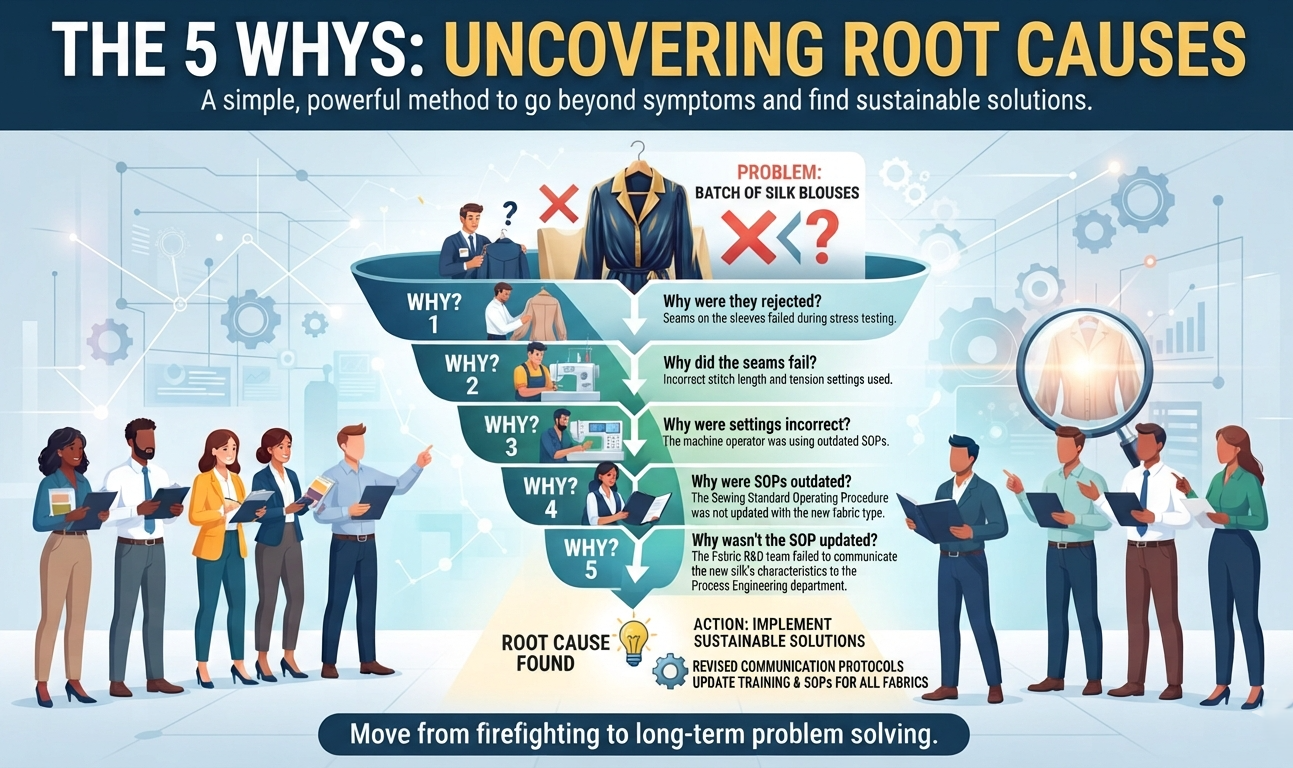
Walk onto almost any production floor in the textile and garment industry and you'll find the same recurring headaches: a batch of fabric comes back from dyeing with uneven shade, a lot of shirts fails the seam-strength test right before shipment, a buyer's audit flags a stitching defect that somehow made it past three inspection points. The usual response is to fix what's in front of you. Re-dye the batch. Re-stitch the garments. Retrain the operator who made the mistake. Everyone moves on, relieved and then the same defect shows up again next month, sometimes on a completely different line.
This is exactly the trap the 5 Whys technique was built to solve. It's one of the simplest tools in the quality toolbox and in an industry built on tight margins, tight timelines and even tighter buyer compliance requirements, it's also one of the most valuable. Used well, it stops a factory from treating the same recurring defect as a fresh surprise every single time it appears.
This guide walks through what the 5 Whys is, where it came from and — most importantly — how to actually apply it inside a spinning mill, a dyeing unit, a cutting room or a sewing line.
What the 5 Whys Actually Is
The method is disarmingly simple. When something goes wrong, you ask "why did this happen?" Then you take that answer and ask "why" again. You keep going, typically about five times, until you land on something that looks like a genuine root cause rather than a surface-level symptom.
The number five is a guideline, not a rule. Sometimes the real cause surfaces after three questions. Sometimes it takes seven. Five is simply, in practice, roughly how many layers it usually takes to get past "the machine broke" or "the operator made a mistake" and into the actual systemic issue underneath.
Here's a version of the classic example, adapted for a garment factory:
- Why did the shipment get delayed? — Because 2,000 units failed final quality inspection and had to be reworked.
- Why did they fail inspection? — Because the collar seams were puckering.
- Why were the seams puckering? — Because the thread tension on three machines was set incorrectly.
- Why was the tension set incorrectly? — Because a new batch of thread with a different weight was issued without re calibrating the machines.
- Why wasn't the tension re calibrated when the thread changed? — Because there's no standard procedure requiring machine re calibration whenever a new thread lot is issued to the line.
Notice the trajectory. If the team had stopped at the first why, they'd have just reworked the 2,000 units and moved on — and the exact same puckering would show up again the next time a new thread lot arrived. Only by pushing to the fifth layer did the real issue surface: a missing standard procedure. That's the entire philosophy of the tool in one example. It's never really about the puckered seam. It's about the missing procedure.
Where the Technique Came From
The 5 Whys is credited to Sakichi Toyoda, the Japanese industrialist whose company eventually gave rise to Toyota. Toyoda was known for refusing to accept surface-level explanations for why machinery failed, insisting instead on understanding problems at their root.
The method became a cornerstone of the Toyota Production System, built around a simple but demanding philosophy: when something goes wrong, stop, investigate properly and fix the actual cause — rather than working around the problem and letting it quietly recur. From there, it spread into Lean manufacturing broadly, into Six Sigma and eventually into nearly every industry that manufactures physical goods at scale, textiles and garments very much included.
It's easy to see why the technique took hold so firmly in apparel manufacturing specifically. Garment production is a long, multi-stage chain — fiber, yarn, fabric, dyeing, cutting, sewing, finishing, packing — and a defect that shows up at the very end of that chain often has its actual origin many stages earlier. The 5 Whys is built exactly for that kind of situation: tracing a visible problem back through a long process to the point where it actually started.
Why "Why" Is Harder Than It Looks on a Production Floor
Most quality investigations in textile and garment factories stop at the first plausible explanation. A fabric roll comes out with shading variation and the immediate answer is "the dyeing operator made an error." A garment fails a pull-test and the answer is "the operator sewed it wrong." These explanations feel satisfying because they're concrete and they point to an obvious next action: retrain the operator, replace the part, move on.
The trouble is that most visible defects in this industry are symptoms of something upstream, not isolated human error. Shade variation is rarely just "an operator error" — it's often a story about inconsistent dye lot quality from a supplier, water temperature drift during the dyeing cycle or a recipe that was never properly validated for that particular fabric blend. A failed seam is rarely just "sewn wrong" — it's usually a story about the wrong needle size for that fabric weight, thread that wasn't matched to the machine tension or a training gap that's been quietly producing the same error for months without anyone connecting the dots.
The 5 Whys forces a team to keep pushing past that first, comfortable answer — the one that requires the least effort to accept and the least willingness to look at the process itself.
Important Note
The number five is not mandatory. Some problems reach the root cause in:
- 3 questions.
- 4 questions.
- 7 or more questions.
How to Run a 5 Whys Session on the Factory Floor
Running a genuinely useful 5 Whys exercise is less about hitting the number five and more about the discipline around the process. Here's how it works in practice for a textile or garment operation.
1. Define the defect or problem precisely
This is the step that gets skipped most often and it's usually where the whole exercise goes wrong before it even starts. A vague statement like "quality is poor on Line 4" gives the team nothing solid to investigate. A specific one does the job: "12% of garments from Line 4's Tuesday batch failed final inspection due to skipped stitches, compared to a normal defect rate of 2%."
A strong problem statement usually answers what happened, on which line or machine, during which shift or batch and how big the impact was — in units, in cost or in time lost. Get this agreed on by the group before a single "why" gets asked.
2. Bring in the right people
The 5 Whys works best with the people who are actually closest to the work, not just supervisors reconstructing events secondhand. That means the machine operator, the line supervisor, the quality inspector who caught the defect and — where relevant — someone from maintenance or the fabric/trims store.
This matters more than it seems. A production manager guessing why a seam failed is speculation. The operator who runs that machine every day usually already knows, even if nobody's ever formally asked, that the thread tension has felt "off" since the new thread lot arrived. Frontline input is often the single biggest factor separating a session that finds something real from one that just confirms whatever theory the most senior person in the room walked in with.
3. Answer each "why" with facts, not guesses
Every answer should be based on something verifiable — machine settings, inspection records, batch numbers, maintenance logs — rather than assumption or blame. This is where sessions most often go sideways. It's tempting to answer "why did the fabric shrink beyond tolerance?" with a guess like "the operator probably ran the wrong cycle," when the actual answer, checked against the machine's logged settings, might be something else entirely.
If the honest answer to a "why" is "we don't know," that's useful information too. It usually points to a gap in record-keeping, calibration logs or supervision — and it's a cue to go find out, not to guess and move on.
4. Keep going until you hit something systemic
You've likely reached a genuine root cause when the answer points to a process, a policy, a specification or a training gap — something structural — rather than a one-off mistake or bad luck. A useful check: would fixing this root cause plausibly prevent not just this specific defect, but a whole category of similar defects going forward? If yes, you've probably arrived. If you're only three whys in and already at something systemic, don't force two more questions just to hit five.
5. Identify a countermeasure that fixes the cause, not the symptom
Once the root cause is clear, the natural next step is deciding what to actually do about it. A good countermeasure addresses the structural issue directly — for example, a mandatory tension-check procedure whenever a new thread lot is issued — rather than simply reworking the current defective batch and hoping it doesn't happen again.
6. Document it and follow up
The insight from a session like this is only valuable if it's written down and acted on. Record the problem statement, the full chain of whys, the root cause, the countermeasure, who owns it and by when it will be implemented. Many factories keep a running log of these across lines and shifts, because patterns tend to emerge — if "no standard procedure for X" keeps appearing as the root cause across unrelated defects, that's a strong signal pointing toward a bigger structural investment, not just another isolated fix.
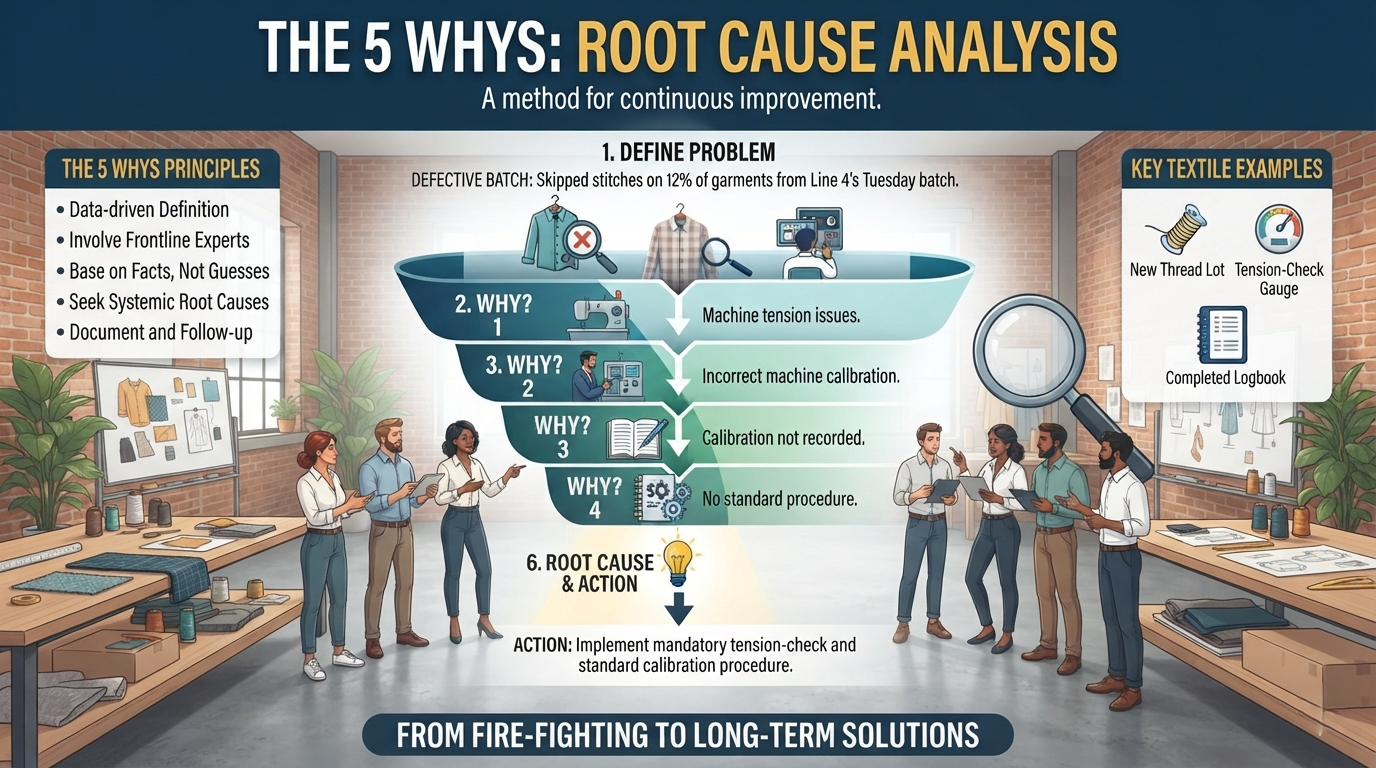
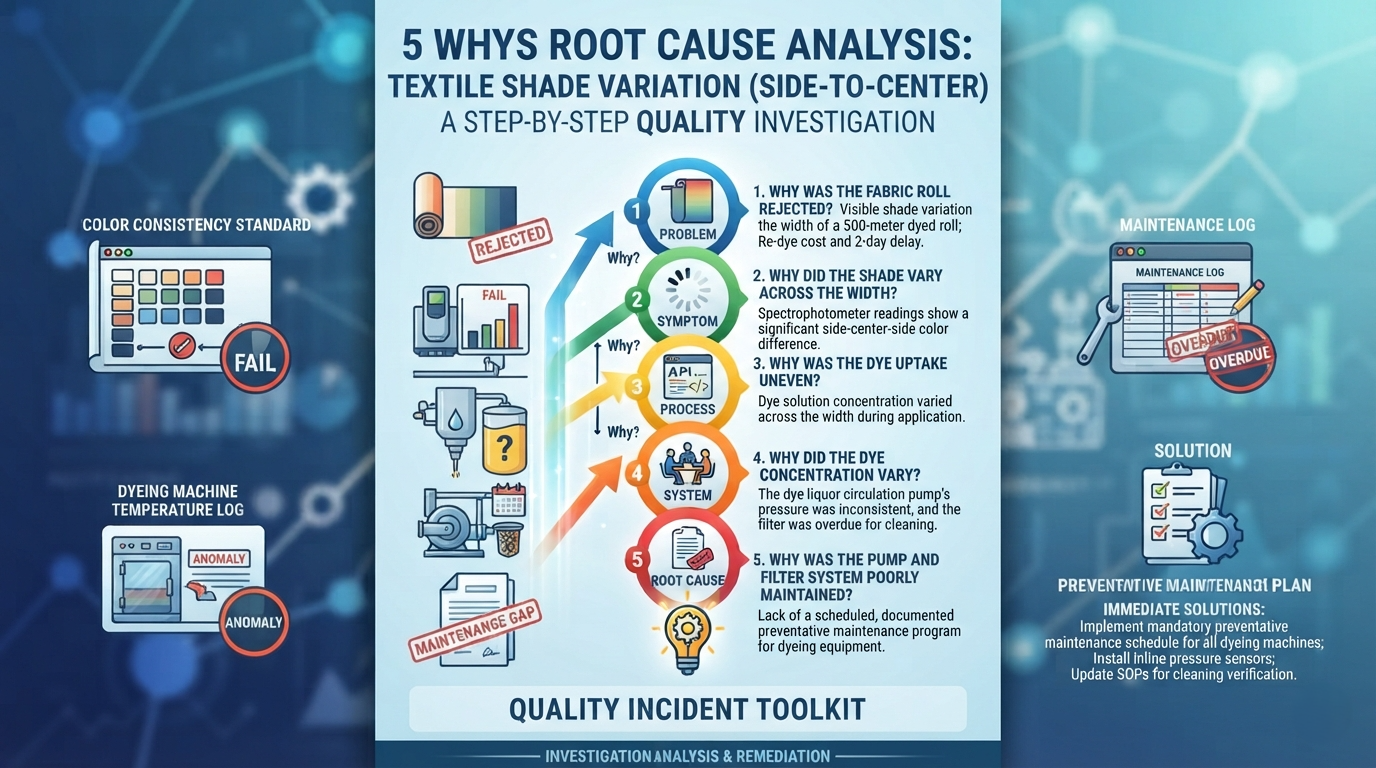
A Second Worked Example: Fabric Shading Variation
Machine breakdowns and seam defects are common examples, but shading and color consistency issues are one of the most costly and reputationally damaging problems in textile manufacturing, so it's worth walking through one in detail.
Problem statement: A 500-meter roll of dyed fabric for a buyer's spring order was rejected during in-house quality check due to visible shade variation across the width of the roll, resulting in a re-dye cost and a two-day delay to the cutting schedule.
- Why did the fabric show shade variation? Because the dye uptake was inconsistent across the width of the fabric during the dyeing cycle.
- Why was dye uptake inconsistent? Because the fabric wasn't running at a uniform, even tension through the dyeing machine.
- Why wasn't tension uniform? Because one of the guide rollers had worn unevenly and was dragging on one side of the fabric.
- Why wasn't the worn roller caught before the run? Because roller wear is checked only during scheduled monthly maintenance, not before each production run.
- Why is roller inspection limited to monthly maintenance? Because there's no pre-run checklist requiring a quick visual and functional check of dyeing machine components before each batch starts.
As with the earlier example, notice what a shallow investigation would have missed. Stopping at the first why would have led the team to simply re-dye the fabric and adjust the recipe slightly — a fix that does nothing to prevent the exact same shading issue from appearing on the next roll that runs through that same worn roller. The real fix is a pre-run equipment checklist, which is a process change, not a dyeing-recipe change.
Where the 5 Whys Shines in This Industry
Textile and garment manufacturing is a good fit for this tool for a few specific reasons.
- It's fast and speed matters when buyers have tight shipment windows. A focused session can often be completed in 20 to 40 minutes, which matters enormously when a delayed root cause investigation could mean missing an already-tight export deadline.
- It costs nothing to run. No specialized software or statistical training required — just a whiteboard, the right people and the willingness to keep asking questions. That matters in an industry where margins are often thin and quality departments are frequently under-resourced relative to the volume they're expected to cover.
- It's accessible to operators, not just engineers. Sewing machine operators, dyeing technicians and line supervisors can meaningfully participate without needing statistical training, which means the people closest to the actual defect are the ones helping diagnose it.
- It traces defects back through a long production chain. Because apparel manufacturing moves through so many discrete stages, a tool built specifically to trace a symptom backward through layers is a natural fit.
- It supports buyer compliance and audit requirements. Many international buyers and compliance programs now expect factories to demonstrate structured root cause analysis for repeated non-conformances, not just corrective action on the spot. A documented 5 Whys record is a straightforward way to show that.
Where It Falls Short
The tool isn't perfect for every situation on the floor and it's worth being honest about the limitations.
It assumes one linear chain of causes, but many textile defects have several contributing factors at once. A pilling problem on knitted fabric, for instance, might be caused by a combination of yarn quality, finishing chemical concentration and washing cycle settings all at the same time — three separate threads converging on one outcome, not a single tidy chain. Forcing that into a straight five-step sequence can produce a clean-looking but incomplete answer.
It depends heavily on who's in the room. Without a data requirement built into the method, a session can drift into a string of educated guesses if the operator who actually ran the machine isn't present or if nobody checks the actual maintenance and batch records. Two different teams investigating the identical defect can walk away with two different "root causes" depending entirely on who was there and what they assumed.
It's not built for highly complex or multi-factor technical failures on its own. For something like a recurring dimensional stability issue across multiple fabric constructions, a straight chain of five questions often isn't enough to capture everything at play. In cases like that, it works better as a first pass, paired with a more structured tool that can hold several contributing causes at once.
It can slide into blaming the operator if the facilitator isn't careful. If the questioning drifts toward "why did she skip that step" instead of "why did the process allow that step to be skipped," the exercise stops being a root cause investigation and starts feeling like an interrogation. That doesn't just damage trust on the floor — it also makes people far less honest in future sessions, which defeats the entire purpose of the tool.
Common Mistakes on the Production Floor
| Mistake | What It Looks Like | How to Fix It |
|---|---|---|
| Vague problem statement | "Sewing quality is bad this week" | Pin down the specific defect, line, batch and impact before starting |
| Jumping straight to a fix | Someone orders a machine part after the first "why" | Hold off on solutions until the root cause is actually confirmed |
| Guessing instead of checking records | "The operator was probably careless" | Pull maintenance logs, batch cards or machine settings before answering |
| Blaming the operator instead of the process | "Why did he sew it wrong?" | Reframe as "why did the process allow that error to happen?" |
| Treating five as a strict rule | Stopping at five even though the cause still isn't systemic | Keep going until you reach a process, policy or training issue |
| Running it solo from the office | A quality manager fills in the chain without floor input | Bring in the operator, supervisor and inspector who were actually there |
| No documentation or follow-up | The fix is discussed once and never tracked | Log the defect, root cause, countermeasure, owner and deadline |
| Missing multiple contributing causes | Forcing a tangled defect into one straight line | Split into parallel branches or pair with a fishbone diagram first |
The 5 Whys vs. Other Root Cause Tools Used in Apparel Manufacturing
Textile and garment factories often reach for more than one quality tool and it helps to know when each one is the better fit.
| Tool | Best For in Apparel/Textile Context | Trade-offs |
|---|---|---|
| 5 Whys | Quick investigation into a fairly linear defect — a single seam failure, a delayed shipment, a specific machine stoppage | Struggles with defects that have several causes acting together |
| Fishbone (Ishikawa) diagram | Brainstorming everything that could cause a recurring defect — man, machine, material, method, environment | Generates a wide list of possible causes but doesn't narrow them down on its own |
| Pareto analysis | Identifying which few defect types account for most of the rejections on a given line | Needs solid defect-tracking data to be meaningful |
| FMEA (Failure Modes and Effects Analysis) | Proactively assessing risk before launching a new style, fabric or process | Time-intensive; better suited to pre-production planning than after-the-fact investigation |
| Statistical Process Control (SPC) | Monitoring ongoing variation in things like dyeing consistency or fabric GSM over time | Requires consistent measurement and some statistical literacy to interpret |
In practice, a fishbone diagram and the 5 Whys pair especially well in this industry. A quality team can use the fishbone to brainstorm the full range of possible categories behind a recurring defect — machine, material, method, manpower, environment — and then apply the 5 Whys to drill down into whichever branch looks most promising. That captures the breadth of a multi-causal apparel defect while still getting the depth a simple list of causes wouldn't provide.
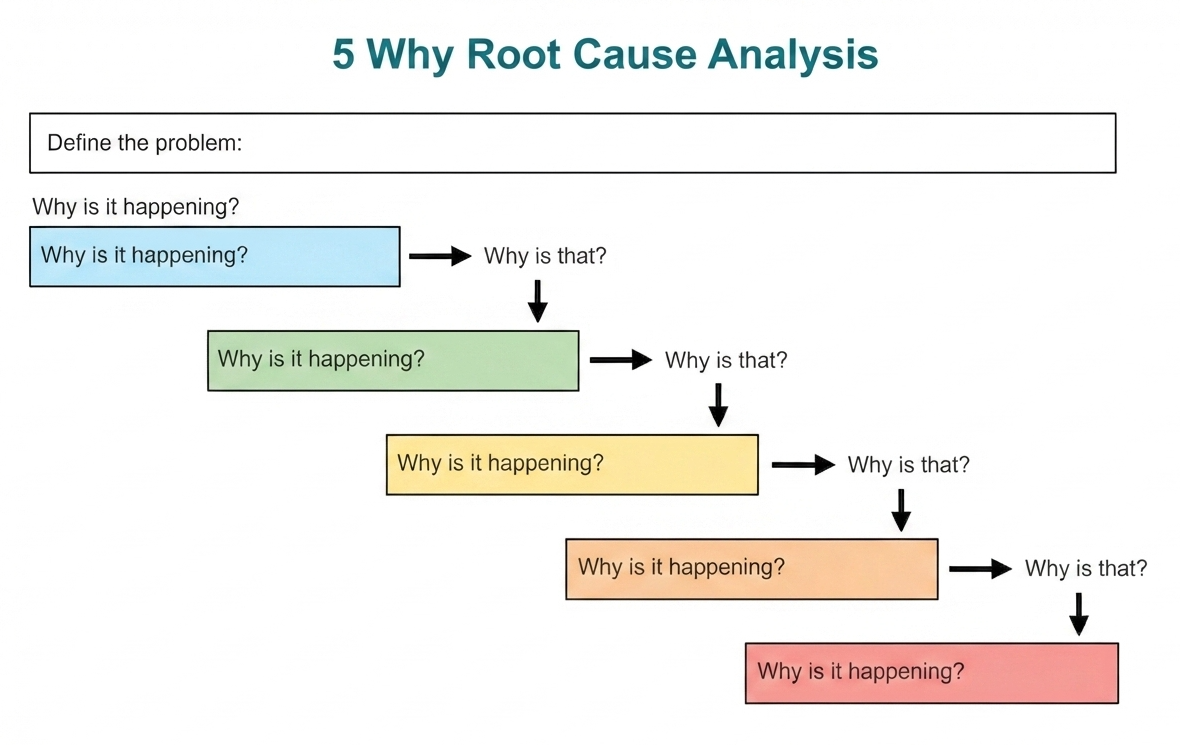
A Simple Template for the Floor
Teams new to this can use a lightweight, standard format to keep every investigation consistent:
Problem statement: (Specific defect, line/machine, date/shift and quantified impact.)
Why 1: _____________________
Why 2: _____________________
Why 3: _____________________
Why 4: _____________________
Why 5: _____________________ (Continue if needed.)
Root cause identified: _____________________
Countermeasure(s): _____________________
Owner: _____________________
Due date: _____________________
Verification plan: (How and when will you confirm the fix actually worked — for example, checking defect rate on the next three batches?)
Keeping this format consistent across sewing lines, the cutting room and the dyeing unit makes it far easier to spot repeat patterns. If "no standard procedure for X" keeps showing up as the root cause across unrelated defects — a thread change here, a fabric batch there — that's a strong signal the factory needs a broader SOP review, not just another one-off fix.
Tips for Facilitating a Good Session on the Floor
- Set the tone before you start. Make clear the goal is understanding the process, not finding someone to blame. Operators give far more honest, useful answers when they're not worried about being singled out.
- Write the chain where everyone can see it. A whiteboard on the floor, visible to the whole group, keeps the discussion grounded and makes weak logic easy to spot.
- Push gently on weak answers. If someone offers a vague or unverifiable answer, it's fair to ask, "how do we know that — is there a record we can check?"
- Watch for more than one thread. If it becomes clear partway through that there are actually two separate contributing issues — say, a machine setting and a material inconsistency — split the analysis into parallel branches instead of forcing one straight line.
- Don't let the group jump to solutions too early. It's natural for someone to blurt out a fix the moment a plausible cause appears. Note it, but keep the group focused on finishing the chain first.
- Always close the loop. Circle back after the fix is implemented to confirm the defect rate actually improved. A session that never gets followed up on quietly trains the floor to stop taking the exercise seriously.
Real-World Applications Across the Value Chain
The 5 Whys shows up at nearly every stage of textile and garment production, not just on the sewing floor.
- Spinning and yarn production: investigating recurring yarn breakage, inconsistent count or twist variation.
- Weaving and knitting: tracing fabric defects like missing picks, holes or uneven density back to their source.
- Dyeing and finishing: getting to the bottom of shade variation, poor colorfastness or fabric shrinkage beyond tolerance.
- Cutting: understanding recurring fabric wastage or pattern misalignment.
- Sewing: diagnosing seam failures, skipped stitches or measurement deviations that keep recurring across shifts.
- Finishing and packing: investigating mislabeling, packing errors or last-minute rejections during final audit.
- Compliance and buyer audits: many international brands now expect a documented root cause analysis, not just a corrective action, whenever a non-conformance is repeated — making a clear 5 Whys record part of maintaining the relationship, not just an internal exercise.
Why This Simple Tool Still Matters on the Factory Floor
There's something almost old-fashioned about a tool this simple surviving in an industry that's increasingly automated, data-driven and under constant pressure to move fast. But that's exactly why it still earns its place. It doesn't require new software or a dashboard. It requires a supervisor, an operator and a quality inspector willing to sit with a defect a little longer than feels convenient and to keep asking a question that busy production floors quietly discourage: but why, really?
The first answer to almost any "why" question on a garment or textile floor is the one that requires the least effort — replace the part, rework the batch, retrain the operator. The real value of the 5 Whys isn't the number five itself. It's the discipline of pushing past that first comfortable answer, because that's almost always exactly where the actual cause is waiting.
Used properly — with a clear problem statement, the right people from the floor in the room, honest answers checked against real records and a genuine follow-up on whatever fix comes out the other end — the 5 Whys remains one of the simplest, cheapest and most effective ways for a textile or garment factory to stop reworking the same defect month after month and finally fix the thing actually causing it.