If you've ever worn a graphic tee with a design that feels a little stiff to the touch or picked up a pair of jeans with that faded, lived-in look straight off the rack, you've already experienced pigment coloration firsthand. Pigments are one of the most widely used coloring methods in the textile world and once you understand how they actually work, it becomes obvious why they're everywhere—from fast fashion racks to your favorite vintage-style denim.
Let's walk through what pigments are, where they show up, how they're applied and why manufacturers love them despite some real trade-offs.
Where Pigments Are Used in Textiles
Pigments aren't a niche coloring technique reserved for one type of fabric or garment. They show up across a surprisingly broad range of textile processes:
- Pigment printing (most common)
- Pigment dyeing
- Garment dyeing
- Denim finishing (over‑dye, tint, vintage looks)
- Blended fabrics (cotton/polyester, tri‑blends)
- Fast fashion programs (short lead time)
Let’s sit with that last point for a second. Fast fashion brands rely so heavily on pigments because they are quick, flexible and require none of the complex chemistry other dyeing methods do.
Types of Textile Pigments
Not all pigments behave the same way and manufacturers typically choose between two broad categories depending on what they need.
Organic Pigments
These are the pigments you reach for when you want color that pops. They deliver bright, vibrant shades with strong tinctorial strength (meaning a little goes a long way) and good transparency. The trade-off is heat stability—organic pigments generally can't handle the same thermal stress that inorganic ones can.
Common examples include phthalocyanine blue and green, various azo pigments and quinacridone red.
- Bright shades
- High tinctorial strength
- Good transparency
- Lower heat stability than inorganic pigments
Examples:
- Phthalocyanine blue & green
- Azo pigments
- Quinacridone red
Inorganic Pigments
Where organic pigments bring brightness, inorganic pigments bring durability. The colors tend to be duller, but they hold up beautifully under light and heat and they offer excellent opacity—meaning better coverage on the fabric surface.
Titanium dioxide (used for whites), carbon black and various iron oxide pigments fall into this category.
- Dull but strong colors
- Excellent light & heat fastness
- Higher opacity
Examples:
- Titanium dioxide (white)
- Carbon black
- Iron oxide pigments
Components of a Pigment System
Here's something that trips people up: a pigment by itself doesn't actually dye anything. Pigments are insoluble in water and have no chemical affinity for fibers, so they need a support system to stick to fabric at all. That system has four key players.
1. Pigment
The pigment provides the color itself, but that's really all it does on its own.
- Provides color
- Insoluble in water
2. Binder (Most Important)
The binder is arguably the most important piece of the whole puzzle. It forms a film that physically glues the pigment onto the fabric surface and it single-handedly determines how well the color survives washing, rubbing and abrasion. Binders are usually acrylic-based, styrene-butadiene based or polyurethane based.
- Forms a film that binds pigment to fabric
- Determines wash, rub and abrasion fastness
- Usually acrylic, styrene‑butadiene or polyurethane based
3. Fixer / Crosslinker
The fixer or crosslinker strengthens that binder film further, improving overall durability and fastness.
- Improves durability of binder film
- Enhances fastness
4. Thickener
The thickener controls the viscosity of the print paste—absolutely essential for printing applications where consistency matters.
- Controls viscosity
- Essential in printing
5. Softener
The softener solves a problem the binder creates: stiffness. Binder films can leave fabric feeling harsh or board-like and softeners bring back a more natural hand feel.
- Improves hand feel
- Reduces stiffness caused by binder
Pigment Application Methods
Pigment Printing (Most Common)
This is the workhorse method, and the process follows a fairly consistent sequence:
Process Steps:
- Fabric preparation (light scouring)
- Preparation of print paste (pigment + binder + thickener)
- Printing (flat bed / rotary / digital)
- Drying
- Curing (critical step)
Curing Conditions:
- Temperature: 150–170°C
- Time: 2–5 minutes
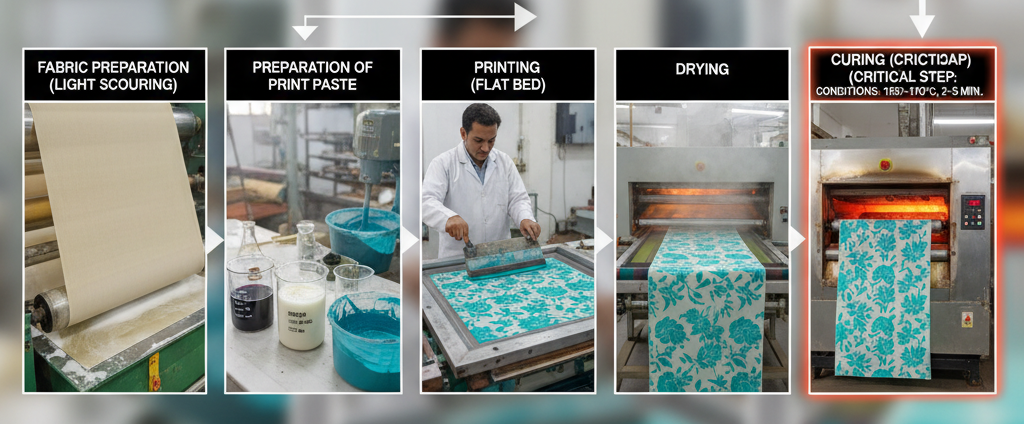
Without proper curing, pigment fastness will fail.
Pigment Dyeing (Piece Dyeing)
Process:
- Pigment exhaustion or padding
- Binder application
- Drying
- Curing
Used for:
- Garment dyeing
- Fashion effects
- Vintage and washed looks
Garment Pigment Dyeing
Features:
- Small lot flexibility
- Fashion appearance
- Uneven, washed look (intentional)
Limitations:
- Lower fastness
- Hand feel issues
- Shade reproducibility challenges
Why Manufacturers Keep Choosing Pigments
There are real, practical reasons pigments remain so popular despite their limitations.
They work on virtually anything. Cotton, polyester, nylon, blends—pigments don't care what fiber they're sitting on top of, since they're not chemically bonding with the fiber the way dyes do.
The process is refreshingly simple. There's no complicated dye-to-fiber chemistry to manage and you skip the salt and alkali requirements that other dyeing methods demand.
It saves water and energy. Because there's no extensive wash-off stage required, the whole process generates a lighter effluent load—a genuine sustainability advantage.
Turnaround is fast. For brands running fast fashion cycles, this matters enormously. Shade matching is easier and quicker than with other coloration methods.
Print sharpness is excellent. Since the color sits on the surface rather than penetrating the fiber, you get high color yield and crisp definition—ideal for detailed, intricate designs.
Where Pigments Fall Short
Nothing comes free and pigments have some meaningful downsides worth knowing about before you commit to them for a project.
Penetration is poor. Because pigment sits on the surface rather than soaking into the fiber, it's not the right choice when you need deep, saturated solid coloring throughout the fabric.
Hand feel can suffer. Without adequate softening, pigment-treated fabric can end up feeling stiff or boardy.
Fastness lags behind reactive or vat dyes. This shows up most noticeably in rubbing and abrasion resistance—pigment coloration just isn't built to compete here.
Shades can dull over time. As the binder film gradually breaks down through repeated washing, color loss follows.
A Quick Look at Fastness Performance
| Fastness Type | Performance |
|---|---|
| Washing | Good (with proper curing) |
| Rubbing (Dry) | Moderate |
| Rubbing (Wet) | Fair |
| Light | Very good |
| Perspiration | Moderate |
It's worth emphasizing that these numbers aren't fixed—they swing heavily based on binder quality and how well the curing step was executed. A great pigment paired with sloppy curing will still underperform.
The Bottom Line
Pigment coloration earns its popularity honestly: it's fast, fiber-flexible, resource-efficient and produces sharp, vivid results—which is exactly why fast fashion and denim finishing lean on it so heavily. But it's not a universal solution. When you need deep, long-lasting color that can take a beating in the wash, reactive or vat dyeing methods still have the edge. Understanding this trade-off is really the key to knowing when pigments are the right tool for the job—and when they're not.