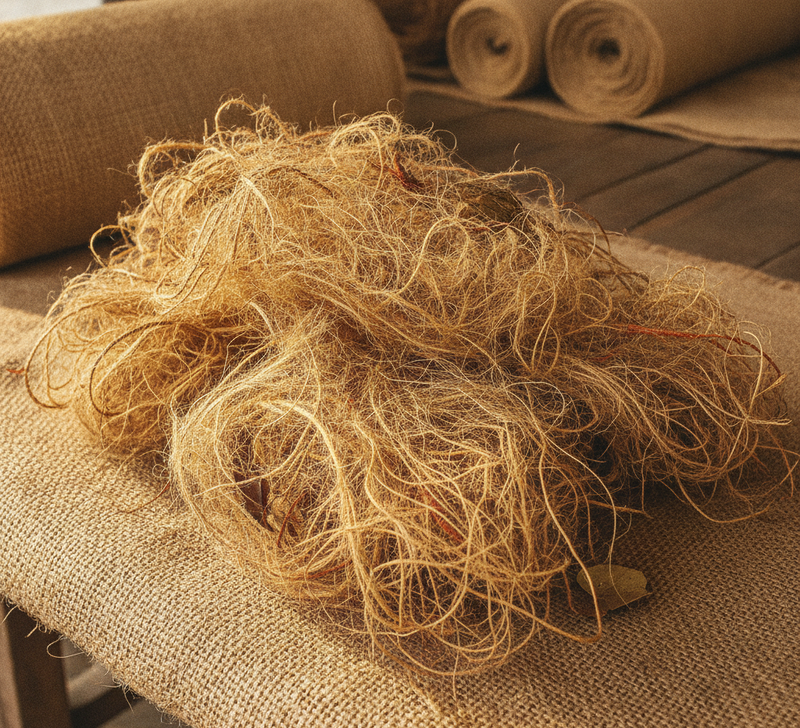
Where It Comes From
Jute grows best in regions with heavy rainfall and fertile alluvial soil. Countries like Bangladesh and India dominate global production, contributing the majority of the world’s supply. Smaller amounts are also grown in nations like China, Myanmar, Nepal, and Thailand.
What makes jute cultivation unique is how closely it is tied to seasonal rhythms. Farmers typically sow jute seeds before the monsoon rains arrive. As the rain nourishes the fields, the plants shoot upward—sometimes reaching 10 to 12 feet in just a few months.
Jute Manufacturing: From Field to Finished Product
Jute manufacturing is a fascinating blend of agriculture, traditional practices, and industrial processing. Though the fiber begins as a simple plant in a field, it goes through several carefully controlled stages before turning into ropes, bags, carpets, or fabrics. Let’s walk through the entire process in a clear, human-centered way—just as it happens in real life.
Cultivation → Harvesting → Retting → Fiber Extraction → Drying → Baling → Softening → Carding → Drawing → Spinning → Weaving → Finishing → Final Products
1. Cultivation of Jute
Everything starts in the field.
Jute plants grow best in warm, humid climates with plenty of rainfall. Farmers usually sow the seeds between March and May, just before the monsoon season. Within 4–6 months, the plants grow rapidly, often reaching heights of 10–12 feet.
- Soil: Alluvial, fertile soil
- Climate: Hot and humid
- Water: Heavy rainfall or irrigation
The crop requires care, but compared to many other fibers, jute needs less fertilizer and pesticide, making it relatively eco-friendly.
2. Harvesting
When the plants begin to flower, they are ready for harvest. Timing is important—if harvested too late, the fiber becomes coarse.
Farmers cut the plants near the base and bundle them into groups. These bundles are then transported to water bodies for the next crucial step.
3. Retting (Fiber Separation)
Retting is one of the most distinctive and labor-intensive stages in jute manufacturing.
- The harvested stalks are immersed in water (ponds, rivers, or slow-moving streams).
- They remain submerged for 10–20 days.
During this period, natural microbial action breaks down the outer bark, allowing the fibers to be separated from the woody core.
Once retting is complete, the fibers are:
- Stripped manually from the stems
- Washed thoroughly
- Hung to dry in the sun
This stage requires experience—poor retting can damage fiber quality.
4. Baling and Transport
After drying, the fibers are sorted based on:
- Color
- Strength
- Length
- Fineness
They are then compressed into bales and sent to jute mills for industrial processing.
5. Softening and Conditioning
Inside the jute mill, the raw fibers are stiff and rough. To make them workable:
- Fibers are sprayed with water and oil (usually mineral or vegetable oil)
- They are then passed through softening machines
This process improves flexibility and prepares the fibers for spinning.
6. Carding
Carding is the stage where fibers are aligned.
- Jute fibers are fed into carding machines
- These machines untangle, clean, and straighten the fibers
The output is a continuous strand known as a sliver
Think of it as combing tangled hair into smooth, parallel strands.
7. Drawing
To improve uniformity:
- Several slivers are combined and drawn out
- This process is repeated multiple times
It helps to:
- Equalize thickness
- Improve fiber alignment
- Remove irregularities
8. Spinning
Now the fibers are ready to become yarn.
- The drawn slivers are fed into spinning machines
- They are twisted into jute yarn or thread
The thickness of the yarn depends on the final product—coarse yarn for ropes, finer yarn for fabrics.
9. Weaving
For fabric production, yarn is woven into cloth using looms.
Two types of looms are used:
- Traditional looms (older mills)
- Modern power looms
This stage produces materials like:
- Hessian cloth (fine fabric)
- Sacking cloth (coarse, heavy-duty fabric)
10. Finishing Processes
After weaving, the fabric may go through several finishing treatments:
- Bleaching: To lighten color
- Dyeing: For colored products
- Printing: For designs or branding
- Calendering: To smooth and polish the surface
These processes enhance both appearance and functionality.
11. Product Manufacturing
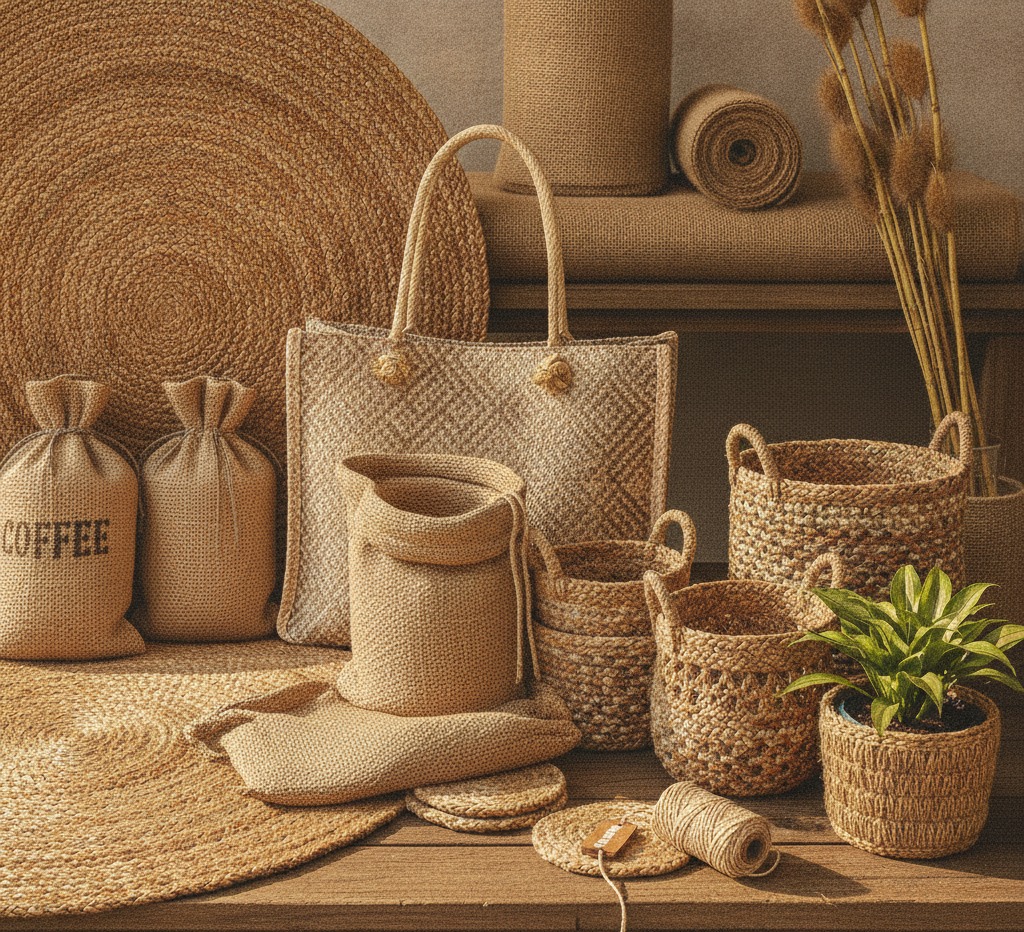
Finally, the processed jute fabric or yarn is converted into finished goods such as:
- Bags (shopping, export sacks)
- Carpets and rugs
- Rope and twine
- Upholstery fabric
- Decorative items
Key Characteristics of Jute Manufacturing
- Labor-intensive: Many stages still depend on human skill
- Eco-friendly: Minimal chemical use compared to synthetic fibers
- Season-dependent: Quality depends on climate and retting conditions
- Versatile output: Can produce both coarse and fine products
Why Jute Still Matters Today
In a world overwhelmed by plastic waste and environmental concerns, jute has quietly made a comeback.
Naturally Sustainable
Jute is biodegradable and compostable. Unlike synthetic fibers, it doesn’t leave behind harmful residues or microplastics. When discarded, it returns to the soil—almost like it never left.
Low Environmental Impact
Jute cultivation requires minimal fertilizers and pesticides. The plants also help improve soil health and absorb significant amounts of carbon dioxide during growth.
Affordable and Accessible
Compared to many eco-friendly alternatives, jute is relatively inexpensive. That makes it an attractive option for industries looking to reduce their environmental footprint without increasing costs dramatically.
Everyday Uses of Jute
Jute’s versatility is one of its greatest strengths. It finds its way into both traditional and modern applications:
- Bags and Packaging: Grocery bags, shopping totes, and export sacks.
- Home Furnishings: Rugs, carpets, curtains, and upholstery.
- Agriculture: Rope, twine, and soil erosion control mats.
- Fashion: Footwear, accessories, and even blended fabrics for clothing.
- Industrial Uses: Geotextiles for road construction and landscaping.
What’s fascinating is how jute moves effortlessly between rustic charm and contemporary design. A jute rug can feel just as at home in a minimalist apartment as in a countryside cottage.
Jute vs Cotton:
Jute and cotton are both natural fibers, but they behave very differently—from how they’re grown to how they feel and where they’re used. Here’s a clear, human-style comparison that reflects real-world industrial and consumer perspectives.
Basic Overview
| Feature | Jute | Cotton |
|---|---|---|
| Source | Stem (bast fiber) | Seed hair (lint) |
| Plant Type | Corchorus | Gossypium |
| Texture | Rough, coarse | Soft, smooth |
| Color | Golden brown | White/cream |
In simple terms:
- Jute comes from the outer stem
- Cotton comes from fluffy fibers around seeds
Fiber Properties
| Property | Jute | Cotton |
|---|---|---|
| Strength | Very strong | Moderate |
| Softness | Low | High |
| Breathability | Moderate | Excellent |
| Elasticity | Low | Moderate |
| Moisture absorption | Good | Very high |
Practical meaning:
- Jute = durable but rough
- Cotton = comfortable and skin-friendly
Chemical Composition (Core Difference)
Both jute and cotton are natural fibers, but their internal chemistry is quite different.
Jute → (C6H10O5)n + Lignin + Hemicellulose
Cotton → ~Pure (C6H10O5)n
Jute (Bast Fiber)
Jute is not pure cellulose. It is a complex lignocellulosic fiber, meaning it contains multiple components:
- Cellulose (main structural component)
- Hemicellulose
- Lignin
Approximate Composition:
- Cellulose: 58–63%
- Hemicellulose: 20–24%
- Lignin: 12–15%
- Others (wax, ash, fats): small %
Chemical Formula (Main Component: Cellulose): (C6H10O5)n
👉 But remember: Jute is not pure cellulose, so this formula represents only part of the fiber.
Role of Components:
- Cellulose → Strength
- Hemicellulose → Flexibility
- Lignin → Stiffness and rigidity
✅ That’s why jute is:
- Strong ✔
- Coarse ✔
- Less flexible ✔
Cotton (Seed Fiber)
Cotton is one of the purest natural forms of cellulose.
Approximate Composition:
- Cellulose: 90–95%
- Water: 5–8%
- Waxes, proteins: trace
Chemical Formula:(C6H10O5)n
Same base formula as jute (cellulose), but cotton has much higher purity.
Structure Insight:
- Long cellulose chains arranged in a highly crystalline structure
- Very low lignin content (almost none)
That’s why cotton is:
- Soft ✔
- Flexible ✔
- Highly absorbent ✔
Key Chemical Differences (Simple View)
| Property | Jute | Cotton |
|---|---|---|
| Main polymer | Cellulose + lignin | Cellulose (almost pure) |
| Cellulose % | ~60% | ~95% |
| Lignin presence | High | Nearly none |
| Chemical purity | Low | High |
Impact of Chemistry on Properties
Strength
- Jute: High (due to lignin + structure)
- Cotton: Moderate
Softness
- Jute: Rough (lignin makes it stiff)
- Cotton: Soft (pure cellulose)
Absorbency
- Jute: Medium
- Cotton: Very high (due to hydroxyl groups –OH in cellulose)
Important Chemical Functional Group
Both fibers contain hydroxyl groups (-OH):
–OH group
These groups:
- moisture (hydrophilic nature)
- Allow dyeing
- Affect swelling behavior
But Difference:
- Cotton → more accessible OH groups → better dyeing & comfort
- Jute → lignin blocks OH groups → lower absorbency
Reaction Behavior (Industrial Relevance)
Jute:
- Reacts with alkali but can degrade
- Difficult to bleach (because of lignin)
- Requires more chemical treatment
Cotton:
- Easily bleached and dyed
- Stable in alkaline conditions
- Preferred in textile wet processing
The Comeback of Jute in Modern Times
For a while, jute lost ground to synthetic materials like nylon and plastic. They were cheaper to mass-produce and often more durable in certain conditions. But this came at a cost—environmental damage that slowly began to surface.
In recent years, global awareness about sustainability has sparked renewed interest in natural fibers. Governments in some countries have even encouraged the use of jute over plastic packaging.
Designers and businesses are also rediscovering jute—not just for its eco-friendly appeal, but for its texture, durability, and unique aesthetic.
Challenges Facing the Jute Industry
Despite its advantages, jute is not without its difficulties.
- Weather Dependency: Being a natural crop, jute is highly sensitive to climate conditions.
- Labor-Intensive Processing: Traditional methods require significant manual effort, which can impact productivity.
- Competition from Synthetics: Plastic alternatives still dominate in many markets due to convenience and consistency.
- Market Fluctuations: Farmers often face unstable prices, affecting livelihoods.
Addressing these challenges requires a mix of innovation, policy support, and investment in modern processing techniques.
A Fiber with a Human Story
Beyond its economic and environmental value, jute carries something deeper—a human connection.
For generations, families have relied on jute cultivation for survival. In many villages, jute is more than just a crop; it’s woven into everyday life, traditions, and community identity.
When you pick up a jute bag, you’re not just holding a product. You’re holding hours of labor, skill, and heritage that stretches across fields, rivers, and generations.
Looking Ahead
Jute stands at an interesting crossroads. It’s an ancient material with renewed relevance in a modern world seeking sustainability.
With improving technology, better market access, and growing eco-consciousness, jute has the potential to play a much bigger role in the future—replacing harmful materials and reshaping industries.
In many ways, the story of jute is a reminder that sometimes, the solutions to today’s problems have been with us all along—rooted in nature, waiting to be rediscovered.