What is a fashion life cycle?
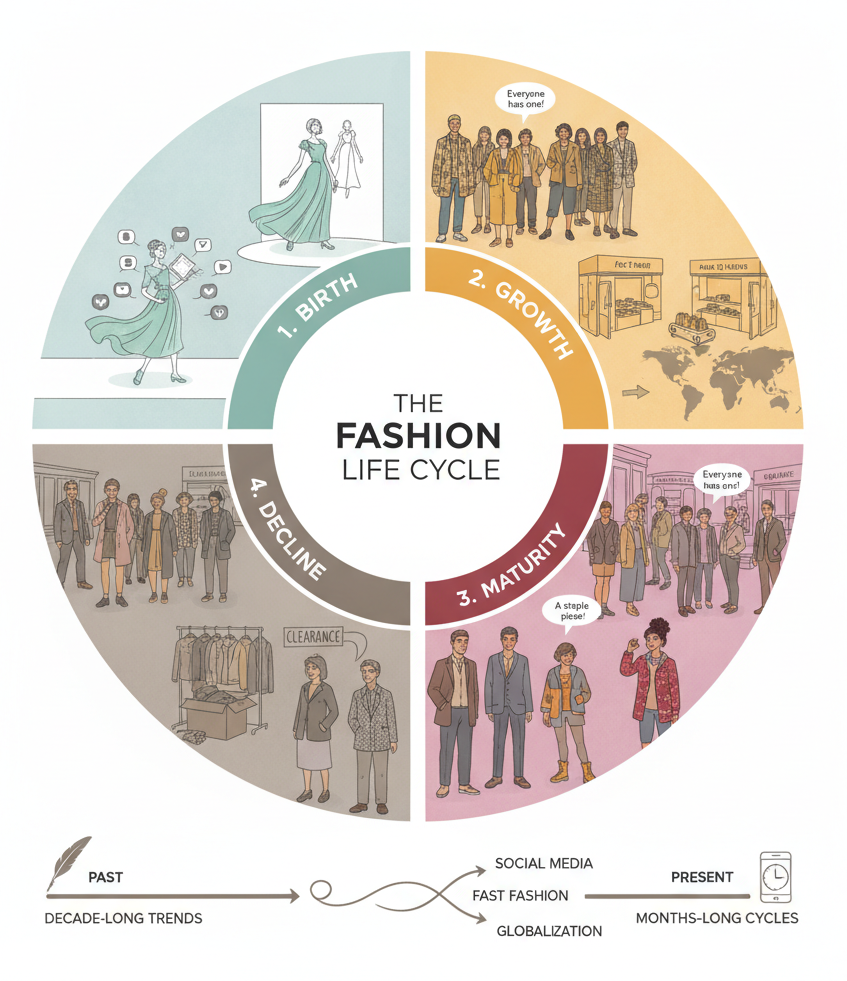
The fashion life cycle is the process of a fashion trend from its birth, growth, maturity, decline and sometimes rebirth. It helps brands, retailers and consumers understand how styles evolve and why some trends disappear while others become timeless classics.
Fashion cycles were slower in the past. Aristocrats set the style in the 18th and 19th centuries and trends would last for decades. Today, social media, fast fashion and globalization can bring the cycles down to a few months.
Key Elements of Fashion
| Element | Description | Example |
|---|---|---|
| Trend | Short-term style movement | Y2K Fashion |
| Fashion | Widely accepted style | Skinny Jeans |
| Classic Style | Long-lasting fashion | Little Black Dress |
Key Takeaway: Understanding the fashion life cycle helps predict consumer demand, avoid overproduction and identify opportunities for revival.
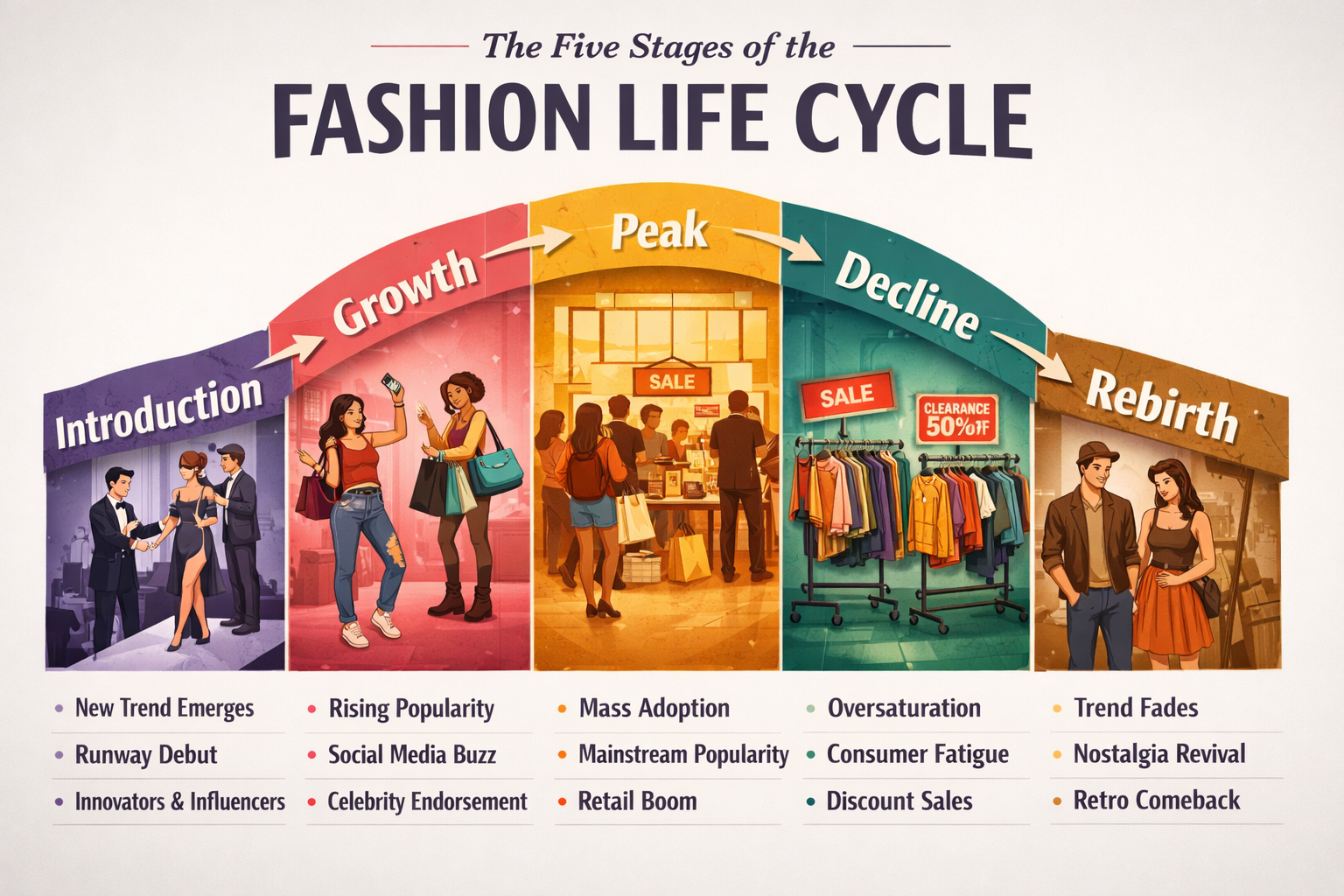
The Five Stages of the Fashion Life Cycle
Introduction Stage
When a fashion trend first appears, it can be experimental and exclusive. Designers present bold ideas on runways. Early adopters, often celebrities, stylists or niche communities, adopt them long before the mainstream even gets a whiff. Think Alexander McQueen’s avant-garde collections or Balenciaga’s chunky sneakers. The trend is risky for brands at this stage, with high production costs and uncertain consumer demand. But it’s also the most exciting, where creativity is king and innovation rules the agenda for what might be the next big thing.
Growth Stage
The trend starts to catch on and social media platforms like Instagram, TikTok and Pinterest help to speed up its exposure. Influencers and celebrities matter here. When Kylie Jenner rocks a look, it gets noticed by millions of followers. As the trend picks up, retailers begin to produce more affordable versions, making it accessible to a broader audience. This is when hashtags trend worldwide and fashion magazines start covering the movement. Athleisure boomed in the 2010s when brands such as Lululemon and Nike capitalized on the rising popularity of fashionable but comfortable clothing.
Peak / Maturity Stage
The trend goes mainstream at maturity. It is everywhere, from the high street to the mall to e-commerce. It’s no longer seen as exclusive, but as a staple for consumers. That’s where retailers make their money, but the danger of saturation is always looming. Take the skinny jeans of the 2010s: a perfect example. They were everywhere, in everyone's wardrobes, from the luxury brands to the fast fashion chains. But when everyone had a pair, the uniqueness disappeared and it paved the way for alternatives like wide-leg trousers.
Decline Stage
Eventually, buyers become tired. The trend feels tired and shoppers are craving something new. Retailers wrestle with unsold stock, often turning to discounts and clearance sales. This phase is crucial for brands; without a pivot you risk slipping into irrelevance. For example, the decline of skinny jeans coincided with the rise of looser silhouettes, reflecting a cultural movement towards comfort and individuality.
Period of obsolescence or renewal
Some trends disappear completely, while others come back years later, powered by nostalgia. Thrift shopping, vintage culture and Gen Z’s love for retro aesthetics have brought back countless styles. Cargo pants, once considered passe, are back in style thanks to TikTok influencers and streetwear brands. Likewise, Y2K fashion—once laughed at—has made a comeback with a vengeance, proving that fashion is cyclical and yesterday’s “outdated” look can become tomorrow’s hottest trend.
| Stage | Characteristics | Consumer Behavior | Business Impact |
|---|---|---|---|
| Introduction | Exclusive, innovative | Early adopters experiment | High risk, low sales volume |
| Growth | Rising popularity | Wider adoption | Increased production, marketing |
| Maturity | Mass-market dominance | Mainstream acceptance | High profits, retail saturation |
| Decline | Oversaturation | Shift to alternatives | Discounting, inventory issues |
| Rebirth | Nostalgic revival | Renewed interest | Vintage resale, rebranding |
Key Takeaway: Brands must anticipate decline and prepare for revival opportunities.
Fashion Adoption Theories
Fashion doesn’t spread randomly—it follows patterns explained by adoption theories.
Trickle-Down Theory: Historically, fashion flowed from elites to the masses. Royals and aristocrats set the tone and society followed. Today, luxury houses like Dior or Chanel still influence mainstream fashion, though the process is faster.
Trickle-Up Theory: Streetwear and subcultures often inspire high fashion. Punk, hip-hop and skate culture have all shaped luxury collections. Virgil Abloh’s Off-White is a prime example of street aesthetics influencing haute couture.
Trickle-Across Theory: In the digital age, trends spread horizontally across social classes. A style can simultaneously appear in luxury boutiques and fast fashion chains. Social media has blurred the lines, making fashion more democratic than ever.
| Theory | Origin | How Trends Spread | Example |
|---|---|---|---|
| Trickle-Down | Elite → Mass Market | Luxury inspires mainstream | Chanel tweed suits influencing Zara blazers |
| Trickle-Up | Street → High Fashion | Subcultures inspire designers | Punk fashion influencing Vivienne Westwood |
| Trickle-Across | Simultaneous adoption | Spread across social classes | Fast fashion copying runway looks |
Key Takeaway: Social media has blurred these theories—today, trends often spread simultaneously across all levels.
Factors That Influence the Fashion Life Cycle
Fashion trends don’t exist in isolation—they’re shaped by cultural, technological and economic forces.
Social Media: Platforms like TikTok can make a micro-trend viral overnight. The “clean girl aesthetic” and “coastal grandma” look are prime examples of trends born online.
Celebrity Culture: When Zendaya wears Valentino or Harry Styles dons a Gucci dress, it sparks global conversations. Celebrities remain powerful trendsetters.
Economic Conditions: Recessions often push consumers toward practical, timeless styles, while economic booms encourage experimentation.
Technology: Digital fashion, AR try-ons and AI-driven design are reshaping how trends emerge and spread.
Sustainability: Growing awareness of climate change has made consumers more conscious, extending the life cycle of sustainable fashion.
Generational Shifts: Gen Z demands authenticity, inclusivity and eco-consciousness, while Millennials balance affordability with style.
| Factor | Influence Level | Impact on Trend Lifecycle |
|---|---|---|
| Social Media | Very High | Accelerates growth & decline |
| Celebrity Culture | High | Drives mass adoption |
| Influencer Marketing | High | Shapes niche & mainstream |
| Economic Conditions | Medium | Affects affordability |
| Technology | High | Enables digital fashion |
| Cultural Movements | High | Shapes inclusivity trends |
| Sustainability | High | Extends lifecycle via reuse |
| Globalization | High | Spreads trends worldwide |
| Consumer Psychology | Very High | Determines longevity |
| Gen Z & Millennials | Very High | Demand authenticity & sustainability |
Key Takeaway: Trends today rise and fall faster due to social media virality and Gen Z’s demand for authenticity.
Fast Fashion vs Slow Fashion in the Fashion Life Cycle
Fast fashion thrives on speed and affordability, but it comes at a cost—environmental damage, labor exploitation and disposable culture. Slow fashion, on the other hand, emphasizes quality, ethics and longevity. Brands like Patagonia and Stella McCartney champion slow fashion, while Zara and H&M dominate fast fashion. The tension between these two models defines modern fashion cycles.
| Aspect | Fast Fashion | Slow Fashion |
|---|---|---|
| Definition | Rapid production, low cost | Ethical, sustainable, slower cycles |
| Advantages | Affordable, trendy | Quality, longevity |
| Challenges | Waste, poor labor practices | Higher cost, slower adoption |
| Environmental Impact | High pollution | Lower footprint |
| Consumer Behavior | Impulse buying | Conscious consumption |
Key Takeaway: Slow fashion aims to extend the life cycle by promoting timeless styles and sustainability.
Fashion Trend Forecasting and Life Cycle Prediction
| Forecasting Method | Accuracy | Usage |
|---|---|---|
| Trend Forecasting Agencies | High | WGSN, Trend Union |
| Data Analytics | Medium | Retail sales, Google Trends |
| AI Forecasting | High | Predicts consumer behavior |
| Market Research | Medium | Surveys, focus groups |
Key Takeaway: AI-driven forecasting is reshaping how brands predict fashion industry trends.
Sustainability and the Modern Fashion Life Cycle
| Sustainable Practice | Benefit | Example |
|---|---|---|
| Circular Fashion | Reduces waste | Stella McCartney initiatives |
| Upcycling | Extends product life | Marine Serre’s patchwork pieces |
| Recycling | Minimizes landfill | H&M’s recycling bins |
| Ethical Production | Improves labor standards | Patagonia’s fair trade supply |
| Consumer Awareness | Drives demand for change | Gen Z thrifting culture |
Key Takeaway: Sustainability is no longer optional—it’s a core driver of modern fashion cycles.
Case Studies of Fashion Life Cycles
| Trend | Introduction | Peak | Decline | Current Status |
|---|---|---|---|---|
| Skinny Jeans | Early 2000s | 2010s | Late 2010s | Declining, replaced by wide-leg |
| Y2K Fashion | Late 1990s | Early 2000s | 2010s | Revived by Gen Z |
| Athleisure | 2010s | 2018–2020 | Stabilizing | Still popular |
| Cargo Pants | 1990s | 2000s | 2010s | Revived 2020s |
| Sustainable Fashion | 2010s | Growing | Ongoing | Expanding |
Role of Fashion Brands in Managing Fashion Life Cycles
Fashion brands are the architects of trend longevity. Their decisions—from design to marketing—determine whether a style thrives or fades prematurely.
Product Development: Brands must balance innovation with consumer demand. For example, Gucci experiments with bold runway pieces but also produces wearable versions for retail.
Inventory Planning: Zara and H&M rely on agile supply chains to avoid overstocking, while luxury houses produce limited runs to maintain exclusivity.
Marketing Strategy: Timing is everything. Brands launch campaigns during the growth stage to maximize visibility, while clearance sales dominate the decline stage.
Trend Adaptation: Nike and Adidas pivot quickly, introducing new sneaker designs when older models lose traction.
Consumer Engagement: Brands like Patagonia build loyalty by aligning with consumer values such as sustainability and ethics.
Key Takeaway: Successful brands treat the fashion life cycle as a roadmap, not a gamble. They anticipate shifts and adapt strategies to extend profitability.
Digital Transformation and Fashion Trends
Technology has revolutionized how trends emerge, spread and evolve.
TikTok Trends: Micro-trends like “coastal grandma” or “clean girl aesthetic” can go viral overnight, reshaping retail demand.
Instagram Fashion: Influencers curate aspirational lifestyles, making platforms a digital runway.
AI-Generated Fashion: Tools now design clothing based on consumer data, predicting what will sell before production begins.
Virtual Influencers: Figures like Lil Miquela blur the line between reality and digital, promoting futuristic looks.
Metaverse Fashion: Gucci and Balenciaga experiment with digital wearables, allowing consumers to “dress” avatars in luxury pieces.
Key Takeaway: Digital transformation has democratized fashion, making trends accessible, global and faster-moving than ever before.
Future of the Fashion Life Cycle
The future will be shaped by AI forecasting, digital clothing and circular fashion models. Imagine owning a digital wardrobe for your metaverse avatar or AI predicting your next purchase before you even realize you want it. Sustainability will remain central, with brands adopting recycling, upcycling and ethical production to extend product lifespans.
AI-driven forecasting will shorten prediction times.
Sustainable innovation will extend product lifespans.
Personalized fashion will cater to individual tastes.
Digital clothing will redefine ownership.
Circular economy will dominate brand strategies.
Key Challenges in Fashion Life Cycle Management
Managing fashion cycles is complex, with challenges that can make or break a brand.
| Challenge | Impact | Possible Solution |
|---|---|---|
| Overproduction | Waste, unsold inventory | AI-driven demand forecasting |
| Waste | Environmental damage | Circular fashion models |
| Forecasting Errors | Financial loss | Data-driven insights |
| Rapid Trend Changes | Inventory mismatch | Agile supply chains |
| Counterfeit Products | Brand dilution | Blockchain authentication |
| Supply Chain Disruptions | Delays, losses | Diversified sourcing |
Conclusion
Fashion isn’t just about what we wear It’s about who we are, how we live and what we care about. The fashion life cycle shows that every trend, whether it is from haute couture or streetwear, follows a rhythm of birth, growth, maturity, decline and often rebirth. By understanding this rhythm, designers, marketers, and consumers are better equipped to make smarter, more sustainable choices.
In this guide, we’ve explored the origins of trends — from creative sparks to cultural movements — their rise via social media and celebrity influence, and their eventual fall or evolution into something new. We have seen how theories of fashion adoption account for the flow of style across social classes and how digital transformation, from TikTok virality to AI forecasting, has sped up the pace of change.
For brands, it is a balancing act between creativity and strategy in managing the fashion life cycle. It’s about understanding when it’s time to innovate, when it’s time to scale, and when it’s time to pivot. Agility, sustainability and tech. Patagonia’s ethical production, Gucci’s digital fashion forays. Companies that are rewriting the rule book on what success looks like today.
Meanwhile, consumers are growing more conscious. Slow fashion, circular design and vintage revival are all popular, showing that people want meaning behind their clothes. The future of fashion will be shaped by a collaboration between technology and ethics, creativity and responsibility.
Ultimately, fashion’s cyclical nature teaches us that style is never dead, it just changes shape. Trends fade, but their influence lingers, inspiring new generations to reconsider the past. By grasping the fashion life cycle, we don’t merely chase trends; we learn to predict, respect, and influence the next iteration of fashion history.