Have you ever walked into a clothing store and noticed that the same colors, patterns or styles seem to be everywhere?
That is usually not a coincidence.
Long before those garments appear on store shelves, people across the fashion industry are already studying what consumers might want next. They look at everything from social media and street style to sales figures, cultural changes and new fabric developments. This work is known as fashion forecasting.
Fashion forecasting helps brands make decisions months and sometimes years, before a collection reaches the customer. It helps them decide which colors to use, what fabrics to develop and which silhouettes or styles are worth investing in.
In this article, we'll look at what fashion forecasting is, how the process works, who is involved and how technology is changing the way future trends are predicted.
What Is Fashion Forecasting?
Fashion forecasting is the process of predicting the styles, colors, materials and consumer preferences that are likely to become popular in the future.
It is somewhat similar to weather forecasting. A weather forecaster looks at data and patterns to predict what the weather might be like next week. A fashion forecaster does something similar, but the subject is consumer behavior and style.
The difference is that fashion is influenced by people, culture and unexpected events, so there is never a perfect prediction.
Forecasters study many different sources of information, including:
Previous sales data
Consumer behavior
Economic conditions
Social media activity
Celebrity and influencer styles
Street fashion
Fashion shows
Cultural events
New textile and material developments
Online searches
They bring these signals together and look for patterns that might indicate where fashion is heading.
Why Is Fashion Forecasting Important?
Fashion is creative, but it is also a huge commercial business.
Producing a garment requires fabric, trims, labor, machinery, transportation and investment. If a company produces thousands of garments that customers do not want, the financial loss can be significant.
That is why forecasting plays an important role.
It Helps Reduce Costs
Producing the right products in the right quantities reduces the risk of excess inventory and unnecessary production.
It Can Reduce Waste
Better predictions can help brands avoid making large quantities of products that eventually remain unsold.
It Keeps Collections Relevant
Fashion changes quickly. Brands need to understand what customers are likely to respond to if they want their collections to remain commercially relevant.
It Supports Production Planning
Garments do not appear in stores overnight. Fabric development, sourcing, sampling, production and shipping can take months.
Forecasting gives manufacturers and brands more time to prepare.
It Supports Marketing
Once a company understands the direction of an upcoming trend, it can build its photography, advertising and product campaigns around that direction.
Who Works in Fashion Forecasting?
Fashion forecasting is rarely the responsibility of one person. Different specialists contribute different types of information.
| Role | Main Responsibility |
|---|---|
| Trend Forecaster | Studies signals and predicts future fashion directions |
| Color Specialist | Researches and develops future color palettes |
| Fabric Specialist | Tracks new materials, finishes and textile developments |
| Market Researcher | Studies consumer behavior, shopping patterns and demand |
| Trend Forecasting Company | Produces trend intelligence and reports for brands |
| Buyer | Uses trend and market information when deciding what products to purchase |
Some professionals work directly for fashion companies, while others work for independent forecasting agencies that provide information to multiple brands.
This shared trend information is one reason similar colors and silhouettes often appear across different retailers during the same season.
How Does Fashion Forecasting Work?
Forecasting is not simply a matter of looking at a runway and deciding what will become popular. It involves collecting information from many different sources and interpreting it.
Step 1: Watching What Is Happening
Forecasters begin by observing changes in society and culture.
They monitor fashion shows, social media, music, movies, art, street style and major cultural events. Even something outside fashion can influence the way people dress.
For example, a popular television series, celebrity or music movement can suddenly influence consumer interest in a particular style.
Step 2: Studying Data
Observation is only one part of the process.
Forecasters also examine sales figures, online searches, consumer behavior and other market data.
Weather and climate can matter as well. If a market experiences warmer winters, for example, brands may reconsider how much heavy outerwear they need to produce.
Step 3: Developing Color and Material Directions
Color and material decisions often need to be made long before consumers see the finished garment.
Forecasters develop palettes, identify promising materials and consider how these elements could work across future collections.
Step 4: Creating the Forecast
The research is then organized into a forecast.
A typical report may contain color palettes, fabric references, photographs, illustrations, market information and explanations of the cultural or commercial factors behind the prediction.
The purpose is not simply to say, "This will be popular."
A useful forecast explains why a particular direction may have potential.
Step 5: Sharing the Information
Brands, designers, product developers and buyers use these reports as one source of information when planning future collections.
A forecast does not dictate exactly what a brand must produce. Instead, it provides direction that designers and product teams can interpret in their own way.
Step 6: Turning the Forecast Into Products
The final step is where predictions become physical products.
Designers create garments, product teams develop samples, sourcing teams find materials and manufacturers prepare for production.
Eventually, the original forecast appears in the form of garments hanging in stores or displayed online.
Long-Term and Short-Term Fashion Forecasting
Not every forecast looks equally far into the future.
Some focus on major changes that could influence fashion several seasons ahead. Others are designed to identify trends that may become popular within a few weeks.
| Type | Time Frame | Main Purpose |
|---|---|---|
| Long-term forecasting | Around 18 months to 2 years ahead | Helps with material development, product direction and longer-term planning |
| Short-term forecasting | Several weeks to a few months | Helps brands respond to more immediate market trends |
| Micro-trend forecasting | Days to weeks | Tracks rapidly changing trends, particularly online |
Long-term forecasting is particularly useful for traditional fashion businesses because developing fabrics, confirming suppliers and producing garments can take considerable time.
Short-term forecasting has become increasingly important for businesses that operate with shorter product cycles.
Micro-trend forecasting is closely connected with social media, where a style can gain enormous attention and then disappear just as quickly.
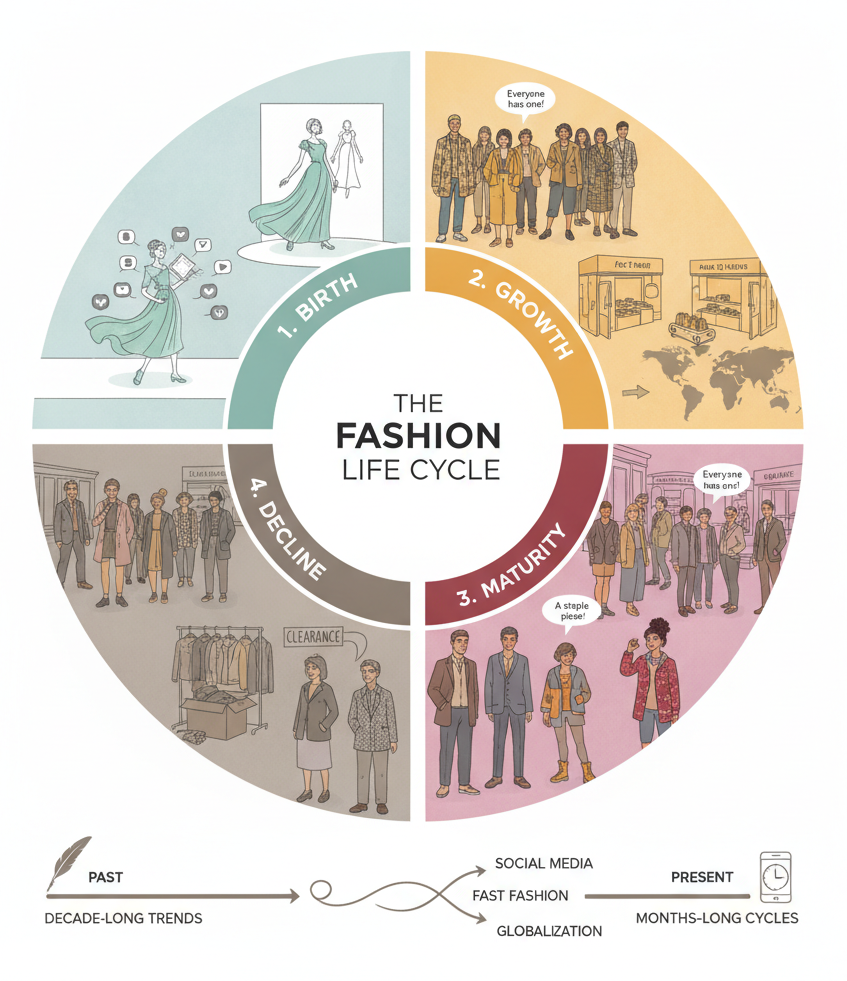
How Social Media Changed Fashion Forecasting
Fashion forecasting used to depend heavily on fashion shows, magazines, designers and other traditional sources.
Social media has changed the process dramatically.
Platforms such as Instagram, TikTok and Pinterest allow trends to spread almost instantly. More importantly, consumers themselves can now become trend creators.
A trend does not necessarily have to start with a major fashion house. A single creator, video or photograph can influence thousands or even millions of people.
Social media has therefore made fashion forecasting:
Faster
More data-driven
More consumer-focused
Less dependent on traditional fashion authorities
More difficult to predict
A trend can appear in the morning, gain attention during the day and become irrelevant within a few weeks.
For forecasting companies, this creates both an opportunity and a challenge.
Many now use software capable of analyzing enormous amounts of online content to identify patterns before they become obvious to the wider market.

Tools Used in Fashion Forecasting
Modern forecasters combine traditional research with digital technology.
Some commonly used tools include:
Trend reports: Professional forecasting services provide information about future colors, silhouettes, materials and consumer behavior.
Color systems: Color references help designers and product teams communicate and develop consistent palettes.
AI and data-analysis tools: Computer systems can process large amounts of online content and identify patterns much faster than a person could manually.
Fashion shows: Runways remain an important source of information about emerging silhouettes, materials and styling directions.
Street-style photography: What people actually wear can sometimes provide a more useful indication of consumer behavior than runway collections alone.
Consumer surveys: Direct feedback can help companies understand what people like, dislike or expect to buy.
Sales data: Previous sales provide evidence of what consumers have actually purchased rather than what they simply say they like.
The strongest forecasts usually come from combining several of these sources rather than relying on one signal.
Well-Known Fashion Forecasting Companies
Several organizations have become well known for providing trend intelligence to fashion and textile companies.
WGSN
WGSN is one of the best-known fashion forecasting services. It provides research covering areas such as fashion, consumer behavior, colors, materials and future trends.
Brands use this type of information when planning collections well ahead of the selling season.
Pantone
Pantone is particularly well known for its work with color.
Its Color of the Year announcement receives considerable attention from the fashion, design and lifestyle industries. Pantone's color systems are also widely used to communicate colors consistently across product development.
Heuritech
Heuritech uses artificial intelligence and image analysis to study fashion content and identify emerging trends.
This type of technology allows brands to analyze large volumes of social-media imagery and detect changes in consumer preferences.
Trendstop
Trendstop provides fashion and consumer trend information used by brands and fashion professionals for product and marketing decisions.
Coloro
Coloro focuses on color and works closely with WGSN on future color directions.
Together, forecasting services such as these provide fashion companies with research that can influence decisions about colors, materials, silhouettes and collections.
What Makes Fashion Forecasting Difficult?
Predicting the future is never straightforward and fashion is especially unpredictable.
Sudden Events
Major economic, political, social or health events can change consumer behavior very quickly.
A trend that looked commercially promising several months earlier may suddenly lose relevance.
Social Media Moves Too Quickly
A trend can become popular almost overnight. By the time a traditional company has designed, sourced and produced a product around that trend, consumer interest may already have moved elsewhere.
Cultural Sensitivity
Fashion draws inspiration from cultures around the world. Forecasters and designers need to understand cultural context and avoid treating cultural elements as simple commercial trends.
Sustainability
Consumers increasingly want to understand how clothing is produced, what materials are used and how long products are expected to last.
Sustainability is therefore becoming another factor in forecasting and product development.
Different Markets Behave Differently
A trend that works extremely well in one country may have little appeal in another.
Climate, culture, income, lifestyle and local preferences can all influence what people choose to wear.
Sustainability Is Changing Fashion Forecasting
Fashion forecasting was traditionally centered on aesthetics: colors, silhouettes, fabrics and styles.
Today, the conversation is broader.
Environmental concerns are influencing what consumers want and how brands develop products. As a result, sustainability has become increasingly relevant to trend research.
Forecasting and product teams may now consider:
Lower-impact materials
Recycled and bio-based fibers
Product durability
Repairability
Secondhand and resale markets
Supply-chain transparency
Reduced overproduction
Circular business models
This is an important change because the future of fashion is no longer determined only by what looks attractive.
Consumers increasingly want to know the story behind the product as well.
How Small Fashion Brands Can Use Forecasting
Fashion forecasting is not limited to multinational brands with large research budgets.
Small brands and independent designers can carry out their own basic trend research.
They can:
Follow relevant fashion and textile publications
Monitor social-media conversations
Study competitors and other independent brands
Use tools such as Google Trends and Pinterest Trends
Speak directly with customers
Review their own previous sales
Visit stores and observe what consumers are buying
The goal is not to predict every trend perfectly.
For a small brand, even identifying a useful market direction early can make a meaningful difference.
What Is the Future of Fashion Forecasting?
Technology will probably play an even bigger role in fashion forecasting over the coming years.
AI systems can process enormous amounts of information, including social-media images, search behavior, sales data and consumer activity. This makes it possible to identify patterns much faster than traditional research methods.
But technology is unlikely to replace human judgment completely.
Fashion is closely connected to culture, emotion and creativity. A computer can identify that a particular color is appearing more frequently online, but understanding why people are responding to that color is much more complicated.
The likely future is therefore a combination of both.
AI and other digital tools will handle large amounts of data, while human researchers, designers and creative teams will interpret that information and turn it into something meaningful.
Forecasting could also become more personalized. Instead of trying to predict one major trend for everyone, brands may increasingly identify smaller trends for specific consumer groups.
That could eventually lead to more targeted collections and products designed around individual preferences.
Final Thoughts
Fashion forecasting happens long before most shoppers realize it.
The color of a sweater, the shape of a jacket or the type of fabric appearing across multiple stores may have been discussed by designers, buyers and forecasting teams many months earlier.
What makes forecasting interesting is the combination of data and creativity. Sales figures, search trends and social-media activity provide measurable signals, while cultural understanding and human judgment help explain what those signals actually mean.
The process is becoming faster as technology develops. Social media can create trends almost instantly, while AI can analyze enormous amounts of information in a fraction of the time traditional research would require.
But forecasting will never be a perfect science.
People change their minds. Markets change. Unexpected events happen. A trend that looks certain today may disappear tomorrow.
That uncertainty is exactly what makes fashion forecasting so important.
The next time you walk into a store and notice the same color or style appearing across several brands, remember that it probably did not happen by accident. Long before you saw it on the rack, someone was already trying to predict that you would want it.