AI-Enhanced Digital Textile Printing
Evolution of Digital Textile Printing
Digital textile printing replaces traditional screen printing with a data‑driven, inkjet-based process. Unlike analog methods that require screens, large setup volumes and excess chemicals, digital printing allows direct application of designs from digital files to fabric, enabling faster turnaround and greater flexibility.
With the integration of artificial intelligence (AI), modern digital printing systems can now:
- Automatically optimize print parameters based on fabric type
- Predict ink absorption and color behavior
- Adjust droplet size, ink density and curing profiles in real time
These capabilities ensure higher first‑time-right quality, minimizing reprints and material losses.
Digital Textile Printing Process (Step-by-Step)
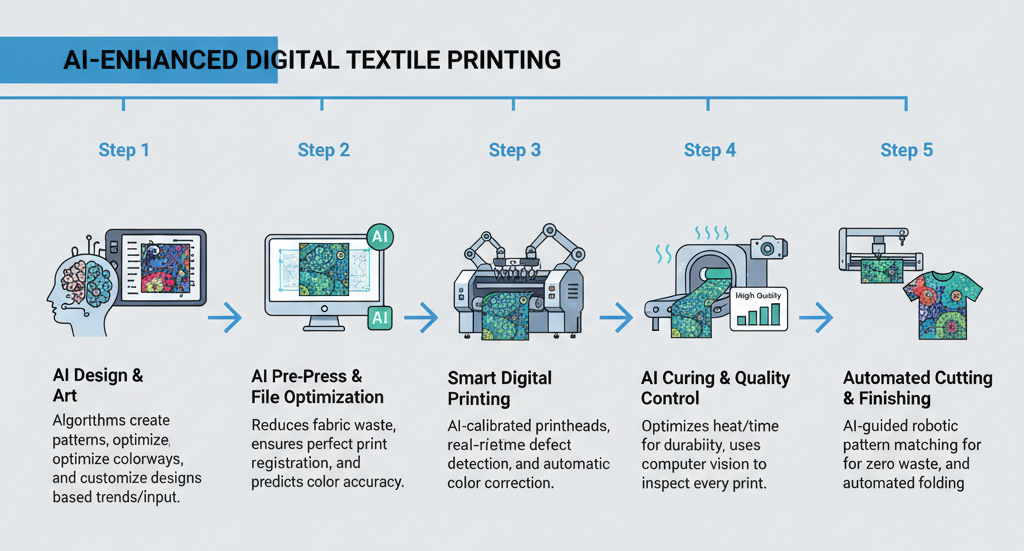
Digital Design Creation
Designs are created or modified using CAD/3D design software, allowing accurate color control and virtual visualization before production.
AI-Based File Optimization
AI systems optimize print settings (resolution, ink density, color profiles) based on fabric type and design complexity to ensure right‑first‑time printing.
In-Line Pre-Treatment
Pre-treatment chemicals are applied precisely within the printing line, improving pigment fixation while minimizing chemical usage and fabric handling.
Inkjet Printing with Pigment Inks
Advanced pigment inks are directly printed onto the fabric without the need for screens, enabling short runs, customization and rapid changeovers.
Drying & Curing
Heat curing fixes the pigment ink to the fabric surface. No washing or steaming is required, leading to major water and energy savings.
Quality Inspection & Finishing
AI-assisted inspection ensures color consistency and print accuracy before fabric moves to cutting or garment production.
Advanced Pigment Inks: A Sustainability Breakthrough
Why Pigment Inks Matter
Pigment inks represent a major advancement over reactive, acid or disperse inks. They bind to the fabric surface using a polymer binder rather than requiring chemical reactions within the fiber.
Key sustainability advantages include:
- No washing or steaming required, drastically reducing water usage
- Compatibility with a wide range of fibers (cotton, polyester, blends)
- Lower chemical consumption and simplified wastewater treatment
- Reduced processing time and energy demand
AI-enhanced pigment ink systems further refine ink laydown accuracy, ensuring consistent color reproduction with minimal ink consumption.
In-Line Pre-Treatment: Efficiency Without Excess
Traditional textile printing relies on separate pre-treatment and post-treatment processes, which involve multiple machines, large floor space and high resource use. In contrast, in-line pre-treatment integrates fabric preparation directly into the digital printing line.
Benefits of In-Line Pre-Treatment
- Precise, localized application of pre-treatment chemicals
- Elimination of over-application and chemical runoff
- Reduced fabric handling and transport
- Lower overall energy and labor requirements
When combined with AI control systems, in-line pre-treatment can dynamically adapt to fabric variability, further improving efficiency and reducing waste.
Waste and Energy Reduction Across the Value Chain
AI-enhanced digital printing fundamentally changes production economics:
- On-demand production replaces bulk manufacturing, reducing dead stock and unsold inventory
- Short-run capability supports mass customization without cost penalties
- Lower setup waste compared to screen preparation and color trials
- Energy savings from fewer process steps and reduced curing requirements
Collectively, these factors help manufacturers meet stringent sustainability targets while maintaining speed and quality.
Immersive Tools: Transforming Design, Sampling and Decision-Making
3D Design and Virtual Prototyping
Immersive tools such as 3D garment design software allow designers to visualize prints, textures and garment fit in a virtual environment. Designs can be tested and modified digitally before a single meter of fabric is printed.
This results in:
- Fewer physical samples
- Shorter development cycles
- Lower material waste and transportation emissions
AR and VR in Product Development
Augmented Reality (AR) and Virtual Reality (VR) enable stakeholders to:
- Review collections virtually
- Simulate fabric behavior and print placement
- Conduct virtual showrooms and buyer approvals
These tools reduce the need for physical samples and international shipping, supporting more sustainable and agile decision-making.
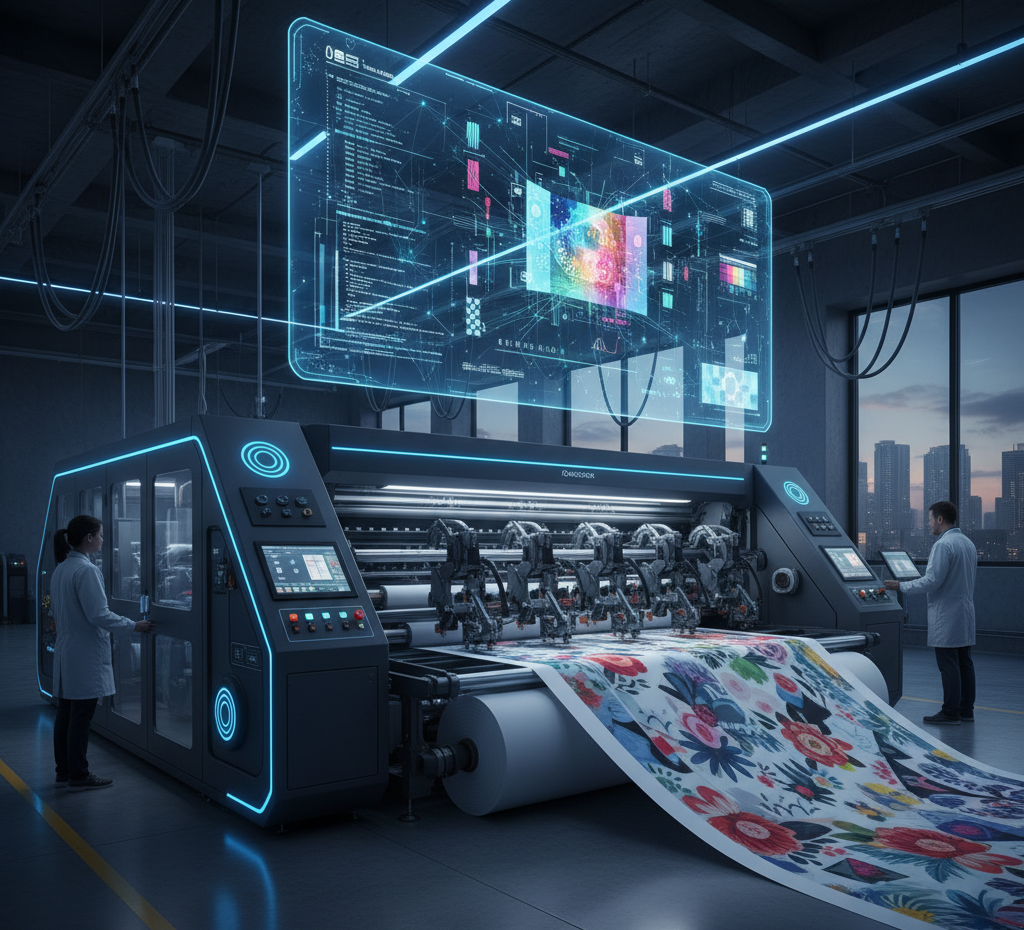
Digital Twins and Smart Factories
Digital printing technologies increasingly operate within digital twin ecosystems, where virtual replicas of machines, workflows and materials are continuously updated with real-time data.
Advantages include:
- Predictive maintenance to reduce downtime and energy loss
- Optimized production planning and capacity utilization
- Data-driven sustainability tracking (ink, energy and fabric usage)
When combined with immersive dashboards, production teams gain deeper visibility into environmental performance and operational efficiency.
Strategic Impact on the Apparel Industry
The convergence of AI-enhanced digital printing and immersive digital tools supports a shift toward:
- Demand-driven manufacturing
- Reduced environmental footprint
- Faster time-to-market
- Greater design freedom and personalization
For global apparel brands and suppliers, these technologies are no longer optional—they are becoming essential enablers of responsible, resilient and competitive manufacturing models.