Every year, we make an enormous amount of clothing. The problem is that we are also throwing away an enormous amount of it.
Fast fashion has changed the way people buy clothes. New styles appear quickly, prices are often low, and buying another shirt or pair of trousers can feel almost effortless. But there is another side to that convenience. Once clothes are no longer wanted, a large portion of them does not find a second life. Instead, they are sent to landfill, burned, or simply lost from the material cycle.
This is one of the reasons circular fashion has become such an important topic for the textile industry.
The basic idea is fairly simple: clothing should not have to follow a one-way journey from raw material to factory, from factory to consumer, and finally to waste.
A circular system tries to keep garments, fibers and other materials useful for as long as possible. That could mean repairing a sweater, selling it to another person, redesigning an old garment, or eventually recovering its fibers and turning them into new textile materials.
But making fashion truly circular is much harder than the concept sounds.
There are technical problems, economic challenges, complicated fabric blends, limited recycling infrastructure and, perhaps most importantly, a huge industry built around producing new products at high speed.
So, what does circular fashion actually mean? How does textile recycling work? Which technologies are being developed? And what will all of this mean for textile manufacturers?
Let's take a closer look.
What Does "Circular Fashion" Actually Mean?
Circular fashion is an approach to designing, producing, using and recovering clothing so that materials remain useful for as long as possible.
Think about the traditional journey of a garment.
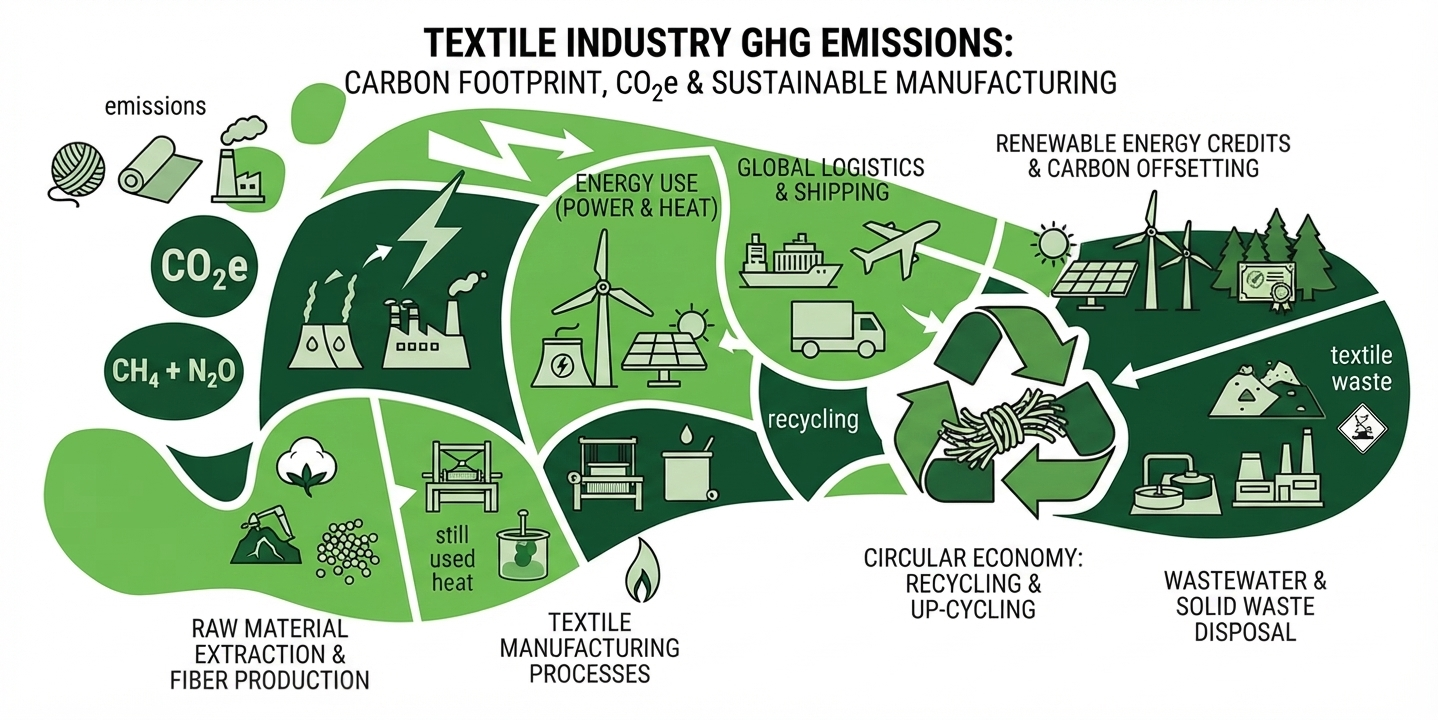
Raw materials are collected, turned into fibers, spun into yarn, made into fabric, cut and sewn into a garment, sold to a customer and eventually discarded.
That is essentially a linear system:
Take → Make → Use → Throw Away
The problem is what happens at the end. Once a garment is thrown away, most of the resources, energy and labor that went into producing it are effectively lost.
Circular fashion tries to change that.
Instead of treating a garment as something with a fixed beginning and end, the circular approach looks at the garment as part of a continuing material cycle.
A shirt might be worn for several years, repaired when necessary, sold secondhand and worn by someone else. Once it can no longer be used as clothing, the material could potentially be recycled into new fibers.
The goal is not simply to recycle everything. In fact, recycling should generally come later in the process. Keeping a good garment in use is usually more valuable than immediately breaking it down for its fibers.
That is why circular fashion covers several stages:
Design → Production → Use → Repair → Resale/Reuse → Recycling → New Production
The closer the industry can get to this kind of loop, the less material is lost from the system.
Circular Fashion vs. Traditional Fashion
The difference between the two models becomes clearer when we put them side by side.
| Traditional Fashion | Circular Fashion |
|---|---|
| Take, make, dispose | Reduce, reuse, repair and recycle |
| Heavy dependence on virgin materials | Greater use of recycled and renewable materials |
| Generates large amounts of waste | Designed to reduce material waste |
| Shorter product lifecycles | Longer product lifecycles |
| End-of-life often considered later | End-of-life considered during design |
| Focus on volume and speed | Greater focus on durability and material value |
This change affects much more than consumers.
Designers need to think about how easily a garment can be repaired or dismantled. Manufacturers need to consider waste and material selection. Brands need to create collection and take-back systems. Recycling companies need reliable supplies of suitable textile waste.
In other words, circular fashion requires cooperation across the entire textile value chain.
Why Does Circular Fashion Matter?
The scale of the clothing industry makes the waste problem difficult to ignore.
Fashion consumes huge quantities of raw materials, water and energy. Cotton production, for example, requires significant amounts of water, while synthetic fibers depend heavily on fossil-based raw materials.
There is also the problem of what happens after a garment is no longer wanted.
Some of the commonly cited figures give an idea of the scale:
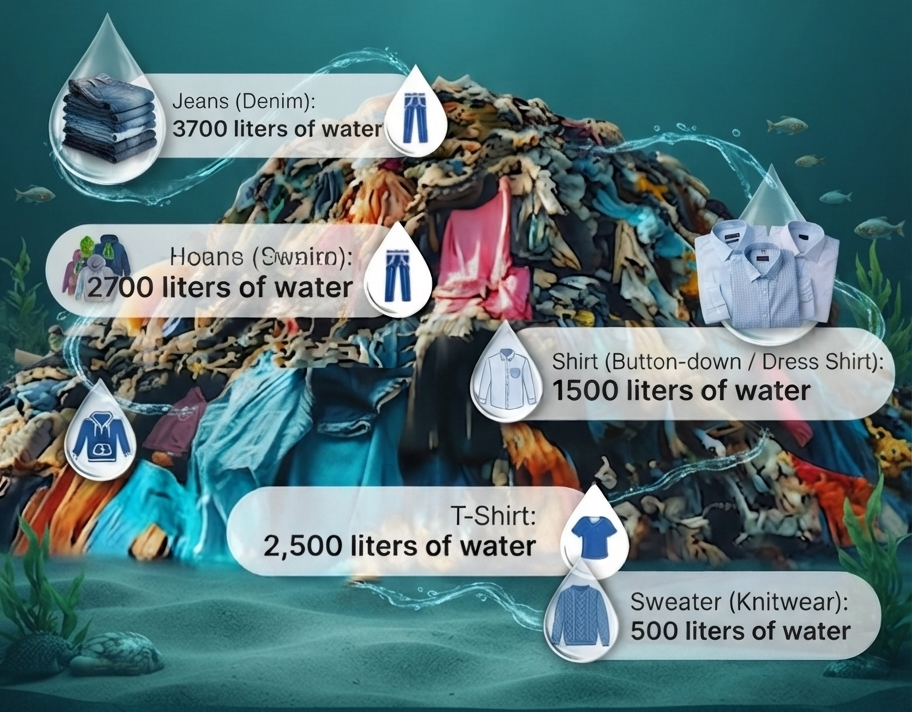
A cotton T-shirt is often estimated to require around 2,700 liters of water to produce.
Textile production contributes significantly to global greenhouse gas emissions.
A large proportion of discarded textiles still ends up in landfill or incineration instead of being recycled into new clothing.
The Ellen MacArthur Foundation has estimated that less than 1% of material used to produce clothing is recycled into new clothing.
Global clothing production has increased substantially over the past two decades, while garments are often being used for shorter periods.
The important point is not any single statistic.
It is the overall pattern.
We are extracting more resources, producing more garments and disposing of more clothing, while only a small portion of those materials successfully returns to clothing production.
That is exactly the gap circular fashion is trying to address.
The Three Pillars of Circular Fashion
Circular fashion is not just about putting old clothes into a recycling collection box. It involves several connected strategies.
1. Designing Clothes to Last
Circularity starts at the design stage.
A garment that falls apart quickly is difficult to make circular, even if a recycling facility exists.
Designers can improve durability by selecting stronger materials, using better construction techniques and creating garments that can be repaired rather than replaced.
Another important idea is design for disassembly.
A garment might contain fabric, buttons, zippers, labels, elastic and several different types of thread. If these components are difficult to separate, recycling becomes more complicated.
Designing garments with fewer incompatible materials can make the eventual recycling process much easier.
This is particularly important as textile-to-textile recycling becomes more advanced.
2. Keeping Clothes in Use
The best way to avoid textile waste is often to prevent the garment from becoming waste in the first place.
That can happen in several ways:
Repair: fixing damaged garments instead of replacing them.
Resale: selling unwanted clothing to another consumer.
Rental: allowing one garment to be used by many people.
Clothing swaps: exchanging garments within communities.
Upcycling: turning an old garment into a different or redesigned product.
A jacket that is repaired and worn for another five years has created considerably more value than one that is thrown away after a few months.
This is why repair, resale and reuse are important parts of circular fashion.
3. Recycling at the End of a Garment's Life
Eventually, even a well-maintained garment may become too damaged to wear.
That is where recycling comes in.
The objective is to recover the valuable material rather than sending the garment straight to landfill or incineration.
Depending on the fiber and construction, the material may be mechanically processed, chemically recycled or treated using heat and mechanical processes.
And this is where things become technically interesting.
How Does Textile Recycling Actually Work?
Textile recycling is not one single process.
The right method depends on the fiber, fabric construction, color, finishing, contamination and whether the garment contains a mixture of different materials.
A cotton T-shirt and a polyester jacket, for example, cannot necessarily be processed in the same way.
Mechanical Recycling
Mechanical recycling is one of the more established approaches.
The basic idea is straightforward: textile waste is physically broken down into fibers, which can then be processed into yarn again.
A typical process looks something like this:
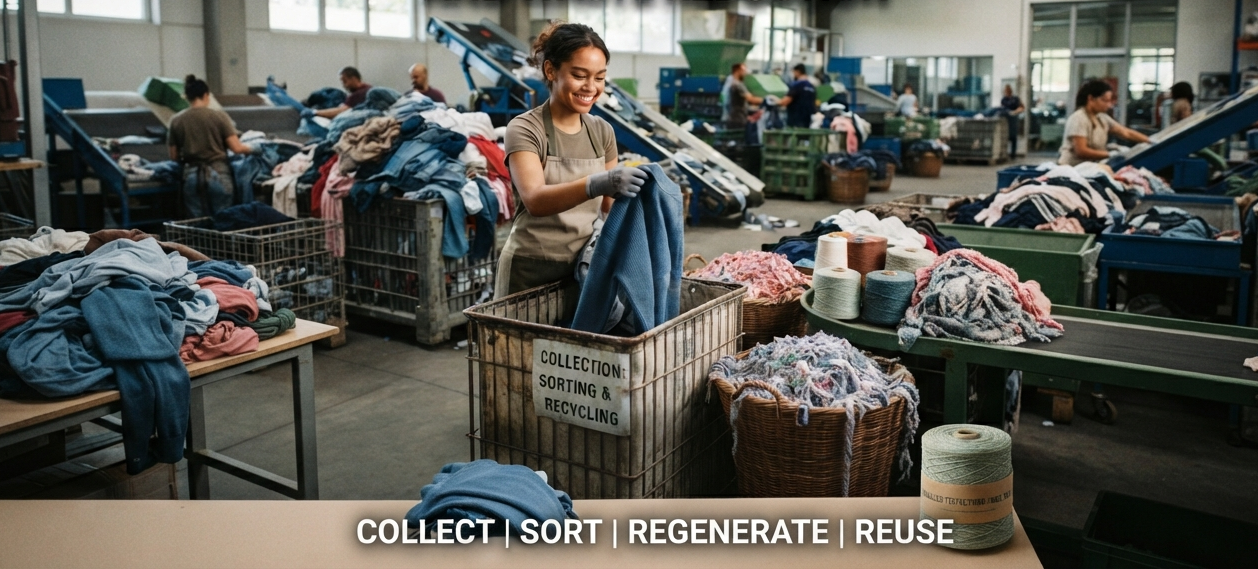
- Used garments are collected and sorted.
- Materials are separated according to fiber type, color and condition.
- The fabric is opened or shredded into fibers.
- The recovered fibers are cleaned.
- Fibers may be blended with other recycled or virgin fibers.
- The resulting material is spun into yarn.
- The yarn is used to produce new fabric.
Mechanical recycling works particularly well with materials such as cotton and wool.
However, there is a catch.
Every time textile fibers are mechanically processed, some fiber length can be lost. Shorter fibers are generally more difficult to spin into strong, high-quality yarn.
For this reason, recycled fibers are sometimes blended with virgin fibers.
That means mechanical recycling can extend the useful life of textile material, but it does not necessarily create an endless loop.
Chemical Recycling
Chemical recycling takes a different approach.
Instead of physically shredding the material, the process uses chemical reactions to break the textile down into its basic components.
Those components can then be purified and used to produce new fibers.
This is particularly interesting for materials such as polyester and for certain textile blends that are difficult to recycle mechanically.
One major advantage is that chemical processes can potentially produce material with properties much closer to the original fiber.
But the technology is more complex.
Chemical recycling facilities require specialized equipment, controlled processes and, depending on the technology, significant amounts of energy and chemicals.
As a result, cost and scalability remain major challenges.
Thermo-Mechanical Recycling
Thermo-mechanical recycling mainly applies to synthetic fibers such as polyester and nylon.
Heat is used to melt the material, after which it can be processed and formed into new fiber.
The concept is similar to the recycling of some plastic materials.
This approach can be useful for suitable synthetic waste, although the quality of the recovered material depends heavily on the feedstock and processing conditions.
Textile Recycling Methods Compared
| Recycling Method | Best Suited For | Fiber Quality | Cost | Availability |
|---|---|---|---|---|
| Mechanical recycling | Cotton, wool and other suitable natural fibers | Can decrease as fibers become shorter | Lower | Widely available |
| Chemical recycling | Polyester and selected blended textiles | Potentially high | Higher | Limited but growing |
| Thermo-mechanical recycling | Synthetic fibers such as polyester and nylon | Moderate to high | Moderate | Moderate |
There is no single recycling technology that can solve the entire textile waste problem.
Different fibers will require different solutions.
The Biggest Challenges in Textile Recycling
The concept of recycling old clothes sounds straightforward until you look at what is actually inside a garment.
A modern piece of clothing can contain several different fibers, dyes, finishes and accessories.
That creates some serious obstacles.
Fabric Blends
Blended fabrics are one of the biggest challenges.
Cotton-polyester fabrics are common because they combine the comfort of cotton with the strength and performance of polyester.
Cotton-spandex is another familiar example.
The problem is that the same combination that makes the fabric useful can make recycling difficult.
Separating the individual fibers is technically challenging, and in many cases the cost of doing so is still too high.
Sorting Is Difficult
Before recycling begins, somebody has to determine what the garment actually contains.
Sorting may involve identifying:
Fiber type
Color
Garment condition
Fabric composition
Contamination
Accessories and trims
Much of this work has traditionally depended on manual labor.
Newer technologies are beginning to change that. Optical systems, infrared scanning, automated sorting and AI-assisted identification could make the process faster and more accurate.
But these systems still need to become affordable and widely available.
Contamination
A garment is rarely just fabric.
It may contain buttons, zippers, coatings, prints, adhesives, dyes and finishing chemicals.
These components can interfere with recycling.
Removing them takes additional time, equipment and money.
Not Enough Recycling Infrastructure
Another major problem is capacity.
The world produces enormous amounts of textile waste, but textile recycling infrastructure is still relatively limited.
Building industrial-scale recycling plants requires significant capital investment.
Even when a plant exists, it needs a steady supply of suitable textile waste and customers willing to purchase the recycled output.
That creates a difficult economic equation.
Recycled Fiber Can Cost More
Virgin materials benefit from large, established global supply chains.
Recycled materials often have to go through collection, transportation, sorting, cleaning and additional processing before they become usable fiber.
That can make recycled fiber more expensive than virgin material.
For brands operating in a highly price-sensitive market, this difference can be difficult to ignore.
Consumer Behavior
Technology alone cannot create a circular fashion system.
Consumers also play a role.
If clothing is purchased cheaply and treated as disposable, even the best recycling infrastructure will struggle to keep up.
Changing habits around buying, washing, repairing, reselling and disposing of clothes is therefore part of the solution.
Who Is Driving the Circular Fashion Movement?
Circular fashion is no longer being discussed only by environmental organizations.
Fashion brands, recycling companies, technology startups, retailers and industry groups are all experimenting with different approaches.
Fashion Brands
Companies such as H&M, Zara, Patagonia and Levi's have introduced various forms of take-back, repair, resale or recycling initiatives.
One well-known example is Patagonia's Worn Wear, which focuses strongly on extending garment life through repair and resale.
At the industry level, the Ellen MacArthur Foundation has worked with major fashion companies through initiatives designed to encourage circular business models.
Its Fashion Initiative and newer Fashion ReModel work have brought brands together around ideas such as resale, rental, repair and remaking.
Material innovation is another area attracting attention.
For example, BASF and Inditex have worked together on loopamid, a nylon 6 material produced from textile waste.
These projects show that circularity is moving beyond collection programs and into material development itself.
Textile Recycling Technology Companies
Several companies are developing technologies aimed at solving some of the industry's toughest recycling problems.
Circ
Circ, based in the United States, has developed hydrothermal technology designed to separate cotton and polyester from blended textile waste.
The ability to recover both components from blended garments is particularly important because cotton-polyester blends are so common.
Circulose
Circulose focuses on converting discarded textiles into dissolving pulp that can be used to produce regenerated cellulosic fibers.
The objective is to replace some virgin raw materials with material recovered from textile waste.
Infinited Fiber Company
Finland-based Infinited Fiber Company has developed Infinna™, a regenerated fiber produced from textile waste containing suitable cotton-rich materials.
Renewcell
Renewcell became an early and well-known name in textile-to-textile recycling by converting cellulosic textile waste into dissolving pulp for new fiber production.
Evrnu
Evrnu developed NuCycl® technology, which focuses on breaking down cotton-rich textile waste and turning it into new fiber materials.
Worn Again Technologies
The UK-based Worn Again Technologies is developing technology aimed at recovering polyester and cotton from mixed textile waste.
Aquafil
Italy-based Aquafil is widely known for its ECONYL® regenerated nylon system, which uses recovered waste materials including discarded fishing nets and other nylon waste.
Reju
Reju is working on textile-to-textile regeneration and has developed Reju Polyester™ from recovered waste.
Other Emerging Companies
Other companies working in the wider textile recycling space include RE&UP, Recover™, ErdoTex and Fiberly.
Epoch Biodesign is taking a different approach, using engineered enzymes to break down synthetic materials. The technology could eventually provide another route for recycling difficult synthetic waste.
The important thing to remember is that many of these technologies are still scaling.
Moving from a successful laboratory or pilot process to a reliable industrial operation is a very different challenge.
Resale and Rental: Another Side of Circular Fashion
Recycling gets much of the attention, but keeping garments in use can have an even more immediate impact.
That is why secondhand and rental markets are becoming increasingly important.
Platforms such as ThredUP, The RealReal, Poshmark, Depop, Vestiaire Collective and Vinted have helped turn secondhand clothing into a mainstream retail category.
Instead of a garment being discarded when the first owner no longer wants it, the item can move to another customer.
Rental works in a similar way.
A garment designed for a special occasion may only be needed a few times by one person. Rental allows the same item to be used by multiple people.
Rent the Runway helped popularize this model in the United States, while other rental platforms have developed large user bases in markets such as China.
In denim, Mud Jeans' ReLoved provides another example of resale being incorporated into a brand's circular strategy.
The Role of Industry Organizations
Individual companies cannot solve textile waste alone.
Organizations such as the Ellen MacArthur Foundation have helped bring brands, innovators and policymakers together around circular economy principles.
Fashion for Good is another important organization in this area, working with companies and innovators to test and scale new technologies.
Industry events and textile recycling forums also provide opportunities for emerging technology companies to present new solutions and connect with manufacturers and brands.
Policy is becoming increasingly important as well.
Extended Producer Responsibility, commonly known as EPR, is one of the approaches being considered or implemented in different markets.
The basic idea is that producers should take greater responsibility for the products they place on the market, including what happens to those products after use.
What Are the Benefits of Circular Fashion?
The potential benefits go beyond reducing the amount of clothing sent to landfill.
Environmental Benefits
A successful circular system could:
Reduce dependence on virgin raw materials
Lower the amount of textile waste going to landfill or incineration
Reduce the environmental impact associated with producing new fibers
Extend the useful life of garments
Reduce the need for new resource extraction
Research from the Ellen MacArthur Foundation has highlighted the potential of resale and other circular business models.
Its analysis has estimated that reselling a garment instead of producing a new one can reduce associated carbon emissions substantially, with one widely cited estimate putting the reduction at around 47%.
The Foundation has also estimated that if rental, resale, repair and remaking represented 23% of the global fashion market by 2030, the sector could potentially reduce its overall carbon emissions by as much as 16%.
These figures should not be interpreted as a guarantee. Actual environmental savings depend on factors such as how products are transported, how long they remain in use and whether consumers replace purchases with additional consumption.
Still, the direction is clear: keeping existing products and materials in use can reduce the need to produce everything from scratch.
Economic Benefits
Circular fashion also creates new business opportunities.
Potential areas include:
Textile recycling
Garment repair
Resale
Rental
Take-back programs
Recycled fiber production
Sorting and collection
Material traceability
The Ellen MacArthur Foundation has estimated that circular business models could represent hundreds of billions of dollars in economic value by 2030.
The growth of major resale platforms is already evidence that secondhand fashion can operate at significant commercial scale.
Social Benefits
There is also a human side to the transition.
Circular systems can create jobs in areas such as:
Garment repair
Textile sorting
Collection
Recycling
Resale
Refurbishment
They can also make clothing more accessible by creating additional ways to purchase or use products without always buying them new.
Circular Fashion in Practice
It is useful to move away from theory and look at what circularity looks like in the real world.
| Example | What It Does | Why It Matters |
|---|---|---|
| Patagonia Worn Wear | Repairs, resells and recycles used products | Demonstrates how extending product life can become part of a brand's business model |
| H&M's Looper Textile | Sorts collected garments for different recovery routes | Shows the importance of large-scale sorting and collection |
| Mud Jeans ReLoved | Provides a resale route for used denim | Shows how brands can build secondhand markets around their own products |
| Elis workwear | Works with complex industrial garments and recycled materials | Demonstrates that circularity can extend beyond consumer fashion |
| Circ | Develops technology for separating cotton and polyester | Addresses one of the major technical challenges in textile recycling |
These examples are important because they show that circular fashion is already happening.
The industry has not solved the problem, but the first pieces of the new system are being built.
Important Circular Fashion Terms
If you're new to this subject, some of the terminology can sound confusing.
| Term | Simple Explanation |
|---|---|
| Circular economy | A system that aims to keep materials and products in use rather than treating them as waste |
| Fiber-to-fiber recycling | Turning used textile fibers into new textile fibers |
| Upcycling | Turning waste or unwanted material into a product of equal or greater value |
| Downcycling | Converting material into a lower-value product |
| Take-back program | A system where brands collect used products from customers |
| Extended Producer Responsibility (EPR) | A policy approach that gives producers greater responsibility for product end-of-life |
| Virgin fiber | Fiber made from newly extracted raw materials |
| Deadstock fabric | Unused fabric left over from production |
What Can Consumers Do?
Circular fashion can sometimes sound like a problem only brands and recycling companies need to solve.
It isn't.
Consumers have a role too.
Buy fewer, better garments
Buying something simply because it is cheap can be expensive in the long run if it has to be replaced repeatedly.
A garment that lasts for years is usually more valuable than one that looks good for a few washes and then loses its shape.
Repair before replacing
A loose button, small hole or broken zipper does not necessarily mean a garment has reached the end of its life.
Repair is one of the simplest circular practices.
Consider secondhand clothing
Buying secondhand gives an existing garment another customer instead of creating immediate demand for a new one.
Use take-back programs
Where reliable take-back systems exist, they can provide another route for unwanted clothing.
However, consumers should remember that putting clothing into a collection box does not automatically mean it will become a new garment. Some collected textiles may be reused, resold, downcycled or otherwise processed depending on their condition and material.
Take care when washing
Washing affects garment life.
Following care instructions, avoiding unnecessarily harsh washing and taking care of delicate fabrics can help clothing last longer.
For synthetic garments, washing can also contribute to microfiber release, so careful laundering matters for another reason as well.
Check the fiber composition
A simple look at the care label can tell you a lot.
A single-fiber garment may be easier to recycle than a complex blend containing several different materials.
Where Is Circular Fashion Heading?
The next phase of circular fashion will probably be shaped by three things: technology, regulation and economics.
Regulation Is Becoming More Important
Governments and regulatory bodies are putting greater pressure on companies to deal with textile waste.
Extended Producer Responsibility schemes, waste reduction targets, traceability requirements and recycled-content rules are all part of a wider movement toward greater accountability.
As regulations become more specific, companies will have stronger reasons to invest in collection, recycling and material traceability.
Recycling Technology Is Developing
Chemical recycling, fiber regeneration, automated sorting and biological recycling are all areas receiving investment.
AI could become particularly useful in sorting.
Imagine a recycling facility where cameras and sensors identify a garment's fiber composition, color and condition almost instantly and direct it to the most appropriate processing route.
That kind of system could reduce one of the biggest bottlenecks in textile recycling.
But technology still has to prove itself economically at industrial scale.
Transparency Is Increasing
Brands are under growing pressure to explain where their materials come from and what happens to their products.
Better traceability can make it easier to understand the environmental impact of a garment and, eventually, to determine how that garment should be handled at the end of its life.
Collaboration Will Be Essential
A clothing brand cannot build a circular system by itself.
It needs textile mills, recyclers, logistics providers, technology companies, retailers and consumers.
That is why partnerships are becoming increasingly common.
The future may depend less on individual companies trying to solve everything themselves and more on shared infrastructure across the industry.
Challenges That Still Need to Be Solved
Despite all the progress, circular fashion is nowhere near a finished system.
Several problems remain.
Textile recycling capacity is still small compared with the amount of waste generated.
Blended fabrics remain difficult to process.
Recycled fibers can be more expensive than virgin materials.
Collection and sorting systems are inconsistent across markets.
Many consumers still have limited awareness of circular options.
Textile waste often moves across borders, making tracking and responsibility more complicated.
Some recycling technologies are still moving from pilot projects toward commercial-scale production.
These are not small problems.
Circular fashion is still developing, and it would be misleading to suggest that recycling technology alone is going to solve textile waste.
It won't.
The industry needs better design, longer product lifetimes, stronger reuse markets, improved collection systems and more effective recycling technologies working together.
What Does Circular Fashion Mean for Textile Manufacturers?
For textile manufacturers, circular fashion is not simply an environmental issue.
It could eventually change how products are designed, sourced, manufactured and sold.
Consider the potential impact across a textile mill:
| Area | Circular Opportunity |
|---|---|
| Spinning | Increase the use of suitable recycled fibers |
| Knitting & Weaving | Develop fabrics that are easier to recycle |
| Dyeing | Reduce water, energy and chemical consumption |
| Finishing | Avoid treatments that create unnecessary recycling problems |
| Quality Control | Reduce defects and production waste |
| Supply Chain | Improve material traceability |
Manufacturers that start preparing now may be better positioned as brands face increasing sustainability requirements.
For example, a mill that understands recycled fiber behavior, develops experience with recycled yarns and maintains reliable material traceability may have an advantage over a supplier that waits until customers begin demanding these capabilities.
Circularity could therefore become a commercial requirement, not just a sustainability initiative.
Circular Fashion Regulations and Industry Standards
Regulation is likely to become one of the strongest forces pushing the industry toward circularity.
Key areas include:
Extended Producer Responsibility
Textile waste reduction
Product traceability
Recycled-content requirements
Sustainable sourcing
Environmental reporting
Product durability
End-of-life management
For brands and manufacturers, this means sustainability requirements are gradually moving from voluntary commitments toward measurable business requirements.
The exact rules vary by market, but the broader direction is difficult to miss.
Companies are being asked to understand not only how clothing is produced, but also what happens after the consumer is finished with it.
Circular Fashion Myths and Misconceptions
Circular fashion is receiving a lot of attention, but some common assumptions need a little more explanation.
Myth 1: Recycling Alone Will Solve Textile Waste
It won't.
Recycling is important, but keeping garments in use for longer is also critical.
Repair, resale, rental, reuse and better purchasing decisions can all reduce the amount of material that needs to be recycled in the first place.
Myth 2: Recycled Fiber Is Always Poor Quality
Not necessarily.
The quality depends on the material, recycling method and processing technology.
Some modern recycling technologies are capable of producing fibers with properties suitable for demanding textile applications.
Myth 3: Circular Fashion Is Only for Premium Brands
Circularity is not limited to luxury fashion.
Mass-market retailers, sportswear companies, workwear manufacturers and textile mills are all exploring circular approaches.
The real challenge is making those systems affordable and scalable.
Myth 4: Consumers Cannot Make a Difference
They can.
How long people keep clothing, whether they repair it, whether they resell it and how they dispose of it all influence the performance of a circular system.
Millions of small decisions can eventually create a very large effect.
Final Thoughts
Circular fashion is sometimes presented as if one new recycling technology will suddenly solve the industry's waste problem.
The reality is much more complicated.
There is no single solution.
A genuinely circular fashion industry will need better garment design, longer product lifetimes, stronger repair and resale markets, smarter collection systems and recycling technologies capable of recovering valuable fibers from difficult materials.
For textile manufacturers, the change could be particularly significant.
The focus is gradually moving beyond simply producing more fabric at lower cost. Material efficiency, recycled content, traceability, product durability and end-of-life considerations are becoming increasingly important.
And for consumers, circular fashion does not necessarily mean giving up fashion altogether.
It can be as simple as buying something you expect to wear for years, repairing a favorite garment instead of replacing it, choosing secondhand when it makes sense, or making sure unwanted clothing enters a responsible collection system.
The fashion industry's waste problem took decades to develop, so it would be unrealistic to expect it to disappear quickly.
But the direction is changing.
The next generation of fashion will likely be judged not only by how a garment looks or how cheaply it can be produced, but also by how long it lasts, what it is made from, and what happens to those materials when its first life is over.
That is the real promise of circular fashion: not simply making less waste, but designing a textile system where materials remain valuable long after the first garment has been worn.