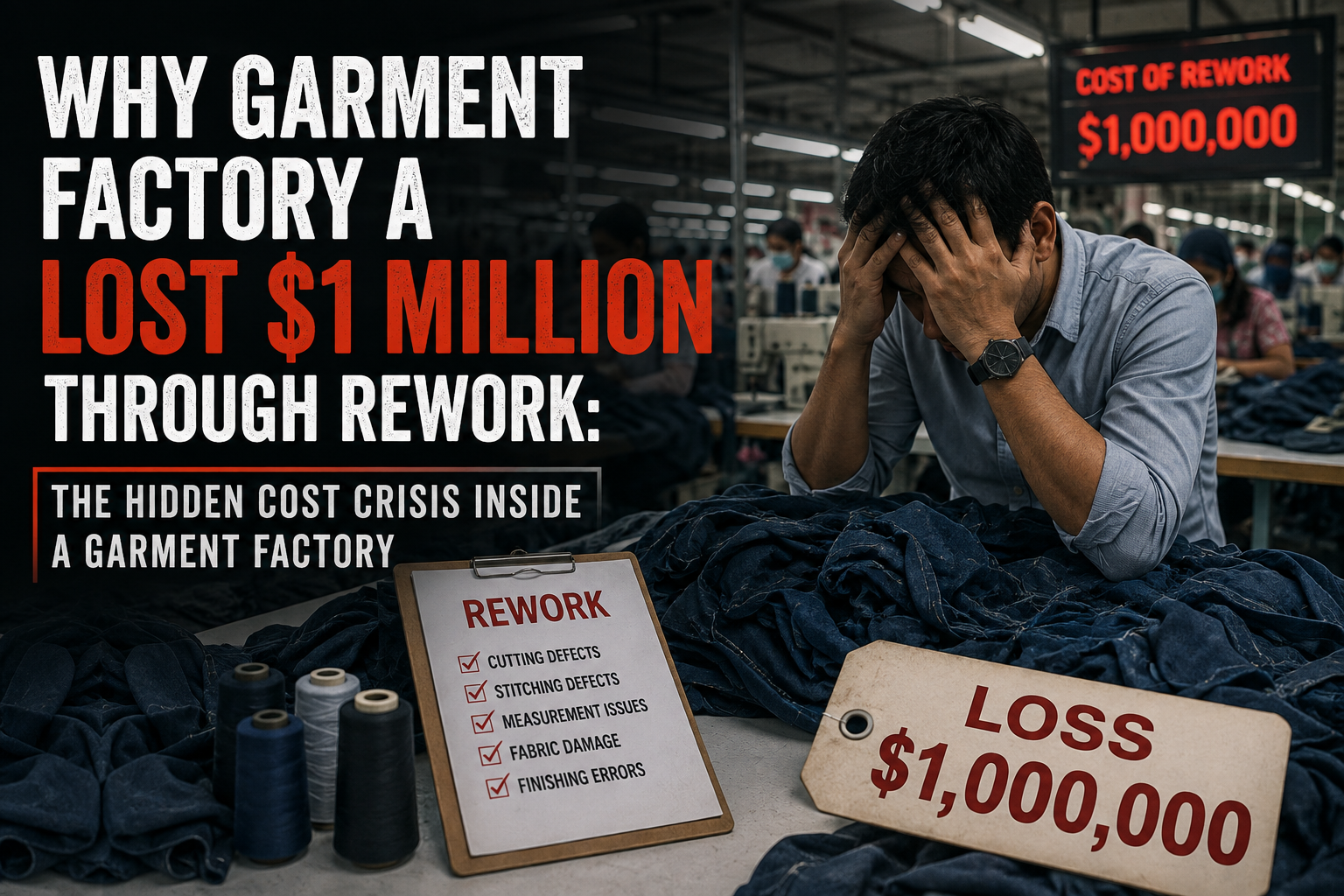
Garment Factory A was one of the better-known manufacturers in its region. With more than 2,500 employees, 30 sewing lines and customers that included well-known international apparel brands, the factory appeared to be doing well.
From the outside, the numbers looked positive. Thousands of garments were shipped every month to customers in Europe, North America and Asia. Production meetings regularly reported good results. Shipment targets were being achieved, sewing output was increasing and line efficiency was showing an upward trend.
So there was no obvious sign of a major financial problem.
But the quality reports were telling a different story.
Alterations were gradually increasing. End-line inspectors were finding more defects. Sewing operators were spending part of their working time repairing garments that had already been produced. Finishing teams were staying late to correct problems before packing.
At first, this did not seem particularly unusual. Rework is part of garment manufacturing, and a certain amount of alteration is expected in almost every factory.
The problem was the scale.
At the end of the year, the finance team carried out a detailed Cost of Poor Quality (COPQ) analysis. The result was a shock to management.
Factory A had lost approximately $1 million in one year through rework-related activities.
There was no single incident responsible for the loss. Instead, thousands of relatively small problems were occurring every day across cutting, sewing, washing, finishing and packing.
The factory had effectively developed a second operation inside the first one.
The visible factory was making garments.
The hidden factory was repairing them.
And that hidden factory was consuming a significant amount of the profit.
Note: Factory A is a composite case based on patterns commonly found in garment manufacturing. The figures are illustrative, but are intended to represent realistic examples of rework, DHU and cost-of-poor-quality issues in apparel production.
What Does Rework Mean in Garment Manufacturing?
Rework occurs when a garment does not meet the required specification and has to be corrected before it can be shipped.
This is different from scrap. A scrapped garment is considered unusable and is removed from production. A reworked garment can still be shipped, but only after additional work has been carried out.
That additional work is where the hidden cost begins.
Typical rework activities include:
Open seam repair
Broken or skipped stitch correction
Uneven topstitch correction
Measurement adjustment
Collar or pocket replacement
Label reattachment
Shade sorting
Printing correction
Embroidery correction
Button replacement
Additional thread trimming
The factory has already spent labor, machine time and overhead producing the garment once.
When that same garment returns for correction, the factory spends those resources again.
The buyer does not normally pay extra for this second operation.
The factory absorbs the cost.
The Hidden Factory Inside the Factory
This is one of the easiest aspects of rework to underestimate.
A reworked garment eventually passes inspection and may ship on time. From the outside, everything therefore appears normal.
But consider a sewing line producing 8,000 garments per day.
If 10% require some form of correction, that means:
8,000 × 10% = 800 garments
Eight hundred garments are being pulled back into the system every day.
Those garments need additional handling.
Operators stop producing new pieces and start repairing old ones. Supervisors spend time following up on defects. Quality inspectors check the garments again. Finishing teams may have to work additional hours to recover the lost time.
The factory can still look extremely busy.
Everyone may be working throughout the shift.
Yet part of that effort is not creating new production. It is recovering production that was not done correctly the first time.
That is the hidden factory.
Where Did the $1 Million Go?
When Factory A's finance team broke down the Cost of Poor Quality, they found that the loss was spread across several departments and activities.
| Cost Category | Annual Loss (USD) |
|---|---|
| Sewing alteration labor | $260,000 |
| Fabric waste | $165,000 |
| Overtime cost | $110,000 |
| Buyer claims and discounts | $95,000 |
| Production efficiency loss | $90,000 |
| Quality inspection cost | $85,000 |
| Shipment delay cost | $75,000 |
| Management and administrative cost | $45,000 |
| Repacking and rechecking cost | $40,000 |
| Packing material waste | $35,000 |
| Total | $1,000,000 |
The largest individual category was sewing alteration labor, at $260,000.
That was not surprising. Garment alteration is labor-intensive, and even a relatively small amount of additional work becomes expensive when repeated across thousands of pieces.
What concerned management most, however, was the distribution of the cost.
Rework was not simply a quality department issue.
It was affecting production, materials, overtime, inspection, shipment performance and customer relationships.
In other words, it was a profitability issue.
The Eight Main Root Causes
Factory A brought in a quality consultant to investigate why the rework rate continued to increase.
The investigation did not identify one careless department or a small group of operators as the problem.
Instead, eight recurring causes were identified.
1. Sewing Defects
Sewing accounted for almost 40% of the total rework.
The common problems included:
Open seams
Skipped stitches
Broken stitches
Exposed raw edges
Uneven topstitching
Incorrect stitches per inch
Puckering
Needle damage
Misaligned panels
The actual defect was often small.
The correction process was not.
For example, a garment with an open seam might need to be separated from the bundle, inspected, unpicked, realigned, re-sewn, checked again and finally returned to the normal production flow.
An operation that originally required perhaps 15 minutes could require another 10–20 minutes of labor simply because the garment had to be repaired.
When that happens repeatedly over thousands of garments, the cost becomes substantial.
2. Cutting Quality Problems
Problems at cutting can create much larger problems later.
Factory A identified issues such as:
Incorrect marker use
Fabric shrinkage variation
Panel mismatch
Missing notches
Fabric defects
Incorrect size panels
Mixed components
The important point is that a cutting mistake does not necessarily stop at cutting.
If an incorrect panel reaches sewing, operators may spend several operations building a garment around the wrong component before the problem is discovered.
The estimated annual cost was:
| Cutting Defect | Annual Cost |
|---|---|
| Size mismatch | $45,000 |
| Panel replacement | $35,000 |
| Fabric re-cutting | $50,000 |
| Additional inspection | $20,000 |
| Total | $150,000 |
This is why early detection is so important.
The earlier a defect is found, the cheaper it normally is to correct.
3. Measurement Failures
Garment buyers work with defined measurement tolerances.
Even a relatively small deviation can result in a garment failing inspection.
Examples of typical tolerances used in the case were:
| Measurement | Typical Tolerance |
|---|---|
| Chest | ±0.5 cm |
| Waist | ±0.5 cm |
| Sleeve length | ±0.5 cm |
| Body length | ±1.0 cm |
Factory A experienced problems such as narrow chest measurements, excessive body length, uneven sleeve lengths and inconsistent collar dimensions.
Some garments could be corrected with relatively simple alterations.
Others required partial or complete panel replacement.
The lesson was clear: a small measurement error at one operation can eventually become a relatively expensive correction at the end of the production process.
4. Inadequate Operator Training
Factory A also had a high turnover of sewing operators.
That meant new workers were continuously entering the production system.
Some had not yet developed the practical skills needed for their assigned operations.
Typical problems included:
Incorrect stitch selection
Wrong thread
Incorrect machine settings
Poor fabric handling
Failure to follow operation bulletins
Incorrect sewing methods
Production pressure sometimes made the situation worse.
New operators were occasionally placed directly into production before they had fully developed the required skills.
The result was predictable: more defects, more rework and more pressure on supervisors.
Training was therefore not simply a human-resources issue.
It was directly connected to production cost.
5. Fabric Defects
Fabric is one of the most expensive components of a garment, often representing a large share of the total garment cost.
Factory A encountered:
Holes
Slubs
Contamination
Shade variation
Oil stains
Dyeing defects
Uneven appearance
The timing of detection was particularly important.
If a fabric defect was discovered during fabric inspection, the affected material could potentially be isolated before cutting.
If it was discovered after the garment had already been sewn, the situation was very different.
The factory might then need to replace panels, re-cut fabric, re-sew the garment and inspect it again.
A defect that could have been controlled at the fabric stage had now become a multi-step garment problem.
6. Shade Variation
Shade variation became one of the more expensive problems identified in the investigation.
Different dye lots, poor bundle segregation and weak shade-management practices resulted in garments containing visibly different shades between components.
Examples included:
Dark sleeve with a lighter body
Mismatched pocket panels
Different shades between front and back panels
For international buyers, visible shade variation can be a serious quality issue.
Factory A estimated the following annual cost:
| Shade Correction Activity | Cost |
|---|---|
| Sorting | $25,000 |
| Replacement panels | $40,000 |
| Re-sewing | $35,000 |
| Inspection | $15,000 |
| Total | $115,000 |
Again, the original problem could be relatively small.
The cost became large because the defect was discovered late.
7. Printing and Embroidery Problems
Printing and embroidery created another group of defects.
Factory A was dealing with issues such as:
Off-center prints
Color mismatch
Registration errors
Incorrect logo placement
Embroidery tension problems
These defects are particularly sensitive because they are often visible on the finished garment.
A logo that is only a few millimeters away from its required position may still be unacceptable to a buyer.
Correcting such a garment can involve removing the existing decoration, replacing or repairing the affected area and then carrying out another inspection.
8. Weak Inline Quality Control
Behind many of the problems was one larger issue:
Factory A was relying too heavily on end-line inspection.
The factory was good at finding defects.
It was not equally good at preventing them.
Imagine a defect occurring at operation 10.
If nobody detects it until operation 35, the garment has already passed through another 25 operations.
Those operations have consumed labor and resources.
Once the defect is finally identified, all that previous work is potentially at risk.
This is one of the fundamental weaknesses of end-line-only quality control.
The defect is detected, but much of the cost has already been created.
When Production Pressure Makes Quality Worse
There was another issue that did not appear directly in the COPQ table.
It was the factory's production culture.
Daily discussions focused heavily on:
Line efficiency
Hourly targets
Production volume
Shipment loading
Output
Quality was important, but production pressure sometimes pushed it into second place.
Operators wanted to maintain their targets.
Supervisors wanted to avoid production shortfalls.
As a result, small quality problems were sometimes allowed to move to the next operation instead of being stopped immediately.
That created a dangerous cycle:
More output pressure → more defects → more rework → less available capacity → more production pressure.
Factory A was achieving its production numbers, but some of that output was being achieved at the expense of additional correction work later.
The Cost Went Beyond Rework
The $1 million figure represented identifiable financial losses.
But the impact went further.
Rework disrupted the entire production system.
| Area | Impact |
|---|---|
| Sewing efficiency | Reduced |
| Line balancing | Disrupted |
| SMV performance | Reduced |
| Capacity utilization | Lower |
| Worker motivation | Decreased |
| Shipment performance | Weaker |
For example, an operator repairing garments is not producing new garments during that time.
A quality inspector checking the same garment for a second time is spending capacity that could have been used for first-time inspection.
A supervisor following up on repeated defects is spending time away from production management.
The effect spreads across the factory.
Customer Relationships Were Also Affected
The financial impact did not stop at the factory gate.
As quality problems increased, Factory A experienced:
More buyer inspections
Additional quality audits
Formal warnings
Price negotiations
Claims and discounts
Shipment pressure
Corrective action requirements
In some cases, buyers reduced order volumes.
That type of loss is harder to measure than alteration labor because it may not appear immediately in the factory's monthly accounts.
But losing future business can be considerably more damaging than paying for a few additional hours of rework.
How Factory A Responded
Once management understood the scale of the problem, the response changed.
Instead of asking the quality department to "reduce defects," Factory A launched a factory-wide improvement program.
The program involved cutting, sewing, quality, engineering, finishing and management.
Cutting
The factory introduced:
100% fabric inspection
Better marker control
Improved shade segregation
Stronger cutting controls
The objective was to prevent incorrect components from entering sewing.
Sewing
The sewing department introduced:
Operator certification
Skill matrices
Stronger inline inspection
Improved operation methods
Greater adherence to standard operation bulletins
The focus shifted from correcting defects later to preventing them at the operation where they occurred.
Quality
The quality team introduced:
Root cause analysis
Pareto analysis
Daily quality meetings
Defect tracking
Corrective action follow-up
Instead of discussing every defect equally, the team focused on the problems creating the largest losses.
Industrial Engineering
The IE team reviewed:
Workstation methods
Operator movement
Machine settings
Standard methods
Production flow
The goal was to make the correct method easier for operators to follow.
Management
Management also changed how quality was treated.
Rework cost became a separately monitored KPI.
Quality performance became part of management review.
The factory also introduced a stronger First Time Right (FTR) approach.
The message was simple:
Getting the garment right the first time is more valuable than producing it quickly and repairing it later.
Results After One Year
After twelve months, Factory A reported significant improvements.
| KPI | Before | After |
|---|---|---|
| Rework Rate | 12% | 3% |
| DHU | 18 | 5 |
| Sewing Efficiency | 52% | 68% |
| Overtime Cost | High | Moderate |
| Buyer Complaints | Frequent | Rare |
| Profitability | Low | High |
The factory estimated that it recovered more than $750,000 per year through the reduction in rework-related losses.
More importantly, it achieved the improvement without simply adding more people or reducing production targets.
The factory changed the process.
How to Recognize a Hidden Rework Problem
A factory may have a rework problem even when its shipment performance looks acceptable.
Some warning signs are easy to recognize.
Watch for these:
Nobody can clearly state the current rework rate
DHU is not regularly tracked by operation
Most defects are found at end line
Fabric reaches cutting without adequate inspection
New operators enter production before completing proper training
Buyer complaints are treated individually rather than analyzed for patterns
Production targets are discussed every day but quality trends receive little attention
Alteration sections are consistently busy
These signs do not necessarily mean a factory is poorly managed.
They may simply indicate that the factory has not yet measured the hidden cost properly.
What Should a Factory Do First?
The first step does not have to be expensive.
A factory can begin with basic measurement.
1. Track DHU
Track defects by:
Line
Operation
Operator
Defect type
Product style
2. Measure Rework
Do not simply record the number of defective garments.
Record the time spent repairing them.
That converts quality information into financial information.
3. Strengthen Inline Inspection
The earlier a defect is found, the lower the potential cost of correction.
4. Build an Operator Skill Matrix
Know which operators are qualified for which operations.
5. Review Recurring Defects Daily
A short daily meeting can identify patterns before they become large losses.
6. Put Rework Cost on the Management Dashboard
If management cannot see the cost, it is difficult to give the problem the attention it deserves.
Key Lessons for Garment Manufacturers
1. Rework is never free
Even when a garment can be repaired and shipped, the additional labor, machine time and inspection cost still belong to the factory.
2. Quality must be controlled at the source
Finding a defect at end line is useful, but preventing it at the original operation is much more valuable.
3. Cutting problems can become sewing problems
A wrong panel can create problems throughout the rest of the garment-making process.
4. Training directly affects quality
Poorly trained operators are more likely to create defects, particularly on complex sewing operations.
5. Shade management deserves attention
A garment can be perfectly sewn and still fail because its components do not match in shade.
6. Inline quality is generally cheaper than end-line correction
The later a defect is discovered, the more value has already been added to the defective garment.
7. Production and quality cannot be managed separately
A factory that increases output while allowing rework to rise may simply be moving the problem further downstream.
8. Rework is also a capacity problem
Every minute spent repairing an old garment is a minute that cannot be used to produce another new garment.
9. First Time Right is a productivity strategy
FTR is not only a quality KPI. It directly affects labor utilization, production capacity and manufacturing cost.
10. The cheapest garment is the one made correctly the first time
That is ultimately the central lesson from Factory A.
Why Factory A's Story Matters
It would be easy to look at this case and conclude that Factory A simply had poor quality management.
The reality is more interesting.
Factory A had experienced managers, established customers, skilled workers and a substantial production capacity. It was not a factory that had completely lost control of its operations.
The problem was that many small losses had become normal.
One alteration did not look expensive.
One hour of overtime did not look serious.
One buyer discount did not appear to threaten profitability.
One rejected garment certainly did not look like a $1 million problem.
But thousands of these events, repeated throughout the year, created something much larger.
That is why rework can be so dangerous.
It does not normally arrive as one large financial loss.
It arrives in small pieces.
By the time the finance department adds everything together, the real cost can be enormous.
Conclusion
Factory A did not lose $1 million because of one major production failure.
It lost the money through thousands of smaller problems that were repeated every day.
Sewing defects, cutting errors, measurement issues, fabric problems, shade variation, printing defects and weak inline controls all contributed to the final cost.
The most important realization was that the factory was effectively operating two factories.
One factory produced garments.
The other repaired them.
Once management began treating rework as a business and profitability issue, rather than simply a quality issue, the approach changed.
Defects were tracked more carefully. Problems were investigated closer to their source. Operators received better training. Inline quality became more important. Rework costs became visible.
And the financial result followed.
The lesson is simple:
Don't focus only on how many garments your factory produces. Look at how many garments it produces correctly the first time.
Because every garment that needs to be repaired is consuming capacity twice.
Make it right the first time. The cheapest rework is the rework that never happens.