If you've worked anywhere in the garment or textile supply chain, there's a good chance you've heard someone mention Higg FEM during a supplier meeting, factory assessment or sustainability discussion. At first, it sounds like just another industry acronym. But behind those three letters is a framework that has become an important part of how textile and apparel factories measure and communicate their environmental performance.
So, what exactly is Higg FEM, why was it introduced, and what does it actually mean for a manufacturing facility?
Let's break it down.
What Is Higg FEM?
Higg FEM (Higg Facility Environmental Module) is an environmental assessment framework developed by Cascale, formerly known as the Sustainable Apparel Coalition. It gives manufacturing facilities a common way to assess their environmental performance and identify areas where they can improve.
One important point is often misunderstood: Higg FEM is not a certification scheme.
A factory doesn't simply "pass" or "fail" Higg FEM. Instead, the assessment is designed to show where a facility currently stands, what systems it has in place, how well it is performing and whether it is making measurable improvements over time.
Facilities complete the assessment themselves, while independent verification can be used to increase confidence in the information provided.
For manufacturers, the value is not just the final score. The bigger purpose is understanding environmental performance and using that information to drive improvement.
Why Was Higg FEM Created?
Textile manufacturing uses large amounts of energy, water, chemicals and other resources. Wet-processing facilities, in particular, can have significant environmental impacts through dyeing, washing, finishing and wastewater treatment.
At the same time, global supply chains have become increasingly complex.
Before standardized assessment tools became common, suppliers could find themselves completing several environmental audits for different customers. One brand might ask for one set of information while another requested something slightly different. The factory could end up answering essentially the same questions again and again.
That created unnecessary work for both factories and brands.
Higg FEM was developed to provide a more consistent approach. Instead of every customer using a completely different assessment, facilities can use a standardized framework that is recognized across the industry.
The idea is relatively simple: measure performance consistently, identify weaknesses and work toward continuous improvement.
From Compliance to Continuous Improvement
Traditional environmental audits often focus heavily on compliance.
Does the factory have the required permit?
Is the wastewater treatment system operating legally?
Are chemicals stored according to regulations?
Those questions are still important. But environmental performance involves more than simply meeting the minimum legal requirement.
Higg FEM also encourages factories to look at their performance over time.
Are energy consumption and emissions being reduced?
Is water use being monitored?
Are waste levels falling?
Are chemical management practices improving?
Has the facility established measurable targets?
That makes the assessment more than a simple compliance exercise. It encourages manufacturers to build systems that support long-term environmental improvement.
The Seven Areas Covered by Higg FEM
Higg FEM evaluates environmental performance across seven main areas:
- Environmental Management System (EMS)
- Energy Use and Greenhouse Gas Emissions
- Water Management
- Wastewater Management
- Air Emissions
- Waste Management
- Chemical Management
Together, these areas provide a broad picture of how a manufacturing facility manages its environmental impact.
1. Environmental Management System
The Environmental Management System looks at the management structure behind environmental performance.
This includes environmental policies, legal compliance, employee training, internal reviews, corrective actions and management responsibility.
In simple terms, it asks whether environmental management is actually built into the way the factory operates, rather than being something handled only when an audit is approaching.
2. Energy Use and Greenhouse Gas Emissions
Factories assess where their energy comes from and how much they consume.
This can include electricity, natural gas, fuel and other energy sources used throughout the facility. The assessment also considers greenhouse gas emissions associated with energy consumption.
The broader objective is to establish a baseline, understand where energy is being used and identify opportunities to reduce consumption and emissions.
3. Water Management
Water is particularly important in textile manufacturing, especially in wet-processing operations.
Facilities are expected to understand how much water they use, where that water is being consumed and what measures are being taken to reduce unnecessary consumption.
Monitoring, water-risk assessment, conservation programs and reduction targets all become relevant here.
4. Wastewater Management
Dyeing, washing, printing and finishing operations can generate complex wastewater streams.
Higg FEM therefore looks at how wastewater is collected, treated, monitored and managed.
Depending on the facility, this can involve onsite treatment plants, offsite treatment, domestic wastewater systems, septic systems or other treatment arrangements.
The assessment also considers whether the facility is meeting applicable legal and environmental requirements.
5. Air Emissions
Air emissions can come from boilers, generators, production processes, refrigerants and other equipment.
This section looks at the facility's applicable emission sources and the systems used to monitor and control them.
Not every facility has the same air-emission profile, which is why applicability plays an important role in this section.
6. Waste Management
Waste management goes beyond simply disposing of factory waste.
Facilities are encouraged to identify and measure different waste streams, separate materials where possible, reduce waste at the source and increase opportunities for reuse or recycling.
The objective is to move away from a disposal-focused approach and toward waste prevention and resource recovery.
7. Chemical Management
Chemical management is particularly important in textile manufacturing because chemicals can be involved in dyeing, finishing, cleaning and other production activities.
The assessment looks at areas such as chemical inventories, Safety Data Sheets (SDS), storage, handling, worker training, spill prevention and chemical control procedures.
For facilities working with restricted-substance requirements, chemical management can also become closely connected with MRSL-related practices.
How Does Higg FEM Scoring Work?
This is probably the part that causes the most confusion.
Higg FEM uses three levels of performance:
Level 1: Basic awareness and management systems
Level 2: Measurement, targets and improvement
Level 3: More advanced or leading practices
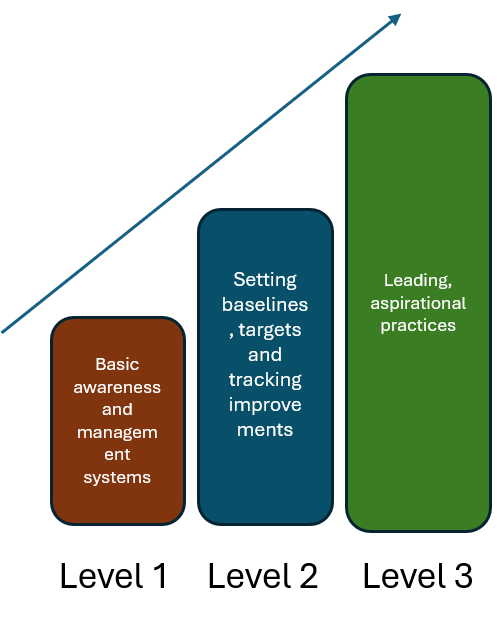
The three levels do not carry the same weight.
Level 1 accounts for 25% of a section's score.
Level 2 accounts for 50%.
Level 3 accounts for the remaining 25%.
That makes Level 2 particularly important because it focuses on actual performance improvement, including baselines, targets and tracking.
There is also a progression between the levels. A facility generally needs to meet the applicable Level 1 requirements before it can earn points from Levels 2 and 3.
Facilities can still answer higher-level questions for their own information, but those answers don't necessarily contribute to the score if the required lower-level conditions have not been met.
How Are Individual Questions Scored?
The basic scoring logic is fairly straightforward.
A Yes answer generally receives the full available points.
A Partial Yes generally receives half.
A No generally receives zero, although the exact treatment can depend on the question.
There is another important category: Not Applicable.
If a question genuinely does not apply to a facility, it can be excluded from the scoring. Its available points are then redistributed among the applicable questions at that level.
This means that two factories can have slightly different question sets depending on their operations.
That is intentional. A garment assembly facility, for example, does not have exactly the same environmental profile as a dyeing or finishing plant.
How the Overall Higg FEM Score Is Built
Each of the seven environmental sections can contribute up to 100 points.
When all seven sections apply, they carry equal weight in the overall assessment. That means each section contributes approximately 14.29% of the total score.
If one section is genuinely not applicable, its weighting is redistributed among the remaining sections.
For example, if Air Emissions is exempt, the remaining six sections would each represent approximately 16.67% of the total.
The basic scoring flow looks like this:
Facility determines applicability
↓
Relevant questions are identified
↓
Level 1 requirements are assessed
↓
Level 2 and Level 3 become score-eligible when applicable requirements are met
↓
Points are awarded based on responses
↓
Not Applicable questions are removed and points redistributed
↓
Level 1, 2 and 3 scores are combined
↓
Section score is calculated
↓
Applicable section scores are combined into the overall FEM score
There are also specific conditions relating to required licenses and environmental permits that can have a major effect on the assessment.
Applicability Matters More Than Many People Realize
One of the useful features of Higg FEM is that a facility doesn't necessarily answer every question in every section.
The assessment uses applicability questions to determine which requirements are relevant.
For example, the Water section takes into account factors such as water use, production activities and water-related risk.
A facility with very low water use and no water-intensive production processes may follow a different assessment pathway from a large wet-processing plant.
Wastewater questions similarly depend on the type of treatment system used.
Chemical Management also changes depending on how and where chemicals are used within the facility.
This approach prevents facilities from being evaluated against environmental activities that simply don't apply to their operations.
A Closer Look at the Different Sections
The applicability process can produce some interesting differences between facilities.
EMS
Most EMS questions are relevant to facilities. However, certain questions can become unscored when specific conditions don't apply, such as situations where the facility has no subcontractors.
Energy and GHG
Applicability can depend on the facility's activities and production characteristics. Some introductory questions are collected for information rather than scoring.
Water
Facilities can be categorized according to water consumption, water risk and whether water is used in production.
A facility with very low water use, low water risk and no production water use may have a much simpler assessment pathway.
Wastewater
The assessment considers the type of wastewater treatment used.
Facilities may have onsite treatment, offsite treatment, domestic systems, septic systems or other arrangements.
A facility relying only on a septic system, for example, follows a different scoring pathway from a large wet-processing factory with an industrial wastewater treatment plant.
Air Emissions
If a facility genuinely has no applicable air emissions, the section may be exempt. Its weighting is then redistributed across the applicable sections.
Waste
Waste Management generally applies broadly across facilities, with questions covering areas such as identification, measurement, segregation, reuse, recycling and disposal.
Chemical Management
The pathway depends on how chemicals are used at the facility, including production, maintenance, operations and other activities.
The applicability process can also affect questions relating to contractors and subcontractors.
What Happens When a Facility Meets Its Targets?
Higg FEM isn't only interested in whether a factory has written procedures.
Actual environmental performance matters too.
The assessment includes calculations related to areas such as energy, water and waste reduction. Facilities that establish targets and demonstrate measurable progress can receive additional recognition through the assessment methodology.
That distinction is important.
There is a big difference between saying:
"We have a water-reduction target."
and being able to show:
"We reduced water consumption by X% compared with our baseline."
The second demonstrates actual performance.
The Serious Issue of Licenses and Permits
There is one part of the assessment that facilities should take especially seriously.
Certain failures involving required legal documentation can result in an overall score of zero.
This includes situations such as not having a valid business operating license or lacking a required environmental permit without a valid justification.
The issue isn't simply that a factory loses a few points in one section. Under the methodology, specific licensing and permitting failures can affect the entire assessment.
That's why environmental compliance documentation needs to be maintained throughout the year rather than prepared only when an assessment is coming.
What Is the Partially Verified Score?
The terminology around verification has also changed.
For FEM 2024/2025, what was previously referred to as the Verified Assessment Score is now called the Partially Verified Score.
The concept is relatively easy to understand.
Part of the assessment is independently checked, while other applicable responses remain based on facility-reported information.
The result combines:
Verified results from the applicable Level 1 verification questions
Unverified results from the remaining applicable assessment questions
This provides greater confidence in foundational information without requiring every answer in the assessment to undergo independent verification.
A Simple Example: Calculating a Water Score
Let's use a hypothetical facility to see how the scoring works.
Suppose the facility has:
5 scored questions at Level 1
8 scored questions at Level 2
6 scored questions at Level 3
The facility is classified as a heavy water user, so all three levels apply.
Level 1
Level 1 represents 25 points.
With five questions, each question initially represents:
25 ÷ 5 = 5 points
Suppose the facility receives:
4 Yes answers
1 Partial Yes
The calculation becomes:
(4 × 5) + (1 × 2.5) = 22.5 points
So the Level 1 score is:
22.5 / 25
The facility has met the requirement to progress to Levels 2 and 3 for scoring purposes.
Level 2
Level 2 is worth 50 points.
There are eight questions, but one is Not Applicable.
That leaves seven scored questions.
Each applicable question is therefore worth approximately:
50 ÷ 7 = 7.14 points
Suppose the facility receives five Yes answers and two No answers.
Its Level 2 score is approximately:
5 × 7.14 = 35.7 points
So:
35.7 / 50
Level 3
Level 3 is worth 25 points.
There are six questions:
25 ÷ 6 = 4.17 points per question
Suppose three answers are Yes and three are No.
The score is approximately:
3 × 4.17 = 12.5 points
Final Water Score
The three levels are then combined:
22.5 + 35.7 + 12.5 = 70.7
So the facility's hypothetical Water score would be:
70.7 / 100
How Does That Affect the Overall FEM Score?
Now imagine the facility has the following scores:
| Section | Score |
|---|---|
| Energy/GHG | 65 |
| Water | 70.7 |
| Wastewater | 55 |
| Air Emissions | Exempt |
| Waste | 80 |
| Chemicals | 60 |
| EMS | 75 |
Because Air Emissions is exempt, the remaining six sections share the overall weighting.
Therefore:
(65 + 70.7 + 55 + 80 + 60 + 75) ÷ 6 = 67.6
The facility's hypothetical overall FEM score would therefore be:
67.6 / 100
The important point is that the overall score isn't simply based on the number of questions answered Yes. Applicability, level weighting and section weighting all influence the final result.
Why Higg FEM Matters to Textile Manufacturers
For manufacturers, Higg FEM can provide a structured way to understand where environmental performance stands today and where improvement efforts should be focused.
It can help facilities:
Identify areas of high resource consumption
Establish environmental baselines
Set measurable improvement targets
Track energy and water performance
Improve wastewater management
Strengthen chemical management
Reduce waste
Improve environmental documentation
Prepare for customer sustainability requirements
Demonstrate progress to business partners
It can also help management move environmental discussions away from general statements such as "we need to become more sustainable" and toward measurable questions such as:
How much water are we using per unit of production?
Where is most of our energy being consumed?
How much waste are we generating?
What percentage are we recycling?
Are our reduction targets actually being achieved?
Those are much more useful questions for a factory manager.
What Higg FEM Means for Different Types of Facilities
Not every textile facility faces the same environmental challenges.
A garment sewing factory may have relatively low water consumption but significant concerns around electricity, waste and chemical use in specific operations.
A dyeing factory, on the other hand, may have much greater exposure to water, wastewater, chemicals, energy and air-emission issues.
A printing or finishing facility can have its own combination of environmental risks.
This is why understanding the applicability pathways is important. A good FEM preparation strategy isn't about trying to maximize every possible point regardless of relevance. It's about understanding which requirements apply to the facility and making sure the supporting systems and evidence are in place.
Common Mistakes Facilities Should Avoid
Many factories don't necessarily struggle because they have no environmental initiatives. Sometimes the problem is that the systems aren't properly documented or the data isn't being tracked consistently.
Some common weak points include:
Environmental targets exist but aren't supported by reliable baseline data
Utility consumption is recorded but not analyzed
Chemical inventories aren't kept fully up to date
Training records are incomplete
Corrective actions are identified but not followed through
Waste streams aren't properly segregated or measured
Environmental permits aren't monitored for expiry
Different departments maintain different versions of the same data
Improvement claims cannot be supported with historical records
The lesson is simple: good environmental performance needs good data and good documentation.
A factory may be doing many things correctly, but if it cannot demonstrate those practices with reliable evidence, it can become difficult to receive full recognition for that work.
Higg FEM Is More Than an Audit
It's tempting to treat Higg FEM as another customer requirement that needs to be completed before the next shipment.
That mindset misses much of its value.
Used properly, the assessment can become a management tool.
A factory can use its FEM results to identify weak areas, prioritize investments and track whether improvement projects are actually working.
For example, if water consumption is consistently high, the factory can investigate where the water is being used, identify the biggest consumption points and establish a reduction project.
The same approach can be applied to energy, waste, chemicals and wastewater.
In that sense, the score is not the final objective.
The improvement behind the score is what really matters.
Key Takeaways
Higg FEM (Higg Facility Environmental Module) is an environmental assessment framework developed by Cascale, formerly known as the Sustainable Apparel Coalition.
It is not a certification program and is not simply a pass-or-fail audit.
The framework was created to provide manufacturers and brands with a more standardized way to evaluate environmental performance and reduce the duplication associated with multiple customer-specific assessments.
Higg FEM covers seven major areas:
Environmental Management System
Energy Use and Greenhouse Gas Emissions
Water Management
Wastewater Management
Air Emissions
Waste Management
Chemical Management
The assessment is organized into three levels:
Level 1 — 25%: Basic systems and awareness
Level 2 — 50%: Measurement, targets and improvement
Level 3 — 25%: Advanced practices
Facilities generally need to establish the required Level 1 foundation before they can earn points from higher levels.
Applicability questions determine which requirements apply to a particular facility, while Not Applicable questions can be removed from scoring and their points redistributed.
Environmental performance isn't judged only by paperwork. The framework also places emphasis on measurement, target setting and demonstrated improvement.
Facilities should also pay close attention to licenses and environmental permits because certain failures in these areas can result in an overall assessment score of zero.
The Partially Verified Score provides an additional level of credibility by combining independently verified Level 1 results with unverified responses from the remaining applicable questions.
For textile and apparel manufacturers, the real value of Higg FEM is not simply achieving a higher number. It is using the assessment to understand environmental performance, identify weaknesses and build a system of continuous improvement.
In an industry where water, energy, chemicals and waste can have a major impact on both cost and the environment, having reliable data and a structured improvement plan is becoming increasingly important.
Higg FEM gives manufacturers a framework for doing exactly that.