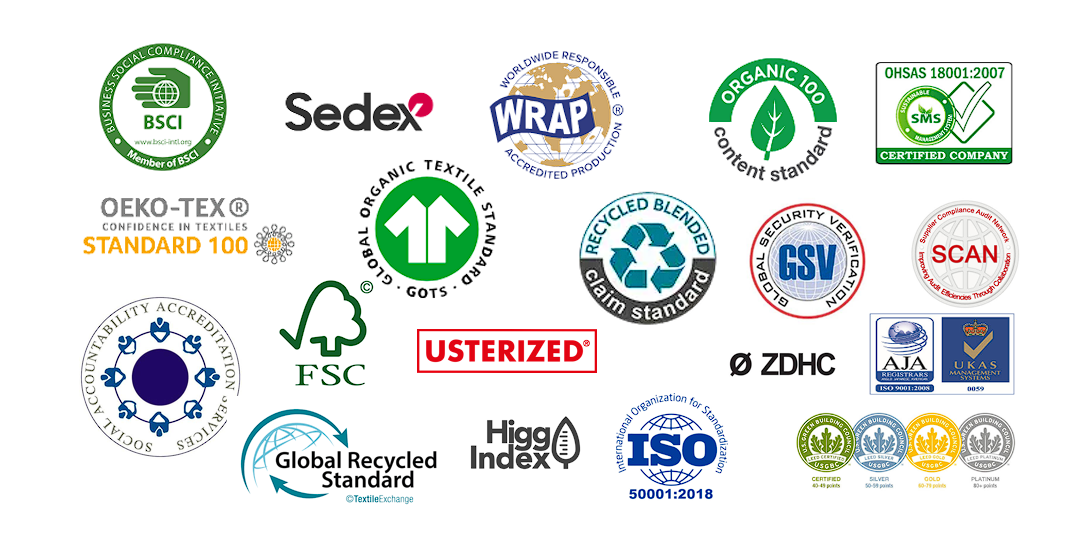
If you spend any time around fashion brands and garment factories, you'll hear the word "certification" a lot. Before anyone signs a purchase order these days, buyers want answers to a few basic questions: Is this factory safe? Were the workers treated fairly? Is the fabric really organic? Will the dye hurt anyone's skin? These questions matter a lot, especially since the brand and the factory are often on opposite sides of the world and may never actually meet in person.
If you're new to this world, all the short forms and acronyms can feel like a wall of noise. BSCI, SEDEX, GOTS, OEKO-TEX, ISO, ACCORD — the list goes on. What do they actually check? Who hands them out? And why does a shopper in Germany care whether a t-shirt was made in a factory with one certificate or another?
This guide breaks down every major certification you'll run into in the garment world. We'll explain what each one checks, who cares about it and why it exists in the first place — in plain language, no jargon required.
Why Certifications Became So Important
Let's start with a bit of background. Making clothes is one of the most spread-out industries on the planet. Cotton might be grown in India, spun into yarn in Pakistan, woven into fabric in China, dyed in Bangladesh and finally cut and sewn in Cambodia — before it even reaches a shop in another country entirely. At every one of those steps, someone should be asking: Was this cotton grown safely? Were the workers paid fairly? Is this fabric safe to wear against skin?
For a long time, brands just took factories at their word or sent someone over for a quick visit now and then. That wasn't enough. It left too much room for problems to hide. The Rana Plaza factory collapse in Bangladesh in 2013, which killed more than a thousand garment workers, made it painfully clear that trust alone wasn't good enough. Out of that tragedy — and years of pressure from shoppers, workers' rights groups and governments — a real system of independent checks grew up. That system is what we now call garment certifications.
Broadly speaking, these certifications fall into a few buckets:
- Worker treatment checks (BSCI, SEDEX, WRAP, SA8000) — do people get paid fairly, work safe hours and have a say in their workplace?
- Material and sourcing checks (GOTS, OCS, RCS, GRS, Better Cotton, Cotton USA, Cotton made in Africa, SUPIMA organic Cotton Accelerator, FSC) — is the cotton, recycled fiber or wood-based fabric actually what it claims to be?
- Chemical and quality safety checks (OEKO-TEX, ZDHC, USTERIZED) — is the fabric, yarn, thread or garment free of harmful chemicals and is the yarn actually good quality?
- Factory management checks (ISO 9001, ISO 14001, ISO 45001, ISO 50001) — does the factory run its quality, safety, environment and energy use in an organized way?
- Environmental and building programs (Higg Index FEM, LEED) — how green is the factory's day-to-day performance or the building itself?
- Building and worker safety checks (Safety Committee Certificate under the Accord/RSC program) — is the building itself safe from fire and structural collapse and do workers have a real say in safety?
- Certification bodies (Control Union and similar) — the actual companies that show up and do the checking.
Now let's go through
Worker treatment (BSCI, SEDEX, WRAP, SA8000) — fair pay, safe hours, a real voice for workers
BSCI: Business Social Compliance Initiative
BSCI — now officially called the amfori BSCI Code of Conduct — is one of the best-known worker-treatment programs in the clothing industry. It was built by amfori (previously called the Foreign Trade Association) so that retailers wouldn't each have to invent their own way of checking a factory. Instead, they can all rely on the same shared system.
BSCI is built around eleven basic rules, mostly borrowed from International Labour Organization guidelines and UN human rights principles. These rules cover fair pay, reasonable hours, safety at work, no child labor, no forced labor, no discrimination and the right for workers to organize and speak up.
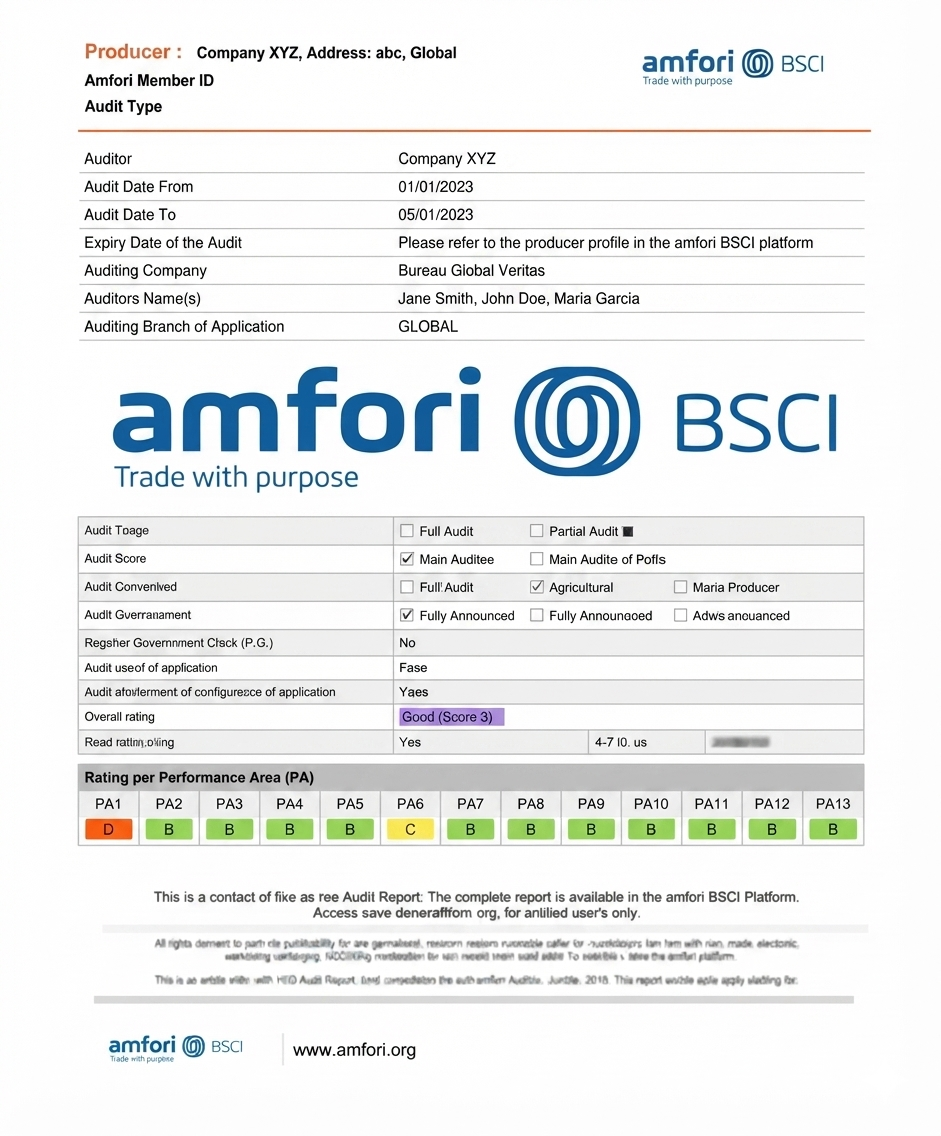
Here's how it works in practice: an independent auditor visits the factory, checks pay records and time sheets, talks to workers privately (so they can speak freely without a manager listening), walks the floor looking for safety issues and writes up a report. The factory then gets a rating. If there are problems, the factory gets a plan and a deadline to fix them.
Because so many big European retailers use amfori, one audit report can often be shared across several buyers at once. That saves factories from being audited over and over for basically the same thing. For manufacturers, having a solid BSCI rating has become close to a minimum requirement if they want to sell to mainstream European and global brands.
One thing worth knowing: BSCI isn't really a pass-or-fail certificate. It's more like an ongoing report card, with a rating that shows how well the factory is doing and how fast it fixes problems. Still, people in the industry usually just say "BSCI certified," and a good rating is treated the same way a pass mark would be.
Why BSCI is needed?
Most large European retailers won't even consider a supplier without a current BSCI audit on file. It's the baseline proof that a factory treats its workers fairly and without it, many buyers simply won't open a conversation.
How to get it — where from: BSCI isn't purchased directly by a factory the way a lab test is. A brand, importer or the factory itself first becomes an amfori member (registering at amfori.org, submitting a Declaration of Membership and turnover information and passing a due-diligence review). Once registered, the business partner (the factory) is set up on the amfori Sustainability Platform, adopts the Code of Conduct and a monitoring request is triggered. The actual on-site audit is then carried out — semi-announced or fully unannounced — by an amfori-approved monitoring firm such as Bureau Veritas, TÜV SÜD, TÜV Rheinland, Intertek, SGS or UL. The resulting rating is uploaded to the platform and visible to connected buyers.
BSCI at a glance:
- Run by amfori, previously the Foreign Trade Association
- Based on ILO rules and UN human rights guidelines
- Covers pay, hours, safety, discrimination and forced or child labor
- Given as a rating, not a strict pass/fail
- Common requirement for European retail buyers
- Get it via amfori membership, audited by firms like Bureau Veritas, TÜV, Intertek, SGS
SEDEX: Supplier Ethical Data Exchange
SEDEX shares the same basic goal as BSCI — better working conditions — but it works a bit differently. SEDEX isn't a code of conduct itself. It's a platform where suppliers, buyers and auditors can all share ethical sourcing data in one place.
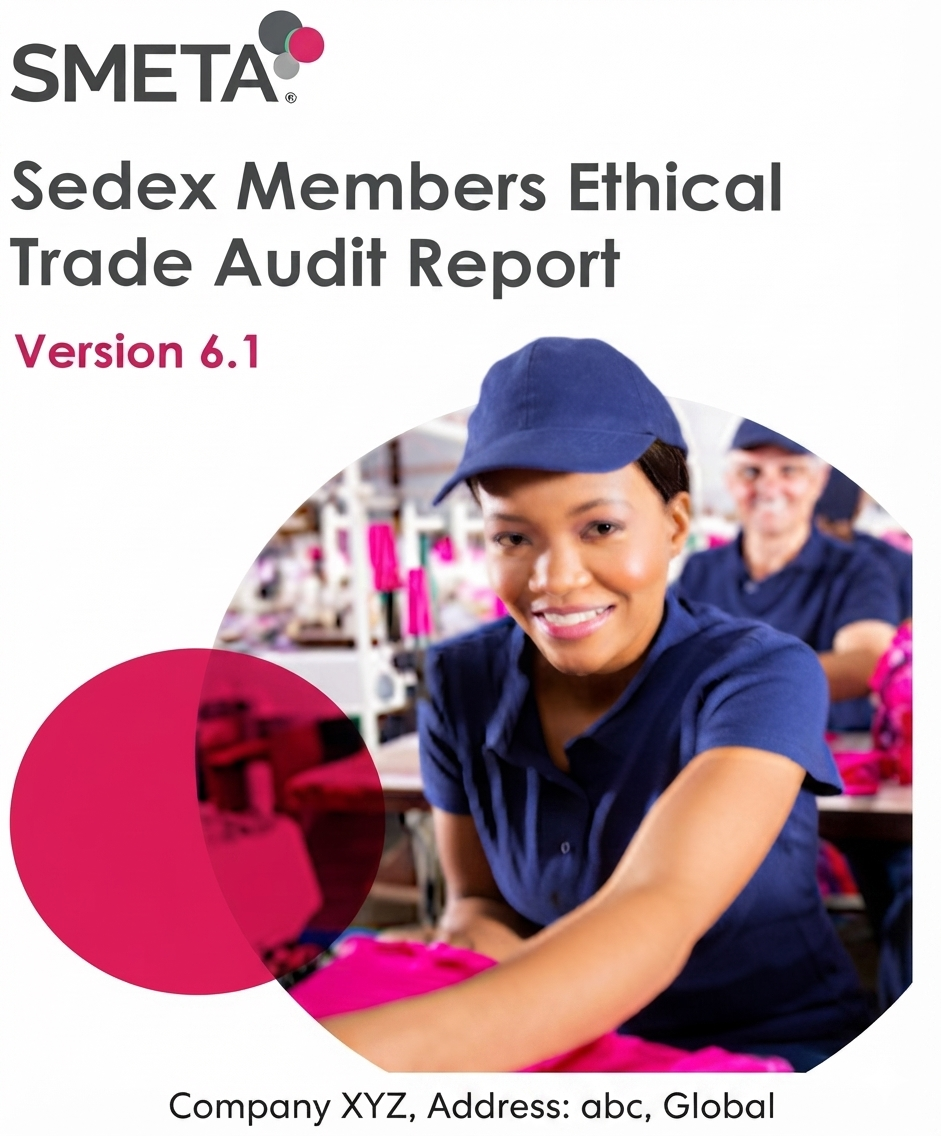
The heart of the SEDEX system is something called SMETA, short for Sedex Members Ethical Trade Audit. SMETA is the actual audit method — probably the most-used one in the world. A full SMETA audit checks four things: labor standards, health and safety, the environment and business ethics. There's also a lighter, 2-part version that only covers labor and safety, depending on what the buyer wants.
When a factory goes through a SMETA audit, the auditor checks pretty much the same things a BSCI audit would — pay, hours, treatment of workers, safety and environmental practices — then uploads the report to the SEDEX platform. From there, any buyer connected to that factory can view the report instead of ordering a brand-new audit of their own.
This shared system is really the whole point of SEDEX. It cuts down on what people call "audit fatigue" — when a single factory gets visited by ten different auditors in one year, each one asking almost the same questions, wasting everyone's time and money. By keeping the data in one place, SEDEX tries to make ethical sourcing easier for everyone without lowering the bar.
For a garment factory, being registered on SEDEX with a recent SMETA report is basically expected if you want to work with UK and European retailers, many of whom have used the platform since the early 2000s.
Why SEDEX is needed?
It saves everyone from repeating the same audit for every new buyer. One SMETA report, shared through SEDEX, can satisfy dozens of buyer relationships at once — so factories that skip it end up facing far more individual audit requests instead.
How to get it — where from: A factory registers directly on the Sedex platform (sedex.com) as a member — there are Supplier, Buyer, Buyer & Supplier or Affiliate Audit Company membership types, each with an annual fee. After registering, the factory books a SMETA audit through an accredited third-party audit firm affiliated with APSCA (the Association of Professional Social Compliance Auditors) — common choices include Bureau Veritas, Intertek, SGS, UL, TÜV Rheinland and Elevate. The completed SMETA report is uploaded to the factory's Sedex profile, where linked buyers can view it directly rather than commissioning their own audit.
SEDEX at a glance:
- A shared platform for ethical sourcing data
- Audits follow the SMETA method (2-part or 4-part)
- The four SMETA areas: labor, health and safety, environment, business ethics
- Reports get shared across connected buyers, cutting down repeat audits
- Standard requirement for UK and EU retailers
- Get it via Sedex membership, audited by APSCA-affiliated firms
BETTER WORK: Improving Working Conditions
Better Work is a joint programme of the International Labour Organization (ILO) and the International Finance Corporation (IFC). Like BSCI and SEDEX, its goal is to improve working conditions, but it focuses mainly on the garment and textile industry.
Better Work combines factory assessments, training and advisory support. It checks areas such as wages, working hours, child and forced labour, discrimination, worker rights, and health and safety. After an assessment, factories receive support to correct problems and improve continuously.
The main difference is that Better Work is not simply an audit or data-sharing platform. It focuses on assessment + improvement + ongoing advisory support.

Why Better Work is needed?
It helps factories identify labour and safety problems and provides practical support to fix them. This helps improve working conditions while also helping brands and factories manage social compliance more effectively.
How to get it — where from: Factories participate through the Better Work programme in their country. Better Work staff conduct assessments and provide advisory and improvement services.

Better Work at a glance:
- Joint programme of ILO and IFC
- Mainly focused on the garment industry
- Combines assessment, training and advisory services
- Covers labour standards, wages, working hours and safety
- Focuses on continuous improvement
- Works with factories, brands, governments and workers
WRAP: Worldwide Responsible Accredited Production
WRAP is a factory-level worker-treatment certification that started in the US clothing and footwear industry and it's still especially popular with factories exporting to America. Unlike BSCI or SEDEX, which lean European, WRAP was built by and for the US apparel world and it's run by an independent non-profit based in Virginia.
WRAP is built around twelve rules covering things like following local laws, no forced or child labor, no harassment, fair pay, reasonable hours, no discrimination, safety, the right to organize, environmental care, customs compliance and drug and security screening. That last part — customs and security — is a bit different from other social audits. It reflects US supply-chain security rules like the C-TPAT program.
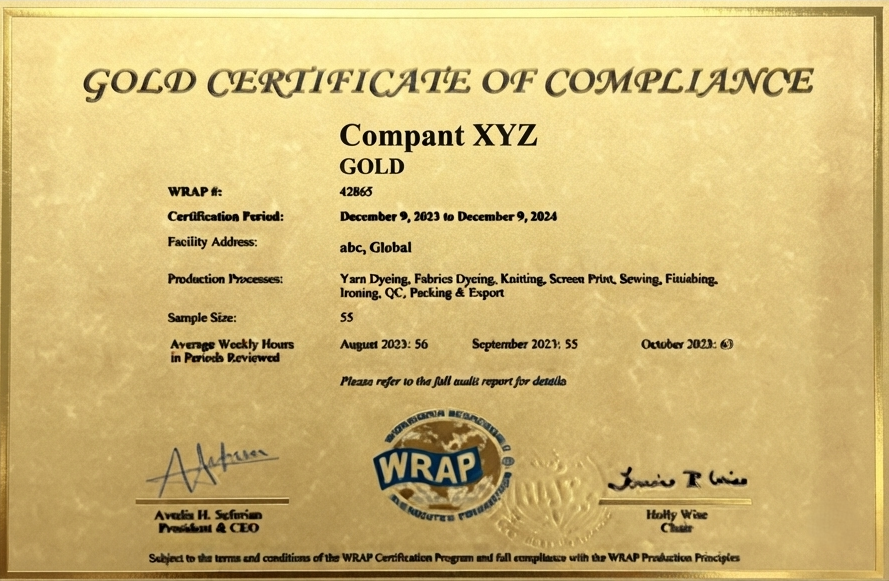
A WRAP audit gives the factory one of three certificate levels: Platinum, Gold or Silver, depending on performance. Platinum, the top level, means the factory only needs to be re-checked every two years. Gold and Silver mean more frequent check-ins.
Why WRAP is needed?
For factories exporting to the US, WRAP is often the certificate American importers ask for by name. It also touches on customs and security requirements that BSCI and SEDEX don't cover, which matters for clearing US border checks smoothly.
How to get it — where from: A factory applies directly through WRAP (Worldwide Responsible Accredited Production, headquartered in Arlington, Virginia — wrapcompliance.org). The process starts with a self-assessment questionnaire submitted to WRAP, followed by an on-site audit carried out by an independent, WRAP-authorized monitoring firm from WRAP's approved list. WRAP itself reviews the audit findings and issues the Platinum, Gold or Silver certificate.
WRAP at a glance:
- A factory-level certificate built on 12 rules, rooted in the US industry
- Includes customs and supply-chain security checks, not just labor
- Three tiers: Platinum, Gold, Silver, based on performance
- Especially valued by buyers focused on the US market
- Get it via WRAP directly, audited by WRAP-authorized monitors
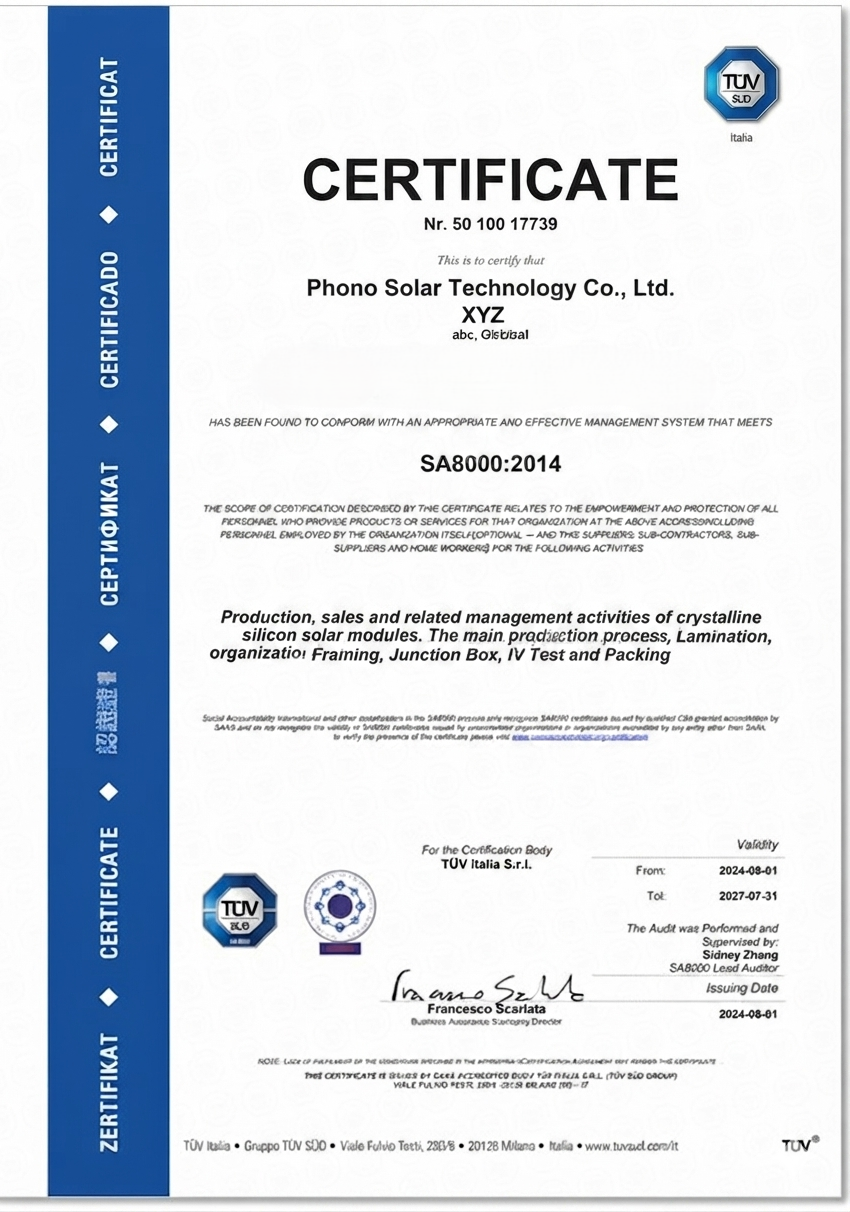
SA8000: Social Accountability Certification
SA8000 is one of the oldest formal worker-treatment standards around, created by Social Accountability International (SAI) back in the late 1990s. Unlike BSCI or SEDEX, which work more like a rating system, SA8000 is set up like a true management standard — closer in style to ISO 9001 — built on the same base as most social audits: ILO rules, the Universal Declaration of Human Rights and UN rules on children's rights.
SA8000 covers nine main areas: child labor, forced labor, health and safety, the right to organize and bargain collectively, discrimination, discipline, working hours, pay and — the part that makes it stand out — a real management system. That last piece means the factory has to show ongoing internal processes for keeping up compliance, not just pass a one-time check.
Because it demands an actual working system rather than a snapshot, SA8000 is generally seen as one of the tougher social certifications out there. Factories usually go after it when they want to stand out on labor practices specifically, not just tick a box. The certificate lasts three years, with regular check-ins in between to make sure the system keeps working.
Why SA8000 needed?
For factories wanting to prove they go beyond the minimum on worker treatment, SA8000 is one of the strongest, most respected credentials available. It's also a differentiator — a factory holding it can market itself to ethically conscious brands willing to pay a premium for verified labor standards.
How to get it — where from: SA8000 certificates are not issued by SAI itself; a factory applies to one of the certification bodies accredited by SAAS (Social Accountability Accreditation Services, SAI's accreditation arm) — examples include DNV, Bureau Veritas, SGS, TÜV Rheinland and Intertek. The factory typically builds the required management system first (often with consultant help), then goes through a certification audit with the chosen body, followed by surveillance audits over the three-year cycle.
SA8000 at a glance:
- Created by Social Accountability International (SAI)
- A real management-system standard, not just an audit score
- Nine core areas, including a required internal system
- Seen as one of the stricter worker-treatment certifications
- Three-year certificate with regular follow-up checks
- Get it via SAAS-accredited bodies (DNV, Bureau Veritas, SGS, TÜV Rheinland, Intertek)
Materials and sourcing (GOTS, OCS, RCS, FSC etc) — is the cotton, recycled fiber or wood pulp actually what it's claimed to be
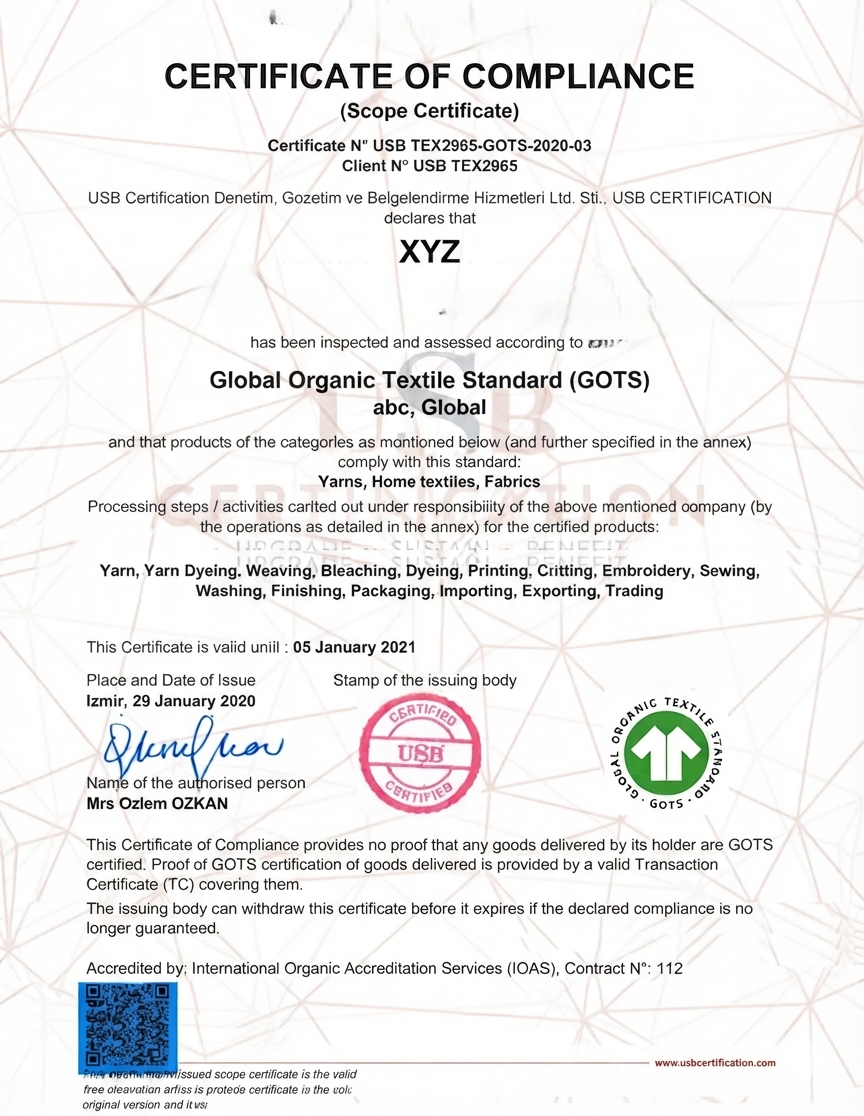
GOTS and ICS GOTS: Global Organic Textile Standard
GOTS, the Global Organic Textile Standard, is the top certification for organic textiles anywhere in the world. It was built by four organizations from different continents on purpose, so it wouldn't just reflect one region's interests.
Here's what makes GOTS different: it checks the entire production chain, not just the raw cotton. A cotton farm can be certified organic on its own — under something like USDA Organic — but that only tells you how the cotton was grown. GOTS goes much further. It follows the fiber from the farm through spinning, weaving or knitting, dyeing, printing and finally sewing into a garment, checking environmental and social rules at every single stage.

To use the GOTS label, a product needs at least 70% certified organic fiber. There are two label levels: "organic" for 95% or more organic fiber and "made with organic" for 70–94%. On top of fiber content, GOTS also blocks toxic chemicals and heavy metals in processing, requires wastewater treatment and demands basic labor rules across the chain — no forced or child labor, safe conditions, fair pay.
Now, about "ICS GOTS" — this just refers to a GOTS certificate issued by an accredited certifying body operating under the ICS framework (Institute for Certification and Control-style bodies). In plain terms, when people say "ICS GOTS," they mean a GOTS certificate handed out by one of these accredited bodies, confirming that a specific factory — a spinning mill, a dye house, a garment plant — has passed the full GOTS check. Every stage that touches the organic fiber needs its own valid certificate, which is why manufacturers often list several GOTS certificates for different linked facilities, not just the final sewing factory.
Getting GOTS certified takes real work. Factories need detailed records to prove the organic fiber going in is the same fiber coming out — with nothing mixed in along the way. Yearly on-site checks are required to keep the certificate and paperwork has to be issued for every single batch sold under the GOTS label. It's not something you earn once and forget about.
For brands and shoppers, a GOTS label is one of the strongest guarantees you can get that a garment is genuinely organic, from the raw cotton all the way to the finished piece of clothing.
Why GOTS needed?
Without GOTS, an "organic cotton" claim is just a claim — there's no way to prove the fiber wasn't mixed with conventional cotton somewhere along the chain. Brands selling organic products need this certificate to legally and credibly back up what's printed on the label.
How to get it — where from: Each facility that touches the organic fiber (spinning mill, dye house, garment factory and so on) applies separately to one of the certification bodies approved on the official list maintained by Global Standard gGmbH (global-standard.org) — the nonprofit that owns and administers GOTS. Common approved bodies include Control Union, Ecocert, OneCert, GECA and IMO/Ecocert. The facility submits documentation of its organic supply chain, undergoes an on-site inspection and — once certified — must obtain a Transaction Certificate for every batch sold under the GOTS label, plus a fresh annual on-site check to keep the certificate active.
GOTS at a glance:
- Covers the whole production chain, not just the farm
- "Organic" label needs 95%+ organic fiber; "made with organic" needs 70–94%
- Blocks toxic chemicals and heavy metals in processing
- Requires wastewater treatment and basic labor rules
- Every linked factory needs its own certificate
- "ICS GOTS" means a GOTS certificate from an accredited body under the ICS framework
- Get it facility-by-facility via a Global Standard-approved body (Control Union, Ecocert, OneCert and others)
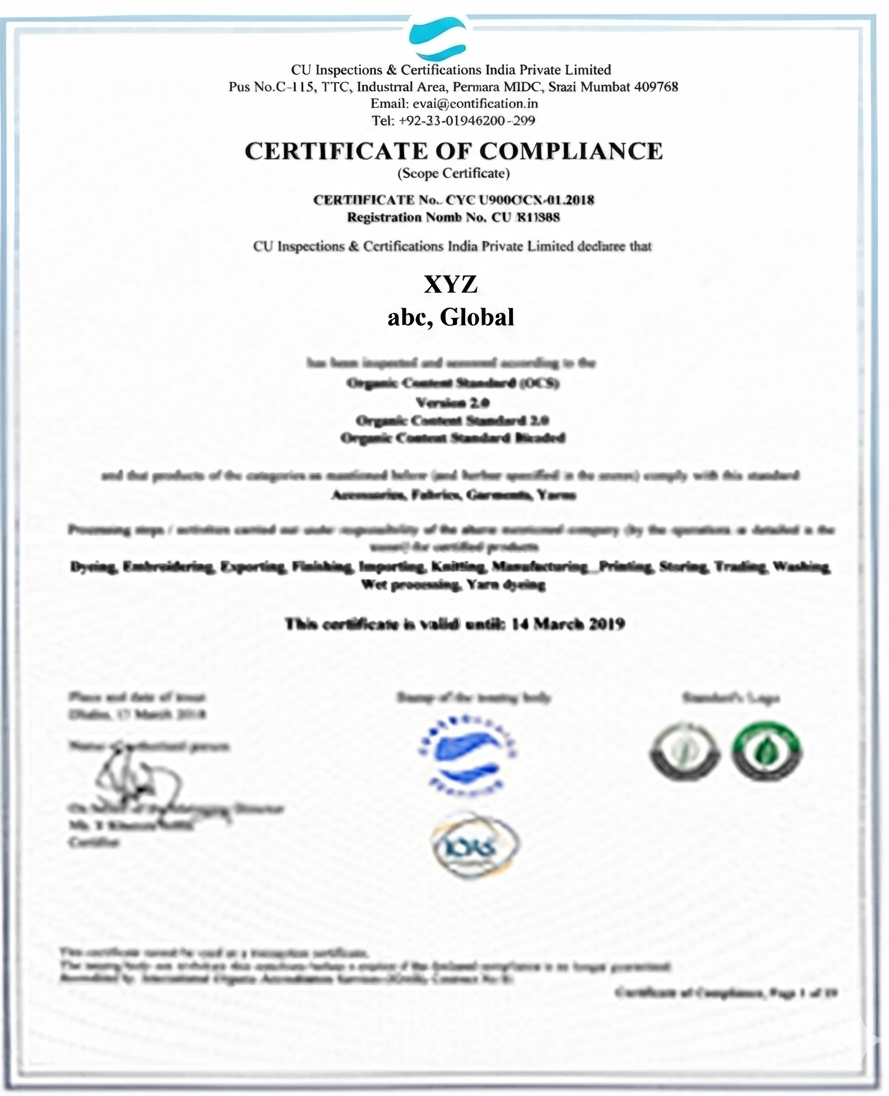
OCS: Organic Content Standard
The Organic Content Standard, run by Textile Exchange, gets mixed up with GOTS a lot because both deal with organic fiber. But they check different things.
GOTS is a full package — fiber content, chemicals, environment and labor rules all together. OCS is narrower. It only checks one thing: how much organic material is actually in the final product and whether the paper trail proves it. It doesn't touch dyeing chemicals, wastewater or labor practices the way GOTS does.
There are two versions: OCS 100 for products with 95–100% organic material and OCS Blended for products with at least 5% organic material mixed with other fibers. This makes OCS a good fit for products that mix organic cotton with something else — like an organic cotton-polyester t-shirt — where GOTS's stricter fiber rules wouldn't really apply.
Because OCS checks less than GOTS, it's usually quicker and cheaper for a factory to get. That makes it a good starting point for brands who want a credible organic claim without taking on the full scope of GOTS. Still, the paper trail requirements are taken seriously — every step handling the organic material needs a valid certificate and surprise audits are part of keeping it.
In short: a factory with OCS certification is telling buyers, "we can prove, with real documents, that the organic content we're claiming is genuine — not stretched or faked anywhere along the way."
Why OCS is needed?
It's the go-to option when a product blends organic fiber with something else and doesn't qualify for GOTS. Without it, a brand has no credible way to back up a "made with organic cotton" claim on a blended product.
How to get it — where from: A facility applies through one of the certification bodies on Textile Exchange's approved list (textileexchange.org) — Control Union, SCS Global Services, Ecocert and DNV are among the most commonly used. The process involves a document review of the organic material's paper trail, an on-site assessment and issuance of a scope certificate plus transaction certificates per shipment.
OCS at a glance:
- Run by Textile Exchange
- Checks organic fiber content and paper trail only — nothing about chemicals or labor
- OCS 100 covers 95–100% organic; OCS Blended covers 5%+ mixed with other fiber
- Quicker and cheaper to get than GOTS
- Good fit for organic-blend products that don't meet GOTS thresholds
- Get it via a Textile Exchange-approved body (Control Union, SCS Global Services, Ecocert, DNV)
RCS: Recycled Claim Standard
RCS, also from Textile Exchange, does for recycled material what OCS does for organic. As fashion has leaned harder into recycling — plastic bottles turned into polyester, old fabric turned into new yarn — RCS has become one of the standards buyers trust to confirm that "recycled" claims are actually true.
Like OCS, RCS has two tiers: RCS 100 for 95–100% recycled material and RCS Blended for at least 5% recycled content mixed with other material. The standard follows a paper trail from the recycler all the way to the finished item, with surprise audits checking that the documents match reality.
One thing RCS doesn't do: it doesn't make any claims about chemicals, dyeing or labor conditions, the way GOTS does. It's purely a "prove the recycled content is real" tool.
For factories using recycled polyester (often shortened to rPET, usually made from used plastic bottles), recycled cotton or recycled nylon, RCS certification has become close to essential. Fashion brands have taken a lot of heat lately for vague or made-up sustainability claims and regulators in the EU and elsewhere are cracking down. RCS gives a factory — and the brand buying from it — solid proof behind any "made from recycled material" label on a hangtag.
Why RCS is needed?
Regulators are actively cracking down on unverified "recycled" claims and a hangtag boasting recycled content without RCS backing it up is now a real legal and reputational risk for brands — which means factories without it get passed over.
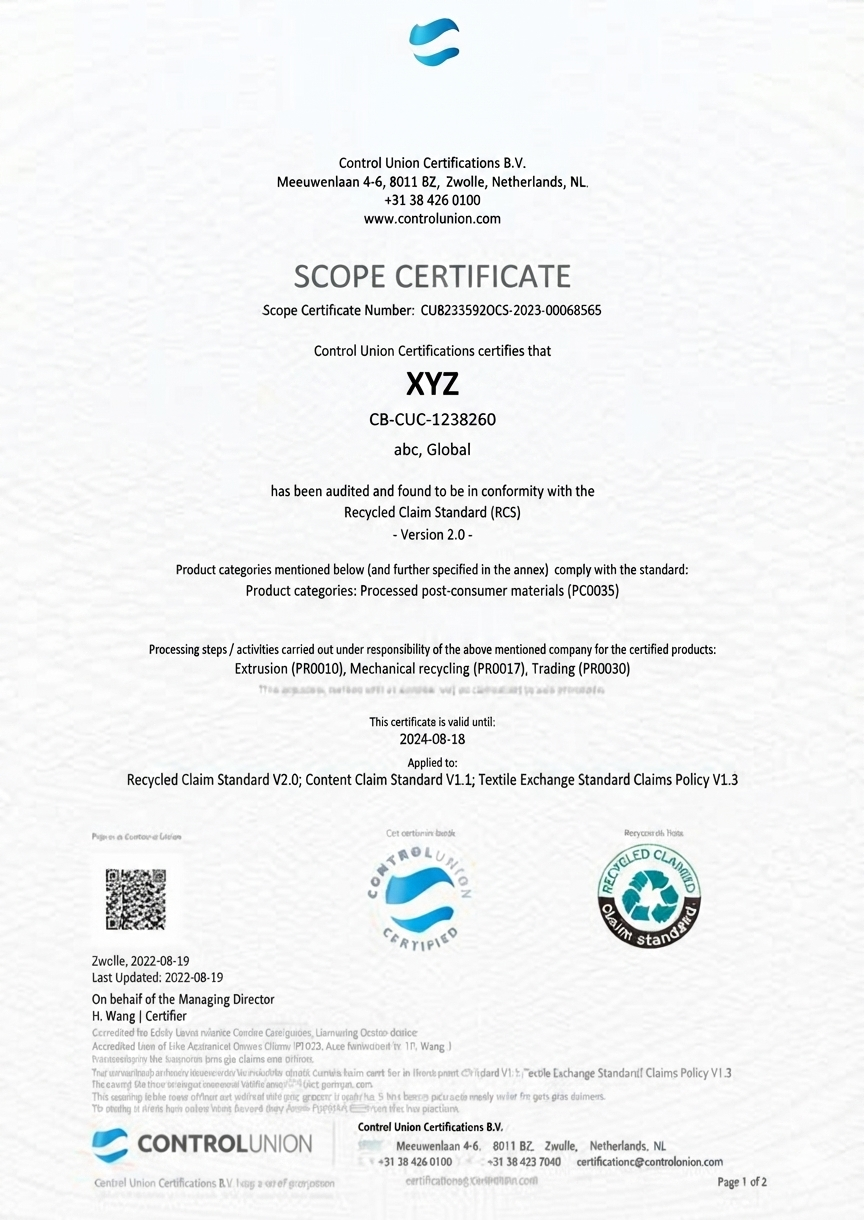
How to get it — where from: Same route as OCS: apply through a Textile Exchange-approved certification body (Control Union, SCS Global Services, Ecocert, DNV and others), which verifies the recycled content's chain of custody from the recycler to the finished product and issues a scope certificate plus per-shipment transaction certificates.
RCS at a glance:
- Run by Textile Exchange, same model as OCS but for recycled material
- RCS 100 covers 95–100% recycled; RCS Blended covers 5%+ mixed content
- Checks the paper trail only — no chemical, environment or labor rules
- Common for recycled polyester, recycled cotton and recycled nylon
- Increasingly important as regulators crack down on false sustainability claims
Get it via a Textile Exchange-approved body (Control Union, SCS Global Services, Ecocert, DNV)
GRS: Global Recycled Standard
The Global Recycled Standard, also owned by Textile Exchange, gets confused with RCS a lot, since both check recycled content. The difference: RCS only checks content and paper trail, while GRS adds environmental rules and social rules on top, making it the broader, stricter option.
To use the GRS label, a product needs at least 20% recycled material — a much higher bar than RCS Blended's 5% minimum. On top of that, GRS-certified factories have to meet environmental rules around chemicals and wastewater, similar in spirit to GOTS, plus basic labor rules covering forced labor, child labor, pay and hours.
Because it checks more, many buyers — especially ones with strong sustainability goals — treat GRS as the more trustworthy "gold standard" recycled certificate, saving RCS for cases where a lighter check is good enough. For a factory, holding GRS tells buyers not just that the recycled material is real, but that it was processed responsibly too.
Why GRS is needed?
Sustainability-focused brands increasingly want more than just proof of recycled content — they want proof it was processed responsibly. GRS is what lets a factory answer that fuller question and compete for higher-value, sustainability-driven orders.
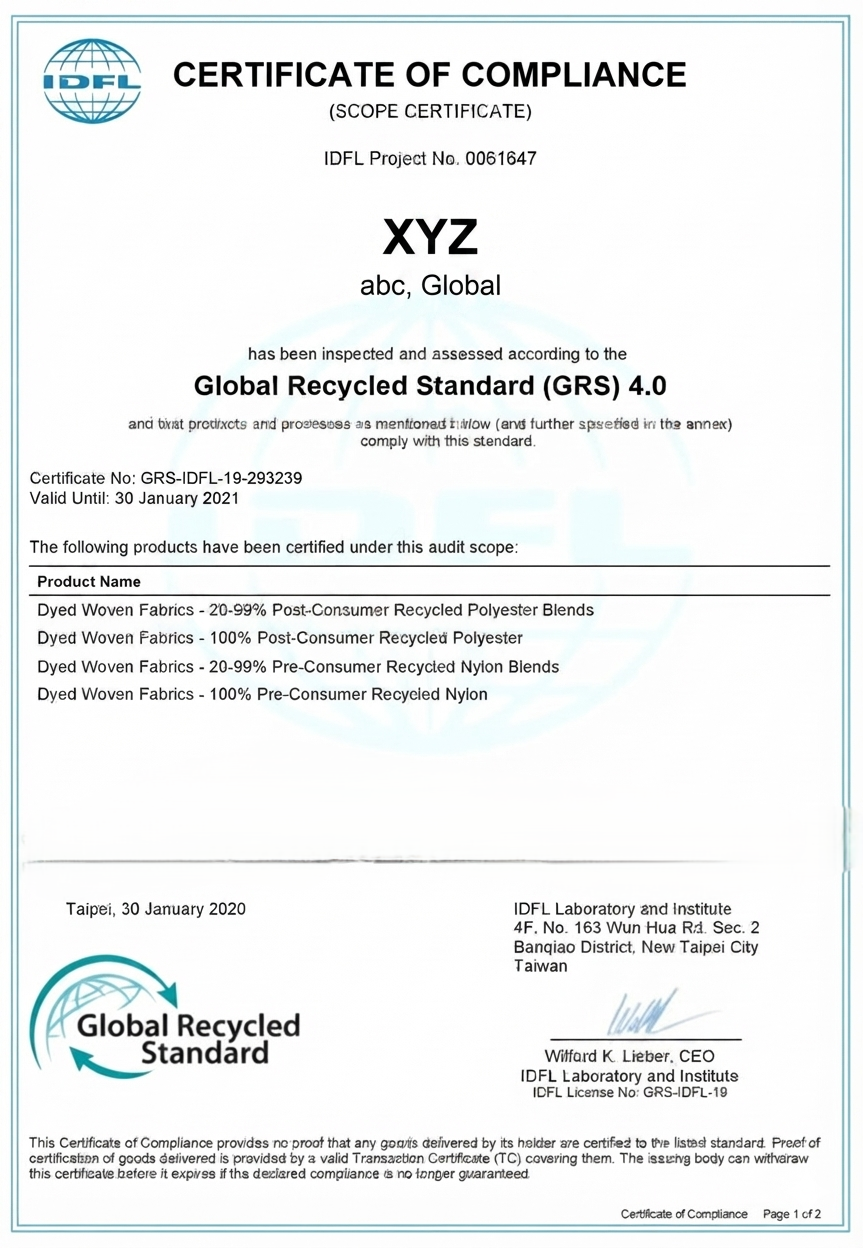
How to get it — where from: Again applied for through a Textile Exchange-approved certification body (Control Union, SCS Global Services, Ecocert, DNV and others), but the on-site audit is more thorough than RCS's, since it also checks chemical management, wastewater and basic labor conditions on top of the recycled-content paper trail.
GRS at a glance:
- Run by Textile Exchange; broader than RCS
- Requires at least 20% recycled material
- Adds environmental rules and basic labor rules
- Often seen as the stricter, more trusted recycled standard
- Get it via a Textile Exchange-approved body (Control Union, SCS Global Services, Ecocert, DNV)
FSC: Forest Stewardship Council
FSC certification doesn't come from the garment world at all — it comes from forestry. But it matters more and more to clothing because of man-made fibers like viscose, rayon, modal and lyocell, all of which come from wood pulp. FSC's chain-of-custody certificate traces that wood pulp back to responsibly managed forests, confirming the harvesting didn't cause deforestation, damage habitats or violate indigenous land rights.
For a factory or fabric mill working with viscose or similar fibers, an FSC certificate offers proof that the wood pulp behind the fabric was sourced the right way. FSC certification also shows up outside the fabric itself — on paper hangtags, swing tickets and packaging.
Why FSC is needed?
Viscose and similar fibers have a real history of being linked to illegal logging and deforestation. FSC gives brands and factories a way to prove the wood pulp behind these fabrics didn't come from a forest that shouldn't have been cut down.
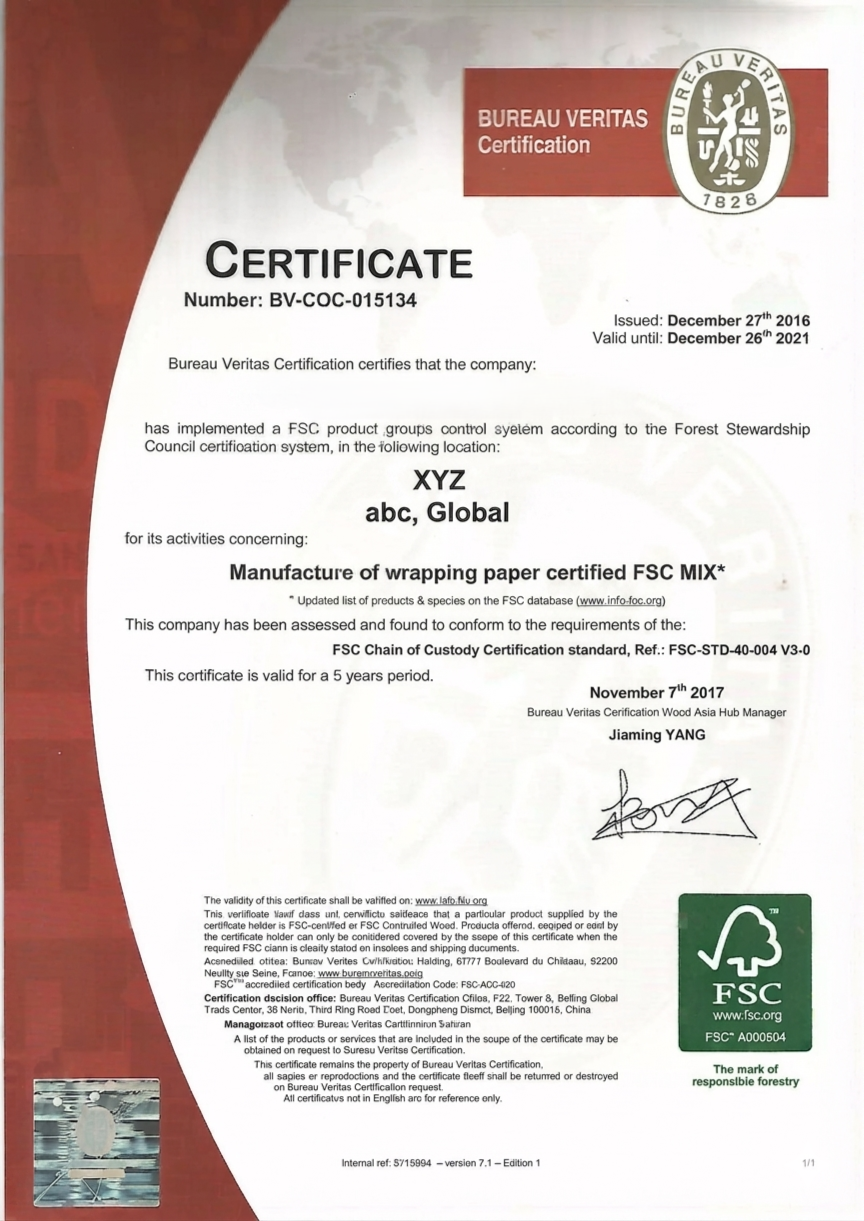
Getting it: A mill or factory applies for Chain of Custody certification through a body accredited by ASI on FSC's behalf (fsc.org) — SCS Global Services, Preferred by Nature, SGS and Control Union all do this work. They'll want to see how the certified material is tracked through your process, then do an audit before certifying.
FSC at a glance:
- A forestry-based certificate, not specific to garments
- Relevant to viscose, rayon, modal and lyocell (wood-pulp fibers)
- Also common on paper hangtags and packaging
- Protects against deforestation and indigenous land rights violation
- Get it via an ASI-accredited body (SCS Global Services, Preferred by Nature, SGS, Control Union)
Cotton-Specific Sourcing Programs
Besides the big organic and recycled standards, there are several programs built just around cotton — one of the most traded and closely watched fibers in the world. They're not interchangeable; each one checks something different.
Why they're needed: Cotton is the single most common fiber in clothing and it comes with real risks around water use, pesticides and farmer welfare. These programs let brands make credible claims about where their cotton came from and how it was grown, instead of just trusting a supplier's word.
- Better Cotton (BCI – Better Cotton Initiative) is the biggest cotton sustainability program in the world by volume. Farmers get trained on smarter water use, less pesticide and fertilizer use, healthier soil and fair work. Better Cotton is tracked using a "mass balance" system — meaning the cotton in your specific t-shirt isn't necessarily traceable back to one exact farm, but an equal amount of verified Better Cotton was grown somewhere in the supply chain. Getting it: farmers join through local Program Partners registered with bettercotton.org; brands and supply chain actors join as Better Cotton members and source through the mass-balance system.
- Cotton USA™ is a trademark and licensing program run by Cotton Council International, marking products made with cotton grown in the United States. It's more of an origin and quality mark than a full sustainability check, though US cotton farming has its own regulations. Getting it: sign a licensing agreement directly with Cotton Council International (cottonusa.org).
- Cotton made in Africa (CmiA) certifies sustainably grown cotton from African smallholder farmers, using a mass-balance model like Better Cotton, with a strong focus on improving farmers' lives across cotton-growing regions in Africa. Getting it: apply for licensing through the Aid by Trade Foundation (aid-by-trade.org), verified by auditors like Control Union.
- SUPIMA® is a trademark, not a sustainability certificate. It protects and promotes American Pima cotton — a long-staple cotton known for strength and softness. A SUPIMA license confirms fiber origin and quality, not environmental or labor practices. Getting it: apply directly to Supima (supima.com) and sign a licensing agreement.
- Organic Cotton Accelerator (OCA) isn't a product certification by itself — it's an initiative that works to improve tracking, data and farmer support across the organic cotton supply chain, usually working alongside GOTS and OCS rather than replacing them. Getting it: join as a member at organiccottonaccelerator.org — there's no product certificate here to apply for.
Chemical and quality safety (OEKO-TEX, ZDHC, USTERIZED) — harmful chemicals in the fabric and whether the yarn is actually good quality
OEKO-TEX Certifications: Fabrics, Garments, Yarn Dyed and Sewing Threads
OEKO-TEX is a Swiss-Austrian group of independent testing institutes and it runs several certification and labeling systems for textiles. Unlike most of the certifications above, which focus on where materials came from or how workers were treated, OEKO-TEX asks a different question: does this fabric contain anything that could hurt the person wearing it?
The main OEKO-TEX certificate is STANDARD 100 by OEKO-TEX and this is what most people mean when they say "OEKO-TEX certified." It's a product-level label, meaning testing happens separately at each stage — fabric, yarn, thread and finished garment can each carry their own certificate, since chemical risk can sneak in at any point:
- Fabrics — woven and knitted fabric is tested for azo dyes, formaldehyde, heavy metals like lead and cadmium, pesticide residue, phthalates and other harmful substances, checked against a list that's updated every year.
- Garments — the whole finished, assembled item is tested as it will actually be worn, including zippers, buttons, prints, coatings and trims, not just the base fabric.
- Yarn Dyed fabrics — where yarn is dyed before it's woven or knitted (think checked or striped shirting) — are tested as their own category, since the dyeing process is different from dyeing finished fabric.
- Sewing Threads — tested to the same chemical safety limits as fabric, since thread runs along every seam and touches skin constantly.
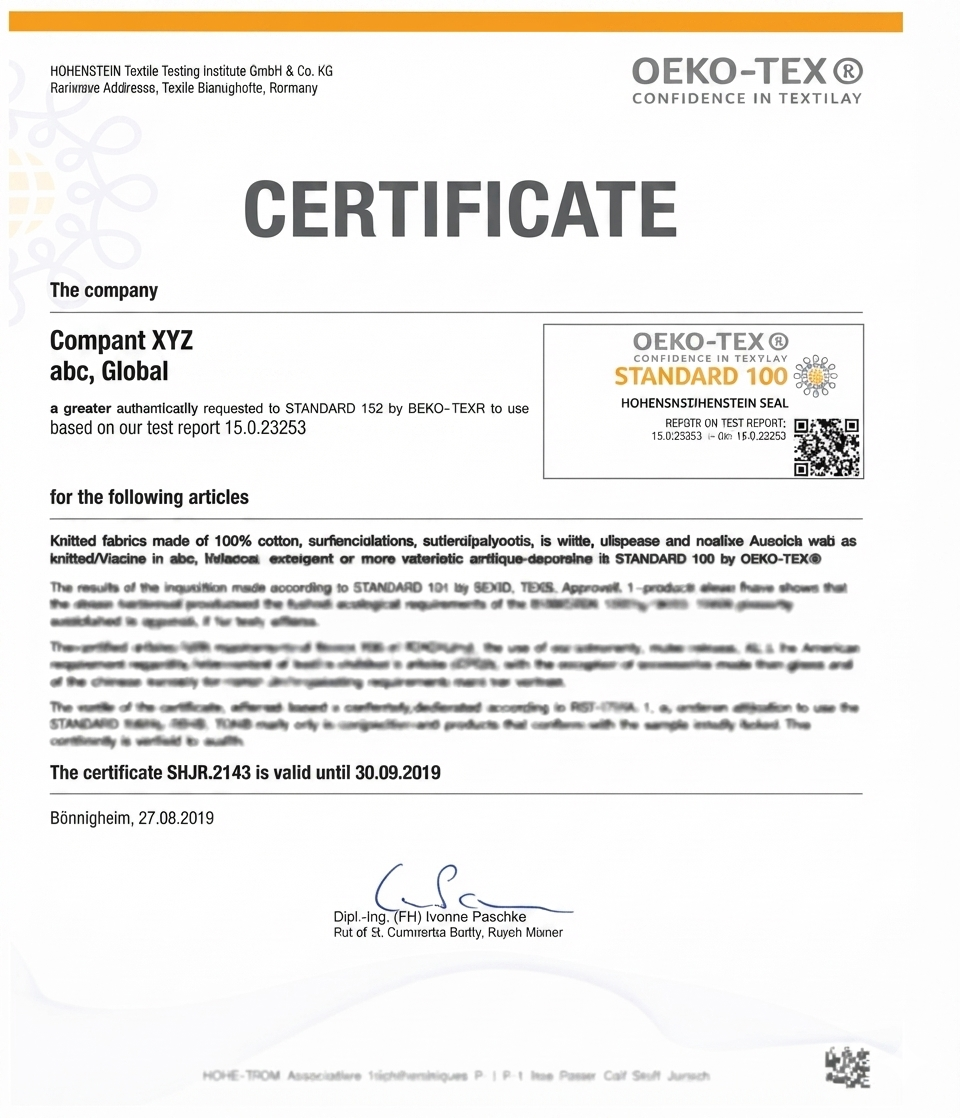
All of these certificates are graded into classes: Class I (baby and infant items, the strictest limits), Class II (items touching skin directly and for long periods, like underwear and shirts), Class III (items with little skin contact, like outerwear) and Class IV (decorative items with no skin contact). Certificates last one year and need fresh testing to renew, since formulas and suppliers can change.
For a factory, holding OEKO-TEX certification across fabric, yarn, thread and garment sends a clear message: quality control isn't just about straight seams and matching colors — it's about proving every single input is safe to wear.
Why OEKO-TEX is needed?
Many countries have laws limiting harmful substances in clothing and OEKO-TEX certification is the easiest way to prove compliance across borders. It also protects brands from recalls, lawsuits and reputational damage if a harmful chemical is ever traced back to their product.
How to get it — where from: Applications go through one of OEKO-TEX's roughly 18 member institutes worldwide, not OEKO-TEX itself as a single office — well-known ones include Hohenstein and TESTEX (both used widely for Asian and European production), along with institutes such as CTC, CETI and SGS's OEKO-TEX-licensed labs. The factory or brand submits fabric, yarn, thread or garment samples to the chosen institute, the lab tests them against the current STANDARD 100 limit list and — if they pass — the certificate is issued for that specific product, valid for one year before retesting.
OEKO-TEX at a glance:
- Product-level certificate (fabric, garment, yarn dyed or thread, tested separately)
- Four hazard classes, from baby items (strictest) to décor (loosest)
- Renewed annually with fresh lab testing
- Applied for through one of OEKO-TEX's accredited member institutes (e.g., Hohenstein, TESTEX, CETI, CTC) — not a single central office
ZDHC: Zero Discharge of Hazardous Chemicals
ZDHC works a bit differently from OEKO-TEX, even though the two are closely linked and often mentioned together. OEKO-TEX tests the finished fabric, yarn, thread or garment for harmful substances. ZDHC looks further upstream — at the chemicals used during manufacturing itself, before they ever reach (or don't reach) the finished product.
ZDHC is an industry-wide program backed by a large group of brands, chemical suppliers and factories. It's built around a Manufacturing Restricted Substances List (MRSL), which sets limits on hazardous chemicals used in places like dye houses and finishing plants. Instead of handing out one pass/fail certificate, ZDHC runs through a set of tools — like the ZDHC Gateway, which lets factories check chemical products against the list, plus wastewater and chemical management checks that produce a conformance score rather than one fixed badge.
For a factory, strong ZDHC results (often paired with OEKO-TEX-approved chemical inputs) show that hazardous chemical management was handled at the source — in the dye house — instead of relying only on testing the finished fabric afterward.
Why ZDHC is needed?
Testing the finished product alone can miss chemicals that get used and washed out during processing but still harm workers or pollute local water supplies. ZDHC closes that gap by checking what actually happens inside the dye house, not just the end result.
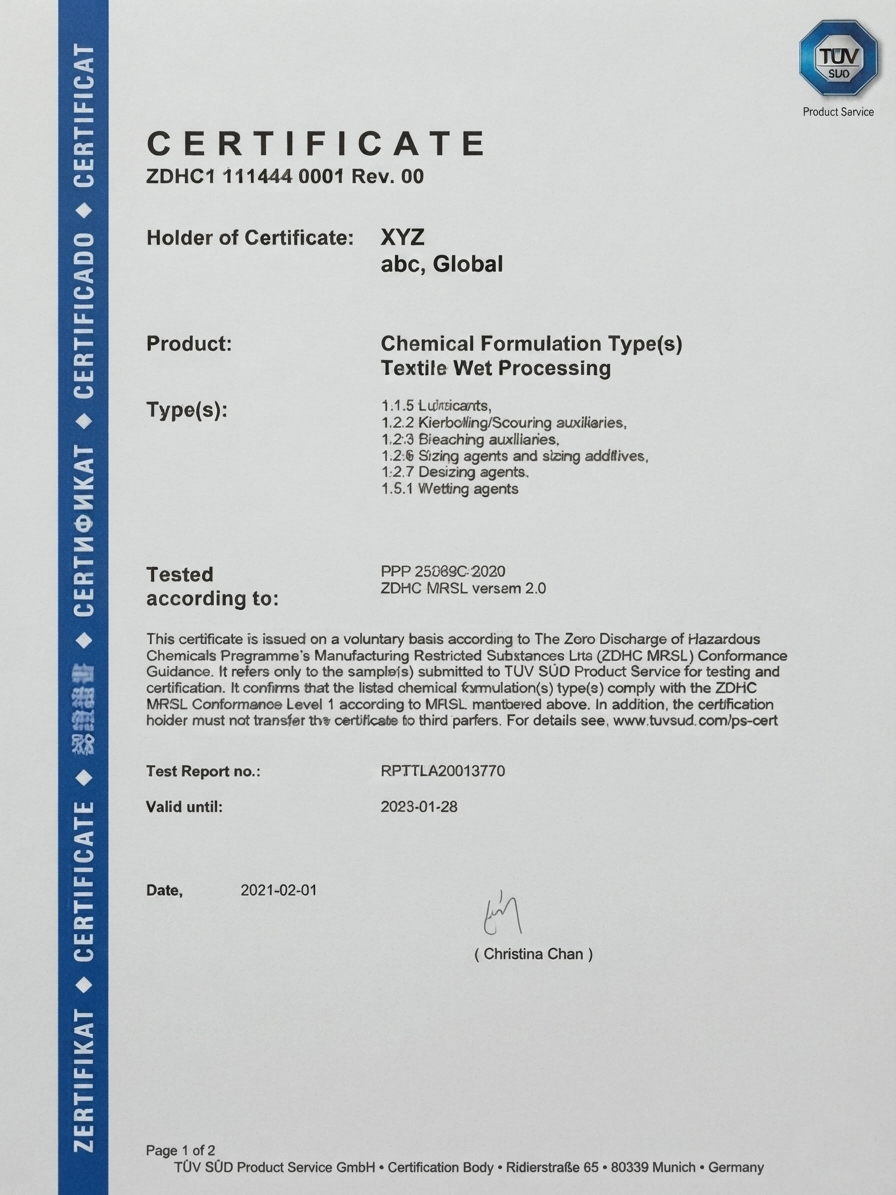
Getting it: No single certificate to chase here. Sign up directly on the ZDHC Gateway (roadmaptozero.com). Chemical formulators submit products for MRSL conformance checks through approved labs like bluesign or Hohenstein; facilities use the Wastewater Module by sending samples to an approved lab.
ZDHC at a glance:
- Focuses on chemicals used during manufacturing, not just the finished product
- Built around a Manufacturing Restricted Substances List (MRSL)
- Works through tools like the ZDHC Gateway, not one single certificate
- Complements OEKO-TEX rather than replacing it
- Sign up directly on the platform, testing through approved labs
USTERIZED®
USTERIZED is a quality mark from Uster Technologies, a Swiss company that's been a benchmark name in yarn and fiber testing for decades. It doesn't check labor practices, chemicals or fiber origin — it checks something more technical: how consistent and high-quality the yarn actually is, measured against the Uster Statistics, a global database built from yarn samples tested around the world.
A spinning mill going for USTERIZED certification has its yarn tested for things like evenness, imperfections, strength and hairiness, then compared against global quality rankings. A strong USTERIZED score tells buyers — knitters, weavers, garment factories — that the yarn meets a verified, internationally comparable quality bar, which matters a lot for consistent fabric and fewer defects down the line.
Why USTERIZED is needed?
Yarn quality problems don't show up until much later — in uneven fabric, weak seams or fabric that pills quickly. USTERIZED lets buyers catch quality issues before they buy, rather than discovering them after a whole batch of fabric has already been made.
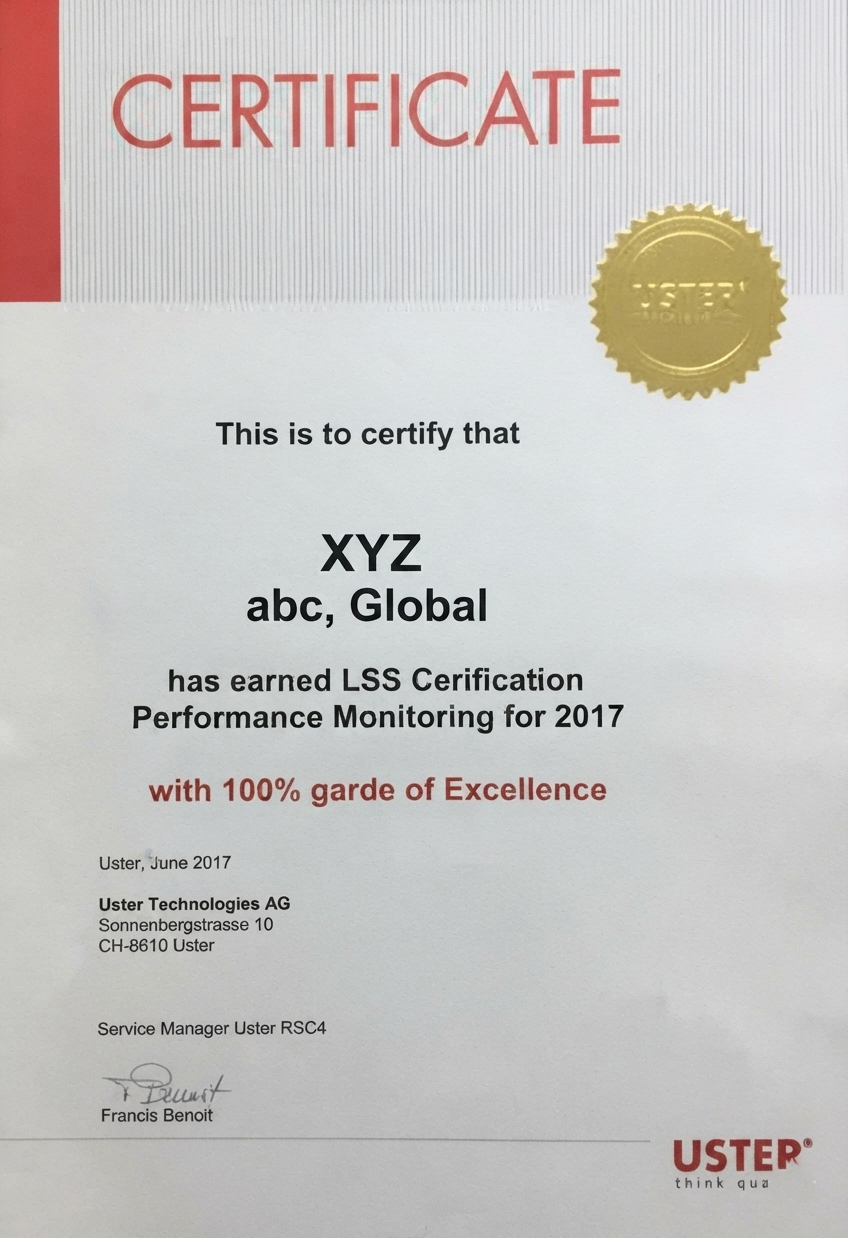
Getting it: Apply directly to Uster Technologies (uster.com, Switzerland). Samples get tested on Uster's own instruments or at an Uster-linked lab and compared against the Statistics database — clear the bar and you get to use the USTERIZED name on that yarn.
USTERIZED at a glance:
- Issued by Uster Technologies, based on the Uster Statistics benchmark
- Checks yarn quality and consistency, not labor or chemicals
- Measures things like evenness, imperfections, strength and hairiness
- Mainly used by spinning mills to prove yarn quality to buyers
- Get it directly through Uster Technologies
Factory management (OHSAS, ISO 9001, ISO 14001, ISO 45001, ISO 50001,) — is the place run in an organized way, quality to energy use
OHSAS: Occupational Health and Safety Assessment Series
OHSAS 18001 (Occupational Health and Safety Assessment Series) was an internationally recognized standard for occupational health and safety management systems. It provided organizations with a structured framework to identify workplace hazards, reduce risks, prevent accidents and create safer working environments for employees.
OHSAS 18001 focused on protecting workers by establishing formal policies, procedures and controls for managing health and safety risks. The standard encouraged organizations to move beyond simply reacting to accidents and instead take a proactive approach to preventing them.
Here's how it works in practice: a company identifies workplace hazards, assesses associated risks, implements control measures, provides employee training, monitors safety performance and regularly reviews its health and safety management system. Independent certification bodies then audit the organization to verify compliance with the standard's requirements.
Because workplace safety is a key concern for customers, employees, regulators and business partners, OHSAS certification became a valuable way for companies to demonstrate their commitment to maintaining a safe and healthy workplace. Many global brands preferred suppliers with a certified occupational health and safety management system.
One thing worth knowing: OHSAS 18001 has been replaced by ISO 45001, the current international standard for occupational health and safety management systems. Organizations previously certified to OHSAS 18001 have largely transitioned to ISO 45001.
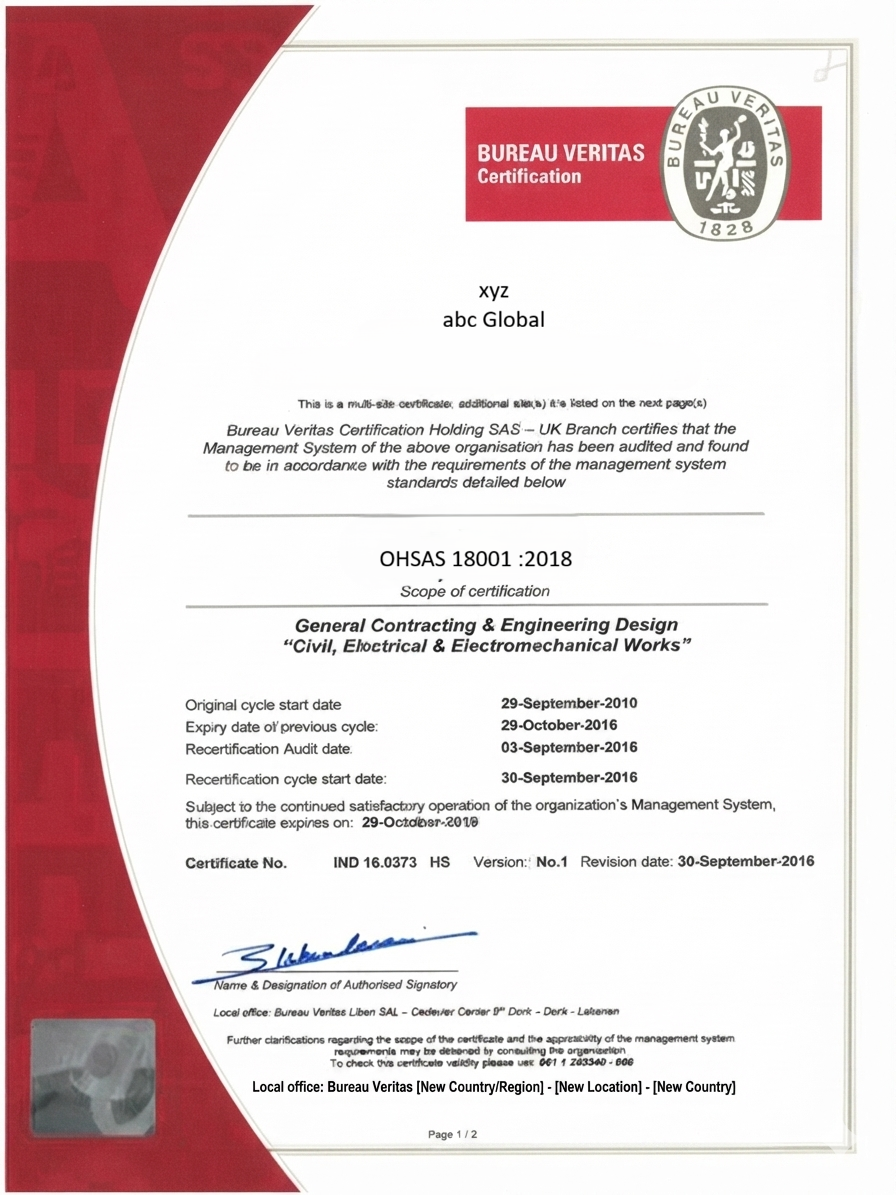
Why OHSAS is needed?
Workplace injuries, illnesses and unsafe conditions can lead to lost productivity, increased costs, legal issues and harm to employees. OHSAS helps organizations systematically identify and control risks, improve safety performance and build a strong culture of workplace safety.
OHSAS at a glance:
- Stands for Occupational Health and Safety Assessment Series
- Provides a framework for managing workplace health and safety
- Focuses on hazard identification and risk control
- Requires employee training, monitoring and continuous improvement
- Demonstrates commitment to worker health and safety
- Replaced by ISO 45001 as the current international standard for occupational health and safety management systems
ISO 9001:2015: Quality Management Systems
Stepping outside textile-specific certificates, ISO 9001 is a globally known management standard from the International Organization for Standardization, used across almost every industry, not just clothing. ISO 9001:2015 is the current version, from the 2015 update.
ISO 9001 doesn't test a specific product — it certifies that a company has a documented, consistent and always-improving quality system in place. It looks at how an organization plans, runs, checks and improves the processes behind its output, rather than just spot-checking the final result.
Things it looks at include leadership's commitment to quality, understanding what customers actually need, thinking ahead about risks, clear roles and responsibilities, trained staff, controlled production processes, ways to measure performance and a real process for fixing problems and improving over time.
For a garment factory, getting ISO 9001 certified means an outside auditor checked the factory's documented quality steps — how fabric gets inspected when it arrives, how sewing defects get caught and fixed, how finished garments get checked before shipping, how customer complaints feed back into better processes — and confirmed it all meets the standard.
Why does this matter to a buyer? Because ISO 9001 is a strong sign of consistency. A factory can make one gorgeous sample, sure — but ISO 9001 tells you the factory can reliably make the same quality across an order of 50,000 pieces, catch problems early and keep improving instead of repeating the same mistakes. It's less about one product and more about whether you can trust the whole operation order after order.
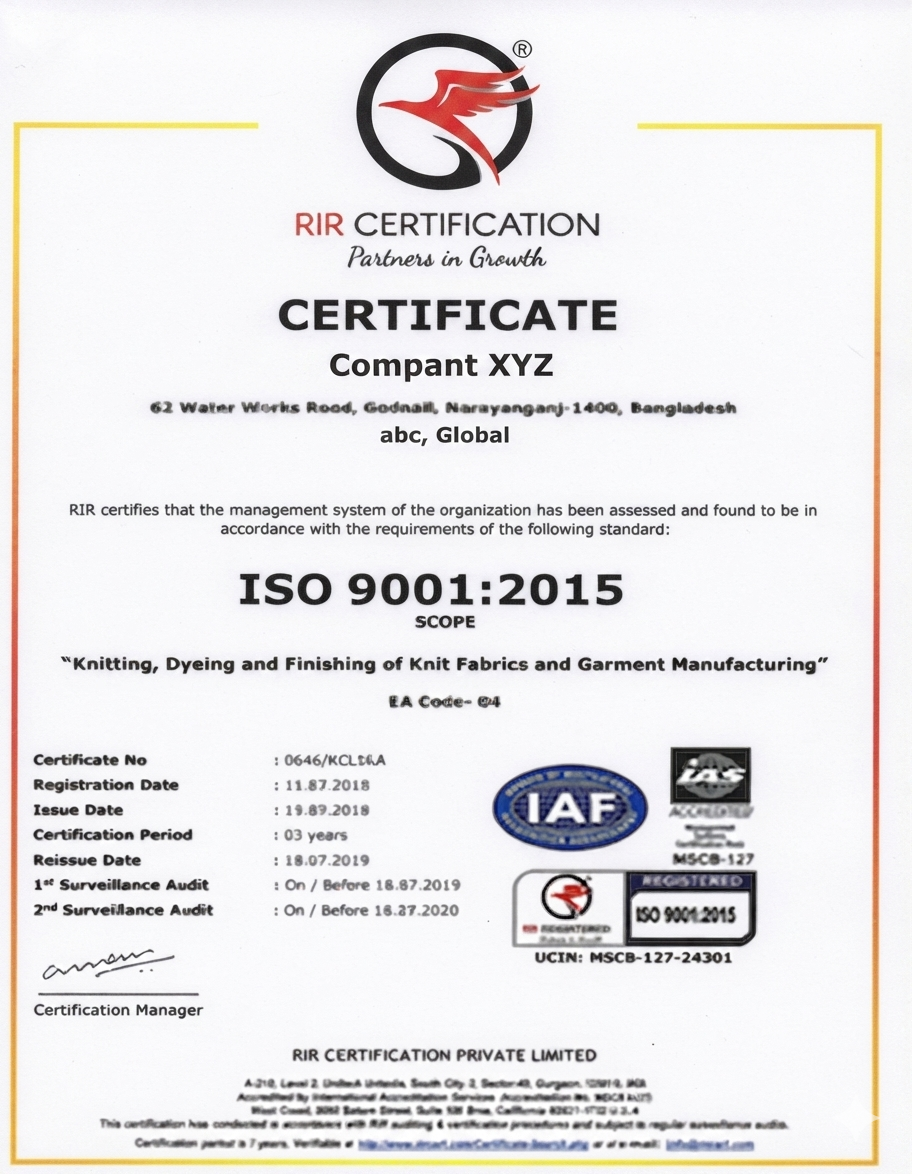
Why ISO 9001:2015 is needed?
Buyers place large orders based on a sample they liked — ISO 9001 is their assurance that piece number 49,999 will be just as good as piece number one, without needing to inspect every single unit themselves.
Getting it: ISO doesn't certify companies directly. Apply to any accredited certification body — meaning one accredited by a national accreditation body that's a member of the IAF (International Accreditation Forum), like UKAS in the UK, ANAB in the US or DAkkS in Germany. Names you'll see a lot in garment manufacturing: BSI, SGS, Bureau Veritas, TÜV SÜD/TÜV Rheinland, DNV, Intertek. Factories usually build the documented system first, often with a consultant, then go through a document review and an on-site audit, with yearly check-ins over a three-year cycle.
ISO 9001:2015 at a glance:
- A general management standard, not textile-specific
- Focuses on process control, not one-off product testing
- Covers leadership, risk thinking and continual improvement
- For factories: fabric checks, defect tracking, shipment QC, complaint handling
- Certified on a three-year cycle with yearly check-ins
ISO 14001:2015: Environmental Management Systems
ISO 14001 is a sibling standard to ISO 9001, from the same organization, but focused on the environment instead of quality. Like ISO 9001, the 2015 version is current and it follows the same overall structure — which makes it easier for a factory to run both systems together.
An ISO 14001-certified factory has shown it has a real system for tracking and reducing its environmental impact — energy and water use, waste, air emissions, wastewater, chemical handling and following local environmental laws.
The standard asks factories to identify their environmental footprint — for a garment factory, that might mean dye wastewater, boiler emissions, fabric offcuts, packaging and energy use in cutting and sewing — and set real, measurable goals for cutting that impact over time. It also requires a written environmental policy, clear responsibilities, emergency plans for things like chemical spills and regular internal and outside checks.
In the garment world specifically, ISO 14001 has become more important as regulators, investors and shoppers push back on supply chains quietly polluting rivers with untreated dye wastewater — a real problem in some textile-manufacturing regions historically. A factory with ISO 14001 gives buyers documented proof that environmental care is a built-in system, not an afterthought.
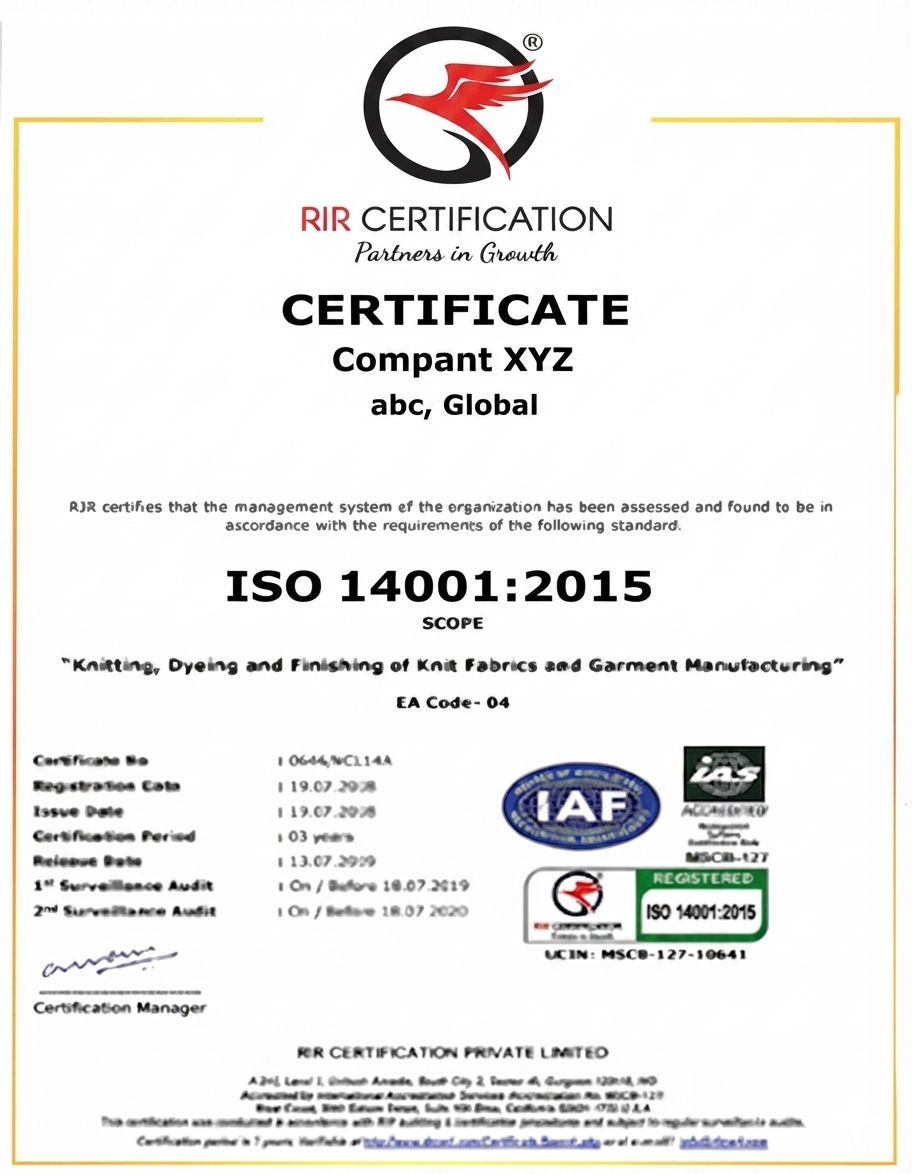
Why ISO 14001:2015 is needed?
Brands are increasingly held responsible for their entire supply chain's environmental footprint, including pollution they didn't directly cause. ISO 14001 protects both the factory and the brand from being tied to environmental scandals like contaminated local water supplies.
Getting it: Same path as ISO 9001 — any IAF-accredited certification body (BSI, SGS, Bureau Veritas, TÜV, DNV, Intertek). Since it shares structure with 9001, many factories go for both together, saving time with the same certifier.
ISO 14001:2015 at a glance:
- Sibling standard to ISO 9001, focused on the environment
- Covers energy, water, waste, emissions, wastewater and chemical handling
- Requires a written environmental policy and emergency plans
- Especially relevant given the industry's past issues with dye wastewater
- Same three-year cycle with yearly check-ins
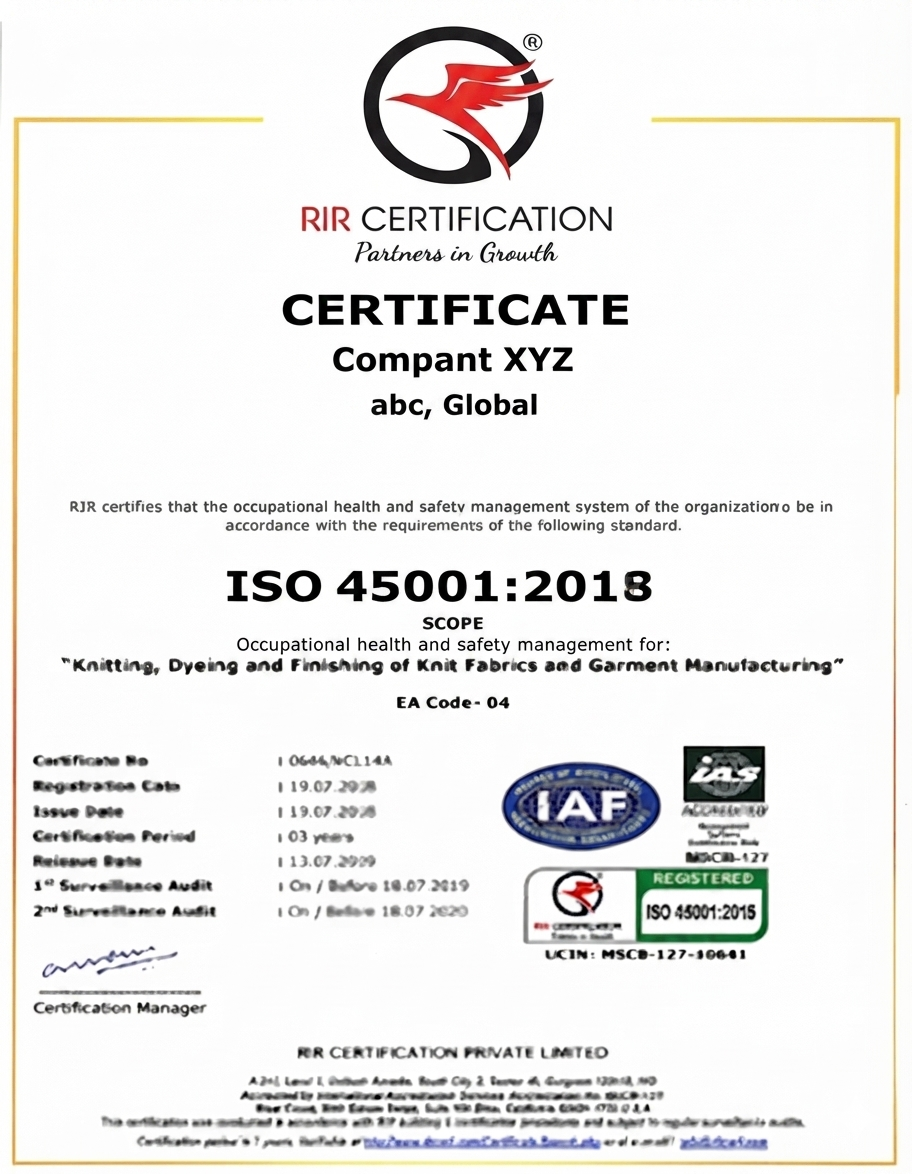
ISO 45001:2018: Occupational Health and Safety Management System
ISO 45001:2018 rounds out the trio of management standards most relevant to garment factories, alongside ISO 9001 and ISO 14001. It replaced the older OHSAS 18001 standard and follows the same overall ISO structure, so a factory can run quality, environment and safety systems together fairly easily.
Rather than certifying one specific safety outcome, ISO 45001 certifies that a company has a real system for spotting workplace hazards, managing risk, involving workers in safety decisions and improving safety over time. For a garment factory, that covers things like machine guards on cutting and sewing equipment, safe chemical handling in dye houses, reducing repetitive strain from sewing, fire evacuation plans and investigating accidents properly.
It overlaps a bit with the Safety Committee program used in Bangladesh, but ISO 45001 is a global, general-purpose standard rather than a country-specific program. More and more international buyers ask for it as proof of real safety management, on top of whatever local laws require.
Why ISO 45001:2018 is needed?
Workplace accidents are costly in every sense — human, legal and reputational. ISO 45001 gives factories outside Bangladesh (where the Accord program doesn't apply) a globally recognized way to prove they take worker safety seriously too.
Getting it: Any IAF-accredited certification body (BSI, SGS, Bureau Veritas, TÜV, DNV, Intertek). Factories that once held OHSAS 18001 typically move over to this through the same certifier.
ISO 45001:2018 at a glance:
- Replaced OHSAS 18001 as the global standard for workplace safety systems
- Covers hazard spotting, risk control and worker involvement in safety
- Works in any country or factory, not tied to one region's program
- Same three-year cycle as ISO 9001 and ISO 14001
ISO 50001: Energy Management System
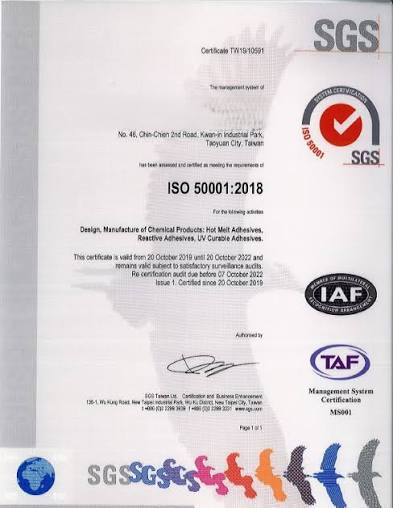
ISO 50001 is a management standard focused specifically on energy — how a factory measures, manages and keeps cutting its energy use. As energy costs and carbon-cutting promises have become bigger priorities for major clothing brands, ISO 50001 shows up more often in supplier reviews, especially for bigger, energy-heavy facilities like fabric mills and dye houses running their own boilers and generators.
Getting certified means writing an energy policy, doing a baseline energy review, setting real targets and tracking progress over time — similar to ISO 14001, but narrowed down to just energy. A factory working toward ISO 50001 usually looks at things like boiler efficiency, compressed air systems, lighting and machinery use, finding ways to cut consumption without hurting output.
Why ISO 50001 is needed?
Energy costs directly affect pricing and brands under pressure to cut their carbon footprint need suppliers who can show real progress on energy use, not just good intentions. ISO 50001 gives factories a documented way to prove both.
Getting it: Same route as the other ISO standards — any IAF-accredited body (BSI, SGS, Bureau Veritas, TÜV, DNV, Intertek). Factories that already have ISO 14001 tend to find layering this on more manageable.
ISO 50001 at a glance:
- A management standard focused purely on energy performance
- Requires a written energy policy, baseline review and real targets
- Especially relevant to energy-heavy places like mills and dye houses
- Increasingly requested as brands chase carbon-reduction goals
Environment and buildings (Higg Index FEM, LEED) — how green the factory or the building itself really is
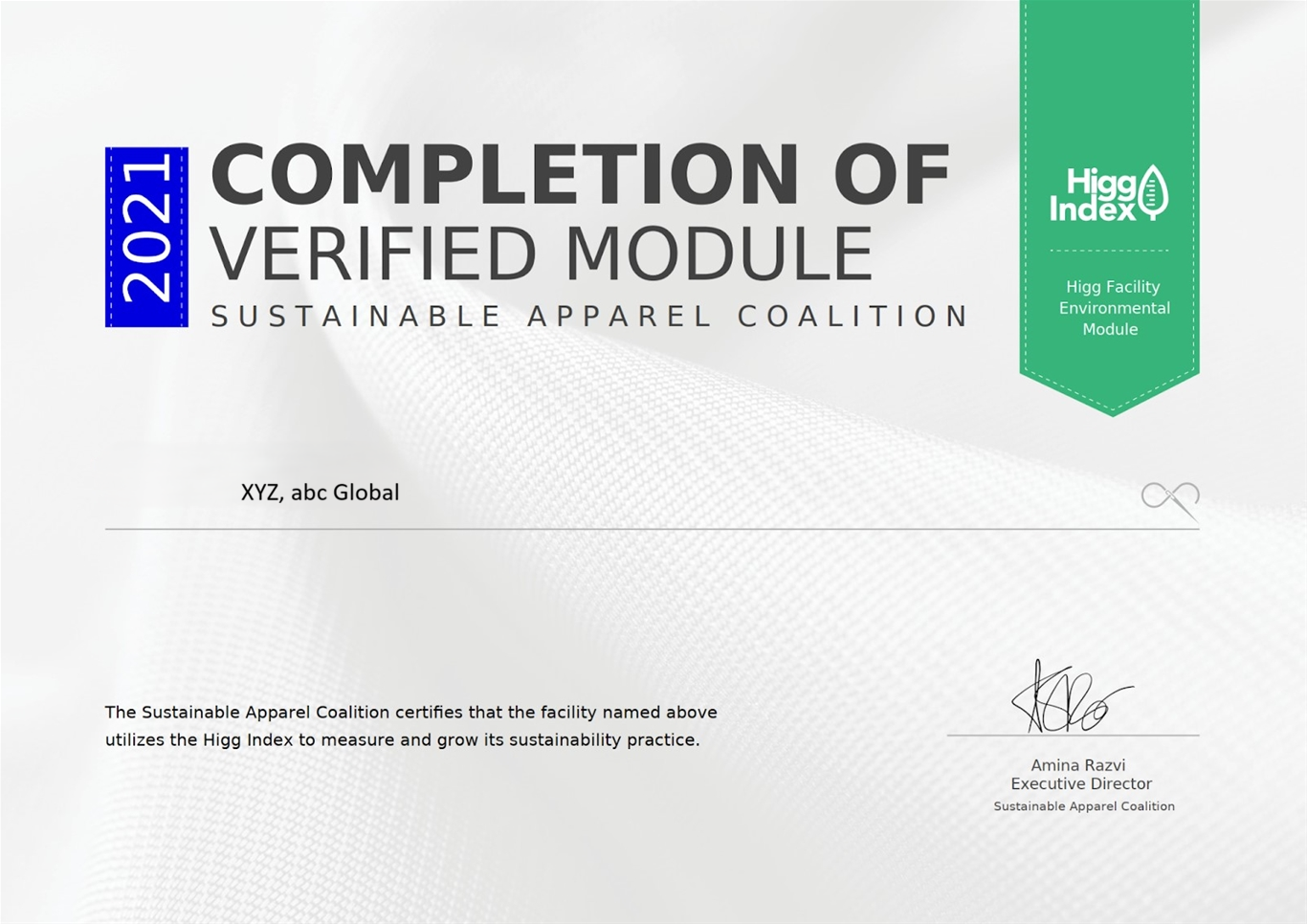
Higg Index Facility Environmental Module (FEM)
The Higg Index is a set of sustainability measurement tools first built by the Sustainable Apparel Coalition (now known as Cascale) and the Facility Environmental Module — Higg FEM — is the part that matters most to individual factories, mills and dye houses. Unlike most certifications here, Higg FEM started out as a self-reported tool, though outside verification of the scores has become common and is now often required by big brand partners.
Higg FEM asks a factory to report in detail on things like energy use and greenhouse gases, water use, wastewater, air emissions, waste management and chemical handling, producing a standardized score. This lets brands compare very different factories in very different countries using one shared scorecard, instead of every brand inventing its own.
Because so many of the biggest global clothing brands use the Higg Index internally, having a current, verified Higg FEM score has become close to a must-have for working with them — even though it's not a traditional pass/fail certificate the way GOTS or OEKO-TEX are.
Why Higg FEM is needed?
Big brands need to compare hundreds of suppliers across totally different countries on one common scale. Higg FEM is that shared scorecard — without a verified score, a factory simply can't be fairly compared or considered by brands that rely on the system.
Getting it: Register on Worldly (worldly.io, which now hosts the Higg tools), complete the self-assessment, then book third-party verification through an approved body on Cascale/Worldly's list — Bureau Veritas, SGS and Intertek are common ones.
Higg FEM at a glance:
- Built by the Sustainable Apparel Coalition (now Cascale)
- A standardized environmental self-report, increasingly verified by outsiders
- Covers energy, water, wastewater, emissions, waste, chemicals
- Required by many major global apparel and footwear brands
LEED Certification (Leadership in Energy and Environmental Design)
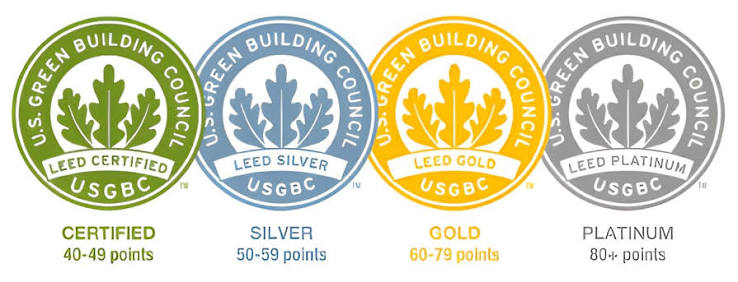
LEED is a green building certification from the U.S. Green Building Council and unlike everything else here, it doesn't check a product, material or management system — it checks the actual building. LEED looks at things like energy efficiency, water use, materials, indoor air quality and how sustainable the site itself is, giving out one of four levels: Certified, Silver, Gold or Platinum.
LEED is still fairly rare for garment factories compared to office buildings or stores, but it's gaining ground among bigger, vertically integrated manufacturers building new facilities who want green credentials to go with their other environmental certificates, like ISO 14001 or ISO 50001. A LEED-certified factory building shows that sustainability was built into the walls, lighting, insulation and water systems — not just the processes happening inside.
Why LEED is needed?
As sustainability becomes a bigger part of brand storytelling, some buyers want to know the building itself was designed responsibly, not just the products made inside it. LEED gives large manufacturers a way to prove that and to stand out from competitors on facility-level credentials.
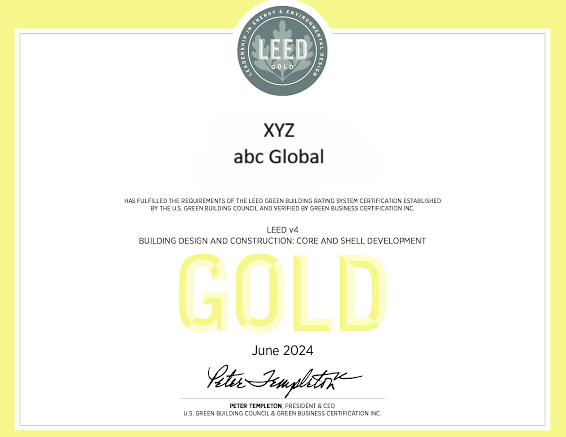
Getting it: Register the project on LEED Online / Arc through the U.S. Green Building Council (usgbc.org); certification itself is administered by GBCI, USGBC's certifying arm, which reviews the documentation — usually prepared with a LEED consultant — and awards the rating.
LEED at a glance:
- A green building certificate for the physical building, not a product or process
- Run by the U.S. Green Building Council
- Covers energy, water, materials and indoor air quality
- Four levels: Certified, Silver, Gold, Platinum
- Still uncommon for garment factories, but growing among bigger manufacturers
Building and worker safety (the Safety Committee Certificate under Accord/RSC) — could this building collapse and would anyone catch it
Safety Committee Certificate by ACCORD (RMG Sustainability Council)
This one has a very specific and important backstory, so let's start there before getting into what it actually covers.
The Accord on Fire and Building Safety in Bangladesh — usually just called "the Accord" — was formed right after the 2013 Rana Plaza building collapse in Dhaka, one of the deadliest industrial disasters in modern history, where over a thousand garment workers died when the building they worked in collapsed due to ignored structural problems. In response, a group of international clothing brands, retailers and trade unions signed a legally binding agreement to make Bangladeshi factories genuinely safe, instead of relying on the weak, unenforced local inspections that came before.
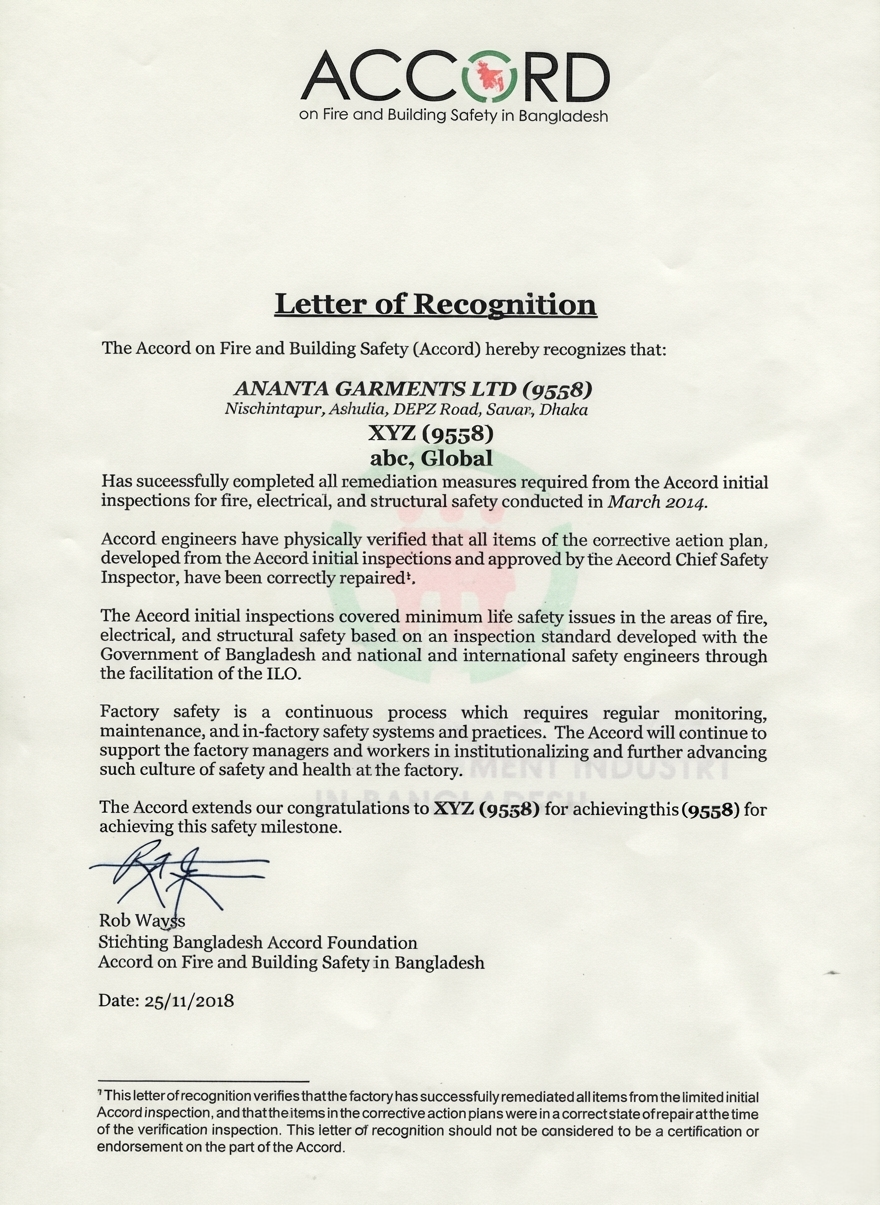
The Accord's original program involved independent inspections of factory buildings for fire, electrical and structural problems, mandatory fixes for anything found and — the part relevant here — setting up joint worker-management Safety Committees in every covered factory, with real training so those committees actually did their job and gave workers a genuine voice in reporting safety concerns.
Over time, the day-to-day work the Accord did in Bangladesh got handed over to a locally based group called the RMG Sustainability Council (RSC), formally set up in 2020. The RSC is a tripartite body — meaning industry groups, international brands and trade unions all sit on its board in roughly equal numbers — and it took over the Accord's staff, infrastructure and ongoing work in the country. Today, when people say "ACCORD certification" or "Safety Committee Certificate by ACCORD" for a Bangladeshi factory, they usually mean this ongoing program, now run through the RSC under the wider international Accord framework, which is still active in Bangladesh and has since expanded a similar model to Pakistan.
A Safety Committee Certificate specifically confirms that a factory has a properly set-up joint Safety Committee — made up of both elected worker reps and management — and that this committee has gone through real training on spotting hazards, doing safety walks, handling complaints and keeping communication open between the shop floor and management. This is separate from, but works alongside, the building's structural, fire and electrical safety inspection under the same broader program.
For a factory in Bangladesh and increasingly for factories elsewhere following similar models, holding a current Safety Committee Certificate is one of the clearest signs that worker safety isn't just a policy on paper — there's a real, working system where workers can raise concerns and expect them to be heard. Given where this certification came from, it carries real weight for buyers who want proof that a factory has actually learned from the industry's worst tragedy, not just met the bare legal minimum.
Why Safety Committee Certificate is needed?
After Rana Plaza, brands can no longer claim ignorance about factory safety — the consequences are simply too severe. This certificate is the direct, verifiable answer to the question every buyer sourcing from Bangladesh has to ask: could this building collapse and would anyone have caught it in time?
Getting it: Not something you shop around for. It applies to factories covered under agreements between the RMG Sustainability Council (rsc-bd.org, Dhaka) and brands sourcing from Bangladesh or Pakistan under the wider Accord. A covered factory works directly with the RSC, which handles the inspections, oversees committee elections, delivers training and issues the certificate.
Safety Committee Certificate at a glance:
- Rooted in the Accord on Fire and Building Safety in Bangladesh, formed after the 2013 Rana Plaza collapse
- Now run in Bangladesh through the RMG Sustainability Council (RSC), set up in 2020
- Confirms a properly set-up joint worker-management Safety Committee
- Requires training on spotting hazards, safety walks and handling complaints
- Separate from, but paired with, structural/fire/electrical building safety checks
Supply chain security (CTPAT, GSV, SCAN) — protection against theft, tampering, smuggling
CTPAT: Customs Trade Partnership Against Terrorism
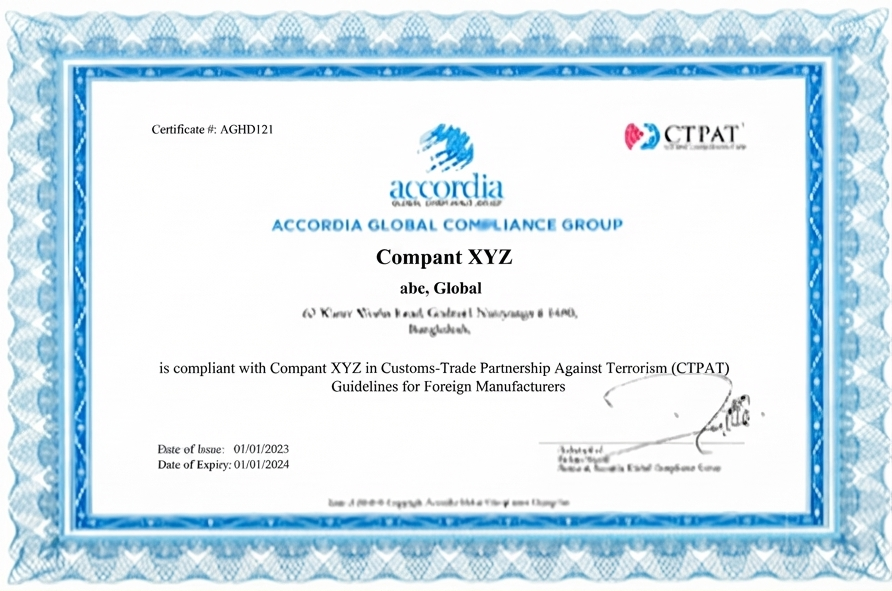
CTPAT (Customs Trade Partnership Against Terrorism) is a voluntary supply chain security program established by U.S. Customs and Border Protection (CBP). It was created to strengthen the security of goods moving into the United States and to reduce risks such as terrorism, cargo theft, smuggling and tampering.
Unlike social compliance programs that focus on workers' rights, CTPAT focuses on supply chain security. Participating companies must identify potential risks and implement security controls covering facilities, cargo handling, transportation, personnel, information technology and business partners.
Here's how it works in practice: a company submits its security profile to CBP, documents its security procedures and undergoes validation by CBP officials. Security measures are reviewed regularly and companies must continuously improve their controls to maintain compliance.
Because many U.S. importers and retailers value secure supply chains, CTPAT membership has become an important advantage for manufacturers and logistics providers that export to the United States. Members may benefit from fewer cargo inspections, faster customs processing and stronger relationships with trading partners.
One thing worth knowing: CTPAT is not a one-time certification. It is an ongoing partnership that requires companies to regularly assess risks and maintain effective security practices.
Why CTPAT is needed?
Many U.S. buyers prefer suppliers that participate in CTPAT because it demonstrates a commitment to supply chain security. It helps reduce the risk of delays, cargo losses and security incidents while ensuring smoother trade operations.
Getting it: No outside auditor here — apply directly through CBP's own CTPAT Portal (cbp.gov). CBP itself reviews and periodically revalidates.
CTPAT at a glance:
- Managed by U.S. Customs and Border Protection (CBP)
- Focuses on supply chain security and risk management
- Covers cargo, facility, transportation, personnel and IT security
- Provides benefits such as fewer inspections and faster clearance
- Widely recognized by U.S. importers and global logistics companies
GSV: Global Security Verification
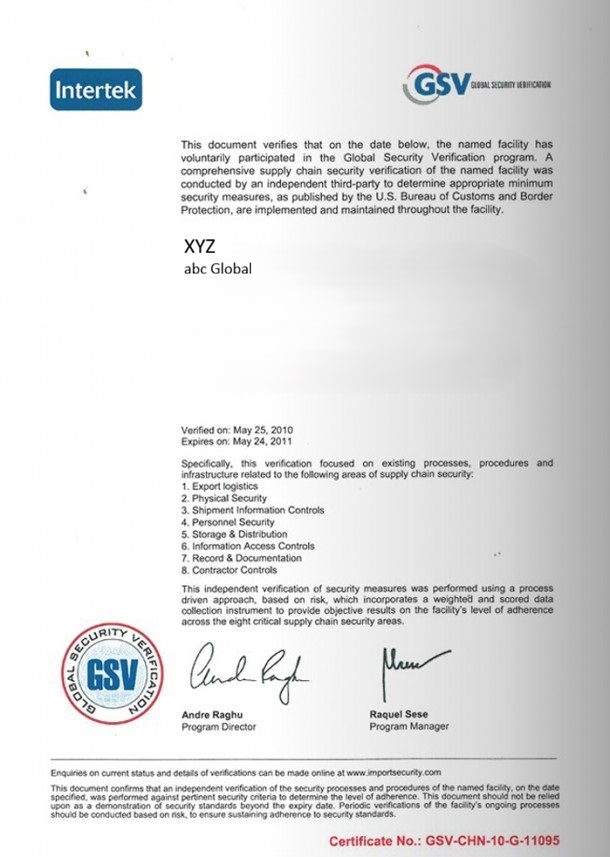
GSV (Global Security Verification) is an internationally recognized supply chain security assessment program used by manufacturers, importers, retailers and logistics providers. It helps companies verify that their facilities meet accepted global security standards.
GSV focuses on protecting supply chains from risks such as theft, cargo tampering, unauthorized access and other security threats. The program evaluates areas including physical security, employee screening, cargo handling, transportation security, information security and crisis management.
Here's how it works in practice: an independent auditor visits the facility, reviews security procedures, inspects physical security controls, interviews key personnel and evaluates how security risks are managed. The results are then documented in a detailed assessment report.
Because global brands increasingly expect secure supply chains, a strong GSV assessment helps demonstrate that a company has effective security systems in place. Many organizations use GSV results to build trust with customers and business partners around the world.
One thing worth knowing: GSV focuses entirely on supply chain security. It does not assess labor practices, environmental performance or product quality.
Why GSV is needed?
Companies need assurance that products move through secure facilities and transportation networks. GSV provides independent verification that a business is effectively managing security risks and protecting its supply chain.
Getting it: Book through an accredited third-party security auditing firm — often the same large firms handling other supply chain audits, like Bureau Veritas or Intertek. Since it's not run out of one central office, it's worth confirming with your buyer or auditor exactly which GSV program they need.
GSV at a glance:
- International supply chain security assessment program
- Evaluates facility, personnel, cargo and information security
- Conducted through independent third-party audits
- Helps reduce risks such as theft and tampering
- Recognized by many global retailers and importers
SCAN: Supplier Compliance Audit Network
SCAN (Supplier Compliance Audit Network) is a collaborative supply chain security audit program developed by major retailers, manufacturers, importers and logistics companies. Its purpose is to provide a common security audit that can be shared among multiple customers.
SCAN focuses on preventing theft, smuggling, terrorism, cargo diversion and other supply chain security risks. The program promotes consistent security standards across international trade networks while reducing the need for duplicate customer audits.
Here's how it works in practice: qualified auditors evaluate facility security, access controls, cargo handling procedures, transportation security, employee awareness and overall risk management practices. The resulting audit report can then be shared with participating SCAN members.
Because many companies accept a single SCAN audit, suppliers can avoid repeated security assessments from multiple customers. This saves time, reduces costs and creates a more efficient approach to demonstrating supply chain security compliance.
One thing worth knowing: SCAN is focused on supply chain security performance, not on labor standards, environmental compliance or product quality requirements.
Why SCAN is needed?
Large retailers and importers need a reliable way to assess supplier security practices. SCAN provides a standardized approach that reduces audit duplication while ensuring suppliers maintain effective security controls.
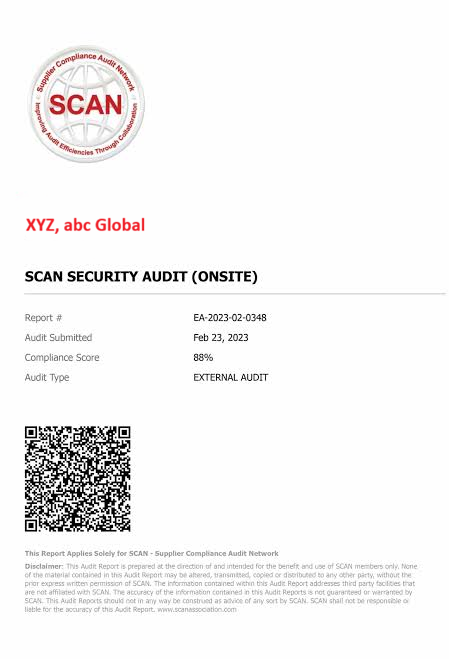
Getting it: Book through a SCAN-qualified auditing firm; since the network runs through participating retailers and manufacturers rather than one public registration point, ask your buyer which auditor to use.
SCAN at a glance:
- Shared supply chain security audit program
- Reduces the need for multiple customer security audits
- Evaluates facility, cargo, transportation and access security
- Supports international supply chain security requirements
- Used by retailers, importers, manufacturers and logistics providers
Certification bodies (Control Union and similar)
Control Union Certification
Control Union isn't a standard by itself — it's one of the largest independent inspection and certification companies in the world, accredited to audit and issue certificates for many of the standards in this guide, including GOTS, OCS, RCS and GRS. When a factory says its GOTS certificate was "issued by Control Union," that just means Control Union is the company that actually did the audit and handed out the certificate — similar to any accredited body working under the ICS framework.
Control Union operates worldwide, with offices and auditors across major garment-producing countries and its work goes well beyond textiles into food, farming and forestry certifications too. For factories and buyers, seeing "Control Union" on a certificate is really just confirmation of who did the independent check — a recognizable, trusted name behind the standard itself.
Why Control Union is needed?
A certificate is only as trustworthy as the body that issued it. Knowing an internationally accredited name like Control Union stood behind the audit gives buyers real confidence the check was done properly, not rubber-stamped.
Getting it: You don't apply for "Control Union certification" as its own thing — you contact your nearest Control Union office (controlunion.com has a country directory) and book an audit for whichever underlying standard you actually need.
Control Union at a glance:
- An independent, globally accredited certification company, not a standard itself
- Authorized to audit and issue GOTS, OCS, RCS, GRS and other certificates
- Similar in role to other accredited bodies under the ICS framework
- Operates across major garment-producing countries worldwide
AJA-UKAS: UKAS-Accredited Certification
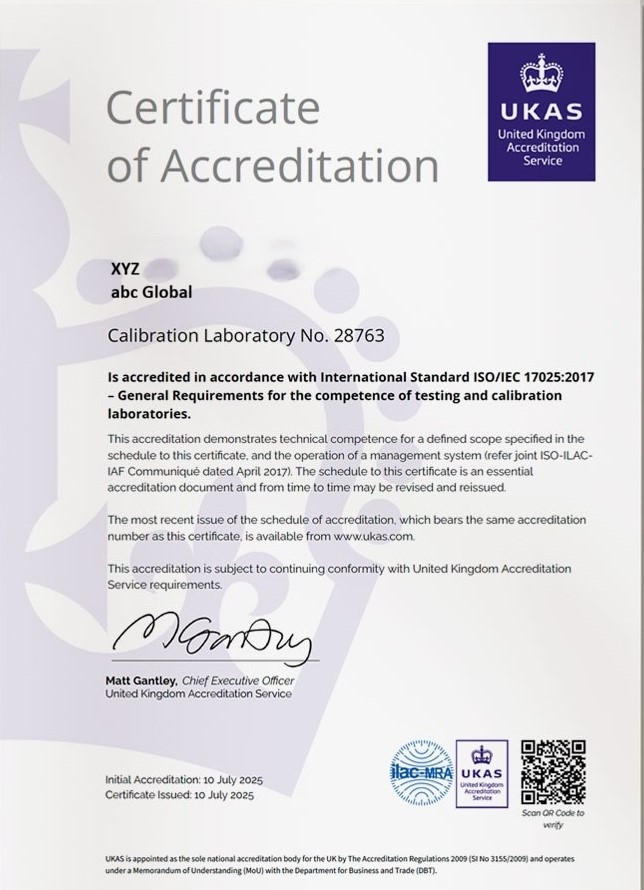
AJA-UKAS refers to certifications issued by AJA Registrars, an independent certification body accredited by the United Kingdom Accreditation Service (UKAS). UKAS accreditation confirms that certification activities are carried out according to internationally recognized requirements and auditing standards.
AJA-UKAS certification provides independent verification that an organization's management systems meet the requirements of internationally recognized standards such as ISO 9001 (Quality Management), ISO 14001 (Environmental Management) and ISO 45001 (Occupational Health and Safety Management).
Here's how it works in practice: a company implements the requirements of a management system standard and undergoes a detailed audit conducted by AJA Registrars. Auditors review processes, records, policies and operational practices to verify compliance. If the requirements are met, a UKAS-accredited certificate is issued. Regular surveillance audits are then conducted to ensure ongoing compliance and continuous improvement.
Because UKAS-accredited certifications are recognized worldwide, many customers, brands and business partners prefer suppliers that hold AJA-UKAS certifications. These certifications demonstrate that an organization follows structured management systems and is committed to maintaining internationally accepted standards.
One thing worth knowing: AJA is the certification body that conducts the audits, while UKAS is the accreditation authority that validates the competence and credibility of the certification process.
Why AJA-UKAS is needed?
Organizations need a reliable way to demonstrate that their management systems meet international standards. AJA-UKAS certification provides independent assurance to customers, regulators and business partners that management processes are effectively controlled and continuously improved.
Getting it: Apply directly to AJA Registrars, the UK-based body itself, for whichever ISO standard you're after. Application, a quote, a Stage 1 document review, a Stage 2 on-site audit, then yearly follow-ups.
AJA-UKAS at a glance:
- UKAS-accredited certification issued by AJA Registrars
- Provides independent verification of management system compliance
- Commonly used for ISO 9001, ISO 14001 and ISO 45001 certifications
- Requires third-party audits and ongoing surveillance assessments
- Demonstrates commitment to quality, safety and operational excellence
- Widely recognized by international customers and business partners
How These Certifications Work Together
It's worth stepping back here: no single certification tells the whole story. A factory could hold OEKO-TEX certification proving its fabric is chemically safe, while still treating workers badly in ways a BSCI or SEDEX audit would catch. Or a factory could run excellent worker safety programs but have no real proof that its "organic" cotton is actually organic. This is exactly why serious buyers look for a mix of certifications, not just one.
A well-rounded, trustworthy factory today usually layers several of these together:
- A worker-treatment audit (BSCI, SEDEX/SMETA, WRAP or SA8000) to prove fair labor practices
- Material certificates (GOTS, OCS, RCS or GRS, depending on the fiber) to back up sustainability claims
- OEKO-TEX certification across fabric, yarn, thread and garment to guarantee chemical safety
- ISO 9001, ISO 14001, ISO 45001 and ISO 50001 to show quality, environment, safety and energy use are all managed properly, not just left to chance
- For factories in Bangladesh, a current Safety Committee Certificate under the Accord/RSC framework, proving building and worker safety
Put all of this together and something genuinely useful happens: a brand on the other side of the world can trust a factory it may never actually visit, based on independent, standardized checks instead of just the factory's word. For factories, chasing these certifications isn't just about paperwork — it opens doors to buyers who won't even talk to an uncertified supplier and it often pushes real improvements in how the factory treats its workers and runs its operations.
Global Certification Bodies
| Certification Body | Website | Phone | |
|---|---|---|---|
| Control Union | controlunion.com | info@controlunion.com | +31 76 579 6000 |
| SGS | sgs.com | bd@sgs.com (Bangladesh office) | +88 029632535 (Dhaka) |
| Bureau Veritas | bureauveritas.com | bv.dhaka@bureauveritas.com | +88 02 48814903 (Dhaka) |
| Intertek | intertek.com | bpcerthelpdesk@intertek.com | +1 855 944 2378 (Global) |
| TÜV Rheinland | tuv.com | tuvcert@de.tuv.com | +49 800 888 2378 (Germany HQ) |
| TÜV SÜD | tuvsud.com | info@tuvsud.com | +49 89 5791 0 (Munich HQ) |
| DNV | dnv.com | business.assurance@dnv.com | +1 281 396 1000 (Houston HQ) |
| UL Solutions | ul.com | info@ul.com | +1 877 854 3577 (Global) |
| Ecocert | ecocert.com | info.ecocertusa@ecocert.com | +1 888 337 8246 (USA office) |
| SCS Global Services | scsglobalservices.com | info@scsglobalservices.com | +1 510 452 8000 (California HQ) |
| Preferred by Nature | preferredbynature.org | info@preferredbynature.org | +45 7020 8666 (Denmark HQ) |
| IMO/Ecocert (Germany) | ecocert.com | heike.steiger@ecocert.com | +49 7531 9429136 (Konstanz office) |
OEKO-TEX Member Institutes
| Institute | Website | Phone | |
|---|---|---|---|
| Hohenstein | hohenstein.com | bangladesh@hohenstein.com | +880 1755524666 (Dhaka office) |
| TESTEX | testex.com | info@testex.com | +41 44 501 26 00 (Zurich HQ) |
| CETI | oekotex.com | info@oekotex.com | +41 44 501 26 00 (Zurich HQ, OEKO-TEX central) |
| CTC | oekotex.com | info@oekotex.com | +41 44 501 26 00 (Zurich HQ, OEKO-TEX central) |
Frequently Asked Questions
Do I need all of these certifications to sell to international buyers? Not all at once — it really depends on who you're selling to and what you're making. A fast-fashion buyer sourcing basic cotton t-shirts might mainly want a solid SEDEX or BSCI audit plus OEKO-TEX on the fabric. A premium sustainable brand working with organic cotton is much more likely to want GOTS or OCS on top of those same safety and labor checks. It's rare to see a serious, established factory with none of these — but the exact mix depends on the buyer and the materials involved.
How long does it take to get certified? It varies a lot. A SMETA or BSCI audit can often be booked and finished within a few weeks, since it's checking conditions as they exist right now. GOTS usually takes longer, since it needs a full paper trail built across every stage of the supply chain before the first audit can even happen. ISO 9001, ISO 14001 and ISO 45001 usually take months of internal system-building before an outside auditor even shows up.
Do these certifications need to be renewed or are they one and done? Almost all of them need renewal. OEKO-TEX certificates last one year and need fresh testing, since formulas and suppliers change. GOTS and OCS need yearly checks and fresh paperwork for every batch. ISO standards usually run on a three-year cycle with yearly check-ins, plus a full recheck when the cycle ends. Even BSCI and SEDEX audits expire, usually within one to two years. None of these are "set it and forget it" — they're ongoing commitments, not a framed certificate you hang on the wall and never think about again.
Can a small factory actually afford all of this? It's a fair worry and the industry is still working on it. Audit fees, testing costs and the time spent fixing gaps can be a real burden for smaller factories competing against bigger, better-funded ones. That said, things have gotten more accessible over time: shared platforms like SEDEX cut down on repeat audit costs, some brands help pay for audits for suppliers they rely on and certification bodies increasingly offer combined audits covering several standards in one visit. For a factory serious about growing its export business, certification costs are generally seen as just part of doing business at that level — one that usually pays for itself by opening doors that would otherwise stay closed.
What happens if a factory fails an audit or falls short? It's rarely a final, instant rejection. Most of these systems — BSCI, SEDEX, GOTS, the ISO standards — are built around fixing problems, not simple pass/fail results. When an audit finds gaps, the factory usually gets a clear report on what needs to change and a deadline to fix it, followed by a check to confirm the fix actually happened. Serious violations — like evidence of forced labor, child labor or life-threatening safety hazards — get treated much more strictly and can end the relationship entirely. But for most routine gaps, the system is built to push improvement, not just kick a factory out.
Final Thoughts
The certifications covered here — worker-treatment programs like BSCI, SEDEX, WRAP and SA8000; material standards like GOTS, OCS, RCS, GRS and the various cotton and forestry programs; chemical and quality checks like OEKO-TEX, ZDHC and USTERIZED; management standards like ISO 9001, ISO 14001, ISO 45001 and ISO 50001; environmental and building programs like Higg FEM and LEED; and the Safety Committee Certificate under the Accord/RSC framework — each answer a different question about how a garment actually came to exist. Put together, they paint a fairly complete picture: Was it made fairly? Are the materials what they claim to be? Is it safe to wear? Is the factory well-run, careful with energy and consistent? Is it environmentally responsible? And most importantly — is the building itself and the people working inside it, actually safe?
None of these certifications are perfect. The industry is still figuring out how to make audits more reliable, cut down on greenwashing and support smaller factories instead of pricing them out. But taken together, this whole system marks a real, hard-won shift in how the garment industry works — moving away from blind trust and toward proof you can actually check.
If you're a factory trying to grow or a brand trying to source responsibly, understanding what each of these certifications actually checks — instead of just treating them as logos on a page — is one of the most useful things you can do. It's how you make smart, confident decisions in an industry that, at its best, genuinely improves the lives of millions of workers around the world.