A fashion design usually starts long before fabric is cut or a sample is sewn. It may begin with a rough idea, a photograph, a piece of fabric, a colour combination or simply something the designer has noticed and wants to explore. At this stage, the idea exists mainly in the designer's mind. The challenge is turning that idea into something other people can see, discuss and eventually produce.
This is where visualization and representation become important. Visualization is concerned with making a design idea visible, while representation is about communicating that idea clearly to the people involved in developing and selling the product. A designer may need to explain the same concept differently to a client, a pattern maker, a garment factory, a buyer or a marketing team.
There is no single method that works for every stage of fashion development. A quick pencil sketch may be enough when an idea first comes to mind. Later, a technical flat may be needed to explain construction details, while a fabric rendering can help show how the material is expected to look and behave. Digital tools and 3D software add another level of visualization by allowing designers to examine a garment before a physical sample is made.
Together, these methods connect the original design idea with the finished product. They help reduce confusion, make design decisions easier to discuss and give everyone involved a clearer picture of what is being developed.
Understanding Visualization in Fashion Design
Visualization is essentially the process of making an imagined design visible. A designer might picture a flowing evening gown, a sharply structured blazer or a relaxed streetwear hoodie, but none of those ideas can be evaluated properly until they are expressed in some visible form.
That expression can take many forms. It might be a pencil sketch, a detailed illustration, a draped fabric experiment, a digital drawing or a realistic 3D garment. The appropriate method depends largely on what the designer is trying to communicate at that particular stage.
Representation takes the idea a little further. It is not simply about making an attractive picture; it is about making the designer's intention understandable to someone else. A manufacturer needs to know how a garment is constructed. A client may be more interested in its overall appearance. A buyer may want to understand whether the design fits the intended market.
Good visualization therefore has a practical purpose. It can prevent misunderstandings, reduce unnecessary development work and make communication between different members of a design team much easier.
Fashion Sketching
Fashion sketching is still one of the simplest ways to capture a design idea. Often, it is the first thing a designer does after an idea takes shape. The drawing does not have to be polished. Its main job is to record the concept before the designer moves on to another idea.
At this stage, attention is usually given to silhouette, proportion, garment shape and overall styling rather than every construction detail. Many designers work with a croquis or a pre-drawn fashion figure, because it allows several ideas to be explored quickly.
Sketching is useful because it:
Makes it possible to record ideas quickly
Gives designers room to experiment
Makes different design options easier to compare
Needs very few tools
Provides a starting point for later development
Imagine a designer developing a spring blouse collection. Within a short period, the designer might draw several versions of the same garment, changing the neckline, sleeve shape, length or overall silhouette. Some ideas may be discarded almost immediately, while one or two may be developed further.
Digital design tools have become common, but sketching has not disappeared. A pencil and paper can still be useful when the designer wants to work quickly without worrying about software settings, measurements or technical precision.

Fashion Illustration
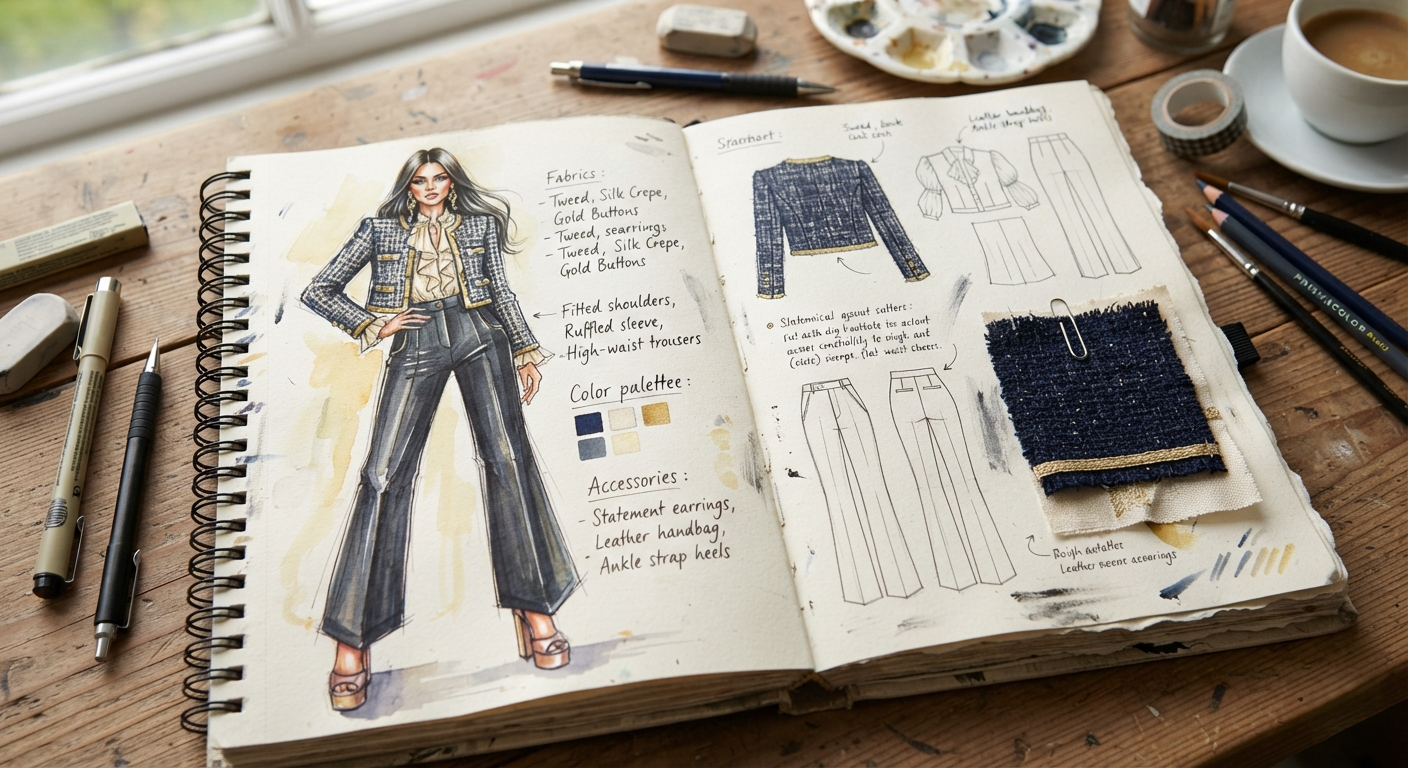
Fashion illustration is more developed than an initial working sketch. It combines garment representation with an artistic approach and is often used when the designer wants to communicate not only what the garment looks like but also the feeling surrounding the collection.
An illustration may include:
Stylized fashion figures
More developed garment details
A clear suggestion of fabric movement
Carefully selected colours
Artistic composition and presentation
Because of this visual emphasis, fashion illustrations are commonly found in:
Designer portfolios
Client presentations
Fashion magazines
Marketing materials
Collection launch presentations
A good illustration can communicate something that a plain technical drawing cannot. The posture of the figure, the choice of colour, the treatment of texture and even the amount of empty space around the garment can influence how the viewer interprets the design.
Consider a flowing chiffon evening dress rendered with soft watercolour tones. Even before seeing the actual garment, the viewer may associate the design with lightness, movement and elegance. The illustration is therefore communicating both the garment and its intended mood.
Flat Sketches and Technical Drawings
Fashion illustration is largely concerned with visual appeal, whereas a technical drawing has a different job: accuracy.
A flat sketch, sometimes called a technical drawing, represents the garment without putting it on a fashion figure. The garment is shown in a simplified, flat form so that its construction can be understood more easily.
Depending on the garment, the drawing may identify details such as:
Seams
Stitching lines
Pockets
Buttons
Zippers
Pleats
Collars
Measurement references
Technical drawings are particularly important when a design moves from the creative stage into production. They provide a common visual language between designers, pattern makers, product developers and garment manufacturers.
For instance, a men's shirt may require information about the collar, cuffs, yoke, button positions and stitching. Those details need to be communicated clearly enough that a manufacturer can interpret the design without having the designer physically present.
This is why a technical drawing is not simply a cleaner version of a fashion illustration. It has a production-oriented purpose. When important construction information is missing or unclear, the chances of sampling and production errors increase.
Mood Boards and Inspiration Boards
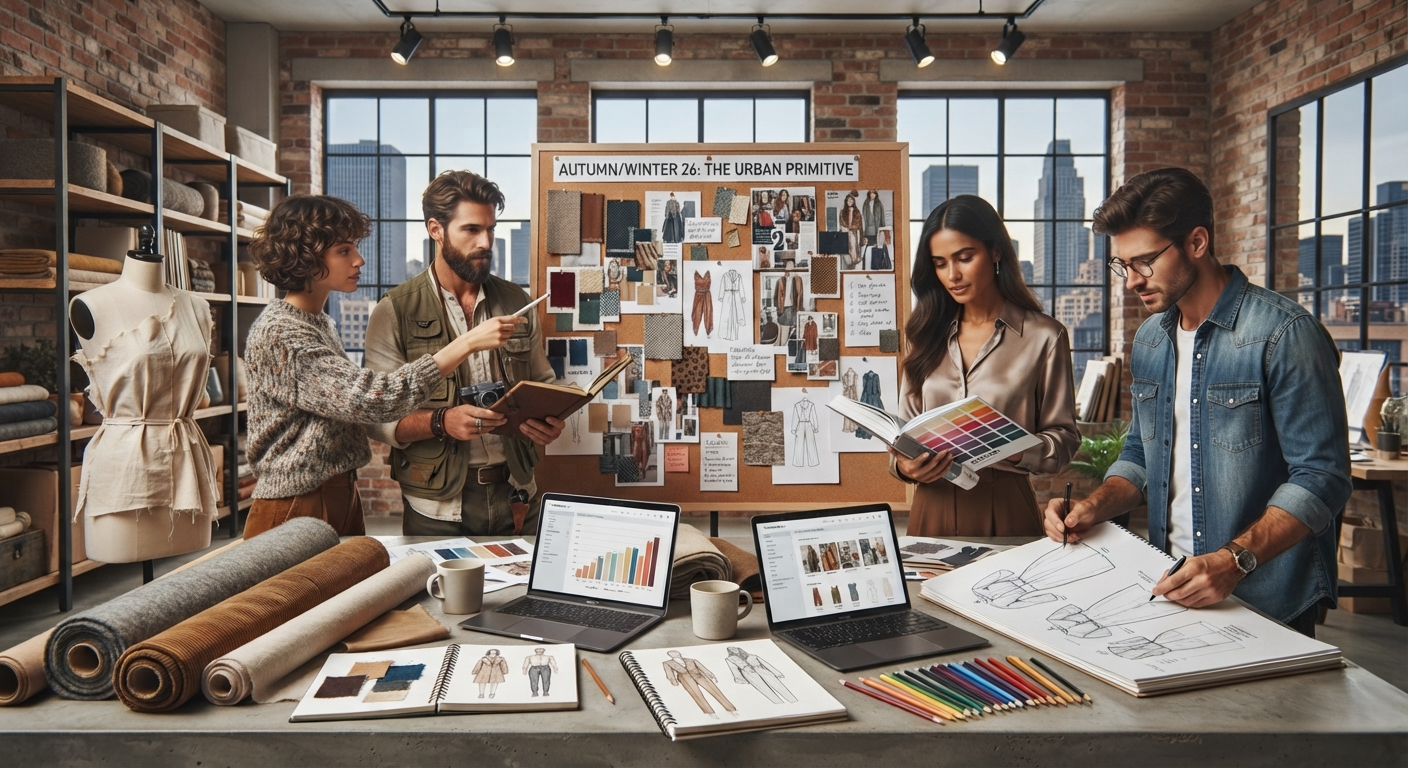
A mood board brings together the visual references behind a design concept. It may contain photographs, colours, textures, fabrics, artwork, architecture, typography and other images that help establish the direction of a collection.
A typical mood board might contain:
Nature photographs
Architecture
Artwork
Fabric swatches
Colour samples
Cultural references
Typography
Lifestyle photographs
The value of a mood board is not simply that it looks attractive. It gives the designer a visual reference to return to while developing individual garments. This becomes particularly useful when a collection contains many pieces and the designer needs to maintain a consistent identity.
For example, suppose a winter collection is inspired by mountain landscapes. The mood board could bring together snow-covered peaks, pine forests, wool textures, muted grey and brown shades and deeper green tones. These references provide a common visual direction for the collection.
Mood boards are also useful when a designer needs to explain an idea to someone who was not involved in its development. A client, investor, buyer or design team member can often understand the intended atmosphere more quickly from a group of carefully selected visual references than from a written description alone.

Color Story Development and Color Rendering
Colour can change the entire impression of a garment. The same silhouette can appear completely different when it is presented in another colour palette. For that reason, colour planning is an important part of fashion visualization.
Color rendering involves applying colours to sketches or illustrations so the designer can assess how the proposed garment might look. Designers may also develop a color story, which is a coordinated palette intended to work across an entire collection.
A well-planned colour story can:
Create visual harmony
Reinforce the collection theme
Support brand identity
Appeal to the intended customer
Help different garments work together as a collection
A summer range, for example, might use lavender, mint green, peach and sky blue. An autumn collection could move in a very different direction, using rust, olive green, chocolate brown and mustard yellow.
Working with colour digitally or through rendered sketches gives the designer an opportunity to compare combinations before committing to fabric production. It is much easier to test several alternatives at the visualization stage than to discover a problem after materials have already been purchased or samples produced.

Fabric Rendering Techniques
A garment is influenced not only by its shape and colour but also by the material from which it is made. Fabric rendering attempts to communicate these characteristics visually.
Different textiles have noticeably different appearances and behaviours. A rendering therefore needs to suggest qualities such as texture, weight, transparency, surface reflection and drape.
For example:
Silk can be represented as smooth and fluid
Velvet may require deeper shading to suggest its rich surface
Denim generally appears more firm and structured
Chiffon needs a lightweight and somewhat transparent appearance
Wool is often shown with a thicker, textured surface
These visual differences help the viewer form an expectation about how the garment will behave when worn. This is especially useful during concept development, when a physical sample may not yet exist.
A satin dress, for instance, would normally be expected to catch and reflect light. A cotton version of the same design would generally have a softer and more matte appearance. Showing this distinction in the design representation gives the viewer a better understanding of the proposed material.
Accurate fabric rendering can therefore support design decisions before the garment reaches the sampling stage.
Draping as a Three-Dimensional Technique
Draping offers a very different approach to visualization because the designer works directly with physical fabric. Instead of starting with a drawing, fabric is arranged and manipulated on a dress form or mannequin.
During the process, a designer can:
Experiment with garment shapes
Observe how the fabric behaves
Develop unusual silhouettes
Check balance and proportion
Adjust design details
Draping becomes particularly useful when a garment depends on folds, volume, asymmetry or other three-dimensional effects that can be difficult to predict accurately from a flat drawing.
A designer developing a couture evening gown, for example, might place silk over a mannequin and begin pinning, folding and rearranging the material. One arrangement may create too much volume, another may distort the balance, while a third may produce the desired effect. Once the form is satisfactory, it can be translated into patterns for further development.
This direct interaction with fabric gives the designer information that a two-dimensional sketch cannot always provide. For this reason, draping remains an important technique in luxury and haute couture design.

Computer-Aided Fashion Design (CAD)
Computer-Aided Design, commonly referred to as CAD, has changed the way many fashion designers develop and present their work. Digital tools allow designers to create drawings, modify details, test alternatives and store design information without having to start again from the beginning each time.
Commonly used software includes:
Adobe Illustrator
Adobe Photoshop
CorelDRAW
CLO 3D
Browzwear
CAD offers several practical benefits:
Faster design development
Easy modification of existing designs
More precise technical drawings
Professional presentation
Easier communication
Convenient digital storage and sharing
One of the biggest advantages is the ease with which changes can be made. A designer may want to alter a sleeve length, change the garment colour, move a print or test another design detail. With a digital file, these changes can often be made in a relatively short time.
This does not mean traditional methods have become irrelevant. Rather, CAD gives designers another set of tools that can make development faster and more controlled, particularly when a large number of design variations need to be explored.
3D Garment Visualization and Virtual Fashion
Three-dimensional visualization takes digital fashion design another step forward. Instead of looking only at a flat drawing, designers can create a digital garment and view it on a virtual model.
Depending on the software and setup, the simulation can represent aspects such as:
Fabric movement
Body fit
Stretch and tension
Garment construction
Lighting effects
There are several potential benefits:
Lower sample development costs
Shorter product development time
Earlier fit evaluation
Less material waste
More effective digital presentations
Consider a sportswear company developing a new jacket. Rather than immediately producing several physical samples, the design team can first build a digital version, place it on different virtual body shapes and examine how the garment responds to movement.
This approach can help identify design or fit issues earlier in the process. It can also reduce the number of physical samples required, which may lower material consumption and shorten development cycles.
As sustainability becomes a stronger consideration within fashion production, digital sampling and 3D visualization are likely to remain important areas of development.
Fashion Storyboards
A storyboard brings several parts of the design process together in a visual sequence. It can show where an idea came from, how the concept developed and how the different elements eventually became a collection.
A storyboard may combine inspiration images, sketches, fabrics, colour references, styling ideas and garment concepts. Rather than presenting these elements separately, it arranges them so the viewer can follow the development of the design.
Storyboards can be used to:
Show how a design developed
Explain a collection theme
Organize creative ideas
Strengthen the overall presentation
For example, a designer might begin a storyboard with an inspiration photograph, followed by selected colours and textures, early sketches, fabric references and finally developed garment designs. The result gives the viewer a visual path from the initial concept to the proposed collection.
This makes storyboards particularly useful during design reviews, academic presentations and meetings with clients.
Photography, Lookbooks and Visual Merchandising
Visualization does not stop once the garment has been designed and produced. The finished product still needs to be presented to its audience and photography becomes one of the main tools for doing this.
A lookbook is a collection of styled photographs used to present garments as part of a collection. The clothing itself is only one element of the image. The model, location, lighting, pose, styling and composition all influence the message.
A beachwear collection photographed beside a bright coastline will naturally create a different impression from the same garments photographed against a dark studio background. The products have not changed, but their visual context has.
Visual merchandising works in a similar way in a retail environment. Store displays, lighting, product placement, window arrangements and other presentation choices can affect how customers notice and interpret products.
These final representation techniques connect the design to the consumer. A well-designed garment still needs an effective presentation if the brand wants customers to understand its character and value.
Why Multiple Representation Techniques Are Necessary
No single visualization technique can handle every requirement in fashion design.
Each method has a particular role:
Sketches encourage quick creative exploration.
Illustrations communicate mood and visual character.
Mood boards establish the overall direction.
Technical drawings communicate construction details.
Draping allows designers to investigate three-dimensional form.
CAD makes digital development and modification more efficient.
3D visualization provides a more realistic view of fit and appearance.
Photography helps connect finished garments with consumers.
The audience also changes from one stage to another. A rough sketch may be perfectly understandable to another designer who is familiar with the concept, but it would not necessarily provide enough information for a factory. A technical drawing is much more appropriate for production, while a lookbook is designed with the customer or market in mind.
The strongest approach is therefore not to choose one technique and use it for everything. Designers generally get better results by combining different forms of representation as the product moves from an initial idea toward production and finally to the market.
Conclusion
Visualization and representation are central to the way fashion ideas are developed and communicated. They provide the means to take something that begins as an internal idea and gradually turn it into a design that other people can understand, evaluate, produce, promote and eventually purchase.
The process can start with something as simple as a pencil sketch or a mood board. As the concept develops, colour rendering, fabric representation, technical drawings, draping, CAD and 3D visualization may all become useful. At the final stage, photography, lookbooks and visual merchandising help communicate the completed product to the market.
Technology continues to change the tools available to fashion designers, particularly through digital CAD and three-dimensional garment simulation. Even so, the basic purpose remains the same: to make an idea visible and understandable.
A designer who can choose the right representation method for each stage of development can communicate more clearly, explore ideas with greater freedom, reduce avoidable production mistakes and maintain a stronger connection between the original concept and the final garment.