Imports are the lifeblood of today’s international trade. Billions of dollars’ worth of goods cross borders every day to connect manufacturers, suppliers, distributors and consumers around the world. Imports range from the raw materials that feed factories, to sophisticated machinery that helps build infrastructure and consumer products that fill retail shelves. They are essential to sustaining economic growth and meeting market demand.
In today’s interconnected global economy, not many countries are fully self-sufficient. To stay competitive, reduce costs, and increase product quality, companies routinely import products, components, and technologies from foreign suppliers. From a garment manufacturer importing cotton yarn to an automobile company sourcing electronic parts or a retailer importing consumer electronics, international procurement has become an integral part of business operations.
However, importing goods is not simply a matter of ordering from a foreign supplier and receiving a shipment. Each import transaction is subject to a complex web of international trade regulations, customs requirements, banking procedures, foreign exchange controls and documentary compliance obligations. Failure to meet these requirements can lead to shipment delays, financial losses, customs penalties, regulatory scrutiny and reputational damage.
Trade finance institutions, customs authorities, freight forwarders, logistics providers and regulatory agencies all play vital roles in ensuring that imports flow smoothly through the global supply chain. Banks are key intermediaries in the foreign exchange market, particularly Authorized Dealer (AD) Banks, who play an important role in facilitating foreign exchange transactions, issuing Letters of Credit (LCs), checking trade documents, and compliance with national and international standards.
Thus it is important for not only importers but also bankers, customs officials, auditors, supply chain professionals and regulators to understand the import process. A good import transaction protects business from operational disruption and offers transparency, accountability and regulatory compliance.
This guide is a comprehensive reference on the entire import process from the perspective of the international trade and trade finance professional. It covers all aspects of the import journey such as purchase orders, shipping arrangements, customs clearance, document scrutiny, lodgment of import bills, retirement of documents and regulatory reporting. Along the way, it highlights common challenges, best practices and emerging trends that are shaping the future of global trade.
Understanding Imports: Meaning and Scope
What Is an Import?
An import refers to the purchase and entry of goods or services into one country from another country. In simple terms, whenever a business, individual, or government acquires products or services from a foreign supplier, the transaction is considered an import.
Imports can involve a wide variety of products and services, including:
Raw materials
Industrial machinery
Consumer goods
Agricultural products
Energy resources
Software and technology services
Professional consulting services
For example, a construction company in Africa may import heavy equipment from Germany, while a clothing manufacturer in Bangladesh may import textile machinery from China. Similarly, a technology company in the United States may purchase software development services from India.
Imports generally fall into several categories:
Commercial Imports
Commercial imports are conducted by businesses for resale, manufacturing, processing, or operational use.
Examples include:
Electronics imported for retail distribution
Industrial chemicals imported for manufacturing
Machinery imported for production facilities
Industrial Imports
Many industries depend heavily on imported raw materials and capital equipment to maintain production efficiency.
Examples include:
Steel mills importing iron ore
Pharmaceutical companies importing active ingredients
Garment factories importing fabrics and machinery
Government Imports
Governments often import goods and services required for public infrastructure, healthcare, defense, and national development projects.
Examples include:
Medical equipment
Transportation systems
Energy infrastructure components
Service Imports
Not all imports involve physical goods. Many countries import services such as:
IT services
Engineering consultancy
Financial advisory services
Digital platforms and software subscriptions
As economies become increasingly digital, service imports continue to grow in importance alongside traditional merchandise trade.
Why Imports Matter in Global Trade
Imports contribute significantly to economic development, industrial growth, and consumer welfare. They allow countries to access products and resources that may not be available domestically while promoting efficiency and competitiveness.
Meeting Domestic Demand
No country can produce every product required by its population and industries. Imports help fill supply gaps and ensure that consumers have access to a broader range of goods.
For instance:
Countries with limited agricultural production may import food products.
Resource-constrained nations may import energy supplies.
Developing economies may import advanced technologies unavailable locally.
By supplementing domestic production, imports help maintain stable supplies and prevent shortages.
Supporting Industrial Growth
Many industries rely on imported raw materials, spare parts, and machinery to maintain production capacity.
Manufacturers often import:
Industrial equipment
Production machinery
Specialized components
Raw materials
Without these imports, production costs may increase significantly, reducing competitiveness in both domestic and international markets.
For example, Bangladesh's globally recognized garment industry imports large quantities of cotton, yarn, dyes, and machinery to support export-oriented manufacturing operations.
Accessing Advanced Technology
Technological innovation is often concentrated in specific regions of the world. Imports enable countries to gain access to advanced equipment, production techniques, and innovative products that enhance productivity and economic development.
Examples include:
Medical technology
Semiconductor manufacturing equipment
Renewable energy systems
Telecommunications infrastructure
These imports help businesses modernize operations and improve efficiency.
Diversifying Supply Chains
Global supply chain disruptions have highlighted the importance of diversification. Relying exclusively on domestic suppliers can expose businesses to production risks arising from natural disasters, political instability, labor shortages, or economic crises.
Imports enable organizations to:
Access alternative suppliers
Reduce procurement risk
Improve supply chain resilience
Enhance business continuity
Diversified sourcing strategies have become a critical component of modern supply chain management.
Enhancing Consumer Choice
Consumers benefit significantly from imports because they gain access to a wider variety of products, brands, and technologies.
Imported products often provide:
Better quality options
Competitive pricing
Innovative features
Greater product availability
This increased competition can also encourage domestic producers to improve quality and efficiency.
Global Regulatory Framework Governing Imports
International trade is heavily regulated to ensure fairness, transparency, security, and compliance. Import transactions must comply with both international standards and domestic regulations.
Several key frameworks govern global import activities.
World Trade Organization (WTO)
The World Trade Organization serves as the principal international body regulating global trade among nations.
The WTO establishes rules that promote:
Fair competition
Non-discrimination
Trade liberalization
Dispute resolution
Transparency in trade practices
Through various agreements, the WTO helps reduce trade barriers and facilitates smoother cross-border commerce.
For importers, WTO rules create a more predictable trading environment and reduce uncertainty in international transactions.
Uniform Customs and Practice for Documentary Credits (UCP 600)
UCP 600 is a globally recognized set of rules issued by the International Chamber of Commerce (ICC) governing documentary credit transactions.
These rules establish standardized procedures for:
Letters of Credit
Documentary examination
Presentation requirements
Banking obligations
Payment responsibilities
Because Letters of Credit are among the most widely used trade finance instruments, UCP 600 plays a crucial role in international imports.
Banks worldwide rely on these rules when examining trade documents and processing payments.
Incoterms
Incoterms, short for International Commercial Terms, define the responsibilities of buyers and sellers during international trade transactions.
They clarify:
Transportation responsibilities
Risk transfer points
Insurance obligations
Customs responsibilities
Cost allocation
Common Incoterms include:
EXW (Ex Works)
The seller makes goods available at its premises, and the buyer assumes nearly all transportation responsibilities and risks.
FOB (Free on Board)
The seller is responsible until the goods are loaded onto the vessel. Risk transfers to the buyer once loading is completed.
CFR (Cost and Freight)
The seller pays transportation costs to the destination port, but risk transfers once goods are loaded onto the vessel.
CIF (Cost, Insurance and Freight)
The seller provides freight and insurance coverage up to the destination port.
DDP (Delivered Duty Paid)
The seller assumes maximum responsibility by delivering goods to the buyer's location while covering duties, taxes, and transportation costs.
Selecting the appropriate Incoterm is critical because it directly impacts costs, risk exposure, and documentation requirements.
National Regulatory Authorities
Beyond international frameworks, every country maintains its own regulatory structure governing imports.
Key authorities typically include:
Central Banks
Central banks regulate foreign exchange transactions and oversee cross-border payment mechanisms.
Responsibilities often include:
Foreign exchange monitoring
Trade payment oversight
Import reporting requirements
Currency control regulations
Customs Authorities
Customs administrations manage:
Import declarations
Duty assessment
Cargo inspections
Revenue collection
Border security
Trade Ministries
Trade ministries develop national trade policies and administer import licensing requirements where applicable.
Revenue Authorities
Revenue agencies ensure collection of:
Customs duties
Value-added taxes (VAT)
Import levies
Regulatory fees
Together, these institutions create a comprehensive framework that balances trade facilitation with regulatory oversight.
Import Process Flow: Step-by-Step Overview
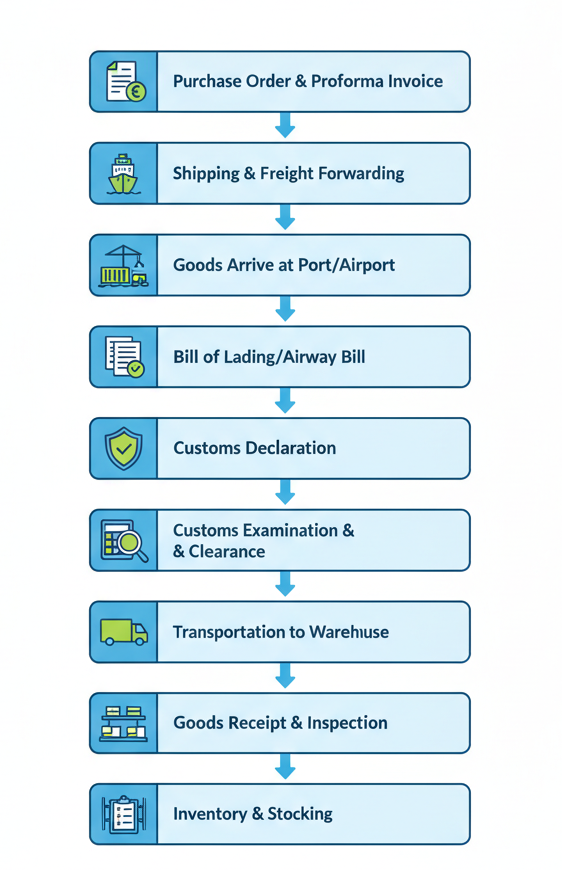
A successful import transaction follows a structured sequence of events. While procedures may vary slightly between countries, the overall process remains remarkably consistent worldwide.
The typical import process includes:
- Purchase Order and Proforma Invoice
- Shipping and Freight Forwarding
- Arrival of Goods at Port or Airport
- Bill of Lading or Air Waybill Issuance
- Customs Declaration
- Customs Examination and Clearance
- Transportation to Warehouse
- Goods Receipt and Inspection
- Inventory and Stocking
Each stage involves specific documentation, compliance requirements, and stakeholder responsibilities.
In the following sections, we will examine each stage in detail and explore the critical role that banks, customs authorities, and importers play in ensuring smooth and compliant international trade operations.
Import Process Flow: Step-by-Step Overview
1. Purchase Order and Proforma Invoice
Every import transaction begins with communication and negotiation between the buyer and the overseas supplier. Before any goods are manufactured, packed, or shipped, both parties must agree on the commercial terms of the transaction.
The importer typically sends a purchase inquiry outlining product specifications, quantities, delivery schedules, and quality requirements. After negotiations are completed, the exporter issues a Proforma Invoice, which acts as a preliminary commercial document describing the proposed transaction.
A Proforma Invoice generally includes:
Product description
Quantity
Unit price
Total transaction value
Payment terms
Shipment schedule
Port of loading and destination
Applicable Incoterms
Validity period of the offer
The importer uses this document for various purposes, including:
Internal approvals
Import licensing requirements
Bank financing applications
Letter of Credit issuance
At this stage, accuracy is essential. Errors in product descriptions, pricing, or shipment terms can create significant problems later during customs clearance or document verification.
Common Mistakes Importers Make
Many import complications originate at the negotiation stage. Common issues include:
Vague product specifications
Incorrect Incoterm selection
Unrealistic delivery deadlines
Ambiguous payment terms
Failure to verify supplier credentials
Conducting supplier due diligence before placing an order significantly reduces operational and financial risks.
2. Shipping and Freight Forwarding
Once the order is confirmed, shipment arrangements begin.
This stage involves coordinating transportation from the supplier's location to the importing country. Depending on the shipment size, urgency, and cost considerations, goods may be transported via:
Ocean freight
Air freight
Rail transport
Road transport
Multimodal logistics solutions
Role of Freight Forwarders
Freight forwarders serve as logistics specialists who coordinate the movement of cargo across international borders.
Their responsibilities often include:
Cargo booking
Route planning
Documentation preparation
Container arrangements
Customs coordination
Cargo tracking
Freight forwarders act as a bridge between exporters, importers, shipping companies, customs authorities, and transport operators.
Managing Transportation Risks
International shipping carries inherent risks, including:
Weather disruptions
Port congestion
Political instability
Labor strikes
Cargo damage
Documentation delays
To mitigate these risks, importers should:
Obtain adequate insurance coverage
Work with reputable freight forwarders
Monitor shipment progress regularly
Maintain contingency plans for delays
Effective logistics management directly impacts delivery timelines and overall supply chain performance.
3. Goods Arrive at Port or Airport
After transportation, goods reach the destination country's port, airport, or border terminal.
Arrival does not mean immediate delivery to the importer. Before goods can be released, they must undergo customs procedures and regulatory verification.
Upon arrival, several activities take place:
Cargo unloading
Storage at terminal facilities
Arrival notifications
Documentation submission
Customs processing initiation
The importer or customs broker receives notification that the shipment has arrived and must begin clearance formalities.
Potential Sources of Delay
Several factors may slow cargo release:
Missing documentation
Customs inspections
Duty payment disputes
Incorrect tariff classification
Regulatory approvals
Efficient document preparation before cargo arrival helps avoid costly delays and storage charges.
4. Bill of Lading or Air Waybill
Transportation documents are among the most important documents in international trade.
Depending on the mode of transport, the shipment will be accompanied by either a Bill of Lading or an Air Waybill.
Bill of Lading (B/L)
A Bill of Lading serves three primary functions:
Receipt of Goods
It confirms that the carrier has received the cargo from the exporter.
Evidence of Contract
It establishes the transportation agreement between the shipper and carrier.
Document of Title
In many cases, possession of the Bill of Lading represents ownership rights over the goods.
Banks pay particular attention to Bills of Lading because they often serve as security in Letter of Credit transactions.
Air Waybill (AWB)
For air shipments, an Air Waybill performs similar functions but differs in one important respect.
Unlike a Bill of Lading, an Air Waybill is generally not considered a document of title.
Air freight offers advantages such as:
Faster transit times
Better shipment visibility
Reduced inventory holding costs
However, these benefits typically come with higher transportation costs.
5. Customs Declaration
Customs declaration is one of the most critical stages in the import process.
Before goods can enter the domestic market, customs authorities require detailed information regarding the shipment.
The importer or customs broker must submit a customs declaration containing:
Product descriptions
Quantity
Value
Country of origin
HS classification codes
Supporting documentation
Importance of HS Codes
The Harmonized System (HS) Code determines:
Duty rates
Tax liabilities
Regulatory requirements
Statistical reporting
Incorrect classification can result in:
Financial penalties
Delayed clearance
Regulatory investigations
Duty and Tax Assessment
Customs authorities calculate applicable charges based on:
Customs value
Product category
Origin of goods
Trade agreement eligibility
Typical charges include:
Customs duty
Value-added tax (VAT)
Supplementary duties
Regulatory fees
Accurate declarations are essential for compliance and smooth customs processing.
6. Customs Examination and Clearance
After receiving the declaration, customs authorities evaluate the shipment.
The level of examination depends on:
Risk assessment systems
Product category
Importer's compliance history
Country of origin
Regulatory requirements
Types of Customs Examination
Documentary Examination
Officials review submitted documents to verify:
Accuracy
Completeness
Consistency
Physical Inspection
Customs officers may physically inspect cargo to confirm:
Product description
Quantity
Quality
Safety compliance
Scanning and Risk Screening
Many customs administrations now use advanced technologies including:
X-ray scanners
AI-assisted risk profiling
Automated clearance systems
Common Reasons for Customs Delays
Delays often occur because of:
Incorrect invoices
Missing certificates
Under-declared values
Classification disputes
Regulatory permits not obtained
Strong documentation management significantly reduces customs-related disruptions.
7. Transportation to Warehouse
Once customs release is granted, goods can be transported to the importer's warehouse or production facility.
This stage involves:
Container release
Inland transportation arrangements
Delivery scheduling
Cargo security monitoring
Depending on the country's infrastructure and geography, transportation may occur via:
Truck
Rail
Inland waterways
Multimodal networks
Importance of Last-Mile Logistics
Even after customs clearance, logistics risks remain.
Potential challenges include:
Traffic congestion
Infrastructure constraints
Theft risks
Delivery coordination failures
Proper planning ensures timely delivery and minimizes operational disruptions.
8. Goods Receipt and Inspection
Upon arrival at the warehouse, the importer conducts a detailed inspection.
This process verifies that the shipment received matches the purchase order and shipping documents.
Inspection typically includes:
Quantity Verification
Confirming:
Number of cartons
Pallet count
Product quantities
Quality Inspection
Evaluating:
Product specifications
Manufacturing standards
Packaging condition
Damage Assessment
Checking for:
Transit damage
Water exposure
Packaging defects
Missing items
Any discrepancies should be documented immediately and communicated to the supplier, carrier, or insurance company if necessary.
Prompt reporting strengthens the importer's ability to pursue claims successfully.
9. Inventory and Stocking
The final stage of the import process is inventory integration.
After inspection, goods are entered into inventory management systems and made available for:
Manufacturing
Distribution
Retail sale
Project implementation
Modern inventory systems provide real-time visibility into stock levels and supply chain performance.
Benefits of Effective Inventory Management
Organizations that maintain strong inventory controls can:
Reduce carrying costs
Improve forecasting accuracy
Prevent stock shortages
Enhance customer service
Improve profitability
Technology now plays an increasingly important role in inventory management through:
ERP systems
Warehouse Management Systems (WMS)
Barcode scanning
RFID tracking
Automated replenishment tools
Role of Authorized Dealer (AD) Banks in Import Trade
While logistics providers move goods across borders, banks facilitate the financial movement that makes international trade possible.
Authorized Dealer (AD) Banks are licensed financial institutions permitted by central banks to conduct foreign exchange transactions and manage international trade payments.
These institutions serve as the financial backbone of import operations.
Why AD Banks Are Important
International trade involves significant financial and regulatory risks.
AD Banks help manage these risks by:
Processing foreign currency payments
Issuing Letters of Credit
Verifying trade documentation
Monitoring regulatory compliance
Reporting trade transactions to authorities
Protecting foreign exchange reserves
Without banking oversight, international trade would become significantly more vulnerable to fraud, money laundering, and foreign exchange misuse.
Key Responsibilities of AD Banks
Foreign Exchange Management
Banks ensure that import payments comply with foreign exchange regulations and approved payment channels.
Letter of Credit Operations
Banks issue and administer Letters of Credit that provide payment assurance to exporters while protecting importers.
Documentation Control
Banks scrutinize documents presented under trade finance arrangements to ensure compliance with contractual and regulatory requirements.
Regulatory Reporting
Trade-related transactions are reported to central banks and other regulatory authorities according to national requirements.
Risk Management
Banks evaluate:
Country risk
Counterparty risk
Documentary risk
Compliance risk
This oversight contributes to the stability and integrity of international trade systems.
Receipt of Import Bills
Following shipment, the exporter's bank forwards the import documents through banking channels to the importer's Authorized Dealer Bank.
This package is commonly referred to as the import bill.
The import bill package may contain:
Bill of Exchange
Commercial Invoice
Bill of Lading
Certificate of Origin
Packing List
Insurance Certificate
Letter of Transmittal
Upon receipt, the AD Bank initiates formal processing procedures to ensure accountability and proper control of trade documents.
Custody and Control of Import Documents
The receipt of import documents marks the beginning of a critical phase in trade finance operations. Since these documents often represent ownership rights, payment obligations, and legal evidence of shipment, banks must maintain strict control over them.
Safe Custody Procedures
Upon receipt, import documents remain under the custody of the:
Head of Foreign Exchange Department
Trade Finance Manager
Authorized Bank Officer
These officials are responsible for ensuring that documents remain protected from:
Loss
Misplacement
Unauthorized access
Fraudulent alteration
Physical damage
Any documents that remain unprocessed at the end of the business day must be stored in secure custody according to the bank's internal control procedures.
Strong custody practices protect both the bank and the importer from operational and legal risks.
Scrutiny of Import Documents
Document scrutiny is one of the most important responsibilities of an Authorized Dealer Bank.
Banks do not inspect the physical goods themselves. Instead, they deal with documents representing the goods. Therefore, careful examination of every document is essential before any payment is made.
The primary objectives of document scrutiny are to:
Verify compliance with Letter of Credit terms
Detect discrepancies
Protect the interests of the importer
Ensure regulatory compliance
Minimize financial risks
Even minor discrepancies can create complications, disputes, or payment delays.
Examination of Letter of Transmittal
The Letter of Transmittal accompanies the document package and provides instructions from the negotiating bank.
The AD Bank verifies:
LC reference number
List of enclosed documents
Payment instructions
Contact details
Documentary remarks
This document serves as the roadmap for processing the import bill.
Scrutiny of Documentary Credit
The Letter of Credit forms the foundation of many international trade transactions.
Banks verify:
LC validity period
Expiry date
Shipment deadline
Presentation period
Compliance with UCP 600
Consistency between documents and LC terms
The bank must ensure that every presented document strictly conforms to the credit conditions.
Failure to detect discrepancies may expose the bank to financial liability.
Verification of Bill of Exchange
A Bill of Exchange is a financial instrument requiring payment from the importer or issuing bank.
The bank examines:
Name of drawer
Name of drawee
Tenor
Currency
Amount
Signatures
Endorsements
Any inconsistency may affect the negotiability and enforceability of the instrument.
Examination of Commercial Invoice
The Commercial Invoice provides detailed information about the transaction.
The bank verifies:
Product description
Quantity
Unit price
Total value
Currency
Exporter information
Importer information
The invoice must match both the Letter of Credit and other supporting documents.
Banks pay particular attention to discrepancies involving values, product descriptions, and quantities.
Examination of Transport Documents
Transport documents provide evidence that goods have been shipped according to agreed terms.
Bill of Lading Verification
Banks examine:
Port of loading
Port of discharge
Shipment date
Consignee details
Notify party details
Clean on-board notation
A "clean" Bill of Lading indicates that goods were loaded without apparent damage.
Air Waybill Verification
For air shipments, banks verify:
Airport of departure
Destination airport
Flight information
Consignee details
Shipment date
Timely shipment within LC validity remains a critical requirement.
Certificate of Origin Verification
The Certificate of Origin confirms where goods were produced or manufactured.
This document is particularly important because it may affect:
Customs duty rates
Trade agreement benefits
Regulatory restrictions
Anti-dumping measures
Banks verify that the certificate:
Is issued by an authorized authority
Matches product descriptions
Complies with LC requirements
Packing List Examination
The Packing List provides a detailed breakdown of shipment contents.
The bank reviews:
Package numbers
Carton details
Weight information
Quantity information
Packaging specifications
The packing list supports customs examinations and assists importers in inventory verification.
Insurance Document Verification
Where insurance is required, banks examine the insurance policy or certificate carefully.
Verification includes:
Coverage period
Risks insured
Insured value
Currency
Beneficiary information
Adequate insurance protects both the importer and financing bank against transportation-related losses.
Lodgment of Import Documents
Meaning of Lodgment
Lodgment refers to the formal process through which the issuing bank records and processes import documents after determining that they comply with applicable requirements.
It represents the point at which:
Documentary liability is recognized
Payment obligations are established
Trade finance records are updated
Lodgment is a key operational milestone in import financing.
Steps in the Lodgment Process
The lodgment procedure generally includes the following actions:
Foreign Currency Conversion
The bank converts the foreign currency amount into local currency using the applicable BC Selling Rate.
PAD Account Creation
The bill amount is transferred to a Payment Against Documents (PAD) account.
The PAD account temporarily records the bank's payment obligation until the importer retires the documents.
Register Maintenance
The bank records:
PAD number
Lodgment date
Bill value
Importer details
LC reference
LCAF Endorsement
The Letter of Credit Authorization Form (LCAF) is updated to reflect utilization.
IMP Form Completion
The importer's IMP form must be properly completed and signed to support regulatory reporting requirements.
Accurate lodgment ensures proper accounting treatment and regulatory compliance.
Importer Notification Process
Intimation of Lodgment
After lodgment, the importer must be informed promptly.
The bank typically sends an intimation letter or electronic notification specifying:
Bill amount
Exchange rate applied
Bank charges
Interest payable
Total liability
Timely communication is essential because delays may result in:
Port storage charges
Demurrage costs
Delivery disruptions
Efficient communication helps importers arrange payment and obtain documents quickly.
Retirement of Import Documents
Payment Requirements
Document retirement occurs when the importer settles all outstanding obligations.
The importer must pay:
Bill value
Interest charges (if applicable)
Commission
Handling charges
Other bank fees
Once payment is received, the bank considers the financial obligation discharged.
Release of Documents
After settlement:
Shipping documents are released
PAD liability is adjusted
Import records are updated
The importer can then proceed with customs clearance and cargo delivery procedures.
The release of documents represents the transfer of documentary control from the bank to the importer.
Matching of Bill of Entry
What Is a Bill of Entry?
The Bill of Entry is a customs document confirming that imported goods have been formally declared and processed by customs authorities.
It serves as official evidence that:
Goods entered the country legally
Duties and taxes were assessed
Customs procedures were completed
This document plays a critical role in post-import verification.
Importance of the Bill of Entry
The Bill of Entry allows banks and regulators to verify that foreign currency remitted for imports was actually used for legitimate trade transactions.
It helps prevent:
Trade-based money laundering
Capital flight
Over-invoicing
Under-invoicing
Fraudulent remittances
Verification by AD Bank
Importers are generally required to submit an authenticated Bill of Entry within the prescribed timeframe.
The AD Bank verifies:
Product descriptions
Quantity information
Customs value
Invoice details
IMP form information
When all information matches, the import transaction is considered satisfactorily completed.
Reporting and Regulatory Compliance
Trade finance operations are subject to extensive regulatory oversight.
Banks must monitor import transactions and report irregularities when necessary.
Non-Submission of Bill of Entry
If an importer fails to submit the Bill of Entry within the prescribed period, the bank must investigate the matter.
Potential concerns include:
Non-arrival of goods
Misuse of foreign exchange
Regulatory violations
Such cases may require reporting to the central bank.
Material Discrepancies
Banks must also identify significant inconsistencies.
Examples include:
Quantity mismatches
Value discrepancies
Incorrect product descriptions
False declarations
Unauthorized shipments
These issues may trigger enhanced scrutiny and regulatory review.
Regulatory Actions
Persistent non-compliance can result in:
Reporting to central bank authorities
Restrictions on future imports
Additional documentary requirements
Regulatory investigations
Financial penalties
Strong compliance practices help importers avoid these consequences.
Common Challenges Faced by Importers
International trade presents numerous operational and financial challenges.
Documentation Errors
Even small errors can delay payments and customs clearance.
Solution:
Conduct pre-shipment document reviews.
Maintain standardized document checklists.
Customs Delays
Inspections, classification disputes, and missing permits often cause delays.
Solution:
Prepare documentation early.
Work closely with experienced customs brokers.
Foreign Exchange Volatility
Currency fluctuations can significantly affect import costs.
Solution:
Use forward contracts.
Implement currency risk management strategies.
Supply Chain Disruptions
Global events can affect transportation networks.
Solution:
Diversify suppliers.
Maintain safety stock.
Develop contingency sourcing plans.
Fraud Risks
Importers may face:
Fake suppliers
Counterfeit goods
Document fraud
Solution:
Conduct supplier verification.
Utilize secure trade finance instruments.
Best Practices for Successful Import Management
Organizations can significantly improve import performance by adopting best practices.
Conduct Thorough Supplier Due Diligence
Verify:
Business registration
Financial stability
Production capacity
Trade references
Choose Appropriate Incoterms
Clearly define:
Cost responsibilities
Risk allocation
Delivery obligations
Review LC Terms Carefully
Ensure that:
Conditions are realistic
Documentary requirements are achievable
Timelines are practical
Maintain Accurate Documentation
Establish systems for:
Record retention
Document tracking
Compliance monitoring
Digitize Trade Processes
Digital documentation improves:
Accuracy
Speed
Transparency
Strengthen Bank Relationships
Close coordination with trade finance banks improves transaction efficiency and compliance outcomes.
Future of Import Procedures and Trade Finance
International trade is undergoing rapid transformation driven by technology and digitalization.
Several innovations are reshaping import procedures.
Digital Trade Finance
Banks increasingly use digital platforms to process trade transactions more efficiently.
Benefits include:
Faster processing
Reduced paperwork
Improved visibility
Electronic Bills of Lading
Electronic transport documents eliminate many inefficiencies associated with paper-based processes.
Advantages include:
Faster transfer
Reduced fraud
Improved security
Blockchain-Based Trade Documentation
Blockchain technology can create tamper-resistant trade records, improving trust among trading partners.
Artificial Intelligence
AI systems assist with:
Document verification
Compliance monitoring
Fraud detection
Risk assessment
Automated Customs Clearance
Many customs administrations now employ automated processing systems that accelerate cargo release.
Real-Time Supply Chain Visibility
Advanced tracking solutions allow importers to monitor shipments from origin to destination in real time.
These innovations are expected to make international trade faster, safer, and more transparent in the coming years.
Conclusion
The import trade remains one of the most important drivers of global economic activity. They allow countries to access vital raw materials, advanced technologies, industrial equipment and consumer products that underpin growth, innovation and competitiveness.
But importing is so much more than just buying goods from overseas suppliers. A transaction means a carefully coordinated process including trade negotiations, logistics management, customs procedures, banking operations, foreign exchange controls and regulatory compliance.
Authorized Dealer Banks have an especially critical function in enabling international payments, examining trade documentation, tracking foreign exchange dealings and ensuring compliance with national and international laws. Their oversight helps protect importers and the broader financial system from operational, legal and financial risks.
Accuracy, transparency and accountability is required at each stage of the import cycle – from purchase order to issuance of Letter of Credit, customs clearance, retirement of documents and verification of Bill of Entry. Any single documentation error or compliance failure could lead to delays, financial losses, or regulatory action.
As global trade continues to evolve, electronic documentation, digital technologies, AI and automated customs systems are changing the way imports are handled. Companies that adopt these innovations while continuing robust compliance practices will be better positioned to navigate complex international markets.
Ultimately, importers, bankers, customs officials, auditors, regulators and supply chain professionals all need to understand the import procedures. A well-designed import process ensures compliance with forex and customs regulations, supports operational efficiency, mitigates risk, and contributes to the sustainable growth of international trade.