International trade involves the movement of goods across different countries, legal systems, transportation networks and customs jurisdictions. In such transactions, one of the most important questions is determining which party is responsible for transportation costs, export and import formalities, insurance and risk at various stages of the shipment process. Without clear rules, misunderstandings and disputes can easily arise between buyers and sellers.
To address these challenges, the International Chamber of Commerce (ICC) developed the International Commercial Terms, commonly known as Incoterms. These globally recognized rules establish a standard framework that clearly defines the responsibilities, costs and risks borne by buyers and sellers in international trade transactions.
Today, Incoterms are used worldwide by exporters, importers, freight forwarders, shipping companies, customs authorities, insurance providers and banks. They provide a common language for international commerce and help ensure that commercial transactions are conducted efficiently and transparently.
Incoterms (International Commercial Terms) are standardized trade terms published by the International Chamber of Commerce (ICC) that define the responsibilities of buyers and sellers regarding the delivery of goods in international and domestic trade transactions.
Incoterms clarify:
- Where delivery takes place
- When risk transfers from seller to buyer
- Which party pays transportation costs
- Responsibility for export clearance
- Responsibility for import clearance
- Insurance obligations
- Allocation of logistics costs
An Incoterm is typically incorporated into a sales contract using a format such as:
FOB Shanghai Port, Incoterms 2020 or CIF Rotterdam Port, Incoterms 2020
By including a specific Incoterm, both parties clearly understand their obligations throughout the transportation process.
Why Incoterms Are Important
Risk Reduction and Transparency
One of the primary purposes of Incoterms is to reduce uncertainty and prevent disputes between trading partners. International business frequently involves parties from different countries who may operate under different legal and commercial systems. Incoterms create a uniform set of rules that clearly establish responsibilities.
Incoterms clarify:
- Transfer of risk
- Cost allocation
- Delivery obligations
- Documentation responsibilities
- Transport arrangements
When trade responsibilities are clearly defined, the chances of misunderstandings and contractual disagreements decrease significantly.
Standardization Across Borders
Incoterms serve as a common commercial language understood by businesses around the world.
They are recognized and utilized by:
- Exporters
- Importers
- Shipping companies
- Freight forwarders
- Customs authorities
- Banks
- Insurance companies
- Trade finance institutions
Because of this global acceptance, Incoterms simplify communication and facilitate smoother international transactions.
Cost Control and Pricing Accuracy
Different Incoterms allocate transportation and logistics costs differently.
For example:
- Under EXW, the buyer bears almost all logistics costs.
- Under DDP, the seller bears nearly all logistics costs.
Understanding the applicable Incoterm helps businesses calculate accurate product costs, profit margins and selling prices.
Improved Risk Management
Each Incoterm specifies the exact point at which risk transfers from seller to buyer.
Knowing this transfer point allows businesses to:
- Plan insurance coverage
- Allocate responsibilities properly
- Manage supply chain risks
- Avoid unexpected losses
Effective risk management is one of the main reasons why Incoterms are essential in modern trade.
Historical Development of Incoterms
Evolution Over Time
The concept of Incoterms was introduced in 1921 and the first official set was published in 1936. Since then, the ICC has periodically updated the rules to reflect changes in global trade practices.
Key Milestones
- 1936 – First Incoterms publication
- 1953–2000 – Multiple revisions
- 2010 – Major restructuring and simplification
- Regular updates ensure relevance to modern logistics
Incoterms for Any Mode of Transport
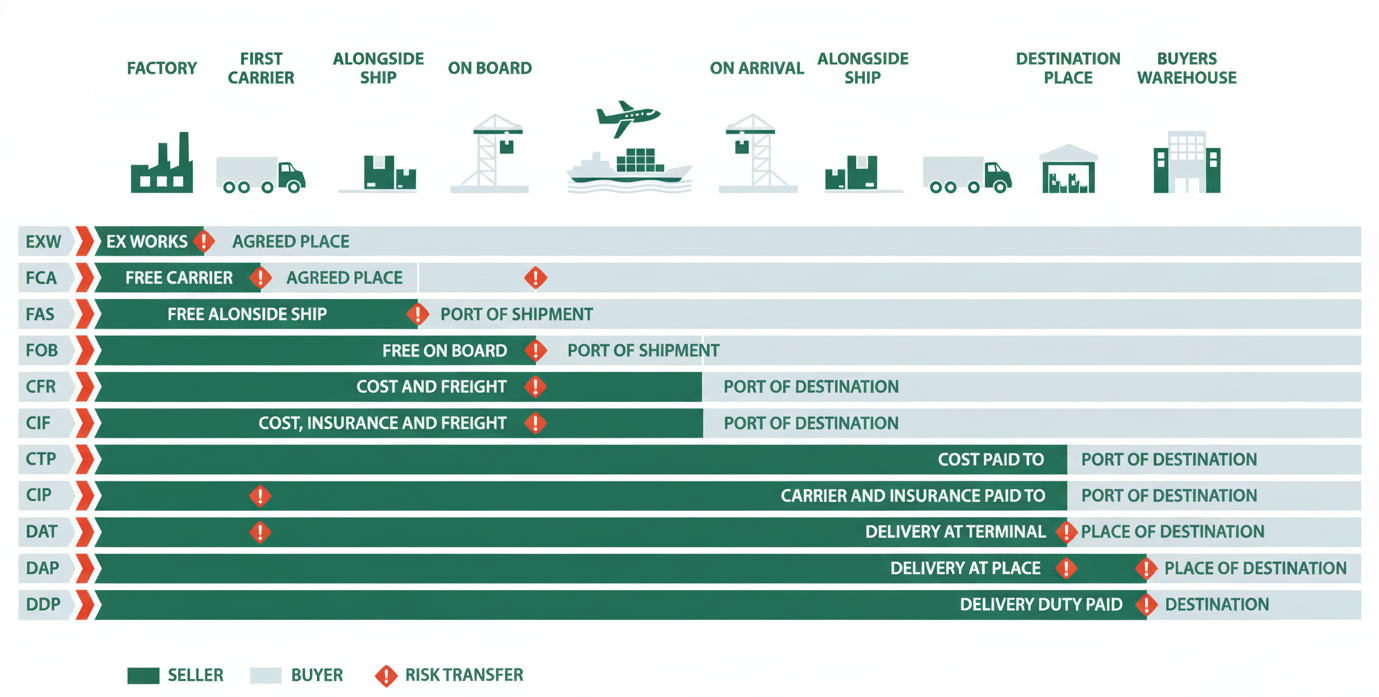
EXW – Ex Works (Named Place of Delivery)
Under EXW, the seller fulfills their obligation when goods are placed at the buyer's disposal at the seller's premises or another named location.
This represents the minimum obligation for the seller.
Seller Responsibilities
The seller must:
- Produce the goods
- Package the goods properly
- Make goods available at the agreed location
The seller is not responsible for:
- Loading goods
- Export customs clearance
- Main carriage
Buyer Responsibilities:
The buyer assumes responsibility for:
- Loading goods
- Export clearance
- Transportation
- Insurance
- Import clearance
- Duties and taxes
Risk Transfer: Risk transfers when goods are made available at the seller's premises.
Advantages
For Sellers:
- Minimal responsibility
- Lowest transportation risk
- Limited documentation requirement
For Buyers:
- Full logistics control
Best Use: EXW is suitable when buyers have strong international logistics capabilities and local representation within the exporter's country.
FCA – Free Carrier (Named Place)
Under FCA, the seller delivers goods to a carrier nominated by the buyer at a specified location.
Unlike EXW, the seller handles export customs clearance.
Seller Responsibilities
- Packaging goods
- Export clearance
- Delivery to nominated carrier
Buyer Responsibilities
- Main transportation
- Insurance
- Import clearance
- Duties and taxes
Risk Transfer: Risk passes when the carrier takes possession of the goods.
Advantages
- Suitable for container transport
- Practical for multimodal shipments
- Preferred under Incoterms 2020
Ideal Application: FCA is widely regarded as the preferred replacement for FOB in containerized shipping.
CPT – Carriage Paid To (Named Destination)
The seller pays transportation costs to the named destination.
However, risk transfers much earlier when the goods are delivered to the first carrier.
Seller Responsibilities
- Export clearance
- Freight payment
- Delivery to first carrier
Buyer Responsibilities
- Insurance
- Import formalities
- Duty payment
Risk Transfer : Risk transfers when the first carrier receives the goods.
Important Consideration: Many businesses mistakenly assume that because the seller pays freight, the seller also bears risk throughout transit. Under CPT, this is incorrect. Risk transfers at shipment.
CIP – Carriage and Insurance Paid To (Named Destination)
CIP is similar to CPT, but the seller must additionally arrange cargo insurance for the buyer.
Seller Responsibilities
- Export clearance
- Freight payment
- Insurance coverage
- Delivery to first carrier
Buyer Responsibilities
- Import clearance
- Import duties
- Customs compliance
Risk Transfer: Risk transfers when goods are handed to the first carrier.
Major Advantage: Provides enhanced protection through insurance coverage while maintaining logistical efficiency.
Frequently used for:
- High-value cargo
- Electronic products
- Industrial machinery
- Container shipments
DPU – Delivered at Place Unloaded (Named Place)
DPU replaced DAT under Incoterms 2020.
The seller is responsible for delivering and unloading goods at the designated destination.
Seller Responsibilities
- Freight payment
- Export clearance
- Delivery to destination
- Unloading
Buyer Responsibilities:
- Import clearance
- Payment of taxes and duties
Risk Transfer: Risk transfers after unloading is completed.
Benefits: Provides buyers with significant logistical convenience because unloading remains the seller's responsibility.
DAP – Delivered at Place (Named Destination)
The seller delivers goods to the named destination and makes them available for unloading.
Seller Responsibilities
- Export clearance
- Freight costs
- Transportation to destination
Buyer Responsibilities
- Unloading
- Import customs clearance
- Import taxes and duties
Risk Transfer: Risk transfers when goods arrive and are ready for unloading.
Popularity: DAP is increasingly popular for international door-to-door deliveries because it provides clarity and operational flexibility.
DDP – Delivered Duty Paid (Named Destination)
Maximum Seller Obligation,DDP places the greatest responsibility on the seller.
The seller delivers goods to the buyer's location after completing export and import formalities.
Seller Responsibilities
- Export clearance
- Transportation
- Import clearance
- Customs duties
- VAT or taxes
- Delivery to final destination
Buyer Responsibilities
Usually limited to receiving the goods.
Risk Transfer: Risk transfers only when goods reach the final destination.
Advantages
For Buyers:
- Maximum convenience
- Predictable landed cost
- Minimal administrative burden
Disadvantages
For Sellers:
- Exposure to foreign customs regulations
- Additional compliance obligations
- Higher administrative costs
Recommended Use: DDP is most suitable when the seller possesses extensive experience with the importing country's customs procedures.
Rules for Sea and Inland Waterway Transport
FAS – Free Alongside Ship (Named Port)
The seller places the goods alongside the vessel nominated by the buyer.
Seller Responsibilities
- Transportation to port
- Export customs clearance
- Placement alongside vessel
Buyer Responsibilities
- Loading onto vessel
- Ocean freight
- Insurance
- Import procedures
Typical Use
Best suited for:
- Commodities
- Heavy equipment
- Bulk cargo
FOB – Free on Board (Named Port of Shipment)
The seller loads goods onto the vessel selected by the buyer.
Seller Responsibilities
- Export clearance
- Delivery onto vessel
Buyer Responsibilities
- Freight
- Insurance
- Import clearance
Risk Transfer: Risk transfers when goods are loaded onboard the vessel.
Common Mistake:
- Many businesses incorrectly use FOB for container shipments.
- Modern trade practice generally recommends FCA rather than FOB for containerized cargo because containers are often delivered to terminals before vessel loading.
CFR – Cost and Freight (Named Port of Destination)
The seller pays freight costs to the destination port but does not provide insurance.
Seller Responsibilities
- Export clearance
- Freight payment
Buyer Responsibilities
- Marine insurance
- Import procedures
Risk Transfer : Risk transfers when goods are loaded onto the vessel at the port of shipment.
Practical Consideration
Although freight is prepaid by the seller, the buyer bears transit risk after shipment.
CIF – Cost, Insurance and Freight (Named Port of Destination)
CIF is similar to CFR, but the seller must also arrange marine insurance.
Seller Responsibilities
- Export clearance
- Freight payment
- Marine insurance
Buyer Responsibilities
- Import clearance
- Duties and taxes
Risk Transfer: Risk transfers once goods are loaded onboard the vessel.
Widely used in:
- Commodity trading
- Agricultural products
- Raw materials
- Bulk maritime shipments
Allocation of Cost and Responsibility
Typical Responsibility Distribution
- Seller: Production, packing, export clearance
- Buyer: Import clearance, duties, final delivery
- Responsibility scope varies significantly by Incoterm
Understanding these differences is crucial for accurate costing and risk management.
Common Mistakes to Avoid
Even experienced traders occasionally misuse Incoterms.
Using FOB for Container Shipments
FCA is generally more appropriate because risk transfer occurs when the carrier takes possession of the container.
Omitting the Named Place
A trade term without a specified location is incomplete.
Example:
❌ FOB
✅ FOB Chittagong Port, Bangladesh
Forgetting the Incoterms Version
Always specify the applicable edition.
Example:
CIF Rotterdam Port, Incoterms 2020
Confusing Risk and Cost
The party paying freight is not always the party bearing risk during transportation.
Assuming Incoterms Transfer Ownership
Incoterms govern delivery, cost and risk allocation only.
They do not determine legal ownership of goods.
Incoterms and Payment Terms
What Incoterms Do Not Cover
One of the most common misconceptions in international trade is assuming that Incoterms regulate every aspect of a commercial transaction.
In reality, Incoterms do not govern:
- Payment terms
- Transfer of ownership or title
- Breach of contract
- Product quality standards
- Force majeure events
- Dispute resolution procedures
- Financing arrangements
These matters must be addressed separately within the sales contract.
For example, a shipment may be sold under CIF Singapore, Incoterms 2020, while payment is made through:
- Letter of Credit (LC)
- Documentary Collection
- Open Account
- Advance Payment
The Incoterm and payment method are separate contractual elements.
Conclusion
Incoterms are among the most important tools in international trade because they establish clear and universally accepted rules governing the delivery of goods, allocation of costs and transfer of risk between buyers and sellers. By providing a common commercial language, Incoterms reduce misunderstandings, improve transparency, support accurate costing and facilitate efficient global trade operations.
A thorough understanding of terms such as EXW, FCA, CPT, CIP, DPU, DAP, DDP, FAS, FOB, CFR and CIF enables traders to select the most appropriate arrangement for their commercial objectives. However, it is equally important to remember that Incoterms do not regulate payment, ownership transfer or contractual disputes. These issues must be addressed separately within the sales agreement. Proper application of Incoterms ultimately contributes to better risk management, stronger business relationships and smoother international trade transactions.