Export is one of the most important columns of international trade and economic development. It is the trade of goods and services between two countries, allowing businesses to enter the global market and earn foreign currency.
In today’s globalized economy, export is not just a commercial activity—it is a structured system that involves legal compliance, banking procedures, logistics coordination, documentation accuracy, and international business communication.
The successful export transaction is governed by a well-defined procedure that ensures smooth movement of goods and secure realization of payment.
Meaning and Scope of Export
Export is the outflow of goods and services produced in a country and bought by buyers in another country. It comprises both tangible goods and intangible services.
Exports are a key driver of:
- Foreign exchange earnings
- Employment generation
- Industrial growth
- Economic stability
- Global market expansion
Types of Export
- Visible Export – physical goods such as textiles, machinery, agricultural products
- Invisible Export – services such as IT, banking, tourism, consultancy
Today, export also includes digital services, software solutions, and online freelancing activities.
Legal Framework Governing Export Trade
Export trade is carried on within a strict legal framework designed to regulate international commercial activity and to secure compliance with the national economic policies. The Import and Export Control Act, 1950 is one of the basic legal documents regulating export activities. This law lays the framework for export licensing, eligibility requirements, and compliance obligations.
Under this legal system, the exporters have to comply with the national trade policies, customs regulations and foreign exchange laws. These laws provide transparency of export transactions and proper monitoring by government authorities. Furthermore, exporters also need to adhere to international banking and trade rules such as UCP 600 which governs Letters of Credit and ensures uniformity in international payment systems.
Legal framework is important in maintaining discipline in export trade and preventing illegal or unauthorized transactions. Export operations cannot run smoothly without proper legal compliance nor be recognized by financial institutions.
This Act shall be governed by:
- Export licensing
- Exporter eligibility
- Trade compliance
- Foreign exchange rules
Exporters must also comply with customs laws and banking regulations as well as international trade rules such as UCP 600 (for Letters of Credit).
Registration of Exporters (ERC Requirement)
Any individual or business must obtain official authorization from the government before engaging in export activities. This is done through the Export Registration Certificate (ERC) issued by the Chief Controller of Imports and Exports (CCI&E).
The ERC is legal evidence that the entity is allowed to do export business. No exporter can legally trade in international markets without this certificate. The ERC number is a unique identifier for the exporter and is used for all official trade related activities.
Once obtained, the ERC number must be quoted on all export documents, including invoices, shipping papers and banking documents. It is also required for customs clearance and financial transactions. This means that all export activities can be traced and verified by the relevant authorities. According to trade law, any export transaction carried out without ERC registration is considered null and void.
Importance of ERC
- Legal permission to export
- Required for banking transactions
- Mandatory for customs clearance
- Must be used on all export documents
Without ERC, export activities cannot be legally conducted.
Securing Export Orders
The export process starts with finding potential buyers and obtaining export orders. Exporters typically enter international markets through several avenues such as chambers of commerce, export promotion agencies, trade missions, and direct communication with foreign buyers. In the contemporary era, digital platforms and online communication have also emerged as important tools for identifying export opportunities.
If a foreign buyer expresses interest, negotiations begin on product specifications, prices, delivery terms and methods of payment. These negotiations are critical because they establish the commercial terms of the export contract. Trust, communication and market understanding are important at this stage, as the two parties are often in different countries with different business environments.
Once all conditions are agreed upon, the buyer will formalize the order by means of a sales contract or a Letter of Credit arrangement.
Exporters may secure orders using several channels, such as:
- Local Chambers of Commerce
- Export Promotion Bureau (EPB)
- Country missions abroad
- Direct communication with foreign buyers via letters, emails or other correspondence
Once price, quality, delivery terms and payment conditions are agreed, the buyer issues a formal sales contract or Letter of Credit.
Sales Contract and Proforma Invoice
Before the finalization of export deal, Proforma Invoice is issued by exporter. This document is a tentative quotation and describes the goods, prices and trade terms in detail. It is not a legally binding document but a basis for negotiation.
After the buyer agrees with the terms on the Proforma Invoice, both parties will sign a formal Sales Contract. This contract is legally binding and includes all major transaction elements such as product description, quantity, price, delivery terms, shipment schedule, and payment method.
The Sales Contract is very important because it helps the exporter and the importer know what each of them has to do and must do.
Includes:
- Product description
- Quantity and price
- Delivery terms (Incoterms)
- Payment method (LC etc.)
- Shipment schedule
Receipt of Letter of Credit or Sales Contract
Once the sales contract is signed, the buyer will work with his bank to arrange for a Letter of Credit. The letter of credit is one of the most important instruments in international trade finance. It guarantees payment to the exporter on the fulfillment of all specified conditions.
The LC will have all the vital information like the name of the issuing bank, exporter’s details, description of the goods, time limits for shipment, documents required, and the terms of payment. It is a financial guarantee to reduce risk for both sides.
Before production begins, the exporter should carefully review the LC to ensure that all conditions are practical and consistent with the sales agreement. Where there are discrepancies identified, immediate amendment requests will be necessary to avoid further issues in the process.
The LC specifies:
- Name of issuing bank
- Beneficiary
- Goods description
- Shipment deadline
- Required documents
- Payment terms
Careful review of LC terms is essential before proceeding with production or shipment.
Procurement, Production and Shipment of Goods
Once the Letter of Credit is confirmed, the exporter begins the process of production or procurement. The process involves sourcing raw materials, manufacturing goods, and ensuring the final product meets the specifications agreed with the buyer.
At this stage, quality control is paramount, as international buyers demand strict adherence to product standards. Any deviation may result in the goods being rejected or disputes at payment time.
The goods are carefully packed according to international shipping standards after production. Packaging also helps to protect products from damage during transportation and handling. Appropriate labeling is also carried out as per buyer instructions and regulatory requirements of the destination country.
Upon receipt of the LC or contract, the exporter shall:
- Procures raw materials
- Manufactures or sources the contracted goods
- Prepares the goods according to buyer specifications
Logistics and Freight Forwarding
Once the goods are ready, the exporter contacts logistics companies and freight forwarders to arrange shipment. This includes arranging cargo space, choosing shipping routes and setting up transportation schedules.
Freight forwarders are central to coordinating the shipment of the goods from the exporter’s facility to the port of destination. They also help prepare shipping documents and ensure compliance with transport regulations.
Good logistics management is a must to ensure timely delivery and avoid delays that may violate conditions of Letter of Credit.
Activities:
- Cargo booking (sea/air/land)
-
Freight forwarder coordination
-
Shipment scheduling
-
Transport documentation
Customs Clearance and Shipment
Goods have to clear customs in the country of export before they can be shipped. This is a mandatory process wherein government officials check that the consignment complies with the export rules and regulations.
The exporter submits the required documents such as the export declaration, commercial invoice, packing list, certificate of origin and shipping documents. The customs authorities will examine these documents and inspect the goods if necessary and approve the shipment.
After clearance the goods are shipped by sea, air or land transport, depending on the agreement and nature of the cargo.
Documents required:
- Export declaration
- Commercial invoice
- Packing list
- Certificate of origin
- Shipping documents
Customs verifies and approves shipment.
After clearance:
- Goods are shipped via sea or air
Documents used:
- Bill of Lading (sea)
- Air Waybill (air)
Shipment must match LC deadline strictly.
Preparation and Procurement of Export Documents
Documentation is one of the most important aspects of export trade because it determines whether payment will be successfully processed. Exporters need to prepare a number of commercial documents like commercial invoice, bill of exchange and beneficiary certificate.
Supporting documents are also procured from third parties such as the bill of lading or air waybill from transport companies, certificate of origin from authorised agencies, insurance certificates and inspection reports when required.
All documents must comply strictly with the terms of the Letter of Credit. Even slight discrepancies can cause delays in payment or rejection.
Exporter’s Documents
Exporters must prepare key commercial documents, including:
- Bill of Exchange
- Commercial Invoice
- Beneficiary’s Certificate
Additional documents are collected from authorized entities, such as:
- Transport documents (Bill of Lading or Air Waybill)
- Certificate of Origin
- Insurance Policy or Certificate
- Inspection Certificate (if required by LC)
Compliance with LC terms is mandatory for all documents.
Submission of Documents to Bank for Negotiation
Once the goods are shipped, the exporter provides the bank with the full set of documents. The bank then checks to see if the documents conform to the Letter of Credit requirements and the international banking standards.
If the documents are in order, the bank proceeds to negotiate. Under UCP 600, negotiation means that the bank purchases the export documents and pays or advances the funds to the exporter.
This is called post-shipment finance and enables exporters to manage their cash flow while waiting for final payment from the issuing bank.
Negotiation of Export Documents
Definition of Negotiation under UCP 600
Under UCP 600, negotiation means the purchasing of drafts and/or documents under a complying presentation by a nominated bank, by advancing or agreeing to advance funds to the beneficiary.
Post‑Shipment Export Financing
Post shipment finance is also considered to be negotiation of export documents which enables exporters to meet their cash flow requirement from the time the goods are shipped to the time the payment is received from the issuing bank.
Complying Presentation and Document Scrutiny
Meaning of Complying Presentation
A complying presentation means that documents:
- Fully comply with LC terms
- Follow UCP 600 provisions
- Conform to International Standard Banking Practice (ISBP)
Common Discrepancies in Export Documents
Bill of Exchange Discrepancies
Common discrepancies include:
- Bill drawn on incorrect party
- Missing LC reference
- Incorrect tenor
- Mismatch in amount (words vs figures)
- Absence of exporter’s signature
Commercial Invoice Discrepancies
Typical issues include:
- Incorrect goods description
- Value mismatches
- Unauthorized issuer
Transport and Insurance Document Discrepancies
Discrepancies may arise due to:
- Incorrect vessel or shipment details
- Missing endorsements
- Improper coverage or dates
Handling of Discrepant Documents
Causes of Discrepancies
Discrepancies often occur because exporters do not fully understand LC terms or fail to consult banks before shipment.
Options for Handling Discrepant Documents
Correction of Documents
If time permits, exporters may correct documents or submit fresh ones. Corrections must be properly authenticated by the issuing authority.
Obtaining Issuing Bank’s Approval
The negotiating bank may:
- Inform the issuing bank about discrepancies
- Seek permission to pay despite discrepancies
If approval is received through authenticated communication, payment may proceed.
Sending Documents on Collection Basis
Documents may be sent with instructions to release against payment upon acceptance by the importer.
Payment under Indemnity
Where permitted by LC terms, banks may make payment under reserve against exporter indemnity, considering past performance and risk exposure.
Realization of Export Proceeds
The issuing bank will pay the negotiating bank upon acceptance of documents and the negotiating bank will credit the account of the exporter. This is called export proceeds realization.
Export proceeds generally have to be realised within a specified period, often within four months from the date of shipment. Failure to do so shall be reported to the central bank in line with foreign exchange regulations.
Credit of Export Proceeds
After the documents have been negotiated or dispatched, the negotiating bank requests the issuing bank to credit the export proceeds to its Nostro account.
Local Settlement
When funds are received, the negotiating bank credits the exporter by debiting the head office account.
Non‑Realization of Export Proceeds
Four‑Month Timeframe
The proceeds of export must be realized within four months from the date of shipment. Failure to do so has to be reported to the central bank as per foreign exchange guidelines.
Dispute Settlement in International Trade
Methods of Dispute Resolution
Disputes arising from export transactions may be settled through:
- Amicable negotiations
- International Chamber of Commerce (ICC) arbitration
- Legal proceedings
Choice of dispute resolution depends on contract terms and jurisdiction clauses.
Export Without Letter of Credit
The Letter of Credit is the safest payment method. But exports can be done without it as well. These are: advance payment, open account transactions and documentary collection.
But these options are more risky in the sense that they do not provide the same level of security of payment as an LC. Therefore, exporters have to properly evaluate the credibility of the buyers before resorting to such methods.
Although Letters of Credit are the safest method, exports may take place without LC under:
- Advance payment
- Open account
- Documentary collection
Such transactions carry higher risk and require careful evaluation by exporters and banks.
Complete Export Procedure (Integrated Step-by-Step Flow)
The export process is a structured chain of activities that begins with buyer inquiry and ends with payment realization.
Below is the fully combined export procedure from your flowchart and detailed explanation:
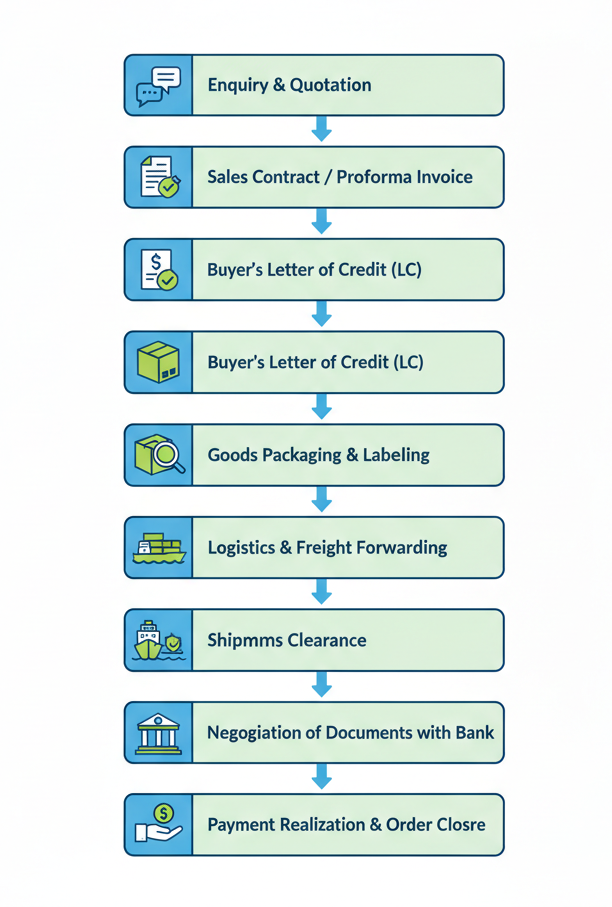
1. Enquiry and Quotation
The process begins when a foreign buyer sends an enquiry.
The exporter responds with:
- Product details
- Price quotation
- Delivery terms
- Payment conditions
This stage establishes initial communication and interest.
2. Sales Contract / Proforma Invoice
After negotiation, the exporter issues a Proforma Invoice, which is a preliminary offer document.
Once accepted, both parties sign a Sales Contract.
It includes:
- Product description
- Quantity and price
- Delivery terms (Incoterms)
- Payment method (usually LC)
- Shipment schedule
This confirms the commercial agreement.
3. Buyer’s Letter of Credit (LC)
The buyer opens a Letter of Credit (LC) through their bank in favor of the exporter.
The LC acts as a payment guarantee and includes:
- Issuing bank details
- Exporter (beneficiary) details
- Goods description
- Shipment deadline
- Required documents
This ensures payment security for the exporter.
4. LC Verification and Confirmation
The exporter carefully reviews the LC to ensure:
- It matches the sales contract
- Terms are realistic
- Documents required are achievable
If necessary, amendments are requested before proceeding.
5. Goods Procurement and Production
After LC confirmation, the exporter begins production or procurement.
Activities include:
- Sourcing raw materials
- Manufacturing goods
- Quality control inspection
- Preparing goods as per buyer specifications
6. Packaging and Labeling
Goods are carefully packaged according to international standards.
This includes:
- Safe export packaging
- Moisture and damage protection
- Proper labeling as per buyer instructions
- Compliance with shipping regulations
7. Logistics and Freight Forwarding
The exporter arranges transportation through logistics providers.
This involves:
- Booking cargo space (ship/air/land)
- Coordinating freight forwarders
- Scheduling shipment
- Handling transport documentation
8. Customs Clearance (Shipment Clearance)
Before export, goods must be cleared by customs authorities.
Required documents include:
- Export declaration
- Invoice and packing list
- Certificate of origin
- Shipping documents
After verification, customs allows shipment.
9. Shipment of Goods
Goods are shipped through:
- Bill of Lading (sea transport)
- Air Waybill (air transport)
Shipment must strictly follow LC deadlines.
10. Export Documentation Preparation
The exporter prepares a complete set of documents such as:
- Commercial Invoice
- Bill of Exchange
- Packing List
- Bill of Lading / Air Waybill
- Insurance Certificate
- Certificate of Origin
Accuracy is critical because even small errors may lead to payment rejection.
11. Submission of Documents to Bank
After shipment, documents are submitted to the bank for processing.
The bank verifies:
- Compliance with LC terms
- Accuracy of documents
- Shipment validity
12. Negotiation of Documents (Bank Processing)
Under UCP 600 rules, the bank may negotiate documents if they are compliant.
This means:
- Bank purchases documents
- Provides immediate or advance payment
- Sends documents to issuing bank
This acts as post-shipment finance for exporters.
13. Settlement with Issuing Bank
The issuing bank checks documents and confirms compliance.
If correct:
- Payment is released
- Importer receives documents
- Goods can be cleared at destination
If discrepancies exist, approval is required.
14. Payment Realization and Order Closure
Finally, payment is transferred to the exporter.
This includes:
- Credit of export proceeds
- Foreign exchange settlement
- Closure of export transaction
The export cycle is successfully completed.
Conclusion
Export is a highly formalized and disciplined international business system. It combines legal frameworks, banking instruments, logistics management and accuracy of documentation into one coordinated process.
“Every step, from the first enquiry to final payment, needs to be done right. A single error can derail the entire transaction, and a well-managed process ensures profitability and global success.
A thorough understanding of the entire export process is essential for all involved in international trade, as it forms the basis for safe, efficient and successful global business dealings.