Walk into a textile factory and you will see fabric moving almost constantly. It passes through looms, knitting machines, dyeing equipment, inspection frames and finishing lines, often at considerable speed.
Somewhere along that process, someone still has to answer a basic question: Is the fabric actually good enough?
That sounds simple until you consider what an inspector is looking for.
A small hole, a broken yarn, an oil stain, a slub or a slight colour variation can be easy to overlook when hundreds or thousands of metres of fabric are moving through a factory. Human inspectors have traditionally been responsible for catching these problems, and experienced inspectors can become remarkably good at spotting them.
But there is a catch.
People get tired.
After several hours of looking at fabric under the same lighting conditions, concentration naturally drops. A defect that would be obvious at the beginning of a shift may be much harder to notice later in the day. Fabric colour, pattern, production speed and the type of defect can make the job even more difficult.
This is where computer vision and artificial intelligence are beginning to change the way textile manufacturers approach inspection.
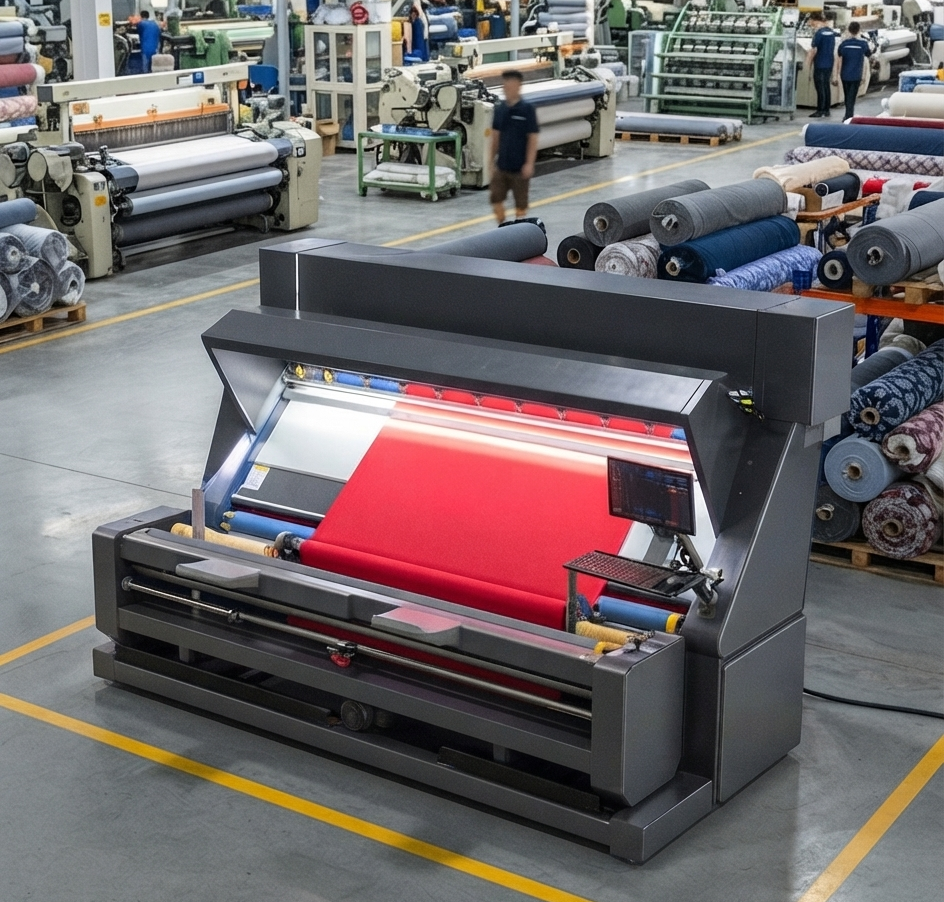
Instead of asking an employee to watch every metre of fabric, manufacturers can install cameras and software that continuously examine the material as it moves through production. The technology essentially acts as another set of eyes—one that can keep watching without becoming fatigued.
That doesn't mean people are suddenly unnecessary. In most practical applications, the more interesting question is how AI and experienced inspectors can work together.
The Problem With Traditional Fabric Inspection
Before getting into the technology, it helps to understand the problem manufacturers are trying to solve.
Textile production is a high-volume process. A single machine may produce a very large quantity of material during a shift, and defects can occur at almost any stage.
Sometimes the problem is obvious. A large hole or dark stain is difficult to miss.
Other defects are much less noticeable. A broken yarn may appear as a tiny irregularity. A slub can blend into the surrounding texture. On patterned or textured material, even an experienced inspector may have trouble distinguishing a genuine defect from a normal feature of the fabric.
Traditionally, inspection has involved placing the fabric under controlled lighting and having an operator examine it as it passes by.
The approach is still widely used because it works reasonably well. It is also flexible: a person can look at an unfamiliar fabric and make a judgment without needing to retrain a computer model first.
The problem is consistency.
An inspector who has been concentrating on fabric for eight hours is unlikely to have exactly the same level of attention as someone who has just started a shift. Different inspectors may also have different opinions about what should be classified as a defect and how serious it is.
Some of the biggest challenges with manual inspection are therefore fairly familiar:
- fatigue during long inspection shifts;
- differences in judgment between inspectors;
- difficulty maintaining inspection speed as production increases;
- the time required to train experienced personnel;
- ongoing labour costs; and
- the possibility of small defects being missed.
Reported figures for manual inspection accuracy vary considerably depending on the fabric and inspection conditions, so there isn't one universal accuracy number that applies to every textile factory. What is clear, however, is that manual inspection has limitations—and manufacturers have been looking for ways to reduce those limitations for years.
So, What Exactly Is AI Fabric Inspection?
At its simplest, an AI fabric inspection system combines cameras, lighting, image-processing software and machine-learning models.
The camera continuously captures the surface of the fabric. Software processes those images, and the AI model looks for visual patterns that could indicate a problem.
If the system detects something unusual, it can flag the location. More sophisticated systems can also determine what kind of defect it is, estimate its size and severity, and store the information for later analysis.
A typical setup works roughly like this:
- Cameras capture images of the moving fabric.
- The images are cleaned up and prepared for analysis.
- A machine-learning model examines the fabric surface.
- Potential defects are identified.
- The system may classify the defect.
- Its location and other details are recorded.
- An operator is alerted or the fabric is marked, depending on the installation.
The important part is that this happens while production is taking place.
If a loom begins producing a recurring defect, the inspection system may detect the problem after a relatively short section of fabric has been produced. An operator can then investigate the machine instead of discovering the problem much later when an entire roll has already been completed.
That early warning can be valuable.
The Technology Behind AI Fabric Inspection
“AI inspection” sounds like a single technology, but there are actually several components involved.
Cameras Matter More Than People Sometimes Realise
An AI model cannot make a good decision if it receives a poor-quality image.
Industrial cameras are therefore a critical part of the system. They are installed in positions where they can continuously see the fabric surface, while specialised lighting is used to make defects easier to distinguish.
Depending on the application, manufacturers may use conventional visible light as well as infrared or ultraviolet illumination.
Line-scan cameras are particularly useful for textile production. Rather than taking separate photographs of individual pieces of fabric, they capture narrow sections continuously as the material moves. Those sections can then be combined to create a detailed representation of the fabric.
Lighting deserves just as much attention.
A defect that is clearly visible under one lighting arrangement may almost disappear under another. Shadows, reflections and changes in fabric texture can all affect what the camera sees.
In other words, buying a powerful camera does not automatically solve the inspection problem. The entire imaging setup has to be designed around the fabric and production line.
Where Machine Learning Comes In
Once the images are available, machine learning is used to interpret them.
Convolutional neural networks, or CNNs, have been widely used for visual inspection because they are particularly good at recognising patterns in images. More recent computer-vision systems can also use object-detection and segmentation techniques.
The distinction matters.
A detection model might say, “There is probably a defect here,” and identify its approximate location.
A segmentation model can go further and outline the affected area pixel by pixel.
Depending on the system, the software may be able to:
- identify whether a defect is present;
- locate it on the fabric;
- classify the type of defect;
- measure the affected area;
- estimate its severity; and
- trigger an alert when it exceeds a predefined threshold.
The exact capabilities depend on the model and the data used to train it.
Training the Model Is One of the Hardest Parts
This is where many AI projects become more complicated than they initially appear.
A machine-learning system doesn't automatically know what a hole, stain or broken yarn looks like. It has to learn from examples.
That means manufacturers need images of both acceptable and defective fabric. Those images may need to be labelled so that the system knows what it is looking at.
And there is an awkward problem with collecting defect data: good fabric is plentiful, while unusual defects are not.
A factory may produce thousands of metres of acceptable fabric for every relatively rare defect. Some problems may occur only occasionally, which means collecting enough examples for a model can take considerable time.
The model also needs to cope with real production conditions.
A system trained on plain white cotton may perform very differently when it encounters dark knitted fabric, a jacquard pattern or a heavily textured technical textile.
That is why data quality and diversity are so important.
Why Edge Computing Is Useful
There is another practical consideration: speed.
Fabric doesn't stop moving while a computer thinks about the last image.
If every frame has to be sent to a distant server, processed and sent back before the system can react, latency can become a problem.
For this reason, inspection systems often use edge computing. The processing hardware sits close to the production equipment, allowing images to be analysed almost immediately.
This arrangement can make it possible to detect a defect and alert the operator while the affected section of fabric is still passing through the machine.
For a fast-moving production line, those seconds can matter.
What Types of Defects Can AI Detect?
The exact list depends on the fabric and the training data, but automated inspection systems can be developed to identify a wide range of common textile defects.
| Defect | What it looks like | Possible cause |
|---|---|---|
| Holes | Gaps in the fabric structure | Broken yarns, machine problems or snags |
| Stains | Areas of unwanted discoloration | Oil, dirt, chemicals or contamination |
| Broken threads | Loose or snapped yarns | Tension or machine problems |
| Slubs | Thick or irregular sections of yarn | Spinning irregularities |
| Missing yarn | Areas where expected yarn is absent | Machine malfunction |
| Colour streaks | Uneven colour across the material | Dyeing or finishing problems |
| Misweave | Irregular weave structure | Loom settings or mechanical problems |
| Creases | Visible fold or pressure marks | Handling or storage |
| Knots | Visible yarn joining points | Yarn joining processes |
| Oil spots | Localised grease or oil marks | Machinery or maintenance |
Some of these are relatively easy for a vision system to spot.
The harder cases are the subtle ones.
A tiny defect that looks almost identical to the surrounding fabric can challenge both people and algorithms. In a complicated patterned fabric, the system has to learn what normal variation looks like before it can reliably identify something that is actually abnormal.
Why Textile Manufacturers Are Moving Toward AI Inspection
The attraction of automated inspection isn't simply that artificial intelligence is fashionable.
There are some fairly practical reasons for adopting it.
Continuous Inspection
A camera-based system can keep examining fabric while the production line is running.
It doesn't need a lunch break, and its performance doesn't decline because it has been staring at the same pattern for several hours.
More Consistent Decisions
Once properly calibrated, an AI system applies the same detection criteria repeatedly.
Human judgment will always have some variation. A computer model does not suddenly change its definition of a defect because it is near the end of a shift.
That doesn't make the AI automatically correct, though. A poorly trained model can be consistently wrong, which is why validation remains important.
Catching Problems Earlier
Early detection may be one of the biggest advantages.
Suppose a machine develops a problem that causes the same defect to appear repeatedly. If the issue isn't noticed until the roll is inspected at the end of production, a considerable amount of material may already be affected.
A real-time system can potentially flag the first occurrences and give the operator a chance to investigate.
Creating a Digital Record
Traditional inspection often results in handwritten notes or manual records.
An automated system can record much more information, including the type and position of a defect, the time it appeared, the machine involved and the production order.
Once that information is collected over weeks or months, it can become useful for more than quality control.
A factory may discover that one loom consistently produces a particular type of defect, for example, or that problems become more common after a certain component has been running for a particular length of time.
That is where inspection data starts becoming production intelligence.
AI Inspection Isn't a Magic Solution
There is a tendency to talk about AI as though installing cameras will immediately solve quality-control problems.
Real factories are more complicated.
Training Data Can Be a Bottleneck
The system needs representative examples.
Those examples should cover different fabric constructions, colours, patterns, lighting conditions and defect sizes. Rare defects are particularly difficult because there may not be enough examples available for training.
In many cases, manufacturers have to build and label their own datasets.
Every Fabric Behaves Differently
Textile products can vary enormously.
A model that performs well on a simple woven fabric may struggle with:
- jacquard designs;
- printed fabrics;
- dark materials;
- melange fabrics;
- highly textured knitted structures; or
- technical textiles.
The more varied a factory's production portfolio becomes, the more carefully the inspection system needs to be tested.
The Initial Investment Can Be Significant
A complete inspection system can involve cameras, lighting, computing hardware, software, installation and integration with existing machinery.
For a high-volume factory, the potential savings may justify the investment. For a smaller manufacturer, the economics need to be examined much more carefully.
The question isn't simply “How much does the system cost?”
It is also:
How much material is currently being lost, how many defects are reaching customers, and how much could earlier detection realistically save?
Older Machinery Can Make Installation Difficult
Many textile factories operate machinery that has been in service for years—or even decades.
Adding modern vision equipment to an older machine may require custom mounting hardware, sensors, wiring and connections to the machine's control system.
The software may be the easy part. Integrating everything into a working production environment can be considerably harder.
False Alarms Are a Real Problem
AI inspection systems can make two important types of mistakes.
A false positive happens when acceptable fabric is incorrectly flagged as defective.
A false negative happens when a genuine defect goes unnoticed.
Neither is ideal.
Too many false positives can lead operators to ignore alerts. Too many missed defects defeat the purpose of installing the system in the first place.
The goal isn't simply to achieve the highest possible detection rate. The system needs to provide useful results under actual production conditions.
People Still Matter
Someone has to maintain the cameras, monitor the software, investigate unusual results and deal with new fabric constructions.
When the factory introduces a new material, the existing model may need additional training or calibration.
So AI doesn't necessarily remove the need for skilled textile personnel.
It changes what they spend their time doing.
Human Inspectors and AI: Which Is Better?
It's tempting to frame the issue as a competition between people and machines.
In practice, that may be the wrong way to look at it.
| Factor | Human inspection | AI-assisted inspection |
|---|---|---|
| Speed | Limited by human observation | Can operate continuously at production speed |
| Consistency | Can vary with fatigue and experience | Consistent after proper calibration |
| Adaptability | Very flexible with unfamiliar materials | May need additional training |
| Data collection | Often manual | Automatically recorded |
| Fatigue | A major consideration | Not an issue |
| Initial investment | Lower equipment cost | Higher equipment and integration cost |
| Judgment | Strong in unusual situations | Dependent on training and model design |
For many factories, the sensible approach is a hybrid model.
The computer watches the fabric continuously and flags potential problems. The human inspector then reviews difficult cases, investigates recurring defects and makes decisions where context matters.
That arrangement plays to the strengths of both sides.
A machine is good at repetitive observation.
An experienced textile professional is good at asking, “Why is this happening?”
Some of the Technologies Available Today
The automated textile-inspection market includes established textile-technology companies, machine-vision suppliers and newer AI-focused businesses.
Uster Technologies
Uster Technologies is one of the established names in textile quality control. Its portfolio includes automated inspection technologies such as Uster EVS Fabriq Vision and Uster Q-Bar 2, along with software for analysing and reporting production-quality information.
Its long experience in textile measurement is one of the company's major strengths.
Elbit Vision Systems
Elbit Vision Systems, often referred to as EVS, has specialised in automated optical inspection.
Its textile-related systems include I-TEX and LOOM-TEX, with applications covering fabric inspection and monitoring during production.
Erhardt+Leimer
Erhardt+Leimer, or E+L, supplies measurement, web-handling and inspection technology for several industries.
In textile applications, its technology can be used to monitor running material and identify issues such as contamination, seams and other irregularities.
Cognex
Cognex is better known as a broad machine-vision company rather than a textile specialist.
Its deep-learning and vision technologies can nevertheless be applied to difficult surface-inspection tasks, including products with complicated patterns and textures.
That makes it an option for manufacturers looking for a more general machine-vision platform.
Mahlo
Mahlo has a long history in textile measurement and finishing.
Its technology focuses heavily on monitoring and controlling finishing processes and measuring properties of the material while it moves through production.
SUNTECH Textile Machinery
Suntech Textile Machinery has also incorporated automated inspection and machine-vision capabilities into its textile machinery portfolio.
Its approach focuses on using imaging and intelligent analysis to identify defects during production.
AiDLab and WiseEye
The Laboratory for Artificial Intelligence in Design in Hong Kong developed WiseEye, an AI-based textile inspection technology designed to identify textile faults using cameras and machine-learning techniques.
The project is particularly interesting because it demonstrates how AI research can be applied directly to textile quality problems.
iFactory
iFactory focuses on AI-based inspection for weaving operations.
Its approach is aimed at bringing automated inspection directly to looms, with an emphasis on rapid installation and adapting inspection profiles to different fabrics.
FlowSense
FlowSense approaches the problem from a data perspective.
Rather than simply providing another inspection camera, its focus is on bringing information from inspection systems together so manufacturers can build a broader view of quality across their production processes.
Serkon AI
Serkon AI focuses on automated fabric inspection and defect classification using machine vision and AI, with applications covering problems such as holes, weaving defects and colour irregularities.
As with any supplier claims, manufacturers should test reported performance on their own fabrics and under their own production conditions before making a purchasing decision.
Comparing the Main Options
| Company / platform | Main strength | Typical application |
|---|---|---|
| Uster Technologies | Textile quality monitoring and inspection | Fabric inspection and finishing |
| Elbit Vision Systems | Automated optical inspection | Weaving and fabric inspection |
| Erhardt+Leimer | Web monitoring and measurement | Textile production and finishing |
| Cognex | General machine vision and deep learning | Complex visual inspection |
| Mahlo | Process measurement and control | Textile finishing |
| AiDLab / WiseEye | AI-based textile inspection | Textile quality control |
| iFactory | AI loom inspection | Weaving |
| FlowSense | Inspection-data integration | Quality management |
| Serkon AI | AI defect detection and classification | Fabric inspection |
There is no universal “best” system.
A manufacturer producing plain cotton fabric at high speed has different requirements from a factory producing patterned technical textiles. Camera resolution, fabric width, machine speed, lighting, defect types, integration requirements and after-sales support all need to be considered.
A demonstration on one fabric isn't enough.
The system should ideally be tested using the actual fabrics and production conditions in which it will operate.
What Happens Next?
The technology is still evolving.
One obvious trend is the gradual reduction in the cost of cameras and computing hardware. As those components become more accessible, automated inspection may become practical for smaller manufacturers as well as large factorys.
AI models are also getting better at dealing with variation.
Today's systems may require additional training when a new fabric is introduced. Future models are likely to become more capable of recognising unfamiliar materials and separating normal variation from genuine defects.
Another important development will be integration.
Imagine a production system in which an inspection camera identifies a recurring defect, the factory-management software records it, and the maintenance system receives an alert because the same machine has produced similar problems several times.
That would turn inspection from an isolated quality-control step into part of the factory's wider information system.
Eventually, automated systems may also be able to respond directly to certain problems—marking defective sections, adjusting machine settings or triggering other equipment when a recurring issue is detected.
The technology still has a way to go, but the direction is fairly clear.
Will AI Replace Fabric Inspectors?
Probably not completely.
At least, there is little reason to assume that the future textile factory will simply remove all its inspectors and replace them with cameras.
The role is more likely to change.
Instead of spending an entire shift staring at every metre of fabric, an inspector may spend more time reviewing alerts, examining uncertain cases, investigating recurring problems and making final quality decisions.
That could actually make the job more valuable.
AI is good at doing the same visual task thousands of times without losing concentration. People are better at dealing with exceptions, context and problems that weren't anticipated when the system was trained.
The two capabilities complement each other.
Final Thoughts
Fabric inspection has always been a combination of technology and human experience.
A skilled inspector develops an understanding of fabric that is difficult to capture in a simple checklist. They know how a normal fabric should look, which irregularities are harmless and which ones suggest a machine problem.
But human attention has limits.
Artificial intelligence offers a way to add continuous monitoring to that experience. Cameras can watch the material as it moves, software can flag unusual patterns, and digital systems can record exactly where and when problems occur.
The technology isn't flawless. It depends on image quality, lighting, training data, appropriate model selection and careful integration with the production line. It also has to deal with one of the hardest characteristics of textiles: every fabric can look different.
For that reason, the most realistic future isn't necessarily a factory without human inspectors.
It is a factory where people and AI share the inspection workload.
The AI watches every metre.
It records what it finds.
It points the production team toward problems.
And the people use their experience to work out what went wrong—and how to prevent the same defect from appearing again.
That last part may ultimately be the biggest opportunity.
For a textile manufacturer, catching one defect is useful. Understanding why that defect happened, preventing it from recurring and reducing the amount of wasted fabric is far more valuable.
As textile factories become increasingly connected, AI-based inspection could therefore evolve from a simple defect-detection system into a much broader quality-management tool.
And for an industry where a relatively small production problem can result in thousands of metres of affected fabric, that is a change worth paying attention to.