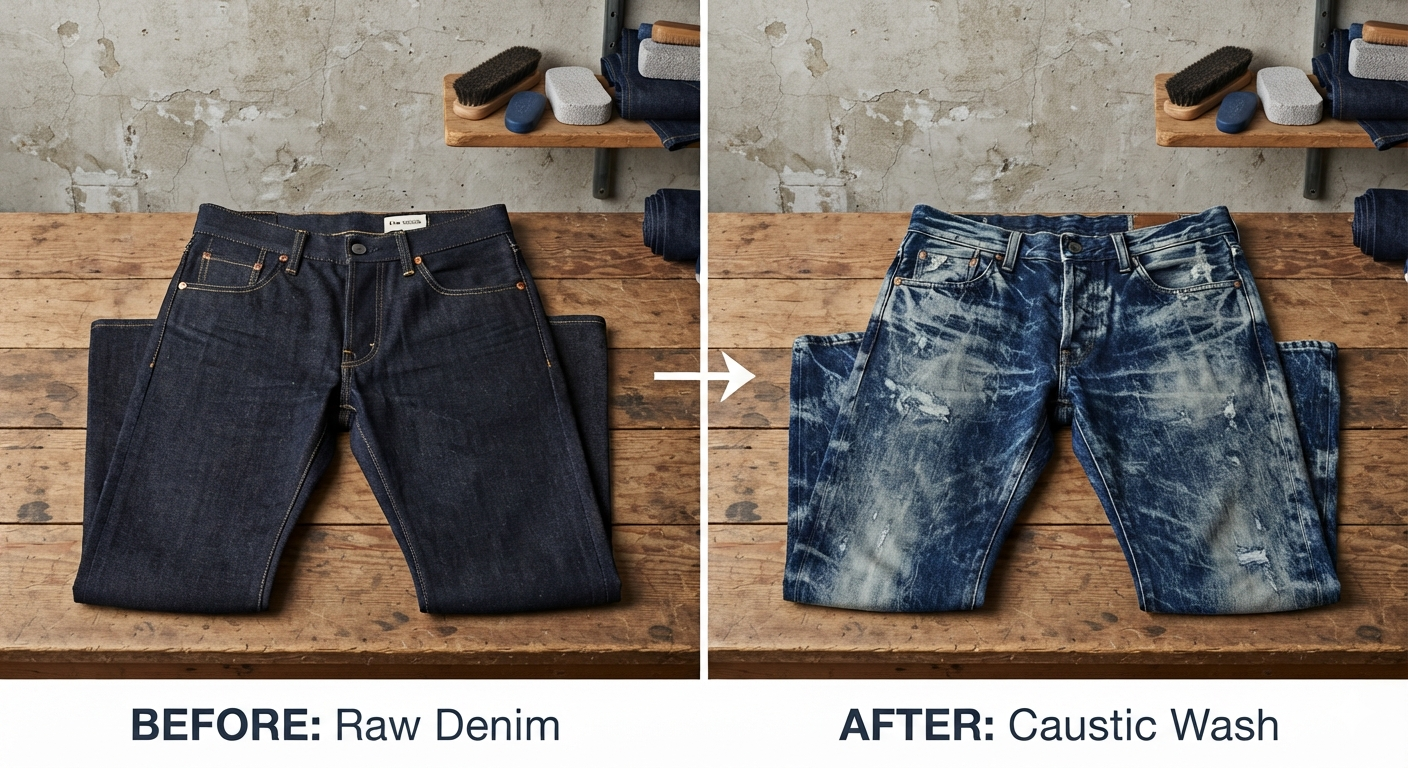
If you have ever looked closely at a pair of jeans and noticed bright, almost shiny streaks across the thighs or knees, you have probably seen the effect of caustic washing.
The contrast can be quite striking. Dark indigo areas sit next to lighter sections with a glossy or slightly silky appearance. It may look like a simple fading effect, but there is some interesting chemistry behind it.
The main chemical involved is sodium hydroxide (NaOH), commonly known as caustic soda. The same chemical has applications well outside the textile industry, including soap production, paper processing and drain-cleaning products.
In denim finishing, however, it is used in a much more controlled way to change the appearance and surface characteristics of the fabric.
Caustic washing is particularly interesting because it sits somewhere between chemical processing and garment aesthetics. The concentration, temperature, application method and treatment time all influence the final appearance.
This article explains what caustic wash is, what happens to cotton during the treatment, how the process is carried out in garment production, the different effects that can be produced, and the quality, safety and environmental issues that need to be considered.
What Is Caustic Wash?
Caustic wash is a wet-processing technique used on denim garments, and in some cases on fabric before cutting. The process uses a solution containing sodium hydroxide to alter the surface and appearance of cotton-based material.
Cotton is mainly composed of cellulose. When the cellulose fibers come into contact with a sufficiently concentrated alkaline solution, they swell and change their physical structure.
This affects the way the surface reflects light.
Instead of the relatively dull appearance normally associated with untreated indigo denim, the treated areas can develop a smoother and more reflective appearance. Depending on the process, the result may range from a subtle sheen to a much stronger glossy effect.
There is an interesting connection between this process and mercerization.
Mercerization is a well-established cotton treatment that also uses sodium hydroxide. The process was associated with John Mercer in the nineteenth century and is used to improve properties such as luster, strength and dye affinity.
Caustic washing uses related chemistry, but the objective in denim finishing is different. Rather than treating the entire fabric uniformly, the chemical effect can be controlled or localized to create a particular visual appearance.
The resulting contrast can resemble the type of fading associated with sunlight, repeated wear or aging, but the effect is produced within a controlled manufacturing process.
The Chemistry Behind Caustic Wash
To understand the process, it helps to start with the fabric itself.
Denim is predominantly made from cotton, and cotton fibers are primarily composed of cellulose. Cellulose is a polysaccharide with the repeating chemical formula:
(C₆H₁₀O₅)ₙ
The cellulose chains contain hydroxyl groups (-OH), and interactions between these groups contribute to the structure and strength of the cotton fiber.
When sodium hydroxide is introduced at a sufficiently high concentration, the alkaline environment disrupts some of the interactions within the cellulose structure.
A simplified representation is:
NaOH + Cellulose-OH → Cellulose-O⁻Na⁺ + H₂O
The actual chemistry in a textile process is more complex than this simplified equation suggests, but the important practical point is that the cotton fiber absorbs the alkaline solution and undergoes swelling and structural changes.
The fiber becomes more rounded and changes the way it interacts with light. This can contribute to the characteristic sheen associated with caustic treatment.
A simplified sequence of what happens during the process can be described as follows:
Sodium hydroxide dissolves and ionizes in water.
NaOH separates into sodium ions (Na⁺) and hydroxide ions (OH⁻).
The alkaline treatment affects the cotton structure and surface.
The fibers swell and their physical arrangement changes.
The appearance of the denim changes.
Changes in the fiber surface and the treatment of the indigo-colored areas alter the way light is reflected.
The process is stopped through rinsing and neutralization.
An acidic neutralizing bath can be used to bring the fabric back toward a suitable pH and prevent continued alkaline action.
The interaction with indigo is also important.
Indigo, the characteristic dye used in denim, is a vat dye and is primarily deposited toward the surface of the cotton yarn rather than penetrating deeply into the fiber in the same way as some other dye systems.
That surface-oriented structure is one reason denim can develop fading during wear and washing.
During caustic processing, the alkaline treatment can contribute to changes in the dyed surface and produce lighter-looking areas, particularly when the process is combined with other mechanical or chemical treatments.
Why Is Sodium Hydroxide Used?
Sodium hydroxide is not the only strong alkali available, so why is it commonly selected for this type of processing?
There are several practical reasons.
High water solubility: It can be dissolved and controlled in aqueous processing systems.
Strong alkaline action: The hydroxide ions provide the chemical activity required for the treatment.
Cost: NaOH is relatively economical compared with alternatives such as potassium hydroxide (KOH).
Process control: Concentration, temperature and treatment time can be adjusted to influence the final effect.
Existing factory infrastructure: Garment and textile processing facilities already have experience handling alkaline chemicals.
Other chemicals may also appear in a caustic wash recipe. They do not all perform the same function.
| Chemical | Formula | Typical Role |
|---|---|---|
| Sodium Hydroxide | NaOH | Main alkaline treatment and fiber-swelling agent |
| Sodium Hypochlorite | NaOCl | May be used for additional bleaching |
| Potassium Permanganate | KMnO₄ | Used in some localized spray techniques |
| Acetic Acid | CH₃COOH | Used to neutralize residual alkali |
| Diluted Sulfuric Acid | H₂SO₄ | Another possible neutralizing agent |
| Sodium Metabisulfite | Na₂S₂O₅ | Used as an anti-chlor agent in relevant processes |
| Hydrogen Peroxide | H₂O₂ | May be used to modify or soften the contrast |
| Cellulase Enzymes | — | Can be included in combination processes to improve hand feel |
The exact recipe can vary considerably between factories. Fabric type, garment construction, machine configuration and the required appearance all influence the formulation.
How Caustic Wash Is Carried Out
There is no single recipe that applies to every denim factory. However, the basic process usually follows several stages.
1. Desizing and Pre-Treatment
Before the caustic treatment, the garment normally needs to be prepared properly.
Desizing removes starch-based sizing materials that were applied to the yarn during weaving. Removing these materials helps the garment absorb subsequent treatments more consistently.
The condition of the garment before caustic treatment can have a noticeable effect on the final result.
2. Caustic Application
This is the main treatment stage.
Depending on the design, the caustic solution can be applied in several ways.
Full immersion
Garments are placed in a washing machine containing the required caustic solution. Mechanical action can be used to distribute the treatment through the garments.
Spray application
For localized effects, the solution or a suitably prepared caustic formulation can be applied only to selected areas. This can be useful for effects resembling whiskers or tiger stripes.
Brush application
A brush can be used where a more controlled or localized application is required. In some processes, mechanical abrasion may be carried out before the chemical application to create additional variation.
The concentration and application method depend heavily on the intended effect.
3. Reaction or Dwell Time
After application, the garment remains under treatment for a defined period.
The reaction time is important because the chemical effect continues while the garment is exposed to the alkaline solution.
Temperature also matters. A warmer solution generally accelerates chemical reactions, which means the process needs to be controlled carefully.
4. Neutralization
Once the required appearance has been achieved, the garments are rinsed and neutralized.
An acid such as diluted acetic acid may be used to neutralize remaining alkalinity and bring the fabric toward an appropriate pH range.
This step is important both for fabric quality and for the safety of the finished garment.
5. Rinsing and Softening
The garments are rinsed to remove remaining processing chemicals.
A softener may then be applied because caustic treatment can affect the original hand feel of the denim. The goal is to return the garment to the required softness and handle.
6. Drying and Finishing
The garments are finally hydro-extracted, tumble-dried or otherwise dried according to the factory's process.
After drying, the finished pieces are inspected for shade, effect, hand feel and possible fabric damage.
If the chemical concentration or treatment time has been too aggressive, the fabric can become weak or develop holes.
Example Caustic Wash Recipe
The following is a representative formulation based on the process information described for a medium-intensity caustic treatment. Actual production recipes should be developed and validated according to the specific fabric, machine, chemical system and approved standard.
Batch basis: 100 kg denim garments
Liquor ratio: 1:8
| Step | Chemical / Material | Formula | Quantity / Concentration | Temperature | Time |
|---|---|---|---|---|---|
| 1 | Desizing enzyme | Amylase | 1–2 g/L | 60°C | 20 min |
| 2 | Rinse | Water | Full bath, 2 cycles | 40°C | 10 min |
| 3 | Caustic treatment | Sodium Hydroxide | 8–10 g/L | 60–70°C | 15–20 min |
| 4 | Wetting agent | Non-ionic surfactant | 1 g/L | Room temperature | Added with Step 3 |
| 5 | Drain and rinse | Water | Full bath, 2–3 cycles | 40–50°C | 15 min |
| 6 | Neutralization | Acetic Acid | 2–3 g/L | 40°C | 10 min |
| 7 | Anti-chlor rinse | Sodium Metabisulfite | 1 g/L | Room temperature | 10 min |
| 8 | Final rinse | Water | Full bath, 2 cycles | Room temperature | 10 min |
| 9 | Softening | Cationic softener | 2–4 g/L | 40°C | 15 min |
| 10 | Hydro-extraction and drying | — | — | 60–70°C | 30–40 min |
This should be treated as a starting reference rather than a universal factory recipe.
The actual formulation may need adjustment depending on fabric weight, shade, machine type, liquor ratio and the required appearance.
For a lighter effect, the NaOH concentration and treatment time can be reduced.
For stronger localized effects, factories may use spray or brush application instead of treating the entire garment in a bath.
The important point is that concentration, temperature and time should be validated through trials before bulk production.
Types of Caustic Wash Effects
Caustic treatment does not produce only one appearance. Changing the application method and combining it with other processes can produce several different effects.
| Effect | Application Method | Typical Appearance |
|---|---|---|
| Caustic Shine Wash | Full garment treatment or controlled spray | Overall glossy or reflective appearance |
| Tiger Stripe / Whisker Wash | Localized spray or stencil application | Strong streaks resembling natural crease lines |
| Caustic Ice Wash | Combined with pumice-stone treatment | Frosted or snow-like contrast against indigo |
| Localized Caustic Brush | Manual brush application | Controlled, artistic or localized effects |
| Caustic Tie-Dye | Fabric is tied or folded before treatment | Irregular, marbled patterns |
| Acid-Caustic Combination | Different chemical treatments applied to selected areas | Multi-tone effects with sharper contrasts |
Factories may combine several of these approaches on one garment.
For example, a pair of jeans could receive an overall caustic effect, followed by localized brushing around the thigh and additional abrasion around selected seams.
The final appearance therefore depends not only on the chemical itself, but also on how and where it is applied.
Why Is Caustic Wash Still Popular?
There are newer technologies available today, but caustic wash continues to have a place in denim processing.
One reason is the appearance.
The combination of lighter areas and a reflective surface can produce a visual effect that is difficult to reproduce exactly through a single alternative process.
There are other practical advantages as well.
It Can Reproduce a Worn Appearance
The treatment can create the impression of fading that would otherwise develop through extended use.
Strong Visual Contrast
The difference between glossy treated sections and darker untreated areas can make the garment visually striking.
Localized Application
Spray and brush methods allow the technician to target particular areas instead of treating the whole garment equally.
Suitable for Bulk Production
Factories that already have wet-processing equipment can incorporate caustic treatment into their existing operations.
Relatively Fast
Compared with processes that require longer biological or specialized treatments, a controlled caustic process can be completed within a relatively short production cycle.
The Risks and Downsides
The visual result may be attractive, but caustic treatment is not a harmless process.
Sodium hydroxide is a corrosive chemical, so both worker protection and wastewater management are important.
Worker Safety
Direct contact with concentrated sodium hydroxide can cause serious chemical burns. Spray or mist exposure can also create additional risks.
Appropriate industrial controls may include:
Chemical-resistant gloves
Goggles or face shields
Suitable protective clothing
Adequate ventilation
Appropriate chemical handling procedures
Training for workers handling the process
The exact personal protective equipment should be selected according to the factory's chemical safety assessment and the concentration and application method being used.
This becomes particularly important in spray operations, where chemical mist can be generated.
Environmental Concerns
Wastewater from caustic processing can have a high pH. If alkaline effluent is discharged without proper treatment, it can negatively affect aquatic environments.
The wastewater may also contain dye residues and other chemicals from the washing sequence.
For this reason, industrial facilities generally need appropriate wastewater treatment systems.
Depending on the process, these can include:
Effluent treatment plants
pH neutralization systems
Filtration or dye-removal systems
Water-recycling systems
The industry has also been moving toward technologies such as ozone and laser finishing partly because they can reduce dependence on conventional wet chemical processing.
Risk of Fabric Damage
Caustic treatment needs to be controlled carefully.
If the concentration, temperature or treatment time is too high, cotton fibers can be excessively affected. The result may be thinning, holes or a shorter garment lifespan.
The finishing technician therefore has to find the point where the visual effect is strong enough without compromising the fabric.
Caustic Wash Compared With Other Denim Finishing Methods
Caustic wash is only one option available to denim manufacturers.
| Technique | Main Method | Typical Effect | Environmental Consideration |
|---|---|---|---|
| Caustic Wash | NaOH solution | Glossy, high-contrast fading | Alkaline effluent requires treatment |
| Stone Wash | Pumice stones and water | Soft, worn and faded appearance | Stone waste and water use |
| Acid Wash | Chlorine-related treatment with pumice stones | Strong, frosted contrast | Chemical and wastewater concerns |
| Enzyme Wash | Cellulase enzymes | Softer hand feel and gentle fading | Enzymes can be biodegradable |
| Ozone Wash | Ozone treatment | Controlled fading with reduced water use | Lower water and chemical requirement |
| Laser Wash | Laser surface treatment | Precise and repeatable patterns | Low chemical requirement, but uses energy |
| Sandblasting | Abrasive blasting | Localized fading and distressing | Significant worker-safety concerns |
The industry has increasingly explored ozone, laser and other lower-impact technologies.
Even so, caustic washing has not disappeared. Its particular combination of surface change and high-contrast appearance can still be difficult to reproduce with a single alternative technique.
Quality Control in Caustic Wash
Because the process involves both chemicals and deliberate fabric modification, quality control needs to cover more than appearance alone.
pH After Neutralization
The finished garment should be checked to ensure excessive alkalinity has been removed.
Residual alkaline chemicals can create problems for both the fabric and the wearer.
Tensile Strength
Random garments can be tested to determine whether the treatment has weakened the fabric beyond the acceptable specification.
This becomes especially important when stronger caustic concentrations or longer treatment times are used.
Colorfastness
The garment should be checked for acceptable colorfastness and dye behavior during subsequent washing.
Visual Consistency
For spray and brush applications, inspectors need to check whether the effect matches the approved sample. Human application can create differences in placement and intensity.
Hand Feel
The final fabric should have the required softness and handle. Excessive caustic treatment can leave the denim feeling harsh or stiff even after softening.
Concentration, Temperature and Time
One of the most important things to understand about caustic processing is that the chemical concentration cannot be considered separately from time and temperature.
These three variables work together.
A lower concentration used for a longer period may produce a more gradual effect.
A higher concentration over a shorter period can create a much stronger result, but the process becomes less forgiving.
Increasing the temperature can also accelerate the reaction, which may be useful for production efficiency but requires closer control.
This is why experienced wet-processing technicians generally do not rely on concentration alone. They consider the complete recipe and test the result before moving into bulk production.
Lab-dip trials are particularly useful. Small fabric or garment samples can be processed first, allowing the technician to adjust concentration, temperature and time until the result is close to the approved design.
Final Thoughts
Caustic wash is a good example of how chemistry can directly influence the visual character of a garment.
A chemical that is widely associated with industrial applications is used in denim processing to change the surface behavior and appearance of cotton fabric. By controlling the concentration, application method, temperature and treatment time, finishing technicians can create anything from a relatively subtle sheen to a much stronger high-contrast effect.
But the process also shows why garment finishing is not simply about making a fabric look attractive.
Sodium hydroxide needs to be handled carefully. The wastewater requires appropriate treatment, and excessive processing can weaken the cotton fibers. For the factory, achieving the right appearance means balancing the visual target with fabric performance, worker safety and environmental requirements.
Newer technologies such as ozone and laser finishing are becoming increasingly important as the industry looks for ways to reduce chemical and water consumption.
Caustic wash nevertheless remains relevant because it produces a particular combination of shine, contrast and fading that designers continue to use.
The next time you see those bright streaks across a pair of dark indigo jeans, the effect may look simple from the outside. Behind it, however, there is a carefully controlled combination of chemistry, time, temperature, application technique and finishing skill.